
Aaron Rodgers and Steelers Injury Challenges Impacting
Explore how Aaron Rodgers and the Steelers are managing wide receiver injuries and their effect on the 2026 offense.
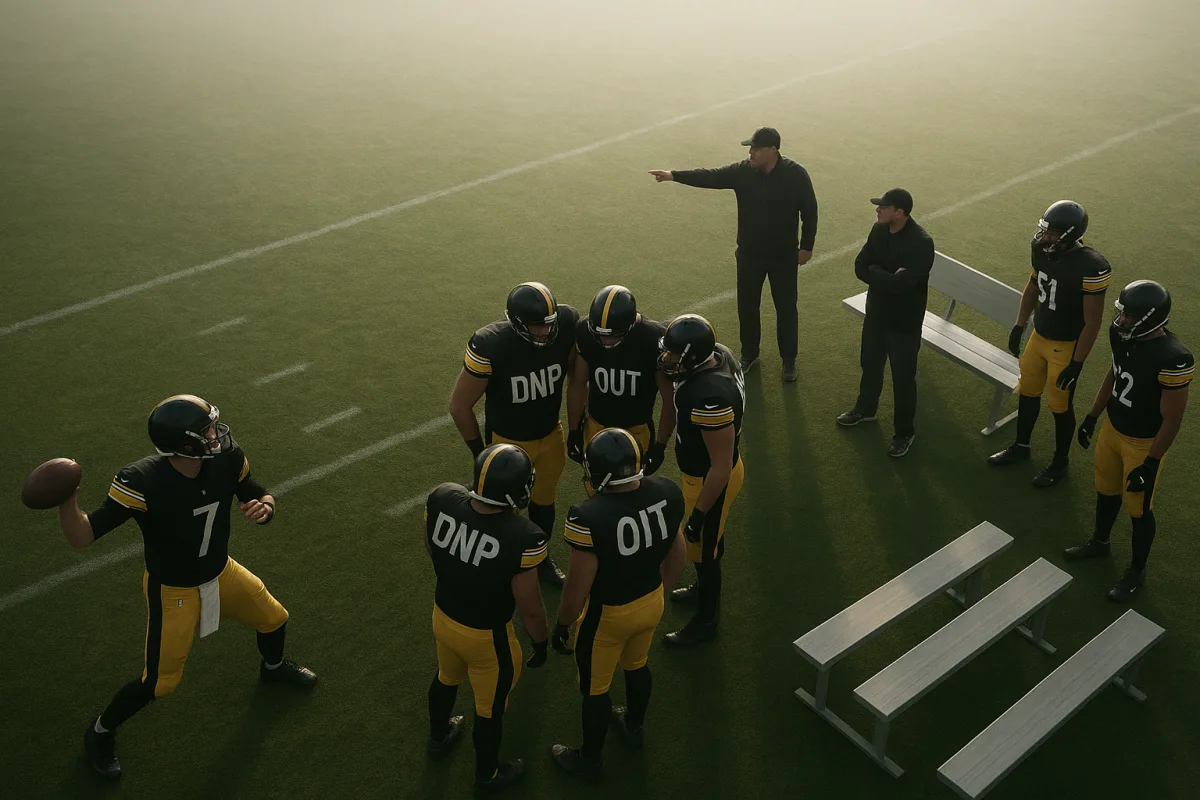
The shift is from receiver depth to receiver contingency
The Steelers entered Week 6 with a receiver room that can no longer be evaluated as a normal rotation. Michael Pittman Jr. is on injured reserve, Roman Wilson has been ruled out with a dislocated finger, and Ben Skowronek has been ruled out with a calf injury. [1][2]
That leaves Pittsburgh needing a contingency plan rather than simply a next-man-up answer. The important distinction is that Pittman has a defined minimum absence, while Wilson and Skowronek do not have publicly specified return dates as of mid-October.
Steelers Depot reported that Pittman went on injured reserve October 10 with plantar fasciitis. Under the available timetable, the earliest realistic return point is after Pittsburgh’s Week 9 bye, on October 29. [1]
NBC Sports reported the Wilson and Skowronek absences, but neither player came with the same type of return window. [2] That uncertainty matters more than a weekly designation because it complicates practice reps, roster decisions and game-plan installation.
The broader trend is clear: Pittsburgh is moving toward reliance on players Rodgers knows from prior stops or from practice work, rather than relying on volume production already established in 2026. That is a meaningful shift, even if the public language around it remains confident.
Rodgers’ confidence is real, but it is not production evidence
At his October 14 press conference, Rodgers called the available replacements “a talented B squad group of guys” and named Brandon Smith, Brandon Johnson and Isaiah Hodgins as players expected to receive chances. He also raised the prospect of more work for tight end Bobby Tonyan.
Rodgers was more specific than a quarterback offering generic support for backups. He said he knew Smith from New York, praised Johnson’s professionalism from their time as locker neighbors last season, and cited Hodgins’ prior work in Pittsburgh and New York.
That is relevant because quarterback-receiver trust is partly operational. Rodgers repeatedly framed preparation as the differentiator, saying he quizzes receivers on opponent personnel and the weekly plan to identify who is ready for a role.
His standard for chemistry was also revealing. Rodgers said the best version becomes “unspoken,” when meeting-room conversation turns into a shared signal or recognition on the field. He did not claim that level already exists with every replacement.
That qualification is more useful than the headline quote. Rodgers said Pittsburgh is trying to accelerate chemistry through meetings and practice, but he explicitly acknowledged that the unspoken level of understanding does not happen overnight.
Pro Football Talk similarly reported that Rodgers expressed trust in Smith, Johnson and Hodgins while noting Pittsburgh’s shortage of healthy wideouts. Its accounting showed only three wide receivers on the active roster, with rookie Kaden Wetjen yet to play an offensive snap.
The public message from Rodgers and the reporting around the roster therefore point in the same direction: Pittsburgh is not waiting for an outside solution to become available. It is preparing internal options and asking them to master a demanding communication environment quickly.
The tape-and-snap-count caution belongs here
Trust is not the same thing as a demonstrated workload. Available snap-count information is especially thin for Pittsburgh’s replacement receivers, which should temper conclusions about what Smith, Johnson or Hodgins can provide on Sunday.
The identifiable data point is Smith’s Week 5 usage: 16 offensive snaps, or 27 percent of Pittsburgh’s plays, without a reception or target. [5][6] That is participation, not a meaningful sample of route volume or quarterback reliance.
There is no comparable publicly available 2026 snap-count or production record in the supplied data for Johnson, Hodgins or Wetjen. [5][6] That may reflect minimal deployment, incomplete public tracking or both, but it does not support projecting established roles.
This is where a common narrative gets ahead of the evidence. It is reasonable to say the Steelers have experienced players who can be promoted into larger jobs. It is not reasonable to say they have already proven they can replace Pittman’s role.
Smith’s value, based on Rodgers’ comments, may initially be more about assignment reliability than target share. Rodgers praised his practice performance, his understanding of the weekly plan and the work he put into reshaping his body.
Johnson and Hodgins come with similar quarterback familiarity, but familiarity does not erase the cost of reduced practice reps. Receivers need to recognize coverage adjustments, sight adjustments, route conversions and protection-related hot answers at full speed.
Those details become especially important against Tampa Bay. Rodgers described Buccaneers coach Todd Bowles as a coach with a history of bringing pressure, disguising looks and presenting concepts Pittsburgh has not previously seen.
Against that type of defense, a backup receiver’s job is not merely to win a one-on-one route. He must line up correctly, identify the coverage family, understand whether the route changes against pressure and arrive in the quarterback’s throwing window on time.
Why the road setting makes the injuries more consequential
The receiver injuries are arriving alongside an extreme home-road split in Pittsburgh’s offensive output. StatMuse and NFL game data show the Steelers averaging 337.5 yards and 25.0 points in two home games, compared with 78.3 yards and 1.0 point across three road games. [3][4]
Five games is a small sample, so those figures do not prove Pittsburgh permanently cannot function away from home. They do show a real operational problem, one too large to dismiss as a few unlucky possessions.
Rodgers identified crowd noise, checks and winning isolated matchups as Pittsburgh’s central road issues. That tracks with the construction of the available offense: if receivers are learning expanded roles, silent counts and late defensive movement reduce the margin for error.
The numbers do not tell us that receiver injuries caused the road split. Pittman’s October 10 injured-reserve placement came after earlier games, and the supplied evidence does not isolate receiver availability as the primary driver. [1][3][4]
But injuries can amplify the conditions that produced it. Road offenses must communicate more efficiently, and Steelers backups are being asked to perform in an environment where the offense has already struggled to handle communication and execution.
Rodgers’ answer on yards after catch adds another layer. He said the quarterback must put the ball on the right number, then allow dynamic players to run, while noting that running back Jaylen Warren and tight end Darnell Washington contribute heavily after the catch.
That is not a declaration that Pittsburgh will abandon its receiver-based concepts. It does show an offense with potential answers that do not depend exclusively on a conventional three-receiver group winning downfield.
What Pittsburgh can change, and what has not been confirmed
The logical adjustment would be to lean further into formations that put Warren, Pat Freiermuth, Washington and possibly Tonyan on the field together. Pro Football Talk noted that Warren and Freiermuth were tied with DK Metcalf for Pittsburgh’s team lead in receptions, while Washington had also been frequently involved.
That distribution suggests Pittsburgh already has non-receiver targets with a connection to the passing game. It does not prove coordinator intent, but it means the offense is not being rebuilt from scratch around unknown call-ups.
Rodgers also referenced Pittsburgh’s use of heavy personnel last season and described the tight end group as versatile. He specifically mentioned using Washington as an extra lineman, an indication that Pittsburgh can move between protection-oriented and receiving-oriented looks without wholesale personnel changes.
There is a league-wide basis for that kind of flexibility. Multi-tight-end usage has grown as offenses seek answers against split-safety structures, light boxes and pressure looks, according to Red Zone HQ’s review of modern tight end usage. [7]
Still, the distinction matters: there is no verified reporting that Rodgers, the Steelers’ coordinator or the coaching staff has installed more 12 personnel specifically because Pittman, Wilson and Skowronek are unavailable. [7] That remains an informed possibility, not a confirmed adjustment.
The same restraint applies to the idea of immediately elevating a practice-squad wideout. Steelers Now’s practice-squad tracker illustrates how frequently bottom-of-roster movement changes available options. [8] A call-up is easy to announce, but difficult to convert into a meaningful offensive role.
Pittsburgh has a 16-player practice squad, limited active roster space and only so many installation reps during a game week. [8] A newly promoted receiver must learn terminology, alignments and Rodgers’ preferred adjustments before he can be trusted in key situations.
That is why Rodgers’ comments about Smith, Johnson and Hodgins carry more weight than a generic vote of confidence. Those players have at least some personal familiarity with the quarterback or system expectations, which reduces the communication burden compared with an outside addition.
What this means for planning the next month
For Pittsburgh, the practical goal is not finding a receiver who replicates Pittman immediately. It is building a weekly menu that asks reserve wideouts to execute a limited number of clear jobs while placing established targets in favorable matchups.
That likely means fewer assumptions about depth-chart labels and more attention to personnel packages. A tight end can help secure the edge against pressure, release late into the flat or create size mismatches, while Warren can provide an outlet when blitz looks force quick throws.
The counterpoint is that heavier personnel can also reduce speed on the field and make it easier for defenses to condense coverage. Tampa Bay will not simply allow Pittsburgh to manufacture easy completions if the Steelers become predictable about formations or route concepts.
For anyone evaluating Pittsburgh’s offense over the next several weeks, the useful indicators are snap shares, route participation and third-down targets. Those will reveal whether Rodgers’ trust turns into real responsibilities, rather than remaining a press-conference assessment.
The early bar should be modest. Smith’s 16-snap, zero-target Week 5 is the only concrete replacement-receiver usage marker currently available. [5][6] Until the other options accumulate comparable data, confidence should be treated as an input, not a conclusion.
Frequently Asked Questions
How are Aaron Rodgers and the Steelers handling wide receiver injuries in 2026?
The Steelers face a significant wide receiver injury problem, with Michael Pittman Jr. on injured reserve until at least after the Week 9 bye, and Roman Wilson and Ben Skowronek having no confirmed return dates. Aaron Rodgers is publicly backing replacement receivers Brandon Smith, Brandon Johnson, and Isaiah Hodgins, focusing on internal options rather than outside additions. The team is also likely relying more on tight ends and running backs, although no formal offensive scheme changes have been reported.
What impact do Steelers' receiver injuries have on Aaron Rodgers' performance?
The injuries have forced Rodgers to work with a "talented B squad" of receivers, which has limited the available production and chemistry on offense. Rodgers emphasizes preparation and communication to build trust with replacement receivers, but acknowledges that the unspoken on-field chemistry is not yet fully developed. The Steelers’ offensive output shows a stark contrast between home and away games, with much lower production on the road, partly reflecting challenges from the depleted receiver corps.
Who are the replacement receivers Aaron Rodgers trusts on the Steelers?
Rodgers has named Brandon Smith, Brandon Johnson, and Isaiah Hodgins as the primary replacement receivers he trusts. He has prior familiarity with these players from past teams or practice interactions, which helps in building operational trust. However, available snap counts and production data for these receivers are very limited, indicating they have yet to establish a significant workload.
How does the Steelers' injury situation affect their offensive strategy?
While there is no verified reporting that the Steelers have formally changed their offensive scheme due to the injuries, the team is expected to increase the use of tight ends and running backs to compensate for the depleted wide receiver group. This aligns with a broader NFL trend toward multi-tight end sets, but specific tactical adjustments by Aaron Rodgers or the Steelers have not been confirmed.
What challenges does Aaron Rodgers face with Steelers' injured receivers?
Rodgers must quickly develop chemistry and communication with a group of receivers who lack extensive playing time and established rapport. The absence of defined return dates for some injured receivers complicates practice reps and game planning. Additionally, integrating practice squad players mid-season is difficult due to roster limits and the complexity of Rodgers’ offensive system.
How we researched this
This article was assembled from 1 video source, 1 published article, 8 cited references.
Nothing here is based on hands-on testing. Where a figure or finding appears, it belongs to the source cited beside it, and the writing says so rather than implying otherwise. Every source is listed below so you can check it.
Sources
Aaron Rodgers Press Conference (October 14) | Pittsburgh Steelers — Pittsburgh Steelers
Aaron Rodgers on injuries at wide receiver: I have a lot of trust in our options — Pro Football Talk
Steelers Place WR Michael Pittman Jr. On Injured Reserve - Steelers Depot
Steelers rule out WRs Roman Wilson, Ben Skowronek - NBC Sports
2026 Pittsburgh Steelers Snap Count Analysis | Wide Receivers | FantasyPros
Modern Tight End Usage in the NFL: Why Multi-TE Sets Are Exp
Pittsburgh Steelers 2026 Practice Squad Tracker — Steelers Now
Watch Aaron Rodgers and Steelers' Injury Challenges on Youtube
Related Articles
Rams Wide Receiver Depth and Super Bowl Contention in 2026
Explore the Rams wide receiver depth and how it impacts their 2026 Super Bowl contention with key player roles and analysis.
Puka Nacua NFL Wide Receiver Status and 2026 Performance
Explore Puka Nacua's rising NFL wide receiver status with 2026 stats, strengths, and comparison to peers like Jaxon Smith-Njigba.
San Francisco 49ers Key Player Performances and Dominance
Explore the San Francisco 49ers' 2026 dominance with key player performances from Brock Purdy, Mike Evans, and their adaptive defense.
Giants Roster Moves and Odell Beckham Jr. Status Explained
Explore the Giants' roster moves and Odell Beckham Jr.'s status, focusing on practice squad roles and special teams impact.