Commanders vs 49ers Monday Night Football Preview
Get a detailed Commanders vs 49ers Monday Night Football preview with key matchups, injury updates, and tactical analysis for the October 19, 2026 game.
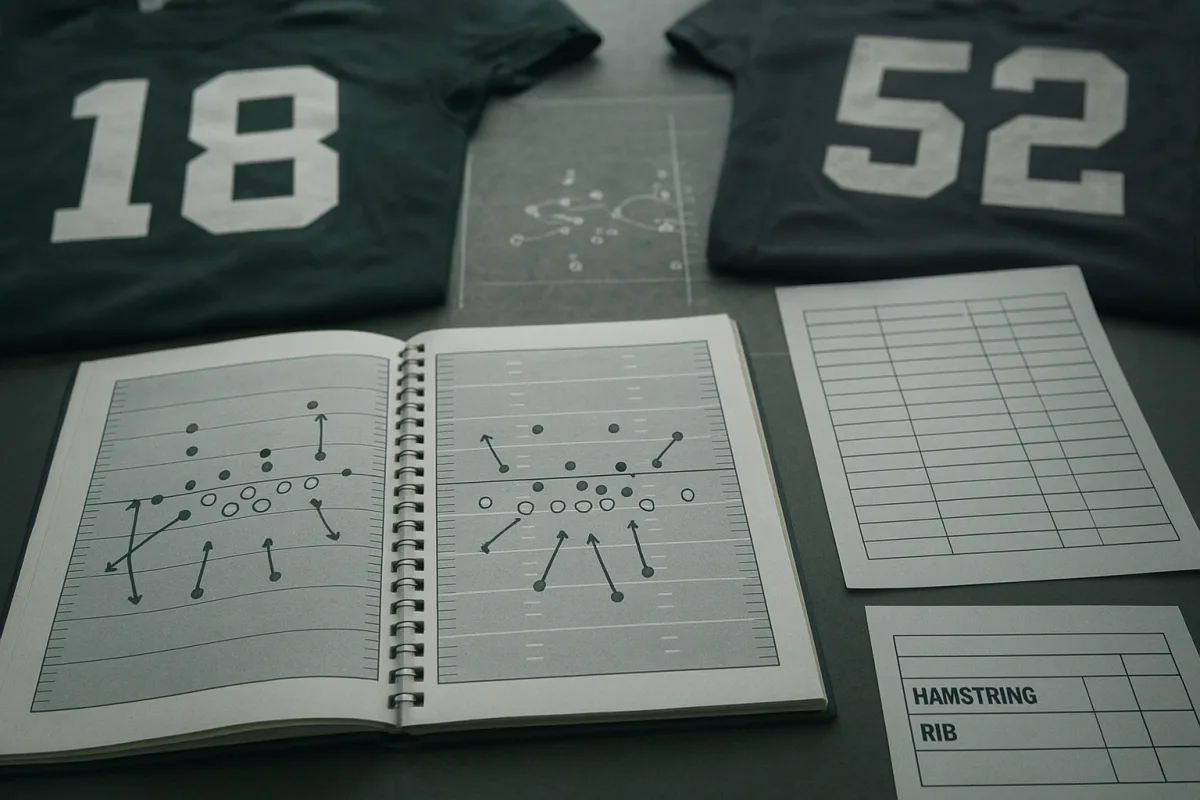
The matchup turns on the middle of the field
The broad preview is simple enough. The Commanders arrive in Santa Clara at 1-3-1, coming off a damaging tie with the Giants, while the 49ers are unbeaten at 5-0 and favored by 7.5 points. [7][8]
But the useful question is not whether Washington can “keep up” with San Francisco. It is whether Jayden Daniels can consistently find answers against the 49ers’ middle-of-field-open coverage structure without turning every possession into a scramble drill.
Washington’s own team preview identified San Francisco as a defense built around two-high safety looks, quarters principles and speed closing passing windows. That description needs some unpacking, because it explains both Fred Warner’s influence and the limits of simply telling Daniels to attack downfield.
Middle-of-field-open means the defense begins with two safeties deep rather than one safety stationed in the middle. The quarterback sees a lighter box before the snap, usually six defenders near the line rather than seven or eight.
That look can invite the run, but it is not automatically a favorable run look. The safeties are part of the fit after the snap, and San Francisco’s safeties have enough range to trigger downhill when the ball declares.
Quarters coverage is often called Cover 4 because four defensive backs divide the deep field. In practice, it is not always a spot-drop zone where everybody runs to grass and watches receivers pass by.
The cornerbacks and safeties read route releases. If an outside receiver pushes vertically, the corner may carry him. If a slot receiver attacks up the seam, the safety can match that route rather than drifting aimlessly into a deep quarter.
That is why quarterbacks can initially see room between the safeties, then find the window gone when the ball comes out. The coverage is designed to keep explosive throws from becoming easy throws, especially on deep overs, seams and post routes.
CBS Sports noted that San Francisco had allowed the league’s lowest explosive-play rate through five games, a historic start by that particular measure. [1] That statistic does not mean the 49ers permit no completions, or that every checkdown is a defensive win.
It means opponents have struggled to create the plays that change field position, force safety adjustments and make a defense abandon its preferred structure. Washington needs those plays, but it cannot hunt them recklessly on every snap.
Why Fred Warner changes the arithmetic
Warner is the hinge in this defense because two-high coverage asks linebackers to handle more space underneath. If safeties stay high to protect against explosives, somebody must close run lanes and deny in-breaking routes before they become easy chain-movers.
Through five games, Warner had 50 total tackles, fourth among NFL linebackers, including 25 solo tackles. [5] He also carried an 82.2 overall PFF defensive grade, third among qualified linebackers, and an 86.7 run-defense grade that led the position. [6]
The tackle totals establish volume, but they do not explain the tape. A tackle five yards downfield after a clean running lane is different from a tackle at the line after the linebacker defeats a block and forces second-and-long.
Warner’s value begins with alignment and communication. Before the snap, an off-ball linebacker identifies formations, possible motions, protection issues and run strength. That communication matters against Washington because the Commanders have shown multiple launch points for Daniels.
In the Commanders’ team preview, analyst Logan Paulsen pointed to formations such as empty sets, bunches, three-by-one alignments and 13 personnel with three tight ends. Those looks are not window dressing if they force a defense to show its coverage rules.
Put three eligible receivers on one side, and the defense must decide who carries the inside vertical route, who handles a shallow route, and whether the safety can stay deep. Motion makes that communication happen faster and reveals whether defenders travel with receivers.
That is where Warner becomes more than a productive tackler. If he is responsible for a hook zone, he must sink under in-breakers, keep his eyes on the quarterback and still fit the run if the ball is handed off.
If the 49ers match routes rather than playing static zone, Warner may have to carry a tight end or slot receiver vertically for part of the route. That responsibility affects how aggressively he can trigger on play action or quarterback movement.
The cost for Washington is that none of this guarantees a clean throw. A well-designed formation can create a favorable matchup, but Daniels still has to identify it quickly, hold the ball securely and throw before the closing defender arrives.
Daniels should use his legs as an answer, not the plan
Washington’s preview correctly framed Daniels as a pass-first quarterback with elite running ability, rather than a runner who occasionally throws. That distinction matters against a defense with Warner in the middle and fast safeties arriving downhill.
Daniels took five sacks against the Giants, but Washington’s in-house analysts noted he continued to work from the pocket and ran decisively when his reads were covered. The sacks show that comfort alone does not solve protection breakdowns.
Designed quarterback runs can be useful against two-high structures because they add an extra blocker to the run count. In a basic zone-read concept, the offense can leave an edge defender unblocked and make him choose between the running back and quarterback.
But that advantage has a price. Every designed Daniels carry adds contact exposure, and the Commanders are still managing a quarterback who recently dealt with a left elbow injury and has worn a brace.
The better use is selective deployment. A red-zone snap, third-and-short call or constraint play after Washington has established inside zone can make Daniels’ running threat matter without asking him to absorb eight or nine designed carries.
Warner also changes those calculations. If a quarterback pulls the ball on zone read, the second-level defender must be made wrong. Against an instinctive linebacker, a late pull can become a short gain or a direct hit.
Washington needs Daniels to use formations and cadence to identify whether Warner is fitting inside, scraping over the top or carrying a receiver. If the linebacker is occupied in coverage, Daniels may have room. If Warner is free, the sensible decision is often the checkdown.
Diggs’ status matters beyond his box score
Diggs is questionable with the hamstring injury that kept him out against New York. He was limited Friday and Saturday after missing Thursday’s practice, and Washington’s final decision is expected close to kickoff. [1]
Before the injury, Diggs led Washington with 31 targets, 18 catches and three receiving touchdowns, while his 170 receiving yards ranked second to McLaurin’s 203. [1] Those numbers describe opportunity, not necessarily offensive efficiency.
His larger value in this matchup is structural. McLaurin can threaten a coverage boundary, but a second receiver who can win isolated routes prevents San Francisco from tilting safety help or brackets toward Washington’s primary outside target.
Diggs and Daniels have had limited full-game time together because of injuries. Their most complete pairing came in the opener, when Diggs caught four of nine targets for 55 yards and a touchdown against Philadelphia. [1]
If Diggs plays, Washington can use him in reduced splits, stacks and motion to test the 49ers’ matching rules. If he does not, the Commanders have fewer credible ways to force Warner and the safeties into difficult choices.
That does not make Diggs a cure-all. A hamstring injury can limit acceleration and the ability to separate at the top of routes, the exact traits needed to beat a coverage designed to close windows late.
San Francisco’s offense still sets the margin for error
Washington’s defensive problem is more basic. The Commanders are allowing 29.8 points per game, third worst in the league, while San Francisco is scoring 30.8 points per game, third best. [7][8]
That gap means Washington’s offense cannot afford empty possessions merely because the 49ers play conservative coverage. A six-yard completion against quarters can be a useful offensive result if it keeps the game from becoming a two-score passing script.
San Francisco’s receiver room is not fully intact. Samuel is out with the hamstring injury suffered October 11, and coach Kyle Shanahan said he would miss “some time.” [3][4] Jacob Cowing is questionable with an ankle injury, while Brandin Cooks remains on injured reserve and is not expected back until Week 9.
Mike Evans is questionable with a rib injury after missing practice October 15. His status is especially relevant because the 49ers can use him as an isolated boundary target, forcing defenses to decide whether to help outside or defend the run with numbers.
The ESPN preview focused on the familiar San Francisco stress point: defenders cannot stack the box against Christian McCaffrey without creating one-on-one opportunities outside. That is true in principle, though Samuel’s absence changes the number of ways Shanahan can create those conflicts.
Washington’s defense does not need to eliminate every explosive possibility. It needs to make San Francisco execute long drives without missed fits, lost leverage or easy yards after catch, an especially demanding assignment given the Commanders’ points-allowed profile.
For Washington, the Monday night blueprint is therefore narrower than an upset narrative. Make the 49ers declare coverage rules, protect Daniels long enough to exploit those rules, and avoid asking him to outrun Fred Warner as a routine offensive concept.
Frequently Asked Questions
What are the key matchups in the Commanders vs 49ers Monday Night Football game?
The matchup centers on how Jayden Daniels can navigate the 49ers’ middle-of-field-open coverage, which features two-high safeties and quarters principles. Washington’s offense must find ways to create explosive plays without turning every possession into a scramble, while the 49ers rely on speed and coverage discipline to limit big gains.
How does Fred Warner influence the 49ers defense against the Commanders?
Fred Warner is critical as he aligns and communicates pre-snap to identify formations and coverage, disrupting Washington’s quarterback movement game. His run defense and coverage skills help close lanes and deny easy chain-moving routes underneath the two-high safety structure, making it harder for the Commanders to find consistent success.
What is the impact of Stefon Diggs' injury on the Commanders' offense?
Stefon Diggs is questionable due to a hamstring injury and has had limited practice participation. His availability is important because Washington needs more than Terry McLaurin to challenge the 49ers’ two-high coverage, which can otherwise limit the Commanders’ passing options.
How should Jayden Daniels approach the 49ers defense in this game?
Daniels should be selective with his reads and avoid forcing plays against the 49ers’ quarters coverage and speed in closing passing windows. He needs to use formations and motions to force the defense to reveal coverage and create opportunities before reaching his second read, rather than relying heavily on scramble plays.
What are the strengths and weaknesses of the 49ers defense for this matchup?
The 49ers’ defense is strong in limiting explosive plays and has the NFL’s best points-allowed average, thanks to disciplined coverage and effective run defense led by Fred Warner. However, their receiver group is thinner due to injuries to Deebo Samuel and Mike Evans, which could affect their offensive balance but does not directly weaken the defense.
How we researched this
This article was assembled from 2 video sources across 2 channels, 2 published articles, 10 cited references.
Nothing here is based on hands-on testing. Where a figure or finding appears, it belongs to the source cited beside it, and the writing says so rather than implying otherwise. Every source is listed below so you can check it.
Sources
Commanders-49ers Preview: Can Anyone Stop the 49ers When They’re Healthy? — NFL on ESPN
MNF PREVIEW: 49ers vs. Commanders | Booth Review | Washington Commanders | NFL — Washington Commanders
Is Stefon Diggs playing on 'Monday Night Football?' A look at the Commanders WR's status vs. 49ers — CBS Sports NFL
Is Mike Evans playing on 'Monday Night Football?' A look at the 49ers WR's status vs. Commanders — CBS Sports
Is Stefon Diggs playing tonight? Injury update, status for Commanders vs. 49ers - CBS Sports
49ers' Deebo Samuel to miss 'some time' with hamstring injury, per Kyle Shanahan | 49ers Webzone
49ers WR Deebo Samuel ruled out with hamstring injury - NBC Sports
Washington Commanders 2026 Record (1-3-1), Stats and Results | StatsNext
4 Reasons the Commanders Will Beat the 49ers, and 2 Reasons They Won't - Athlon
Watch Commanders vs. 49ers Monday Night Football Preview on Youtube
Also from the sources
Related Articles
San Francisco 49ers Key Player Performances and Dominance
Explore the San Francisco 49ers' 2026 dominance with key player performances from Brock Purdy, Mike Evans, and their adaptive defense.
San Francisco 49ers Week 4 Preview and Player Updates
Get the San Francisco 49ers Week 4 preview with injury updates and analysis on handling Denver's pressure defense.
Steelers vs Browns Thursday Night Football Preview &
Get a detailed Steelers vs Browns Thursday Night Football preview with injury updates, matchup analysis, and best betting picks for Week 4.
Washington Commanders Upset Win Over Seattle Seahawks
Detailed analysis of the Washington Commanders' upset win over the Seattle Seahawks, focusing on quarterback performance and key game factors.