San Francisco 49ers Key Player Performances and Dominance
Explore the San Francisco 49ers' 2026 dominance with key player performances from Brock Purdy, Mike Evans, and their adaptive defense.
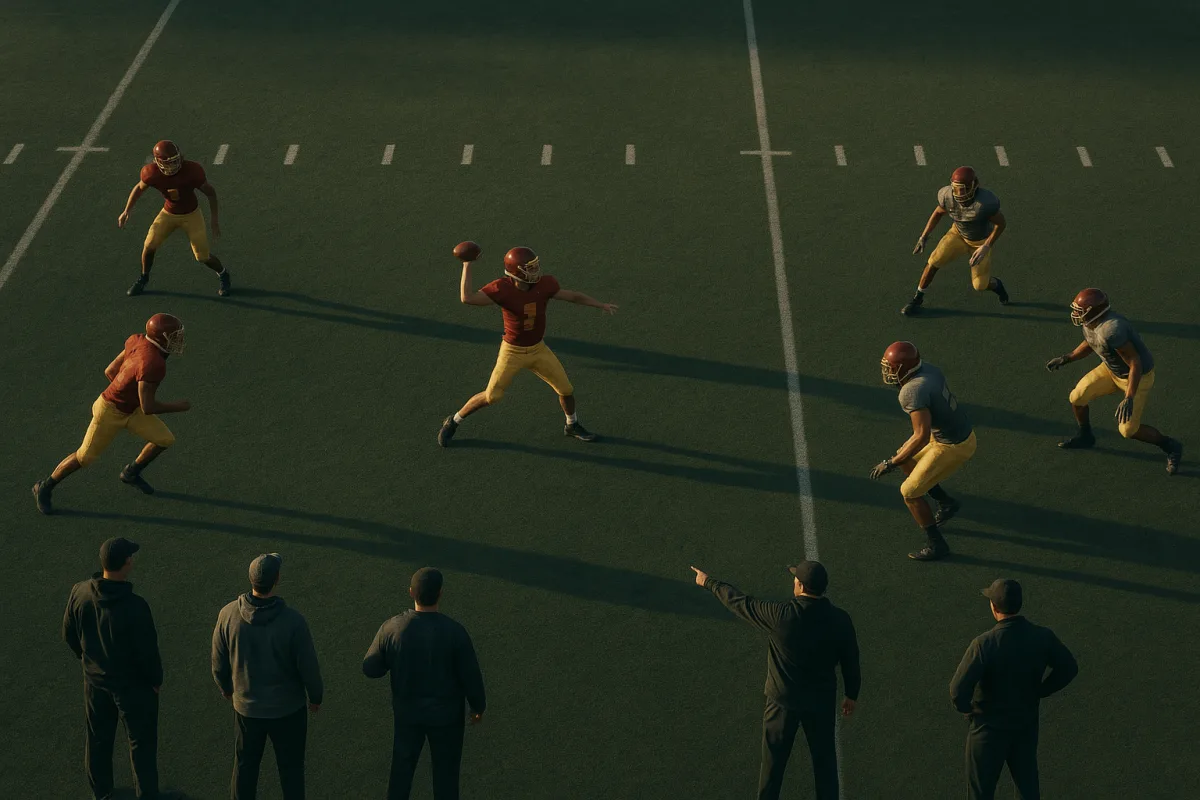
The shift is that San Francisco can now win outside its preferred script
The 49ers are 5-0, and the important part is not the record by itself. The shift is that San Francisco has won while its cleanest offensive structure has been disrupted, its defense has lost contributors, and opponents have forced the game into late-down, late-game situations. [6][8]
That is different from the familiar shorthand around Kyle Shanahan’s teams, which tends to treat every productive snap as a product of easy throws and motion-created space. The current version still relies on those things, as any Shanahan offense should. It also has evidence of answers when those advantages are reduced.
The Seattle win supplied the clearest example. In the 49ers’ official postgame coverage, Shanahan described a game in which San Francisco had penalties, poor down-and-distance situations and stretches where Seattle’s coverage took away the initial option. His response was not to claim the offense had operated perfectly.
Instead, Shanahan pointed to Purdy’s fourth-quarter decision-making and the availability of Evans when Seattle left favorable coverage. That distinction matters. A quarterback can play within structure and still make difficult decisions once the structure no longer produces an obvious throw.
Purdy’s production is strong, but context still matters
Purdy’s early statistical profile is difficult to dismiss. Through October 12, he had thrown for 1,196 yards, 13 touchdowns and two interceptions, while posting a 119.3 passer rating, second among qualified NFL quarterbacks. He had also added 128 rushing yards and a rushing touchdown. [1][2]
The touchdowns and rating show efficiency, but they do not prove that every throw has been difficult or every read has been perfect. Passer rating is a result statistic. It rewards completion, touchdown and interception outcomes, not whether a quarterback identified a coverage rotation before the snap or created a completion after protection broke down.
Still, the rushing production is useful context. Purdy is not suddenly functioning as a designed-run quarterback, but he has created additional value when the pocket is compromised or when coverage removes the first progression. That was central to Shanahan’s postgame description of the Seattle game.
The useful tape question is not whether Purdy benefits from Shanahan’s offense. He clearly does, and that is the point of employing an offensive system with defined throws, motion, condensed formations and complementary run action. The question is whether he is converting the snaps where those answers are imperfect.
Against Seattle, the answer appeared to be yes. The 49ers did not simply produce a series of wide-open play-action throws. Purdy gave Evans chances on boundary throws, including a back-shoulder opportunity when San Francisco was behind the chains. That is a quarterback recognizing leverage and trusting the receiver’s catch radius.
There is a practical limit to this trend. San Francisco’s offensive line has received deserved credit for its early sack-free stretch, but line depth remains a concern, particularly as injuries accumulate. [14] Purdy’s efficiency is easier to sustain when the offense can stay on schedule and force defenses to defend both the run action and the middle of the field.
Mike Evans is changing the calls Shanahan can make
The Mike Evans signing was not merely about adding another recognizable name to a roster already stocked with established talent. It was an attempt to add a specific offensive solution: an outside receiver who can win on isolated routes when the defense commits resources elsewhere.
San Francisco signed Evans in March to a three-year, $42.4 million deal with $16.3 million guaranteed and a $12 million signing bonus. His 2026 cap hit is reported at $4.25 million, and incentives could increase the deal’s total value to $60.4 million. [3][4][5]
Those numbers matter because the 49ers were not paying only for box-score production. They were buying a player who affects coverage decisions before the ball is snapped. A defense that rolls help toward Evans risks lighter numbers elsewhere. A defense that plays him one-on-one accepts the possibility that Purdy will throw a contested ball.
That was the actual significance of the Seattle performance described by Shanahan, Purdy and NBC’s Football Night in America panel. Evans was not consistently running free. He was winning with frame, positioning and timing when Seattle’s coverage rules allowed an isolated matchup.
NBC’s analysis correctly identified Evans as a bailout option in difficult situations. That label needs a little refinement. A bailout throw is not necessarily a reckless throw. If the coverage gives a big-bodied receiver outside leverage, a back-shoulder ball can be the designed answer, particularly when the offense is behind the chains.
Shanahan’s comments made that clear. He said the offense has Evans built into many concepts, but cannot force the ball to him when defenses devote two defenders to the route. The coordinator’s adjustment is not an endless stream of fades. It is using formation and progression design to identify when Evans has a favorable look.
That is why the acquisition has mattered quickly. The offense has long been built to manufacture space through motion, versatile backs and yards-after-catch players. Evans adds a different answer. He gives San Francisco a contested-catch option that does not require perfect separation or a completely clean pocket.
Toughness has shown up as continuity, not slogans
Shanahan called his players “warriors” after the Seattle game, but the more useful evidence is deployment. San Francisco lost defenders during the game and still asked younger replacements to operate within the same coverage and front framework rather than protecting them with a radically simplified plan.
Shanahan specifically credited players such as Renardo Green, whom he said produced two interceptions and a key stop on a late slant route, along with replacements forced into larger roles after injuries. The individual names matter less than the coaching decision behind them: the 49ers did not treat every injury as a reason to abandon their normal standards.
That pattern has been necessary. By mid-October, the 49ers had dealt with injuries involving Nick Bosa, Kyle Juszczyk, Marques Sigle, James Thompson Jr. and Upton Stout. [8][9] No team can lose players of that caliber and assume its ceiling remains unchanged over a full season.
The early evidence instead says San Francisco has enough role-specific preparation to avoid immediate collapse. In the Seattle game, the official 49ers postgame interviews repeatedly returned to the same theme. Young players had practiced the jobs they were asked to perform, and veterans expected them to meet the same standard.
That is the part worth taking seriously when evaluating “toughness.” Toughness is often used as a substitute for analysis. Here, it is better understood as operational continuity. A player steps in at linebacker, corner or fullback, understands the motion, run fit, coverage leverage or route responsibility, and prevents one injury from creating multiple busted snaps.
The limit is obvious. Depth can stabilize a roster for several weeks, but it cannot always replicate top-end players over four months. Bosa’s availability, in particular, matters because San Francisco’s pass rush has not been consistently disruptive even during the undefeated start. [14]
The defense is good, but the dominance claim needs restraint
The most inflated narrative around the 5-0 start is that San Francisco’s defense has simply overwhelmed every opponent. The Seattle game was an excellent situational performance. Shanahan praised the group for generating turnovers, limiting explosives and defending the run when the game required it.
That game also showed why single-game turnover totals can mislead. Turnovers are decisive events, especially when an offense turns them into touchdowns or field-position advantages. NBC’s postgame panel noted that San Francisco capitalized in the red zone and added a defensive score, which is exactly how a tight divisional game gets tilted.
But a turnover-heavy afternoon does not automatically establish a season-long defensive identity. Through October 12, San Francisco’s turnover differential stood at plus-2, behind the Vikings at plus-6 and Jaguars at plus-5. [7] The 49ers have been opportunistic, but they have not separated themselves from the field through takeaways.
There are also known concerns. The run defense struggled against Miami running back De’Von Achane in Week 1, while the pass rush has had periods where it failed to create enough sacks without help from coverage or game situation. [14] Those are not minor issues, because January opponents will test both areas.
The better reading is that the 49ers’ defense has been resilient and timely. It has survived injuries, produced high-leverage plays and held together late. That is valuable. It is not the same as saying every structural issue has been fixed.
What opponents and imitators should take from this start
For opponents, the priority is to make San Francisco sustain drives without offering Evans isolated throws outside or easy access to its middle-of-field concepts. That means disciplined coverage communication, pass-rush plans that do not lose contain against Purdy, and enough run-defense integrity to avoid overcommitting safeties.
For teams hoping to build a similar project, the lesson is not “sign a Hall of Fame receiver” or “hire Kyle Shanahan.” Those are not replicable instructions. The transferable idea is constructing an offense with multiple kinds of answers: manufactured separation, efficient run-action throws, and at least one receiver who can beat sound coverage.
The defensive lesson is equally practical. A roster’s depth is not proved by a preseason depth chart. It is proved by whether replacements can remain in the same calls, communicate through motion and formations, and avoid becoming the obvious target on every third down.
San Francisco has done that well enough to reach 5-0, even while dealing with injuries and the organizational distraction created by CEO Jed York’s six-game suspension and $500,000 fine announced October 5. [12] The record is meaningful, but it is not a verdict on October.
The 49ers have shown a broader menu of winning methods than they had been credited for. Purdy is playing at an elite statistical level, Evans has supplied a real tactical answer, and Shanahan’s staff has kept the operation stable through disruptions. The unresolved issues, especially pass rush, run defense and offensive-line depth, are why the 5-0 start should be treated as evidence, not a coronation.
Frequently Asked Questions
How has Brock Purdy performed in the 2026 NFL season?
Through October 12, 2026, Brock Purdy has thrown for 1,196 yards, 13 touchdowns, and two interceptions, with a passer rating of 119.3, ranking second among qualified NFL quarterbacks. He has also contributed 128 rushing yards and one rushing touchdown, showing the ability to create plays when the pocket breaks down or coverage limits his first read.
What impact has Mike Evans had on the 49ers offense?
Mike Evans provides the 49ers with a reliable perimeter target who can win isolated matchups when defenses focus elsewhere. His presence allows quarterback Brock Purdy to have a viable option beyond the offense’s usual structure, expanding the play-calling possibilities for Kyle Shanahan.
How are the 49ers winning despite injuries in 2026?
The 49ers have maintained a 5-0 start despite losing key players on both offense and defense by relying on roster depth and role clarity. Backup players have been able to execute the same solutions as starters, allowing the team to adapt without abandoning its overall structure.
What makes the 49ers offense effective beyond their usual script?
The offense remains grounded in protection and matchup creation but has shown the ability to convert difficult throws and make smart decisions when the initial options are covered. Brock Purdy’s decision-making and the availability of Mike Evans in tight coverage have been crucial in sustaining drives under challenging circumstances.
How does the 49ers defense adapt to player injuries?
While the defense has been opportunistic, its turnover differential of +2 is modest compared to other top teams, indicating it is not overwhelmingly dominant. The 49ers have preserved their defensive structure and relied on role clarity to allow backups to fill in effectively, though vulnerabilities remain, especially against the run and in pass rush consistency.
How we researched this
This article was assembled from 5 video sources across 3 channels, 14 cited references.
Nothing here is based on hands-on testing. Where a figure or finding appears, it belongs to the source cited beside it, and the writing says so rather than implying otherwise. Every source is listed below so you can check it.
Sources
Kyle Shanahan and 49ers Players React Following #SFvsSEA | 49ers — San Francisco 49ers
Kyle Shanahan: ‘We Have a Bunch of Warriors on This Team’ | 49ers — San Francisco 49ers
Purdy, Green, Warner, McCaffrey, Evans Talk Finishing Strong vs. Seahawks | 49ers — San Francisco 49ers
NFL Week 5 recap: 49ers, Vikings move to 5-0; Eagles stunned + Gibbs, Maye shine | FNIA | NFL on NBC — NFL on NBC
Are the 49ers officially the NFL's BEST TEAM with Brock Purdy, Mike Evans & Kyle Shanahan?! | Get Up — NFL on ESPN
49ers officially sign Mike Evans; 6-time Pro Bowl receiver inks 3-year deal - CBS San Francisco
Details emerge on WR Mike Evans' 3-year deal with 49ers | 49ers Webzone
San Francisco 49ers Injury Report and Status 2026-27 - CBS Sports
2026 San Francisco 49ers Injuries | Pro-Football-Reference.com
How to watch NFL 2026: FREE live streams, broadcast details and Week 5 games
‘As good as it gets’ - 49ers’ ascending position group faces huge test | Niners Nation
El nuevo hospital de San Francisco, siguen las lesiones en los 49ers
One Glaring Issue 49ers Might Be Unable to Fix Without a Trade
Watch San Francisco 49ers' Dominance and Key Player Performances on Youtube
Also from the sources
Related Articles
San Francisco 49ers Week 4 Preview and Player Updates
Get the San Francisco 49ers Week 4 preview with injury updates and analysis on handling Denver's pressure defense.
Week 1 NFL Defensive Highlights and Impact Plays
Explore Week 1 NFL defensive highlights and impact plays, featuring key performances and game-changing defensive moments.
Puka Nacua NFL Wide Receiver Status and 2026 Performance
Explore Puka Nacua's rising NFL wide receiver status with 2026 stats, strengths, and comparison to peers like Jaxon Smith-Njigba.
Week 5 NFL Game Previews and Injury Impact Analysis
Get detailed Week 5 NFL game previews with injury updates and tactical analysis to understand how player availability shapes matchups.