
Alaric Jackson Punch Incident and Rams Team Impact
Explore the Alaric Jackson punch incident, NFL discipline process, and its impact on the Rams' left tackle position and team strategy.
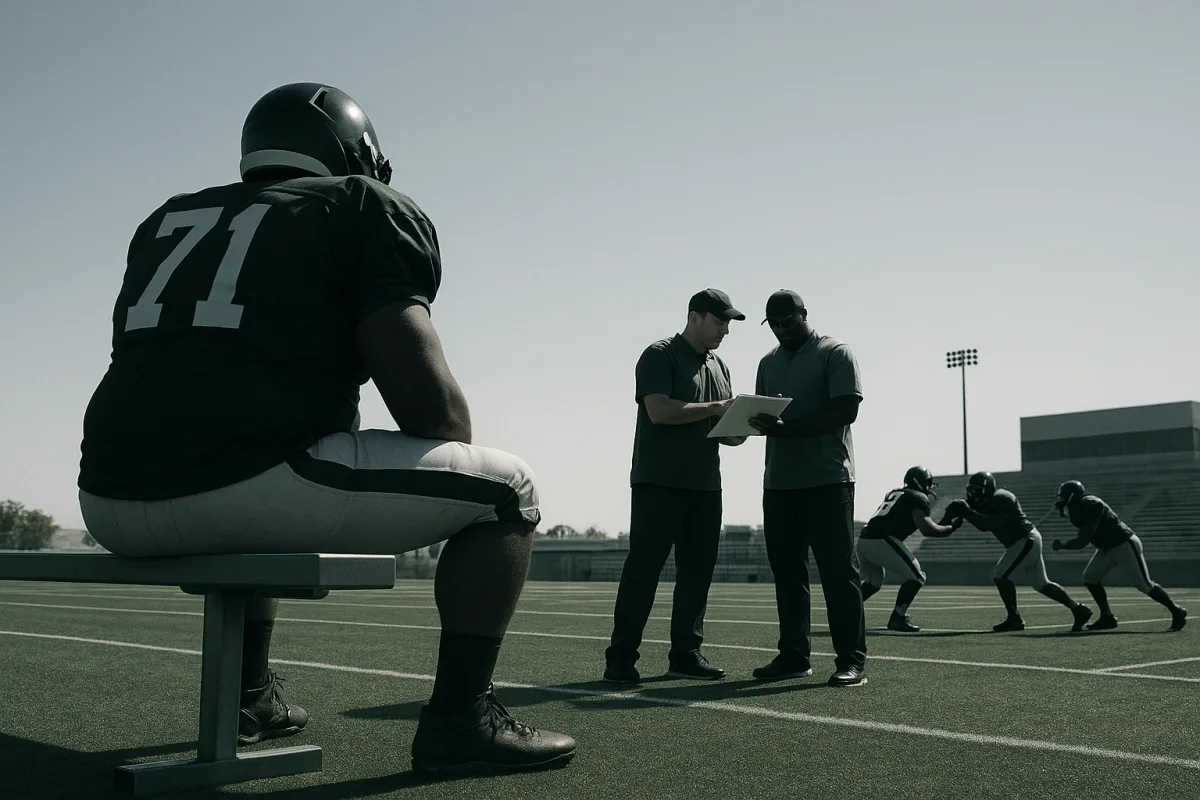
Alaric Jackson’s punch puts the Rams’ left tackle spot, and the NFL discipline process, under scrutiny
The central issue is discipline, not a simple penalty chart
The camera angle from the Rams’ overtime loss to the Buffalo Bills showed Alaric Jackson approaching Bills linebacker Bradley Chubb after the game and striking him in the face. Chubb characterized it as an emotional reaction after a close game, but the visual itself leaves the league a straightforward conduct question. [2]
What follows is not as simple as finding a line in the rulebook that assigns a fixed punishment. NFL discipline for punches has two tracks: the in-game rules that govern fouls and ejections, and the league’s broader authority under its personal conduct policy. [7]
That distinction is worth making because it explains why the likely consequence is more than a fine. Rule 12, Section 3, Article 1(a) bars throwing a punch, forearm or kick at an opponent, but a postgame altercation also reaches the league office’s player-conduct review. [7]
A game official can flag, eject or disqualify a player when an incident occurs within the game’s officiating structure. A postgame incident, by contrast, usually becomes a video-review and discipline-office matter, with the league deciding whether the conduct warrants lost game time.
The league does not publish a clean formula saying one punch equals one game. That is frustrating for readers seeking a definitive answer, but it reflects how the NFL actually operates. Severity, provocation, prior discipline and prior comparable cases can all affect the outcome.
That is why comparisons matter, though they are not binding precedent in the legal sense. NBC Sports pointed to Detroit defensive back Brian Branch’s one-game suspension in October 2025 after a postgame punch as the most relevant recent guide for Jackson’s case. [3]
The Branch comparison establishes a floor more than a ceiling. It tells Jackson that the league has recently viewed a postgame punch as suspension-worthy, rather than merely worthy of a fine. It does not guarantee identical punishment because the NFL evaluates each player’s overall record.
There is also precedent for negotiation after the initial ruling. The NFL originally suspended former Cowboys defensive tackle Trysten Hill for two games following a postgame punch against the Raiders, then reduced the discipline to one game on appeal. [4]
That case shows two things. First, the NFL can start above one game for a postgame strike. Second, an announced suspension is not always the final number, because the appeal process can alter the original decision. [4]
As of Oct. 13, however, there was no official NFL announcement of a fine or suspension for Jackson. The Los Angeles Times reported that a suspension appeared likely, but likely is not the same thing as imposed. [2]
That timing distinction matters. Treating an expected punishment as settled fact is how coverage gets ahead of the record, particularly when the league has not issued a transaction, disciplinary letter or public statement.
Why Jackson’s history could change the calculation
Jackson is not entering this review with a blank disciplinary file. The Rams tackle served a two-game suspension in 2024 for a personal-conduct-policy violation tied to a civil lawsuit alleging non-consensual recording during a sexual encounter.
That allegation was not an on-field punch, and it should not be described as if it were. But prior league discipline can matter because the NFL’s policy gives the commissioner broad latitude to account for conduct history when determining whether repeat behavior warrants stronger punishment.
Jackson also was arrested in June 2026 on suspicion of felony domestic violence involving a pregnant woman. The matter is in a pre-filing diversion program and no formal charges have been filed, an important qualification when discussing the case.
The relevant football point is narrow. The league is not required to wait for every legal process to finish before evaluating conduct under its own policy, as the NFL’s 10-week 2026 suspension of former Ravens kicker Justin Tucker illustrated. [1]
That Tucker case involved separate allegations and should not be used to predict Jackson’s exact penalty. It does show the distinction between criminal adjudication and league discipline, which are separate processes with different standards and different timelines. [1]
For Jackson, the postgame punch is the immediate case. His history may affect the league’s view of whether this was an isolated loss of composure or part of a broader pattern requiring a sharper response.
A one-game absence means more than replacing a name on the depth chart
The Rams’ football problem begins with a basic offensive-line reality: the left tackle is not merely another blocker. He is a full-time participant in both the pass-protection plan and the run-game structure, often responsible for the quarterback’s blind-side edge.
Jackson has played 134 offensive snaps in 2026, according to PFF, and that volume matters more than a generalized claim that he is “important.” A potential suspension would remove every one of those duties from the same lineup for at least one game. [5]
The Rams would not simply insert a replacement and run the same menu unchanged. Offensive line play is coordinated work, especially against pressure. The tackle, left guard, center, running back and tight end must all understand where help is going.
Consider a standard five-man protection. The line has five eligible blockers for the defense’s most immediate rush threats, while the quarterback identifies the likely fifth rusher and the offensive line sets its slide or man assignments accordingly.
A reliable left tackle allows the Rams to leave that edge one-on-one more often. That frees a tight end for a route, lets a running back release rather than chip, and gives Stafford a fuller progression instead of a protection-adjusted throw.
If the replacement cannot handle those isolated blocks with equal confidence, the coordinator’s cost appears elsewhere. A tight end may align next to the tackle. A running back may scan outside before releasing. Receivers may run quicker concepts with fewer vertical options.
None of that means a backup tackle automatically fails. It means protection confidence changes play design. The consequence is often not a visible sack total, but a smaller offensive menu, fewer eligible receivers in routes and less flexibility on obvious passing downs.
That is why the raw PFF numbers require context. Jackson’s 75.4 overall grade ranks 14th among 69 qualified tackles, but his specific strengths are more telling than the composite grade. [5]
His 77.0 run-blocking grade ranks 10th at the position, while his 66.8 pass-blocking grade ranks 42nd. [5] The profile suggests Jackson has been more valuable to the Rams’ movement-based run game than as an elite one-on-one pass protector.
That does not make pass protection unimportant. It means a Jackson absence could be felt most immediately when the Rams want to run toward the left edge, use the tackle to reach defenders on outside-zone concepts, or create displacement on off-tackle runs.
On outside zone, the tackle’s job is not always to overpower a defender. He may need to reach a defender aligned outside him, seal that defender from the intended lane, or climb to the next level after the first block is secured.
Those plays work because five linemen take coordinated tracks. If one blocker cannot make the reach block, the back may have to cut before the intended landmark, turning a designed edge run into a cramped interior decision.
Jackson’s run-blocking grade does not prove every Rams run depends on him, and it cannot tell readers how a replacement would perform. It does establish that the Rams would be removing a tackle who has graded among the better run blockers at his position. [5]
What the incident exposes about the Rams
The word “fatal flaw” has circulated in discussion of a possible Jackson suspension, but that framing gets ahead of the evidence. Yahoo Sports raised the concern because left tackle is a difficult position to replace, not because there is public proof the Rams lack a workable contingency.
There has been no detailed public analysis establishing the Rams’ replacement plan, its snap history or how the offense would change with another player at left tackle. Without that information, predicting a collapse is narrative rather than line-play analysis.
The fairer assessment is that Jackson’s incident creates avoidable uncertainty at a premium position. The Rams built their offense around a veteran quarterback who benefits from predictable protection, and a suspension would force adjustment at the spot tasked with protecting his blind side.
It also exposes the roster-management cost of off-field and postgame conduct. A team can prepare for a sprained ankle or a matchup-based rotation. It has less control over losing a starter because he threw a punch after the final whistle.
There is no public indication the Rams have disciplined Jackson internally, and neither the Rams nor Bills had publicly detailed a team response to the incident. [2] It would be irresponsible to invent a morale crisis or claim knowledge of how coaches view him.
The next meaningful update is procedural: an NFL decision, if one arrives, and the specific length of any suspension. Until then, the tape supplies the conduct, the precedent supplies the likely range, and Jackson’s snap role explains why the Rams cannot treat the situation as a minor inconvenience.
Frequently Asked Questions
What was the Alaric Jackson punch incident?
After the Rams’ overtime loss to the Buffalo Bills on October 12, 2026, Alaric Jackson approached Bills linebacker Bradley Chubb and struck him in the face. The punch occurred after the game had ended, making it a postgame altercation rather than an in-game foul.
Will Alaric Jackson be suspended for punching Bradley Chubb?
As of October 13, 2026, the NFL had not officially announced any suspension or fine for Jackson. However, precedent from similar postgame punches, such as Brian Branch’s one-game suspension in 2025, makes at least a one-game suspension a reasonable expectation, though no discipline has been confirmed.
How does Alaric Jackson's punch affect the Rams' offensive line?
Jackson is a key contributor to the Rams’ offensive line, with a strong run-blocking grade (77.0, 10th among qualified tackles) and a moderate pass-blocking grade (66.8, 42nd). Losing him for any games due to suspension could impact the Rams’ ability to fully replace a starting left tackle’s snaps without altering their protection schemes.
What is the NFL's process for disciplining postgame punches?
The NFL distinguishes between in-game fouls and postgame conduct. Postgame punches are reviewed by the league’s discipline office under the personal conduct policy and Rule 12, Section 3, Article 1(a). The league considers factors like severity, provocation, prior discipline, and comparable cases before deciding on suspensions or fines.
Has the Rams team addressed Alaric Jackson's punch incident?
There is no public evidence that the Rams have imposed any internal discipline or that coaches have publicly addressed the incident. Claims about locker-room fallout remain speculative, as neither the Rams nor the Bills have commented on the matter.
How we researched this
This article was assembled from 1 video source, 6 published articles, 7 cited references.
Nothing here is based on hands-on testing. Where a figure or finding appears, it belongs to the source cited beside it, and the writing says so rather than implying otherwise. Every source is listed below so you can check it.
Sources
How will the NFL punish Rams LT Alaric Jackson for punching Bills LB Bradley Chubb?! | First Take — NFL on ESPN
Former Iowa football player Alaric Jackson throws punch after NFL game — Hawk Central
Cowboys Predicted to Win NFC East by NFL HC After 'Legit' Mike Pettine Hired to Staff — Bleacher Report
Will Alaric Jackson be suspended after Rams player punched Bills' Bradley Chubb? — USA Today
NFL DFS, Seahawks vs. Broncos: Top daily Fantasy picks, lineups, advice for 'Thursday Night Football' — CBS Sports
If Alaric Jackson is suspended for his punch, it'll expose Rams' fatal flaw — Yahoo Sports
Suspension likely for Rams tackle Alaric Jackson for punching Bills' Bradley Chubb after loss — LA Times
NFL suspends Justin Tucker for first 10 weeks of the season for violating personal conduct policy
Suspension looms over Rams star Alaric Jackson after postgame punch - Los Angeles Times
Brian Branch precedent points to a suspension for Alaric Jackson - NBC Sports
Watch Alaric Jackson Punch Incident and Rams Team Impact on Youtube
Related Articles
Los Angeles Rams and Chargers Week 6 Outlook and Analysis
Get a detailed Week 6 outlook for the Los Angeles Rams and Chargers, including key challenges, player analysis, and game predictions.
Bo Nix Key Plays Fuel Broncos Comeback Over Rams
Explore how Bo Nix's key plays and Broncos' adjustments led to their comeback win over the Rams.
Buffalo Bills Week 1 Defensive Highlights and Team Outlook
Explore Buffalo Bills Week 1 defensive highlights, player insights, and the impact of the new stadium on their 2026 season opener.
Giants vs Rams Injury Impact
Analyze the Giants vs Rams injury impact in Week 2 and how key injuries changed offensive performance and game outcomes.