NFL Injury Impact on Team Game Plans and Strategy
Explore how NFL injuries affect team game plans, quarterback roles, and roster strategies with detailed injury impact analysis.
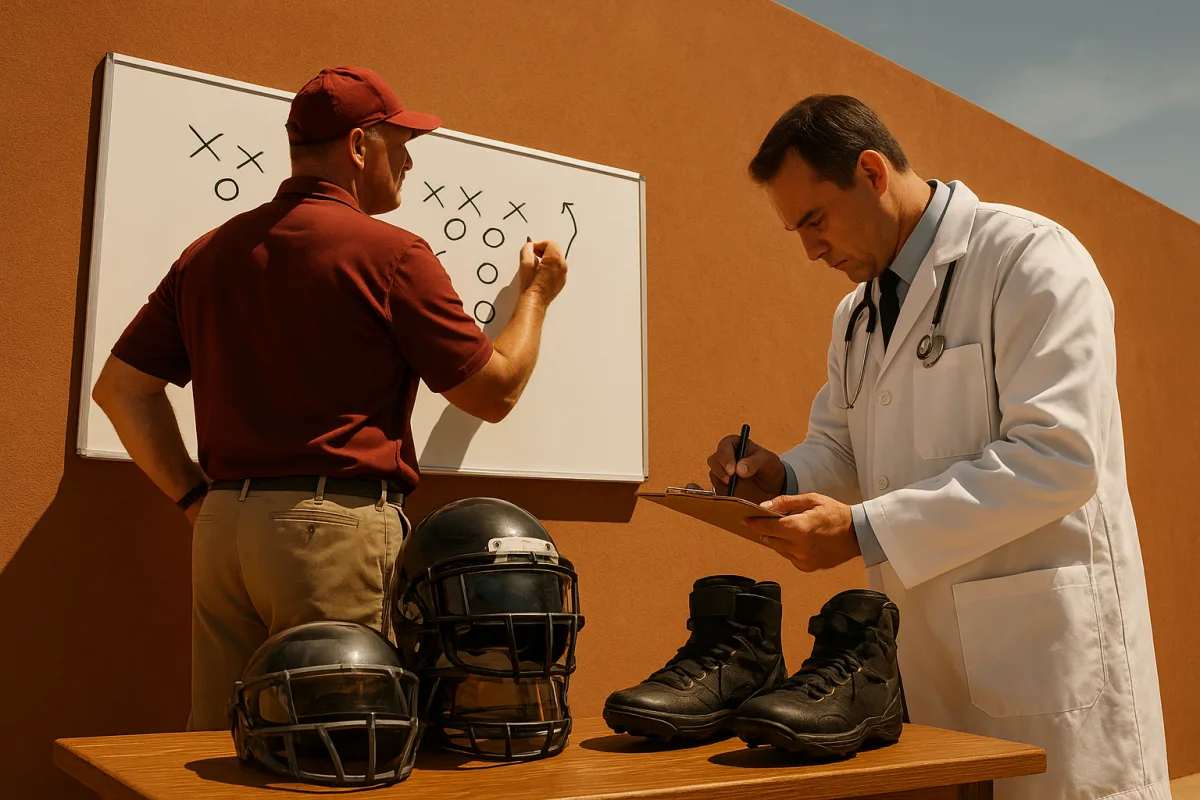
NFL Injury Updates: How to Read the Week 9 Fallout
Confirm whether the player is actually out
Your first job is separating “injured reserve” from “out for the year.” Lamar Jackson is on injured reserve after thumb surgery, but Baltimore has not announced an expected return date or a detailed recovery timetable. His season has not been formally declared over.
IR requires a player to miss at least four games, and a team must designate him for return before activating him. That designation opens a 21-day practice window, and clubs have a limited number of return designations during the season. [4][5]
So the correct read on Jackson is not “he will be back for the playoffs,” nor “his season is finished.” It is that Baltimore must build its immediate plan without him, then wait for a team-issued update before assigning any later-season value.
This is where injury reporting gets distorted by urgency. A quarterback’s absence creates a weekly crisis, but a thumb surgery without a published timeline does not let you project his availability for December, January, or a possible postseason game.
Build Baltimore’s Thursday plan around the healthy quarterback
The Ravens face Jacksonville on Thursday night, leaving little time for an injured quarterback room to recover. Tyler Huntley is listed as the starter but questionable, while rookie Joe Fagnano is also questionable after injuring his ankle against Buffalo. [7]
Pro Football Talk reported that Fagnano practiced with a heavy brace on his right ankle after a low hit from Bills defensive tackle Ed Oliver. He was limited on Baltimore’s estimated report, a meaningful sign of participation but not a declaration that he can make the start.
If Huntley starts, expect Baltimore to lean into quarterback movement, designed runs, shotgun concepts, quick throws, and defined reads. That is the route to protecting an offense that has lost Jackson and cannot afford a long-developing dropback game behind an unsettled depth chart.
If Fagnano is the choice, the call sheet should get even narrower. The Ravens can use condensed formations, extra tight ends, play-action boot action, and early-down runs to avoid asking a rookie with an ankle injury to repeatedly hold the ball against Jacksonville’s rush.
The betting market reflects the quarterback uncertainty. CBS Sports listed Jacksonville as an 8.5-point favorite with a 43.5-point total for Thursday, numbers that make sense if Baltimore’s offensive ceiling is limited by availability at the sport’s most important position.
Do not overread any report on emergency depth. Baltimore’s current depth chart lists Skylar Thompson on IR, with Jackson out and Huntley and Fagnano uncertain. [7] That leaves the Ravens’ game plan dependent on who can take a full practice workload, not who is merely in the building.
Remove Jeremiyah Love from Arizona’s short-term projection
Arizona rookie running back Jeremiyah Love is on injured reserve with a right high-ankle sprain expected to keep him out four to five weeks. [8][9] Love had also dealt with a left ankle issue, so this is not a situation where the Cardinals can count on continuity.
High-ankle sprains affect the rotational stability and push-off a runner needs to make one-cut decisions. For a rookie whose early appeal came from acceleration through creases, that changes the offense from a big-play bet into a workload-management problem.
The immediate replacement is Tyler Allgeier, who has performed well in Love’s absence. That should guide how you view Arizona’s next few games: Allgeier’s snap share, short-yardage role, and receiving usage will show whether the Cardinals see him as a bridge or an answer.
We would not assume Love’s injury forces Arizona into a deadline move. The Cardinals already have James Conner and Allgeier, and there is no indication that Love’s absence has driven league-wide running back trade activity beyond Arizona’s own roster decisions. [10]
The injury does, however, change how Arizona can evaluate its backfield after the deadline. If Allgeier handles early-down volume efficiently and Conner remains available, Love can return without being handed a full workload on his first game back.
Use Brady Christensen’s practice window before penciling him into the lineup
Carolina designated veteran lineman Brady Christensen for return from injured reserve on November 3. Christensen has not played this season after a hamstring injury suffered while rehabbing the torn Achilles that ended his 2025 campaign. [6]
Panthers coach Dave Canales said Christensen is healthy, strong, fit, and ready, but also said he needs football work before the staff determines where he can help. [6] That is the right framing for a player returning from layered injuries.
Christensen has played 59 games over five seasons and brings experience at guard and tackle. [6] For Carolina, that versatility can matter immediately, particularly if game injuries force protection changes or if the staff needs a sturdier interior combination.
But a designation for return is not activation. Christensen now has a 21-day practice window, and Carolina can activate him, keep him on IR for the season, or make the decision after assessing how his movement holds up through football conditioning. [4][5]
The medical history is central to the evaluation. Achilles recoveries commonly take nine to 12 months, and the available NFL injury literature identifies performance decline and reinjury concerns after the injury. [2] A subsequent hamstring strain adds another variable.
Hamstring injuries also carry meaningful recurrence risk. A 12-year NFL review found reinjury rates ranging from 16% to 38%, which is why a player looking fit during a practice period cannot be equated with being ready for a full snap load. [3]
Fix Carolina’s numbers problem before expecting the defense to rebound
Carolina’s defensive reset is tied directly to injuries at cornerback. With Jaycee Horn and Mike Jackson unavailable, the Panthers have used more split-safety and nickel looks to protect replacement corners, but that has created thinner boxes against the run.
The Panthers have allowed 5.5 yards per carry on first down, tied for the league’s worst mark, according to the team’s film breakdown. They are also second from the bottom in run-stuff rate, which means opponents are staying on schedule too often.
The tape explanation matters. In nickel, Carolina is allowing 5.4 yards per carry, but when it has seven or more defenders in the box, that figure falls to about 4.3 yards. With eight in the box, opponents average a little more than two yards per rush.
That points away from a blanket claim that Carolina’s front cannot play the run. The Panthers’ defensive line is creating contact near the line of scrimmage, but the defense has allowed the league’s highest yards after contact in nickel, with 37 broken tackles cited in the team analysis.
Todd Wash, previously Carolina’s defensive-line coach, has taken over defensive play-calling after the club made staff changes. The immediate adjustment should be cleaner fits against motion, more controlled linebacker flow, and fewer situations in which one missed tackle becomes a six-yard gain.
Safety Tre’von Moehrig is a key player to watch. Carolina’s breakdown put his missed-tackle rate above 20%, a career high, even though he has previously handled multiple coverage and box roles. The scheme can change, but the tackling has to improve.
Christensen’s return will not cure that defensive problem. It can help Carolina stabilize its offensive line and perhaps stay ahead of the chains, but the defense still needs to survive until Horn and Jackson return and allow the staff to play more aggressive coverage structures.
Grade rookies only after separating injury from performance
Injury context also changes how you read a rookie season. CBS Sports noted that Love had not looked like the explosive runner he was at Notre Dame, but reported that his ankle issue had limited his cutting and burst before the IR placement.
That is a better explanation than labeling the rookie a disappointment after eight games. A back who cannot plant and accelerate is missing the very trait Arizona drafted, and Love’s evaluation should remain incomplete until he returns healthy enough to show it.
CBS Sports applied the same logic to Baltimore center Ola Ioane, whose promising start was interrupted by an MCL injury, and Miami guard Kadyn Proctor, who missed Week 8 after a concussion. Availability can halt development even when the underlying traits remain encouraging.
Do not make the opposite mistake and excuse every poor performance as an injury issue. Dallas safety Caleb Downs has allowed 20 completions on 24 targets for 230 yards and three touchdowns, according to CBS Sports, along with poor pursuit angles on explosive runs. That requires correction on the field.
Keep the Raiders’ quarterback decision separate from injury panic
Las Vegas has a different quarterback situation. No. 1 overall pick Fernando Mendoza is not being held back by a reported injury, but by a roster plan that keeps veteran Kirk Cousins in the starting role for a 4-4 team.
Owner Mark Davis said there is “absolutely no pressure whatsoever” from him to start Mendoza. Mendoza has appeared once, completing six of eight passes for 48 yards in mop-up work during a Week 5 loss to New England.
That matters because quarterback changes get framed as emergency medicine too often. The Raiders are choosing development time, with Davis pointing to Mendoza’s work with Tom Brady and the need to learn pro footwork and game speed before carrying a starting offense.
CBS Sports’ midseason rookie review similarly described Mendoza’s short appearance as tidy, not transformative. Until Cousins’ play declines or Las Vegas falls out of contention, there is no football reason to confuse a patient development decision with an injury-driven lineup change.
Check how returns alter the NFC race
Chicago is the reminder that a quarterback return can change a team’s identity faster than almost any coordinator adjustment. NFL on ESPN noted that Caleb Williams missed three games with a hamstring injury, then returned to help the Bears beat New England and Seattle.
Williams’ availability gives Ben Johnson’s offense access to plays that are difficult to call for a replacement quarterback. His ability to escape pressure, extend the down, and find throws over the middle changes the math on third-and-long and red-zone possessions.
That does not make every injury return a guaranteed cure. It does show why Chicago’s Week 9 matchup with Tampa Bay, where CBS Sports listed the Bears as six-point favorites, should be viewed through the quarterback’s mobility and snap-to-snap creation, not only his box-score production.
Finally, resist turning equipment trends into health guarantees. More NFL players are wearing Guardian Caps in games, but the benefits remain debated, according to the Associated Press. [1] For now, roster decisions still turn on practice participation, medical clearance, and whether a player can execute his assignment at game speed.
Frequently Asked Questions
How do NFL teams adjust game plans after key injuries?
Teams often simplify their offensive approach when key players are injured. For example, Baltimore is expected to use quicker throws, shotgun formations, and designed runs if their starting quarterback is unavailable. When a rookie or less experienced player starts, teams may rely on condensed formations, extra tight ends, and early-down runs to reduce risk and complexity.
What is the impact of quarterback injuries on NFL offenses?
Quarterback injuries create immediate challenges, forcing teams to adapt quickly. Without their primary quarterback, teams may limit deep drops and complex reads, focusing instead on quick decisions and mobility to protect less experienced players. The uncertainty at quarterback can also lower a team’s offensive ceiling and affect betting markets.
How do running back injuries affect NFL team strategies?
Running back injuries can shift workload and change offensive dynamics. For instance, Arizona’s injury to rookie Jeremiyah Love has led to increased reliance on Tyler Allgeier. Teams may manage the injured player’s return cautiously, using backups to handle early-down work and avoiding immediate full workloads to reduce reinjury risk.
What does a player’s return from injured reserve mean for NFL teams?
A player’s return from injured reserve signals a chance to evaluate readiness rather than an immediate lineup solution. For example, Brady Christensen’s return to practice allows the Panthers to assess his health and game readiness before deciding how he fits into the offensive line. Teams must balance recovery progress with the risk of reinjury.
How do NFL teams manage offensive line depth after injuries?
Teams use practice windows and evaluations to determine how returning linemen can contribute. Even when a veteran like Brady Christensen is designated to return, coaches need to assess his conditioning and fit before relying on him to address depth or run-defense issues. This cautious approach helps manage the risks of reinjury and performance decline.
How we researched this
This article was assembled from 2 video sources across 2 channels, 5 published articles, 10 cited references.
Nothing here is based on hands-on testing. Where a figure or finding appears, it belongs to the source cited beside it, and the writing says so rather than implying otherwise. Every source is listed below so you can check it.
Sources
What One Coach Told Schefty About the Bears + Surprise Trade Names | The Adam Schefter Podcast, NFL on ESPN
A Defensive Reset | The Deep Dive Ep. 4 w/Anish Shroff & Trevor Sikkema | Carolina Panthers, Carolina Panthers
Ravens QB Joe Fagnano practices Tuesday with brace on ankle, Pro Football Talk
2026 midseason rookie grades: Ranking the early hits, misses and biggest surprises, CBS Sports NFL
Panthers designate OL Brady Christensen for return from IR, Pro Football Talk
Week 9 NFL odds, lines, totals, spreads for every game, including Jaguars-Ravens, Jets-Chiefs, Giants-Eagles, CBS Sports NFL
Mark Davis: "Absolutely no pressure whatsoever" from me to start Fernando Mendoza, Pro Football Talk
More NFL players are wearing Guardian Caps during games. The benefits are still up for debate
NFL Injury Report Explained: History, Rules, and Designations
Panthers designate OL Brady Christensen for return from IR - NBC Sports
Jeremiyah Love Injury: Bound for IR with high-ankle sprain | RotoWire
Cardinals rookie RB Jeremiyah Love out several weeks with ankle injury, sources say
NFL Trade Deadline 2026: Five Teams That Should Buy, and Five That Should Sell
Watch Injury Updates and Their Impact on NFL Teams on Youtube
Also from the sources
Related Articles
Giants vs Rams Injury Impact
Analyze the Giants vs Rams injury impact in Week 2 and how key injuries changed offensive performance and game outcomes.
Lamar Jackson Injury and Its Impact on Ravens' QB Future
Explore Lamar Jackson's thumb injury, recovery outlook, and how it shapes the Ravens' quarterback options and offensive strategy in 2026.
Falcons vs Ravens Overtime Game and Injury Impact Analysis
Detailed analysis of the Falcons vs Ravens overtime game and how player injuries impacted the outcome and team strategies.
Week 5 NFL Game Previews and Injury Impact Analysis
Get detailed Week 5 NFL game previews with injury updates and tactical analysis to understand how player availability shapes matchups.