Giants vs Rams Injury Impact
Analyze the Giants vs Rams injury impact in Week 2 and how key injuries changed offensive performance and game outcomes.
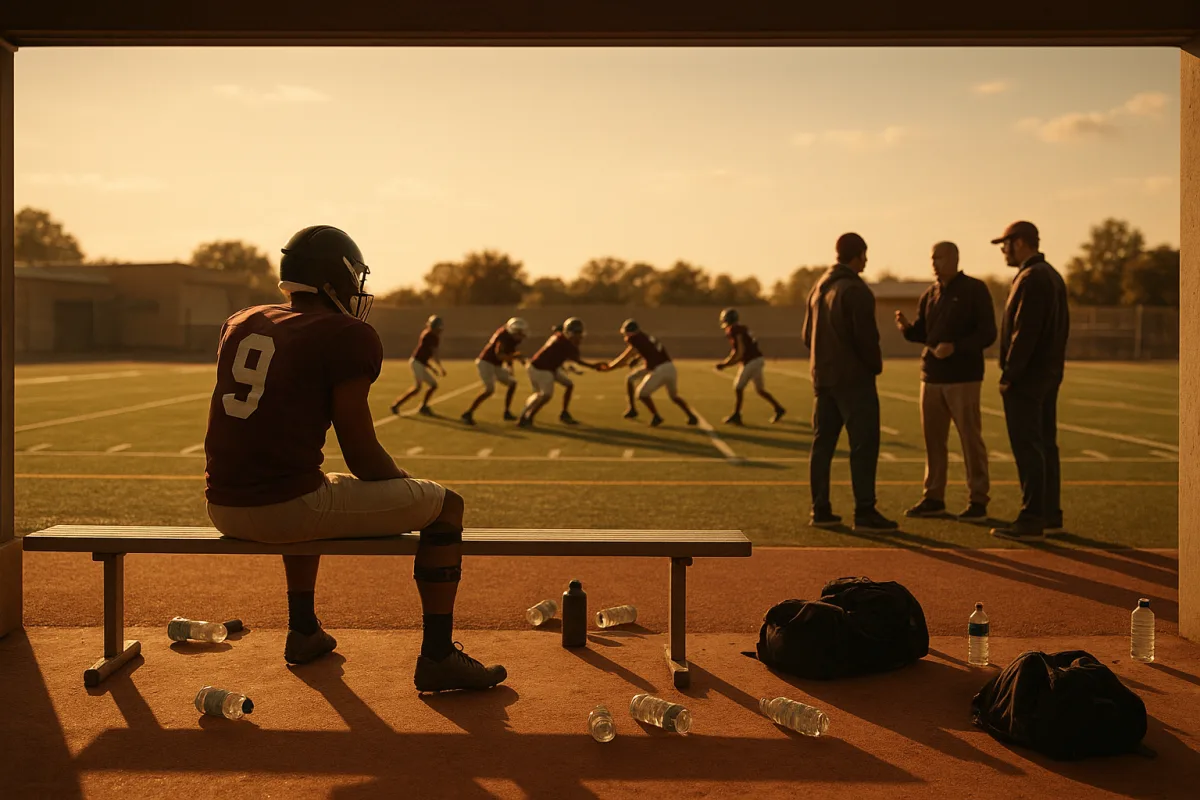
Giants-Rams injury impact: Why losing Jaxson Dart changed the offense, not just the quarterback
The injury that changed the game was a system injury
The easy description of Monday night is that the Giants lost quarterback Jaxson Dart, then lost 28-6 to the Rams. That is factually true. It also skips the football reason the offense changed shape so quickly. [5]
Dart left on the opening drive after taking pressure near the goal line, and FOX Sports reported the rookie quarterback suffered a right knee injury. He had started both Giants games entering Week 2 and had not missed NFL game action before this point. [4]
That matters because there was no existing 2026 sample showing what New York’s offense looks like without him. The Rams game was not a clean before-and-after comparison, either, because the opponent had already disrupted the initial plan and several other Giants starters were injured.
Still, the tape-level question is more useful than the broad “next man up” slogan. The issue was not merely whether Jameis Winston could complete a pass. It was whether Winston could operate the same offensive architecture Dart had spent the week preparing to run.
A quarterback change changes the math before the snap
An NFL call sheet is not a menu every quarterback runs identically. The play can have the same name, formation and personnel, yet become a fundamentally different call depending on the quarterback’s comfort with protections, footwork and coverage identification.
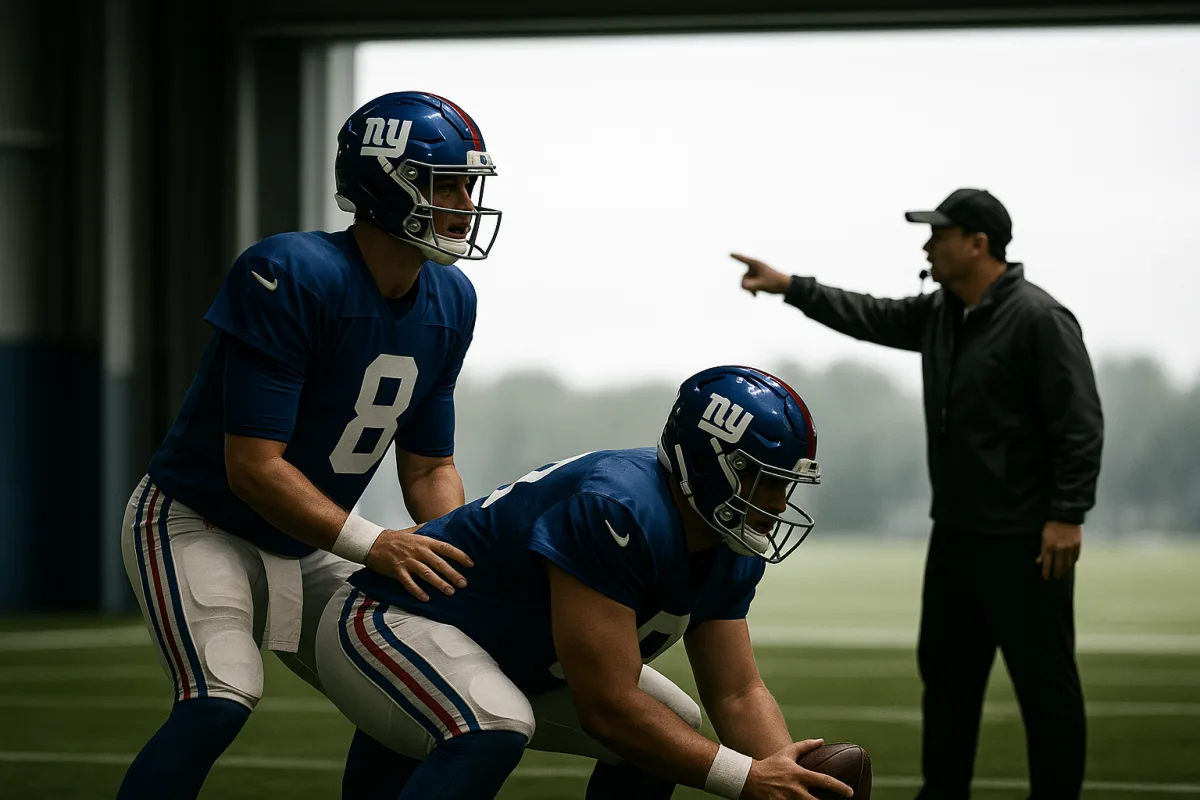
With Dart, the Giants had shown an offense that could marry under-center formations with run action. That matters because under-center play-action puts linebackers and safeties in conflict: step downhill against the run, or stay deep enough to defend intermediate routes.
The Rams’ broadcast analysis on NFL on ESPN noted that New York stopped operating under center as often after Winston entered. The shift toward shotgun was logical, but it also made the offense more legible to a defense already controlling the line.
Shotgun is not inherently passive. It can be an efficient way to get the quarterback an immediate view of the defense, activate quick-game concepts and create space for a mobile runner. But it alters the timing and threat structure of the offense.
From under center, a quarterback turns his back to the defense during many play-action fakes. That inconvenience is the point. The fake can pull second-level defenders forward, creating throwing windows behind them before they regain depth.
From shotgun, the quarterback faces the defense throughout the exchange. The offense can still use play-action, including split-zone and read-option looks, but linebackers often have a clearer path to diagnose the backfield action and react to routes.
That is the cost of the switch. Winston may be more comfortable setting protections and throwing from the gun, but the Giants lose some of the deception that had helped define their early-down offense with Dart.
Why the Rams could press the issue
The Rams did not beat the Giants solely because Dart got hurt. Sean McVay’s team was already winning the physical and schematic matchups that make a backup quarterback’s job particularly difficult.
Giants coach John Harbaugh identified interior defensive-line games as a major issue immediately after the game. Those games are coordinated stunts, where rushers exchange lanes after the snap to force blockers to communicate and pass off assignments.
A basic version involves a defensive tackle driving vertically into a guard or center, occupying him, while an edge rusher loops behind into the vacated interior lane. The line must recognize the exchange instantly, without opening another rush lane.
That is especially difficult against shotgun dropbacks. The ball may be expected out quickly, but if the quarterback holds it for an extra beat because the first read is covered, the pressure arrives through the middle, where it is hardest to escape.
The Giants’ own game footage showed Winston uncomfortable in several compressed pockets. That does not mean every incompletion belongs to the quarterback. Protection, route spacing, coverage leverage and receiver execution decide whether a passing concept has a viable answer.
Harbaugh put it more accurately than the standard postgame diagnosis. He said the Giants did not execute, did not run effectively and did not make downfield plays when opportunities appeared. He also said the specific explanations required tape review, play by play.
That distinction matters. “Winston struggled” is a result. It does not identify whether a particular failure came from a missed protection call, a receiver failing to separate, an inaccurate throw, a bad route conversion or a defense winning its one-on-one.
CBS Sports recorded Winston’s line at 11 completions on 27 attempts for 111 yards and an interception. Those numbers describe an offense that repeatedly failed to sustain drives, but they do not independently explain why each drive ended.
The supporting injuries make the quarterback problem larger
A backup quarterback can survive a reduced playbook if the surrounding structure remains intact. The Giants did not have that luxury for long against Los Angeles, because the injury list hit the exact positions that stabilize a young offense.
Nabers injured his right shoulder in the first quarter, according to FOX Sports, then returned. [4] His ability to come back was encouraging, but it does not establish that he was unaffected, nor is there reliable public data measuring New York’s offense before and after the injury.
The practical effect is straightforward. A receiver with any shoulder limitation can still run routes and draw coverage, but contested-catch positioning, late hands, blocking willingness and willingness to absorb contact over the middle can all become more complicated.
Nabers finished with one catch on four targets, but it would be poor analysis to attribute that stat entirely to the shoulder. Coverage, quarterback change, route distribution and the Rams’ ability to create pressure all likely shaped that outcome.
Andrew Thomas is even more central to the system question. The Giants listed their left tackle among players dealing with injury uncertainty, and their offensive-line depth chart also included right guard Francis Mauigoa as questionable after Week 2. [7]
There is conflicting information around Thomas’s injury. Harbaugh described a late-game groin issue after the Rams loss, while the independent research brief notes an earlier ankle report and no definitive later timetable. The only responsible conclusion is that his status remains unclear.
That uncertainty matters because the left tackle is not simply a pass protector. In an under-center, run-action offense, he can be part of the run surface, sell the initial run picture and keep the quarterback’s blind side clean on deeper developing throws.
If Thomas is unavailable or limited, the Giants may have to keep a tight end or running back in protection more often. That helps the line, but it removes an eligible receiver from the route concept and narrows the quarterback’s options.
Pro Football Talk reported that veteran receiver Odell Beckham Jr. played only three of the Giants’ 58 offensive snaps against the Rams, after 11 of 69 in Week 1. That limited deployment becomes more notable if New York needs answers at receiver.
Beckham’s snap count alone does not prove a coaching error. The Giants may have had conditioning, package or matchup reasons. But a Winston-led offense cannot afford to carry unused options if it is already reducing formations and keeping extra protectors in.
Burns is part of the same equation
Brian Burns’s low ankle sprain came late, but its effect reaches back to the offense. A defense that cannot create pressure or finish drives forces its own offense to chase more possessions, more points and more obvious passing situations.
Harbaugh called Burns’s injury a low ankle sprain, and subsequent reporting characterized his Week 3 availability as uncertain despite the injury being considered relatively minor. [6] The short week is meaningful because low-ankle labels do not guarantee functional readiness.
Against the Rams, the Giants managed one sack and two quarterback hits despite Matthew Stafford dropping back more than 30 times, as Harbaugh noted afterward. The Rams repeatedly gave Stafford clean protection and let him distribute the ball on schedule.
That outcome heightened the cost of New York’s offensive injuries. When the defense cannot create short fields or extra possessions, the backup quarterback must build conventional drives against a settled defense, which is the least forgiving version of the assignment.
What the Giants need to change if Dart misses time
The immediate question is not whether Winston can replicate Dart. He cannot, because no backup replicates the starter’s particular preparation, movement profile and timing in a matter of snaps. The useful question is which concepts reduce Winston’s burden.
First, New York needs more defined throws. That means concepts where the quarterback reads one defender or one side of the field, rather than holding the ball while scanning a full-field progression against disguised coverage.
Second, the Giants should use motion with purpose. Motion can reveal man or zone indicators, change the leverage of a slot defender and create a free release for a receiver. It cannot cure poor protection, but it can simplify pre-snap information.
Third, the run game needs to create manageable second downs. The Giants leaned on the run near the Rams’ goal line after recovering a fumble, but Harbaugh acknowledged the staff would revisit both the decision to keep running and the particular calls.
That is not an argument against Cam Skattebo or the ground game. It is an argument for using the run to create favorable passing situations, not treating repeated runs into a condensed front as an automatic solution to quarterback uncertainty.
The medical timeline will determine how aggressively New York must rebuild. MCL sprain recovery ranges from roughly one to three weeks for a Grade 1 injury to four to six weeks for a Grade 2 injury, with Grade 3 cases potentially lasting far longer. [2]
The Giants had not publicly confirmed the grade after the game. Dart’s negative X-rays and ability to remain on the sideline were reassuring signs, but they do not substitute for the MRI-based diagnosis or establish a firm return date.
Jordan Love’s 2024 MCL sprain initially carried a three-to-six-week estimate, a useful real-world reference point rather than a prediction for Dart. [3] Recovery depends on ligament grade, stability, pain tolerance, position-specific movement and the team’s medical decision-making.
It would also be wrong to use ACL research as a direct forecast for Dart. A 2014 study found that 67 percent of NFL quarterbacks returned after ACL reconstruction, often with diminished performance, but an MCL sprain is a different injury with different treatment and demands. [1]
For the Giants, the Week 2 lesson is not that the season turned on one injury. It is that the quarterback injury exposed how much their offensive structure depended on a specific blend of under-center sequencing, protection and available skill talent.
If Dart is out, New York’s path is not mysterious. Protect Winston better, build the call sheet around his shotgun comfort, manufacture simple throws and avoid mistaking a reduced offense for a passive one.
Frequently Asked Questions
How did Jaxson Dart's injury affect the Giants offense vs Rams?
Dart’s early knee injury forced the Giants to abandon their under-center, run-action offense and switch to a shotgun-heavy scheme led by Jameis Winston. This change reduced the offense’s deception and altered timing, making it easier for the Rams’ defense to read and react. The shift was not just about the quarterback but about the entire offensive system losing its original structure.
What injuries impacted the Giants vs Rams Week 2 game?
Besides Dart’s right knee injury, Malik Nabers suffered a right shoulder injury early in the game, Brian Burns sustained a low ankle sprain late in the game, and Andrew Thomas had an existing ankle injury with no recent updates. These injuries affected key positions on both offense and defense, influencing the Giants’ overall performance.
Why did the Giants offense change after Dart's injury?
The offense changed because Winston’s skill set and comfort zone differ from Dart’s. Dart’s under-center play-action offense relied on deception that pulls defenders out of position, while Winston operated mostly from shotgun, which is more transparent to defenses. This required the Giants to adjust their play-calling and protection schemes to fit Winston’s strengths.
How did supporting injuries affect Giants performance vs Rams?
Injuries to Malik Nabers, Andrew Thomas, and Brian Burns impacted the Giants’ ability to create easy throws on offense and to get defensive stops. These players occupy critical roles that influence blocking, route running, and defensive pressure, and their absence or limited effectiveness contributed to the Giants’ struggles during the game.
What was Jameis Winston's performance impact after Dart's injury?
Winston completed 11 of 27 passes for 111 yards in relief of Dart, showing he could function as a starter but not simply inherit Dart’s offensive system unchanged. His discomfort in compressed pockets and the need for a different game plan highlighted that the quarterback change affected more than just passing statistics.
How we researched this
This article was assembled from 5 video sources across 3 channels, 3 published articles, 7 cited references.
Nothing here is based on hands-on testing. Where a figure or finding appears, it belongs to the source cited beside it, and the writing says so rather than implying otherwise. Every source is listed below so you can check it.
Sources
MNF REACTION 🏈 Rams’ get huge win over Giants + Latest on Jaxson Dart’s injury | SC with SVP — NFL on ESPN
Sean McVay, Davante Adams, Matthew Stafford & Aaron Donald Recap Week 2 Win Over The Giants — Los Angeles Rams
Highlights: Giants vs. Rams | Week 2 Monday Night Football | New York Giants — New York Giants
Postgame Interview: John Harbaugh addresses the media following Week 2 vs. Rams | New York Giants — New York Giants
Nate Landman, Terrance Ferguson, Kyren Williams & Steve Avila Recap Monday's 28-6 Win vs. the Giants — Los Angeles Rams
The only silver lining to New York Giants' no good, very bad night on 'MNF' — CBS Sports NFL
Odell Beckham Jr. was on the field for three plays on Monday night — Pro Football Talk
Giants QB Jaxson Dart heads for MRI after knee injury vs. Rams; Updates on Brian Burns, Malik Nabers, others — nydailynews.com
Performance and return-to-sport after ACL reconstruction in NFL quarterbacks.
Quarterback Knee Sprains NFL Treatment: What Happens When A QB Goes Down - Knee Hurt
Giants vs. Rams Box Score, September 21, 2026 | The Football Database
Giants’ Brian Burns Status Uncertain Following Ankle Injury in Rams Loss – Azat TV
New York Giants Depth Chart 2026 — Starters & Backups · Statz NFL
Watch Giants vs Rams Week 2 Injury and Performance Impact on Youtube
Also from the sources
Related Articles
Washington Commanders Upset Win Over Seattle Seahawks
Detailed analysis of the Washington Commanders' upset win over the Seattle Seahawks, focusing on quarterback performance and key game factors.
Falcons vs Ravens Overtime Game and Injury Impact Analysis
Detailed analysis of the Falcons vs Ravens overtime game and how player injuries impacted the outcome and team strategies.
Jaxson Dart Development with the New York Giants in 2026
Explore Jaxson Dart's development with the New York Giants, focusing on his 2026 progress, challenges, and adaptation to Matt Nagy's offense.
Week 5 NFL Game Previews and Injury Impact Analysis
Get detailed Week 5 NFL game previews with injury updates and tactical analysis to understand how player availability shapes matchups.