
Caleb Williams Injury Update and Bears QB Status for Week 3
Get the latest on Caleb Williams' hamstring injury and the Bears' QB status for Week 3, including possible replacements and recovery outlook.
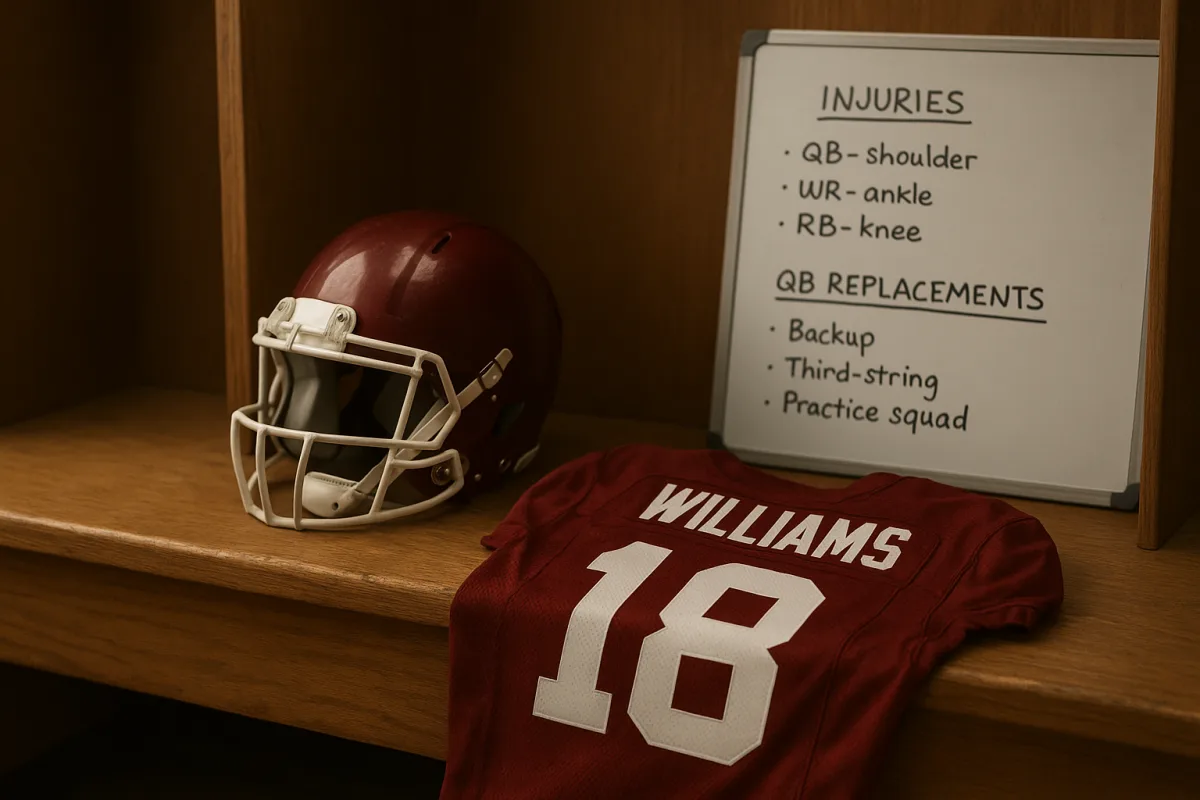
Start with the official status, not the first reaction
The useful update is straightforward: Caleb Williams is week-to-week after suffering a right hamstring injury in Chicago’s September 20 loss to the Minnesota Vikings. Ben Johnson said the quarterback is unlikely to practice during the week, while declining to eliminate the possibility of playing the Eagles. [3][6]
That language matters. “Week-to-week” is not a coded declaration that Williams will miss one game, nor is it a sign the Bears expect him back next Monday night. It means the club has not established a return date publicly. [4][6]
The early reaction after Williams was carted off naturally focused on the worst possibilities. The Pat McAfee Show relayed an early report that testing had not revealed a major hamstring injury and suggested a Week 3 return remained possible.
That report should now be treated as an initial indication, not a timetable. Johnson’s later public position was more cautious: Williams would not practice early in the week and was likely to miss time. That is the team’s current baseline. [4][6]
The injury occurred late in Chicago’s 9-3 loss to Minnesota, a game in which the Bears never found a functional offensive rhythm. Williams leaving on a cart created an alarming visual, but the cart itself does not establish strain grade or recovery length. [1]
Why the “not serious” label does not settle the Week 3 question
A hamstring hyperextension can cover a wide range of outcomes. General medical guidance cited in the research brief places a mild Grade 1 injury in a roughly one-to-three-week window, while a severe Grade 3 injury can require months. [2]
That range is precisely why the Bears are not committing. A quarterback does not merely need to walk without discomfort. He has to drive off the back leg, reset in the pocket, accelerate outside structure, and avoid compensating in ways that alter his throwing base.
Williams’ status will turn on what he can do at practice, not on whether he appeared mobile after the game or whether imaging avoided the most catastrophic outcomes. The Chicago Sun-Times reported Johnson would not rule him out, but that is different from expecting him to play. [6]
For readers trying to set fantasy lineups or assess the Eagles matchup, the actionable checkpoint is participation. A limited practice would represent progress. No practice, after Johnson already signaled that expectation, keeps the evidence pointed toward an absence. [3][6]
Do not convert “week-to-week” into a prediction of exactly one missed game. The available reporting does not provide a grade, a sprinting benchmark, or a medically defined return date. Any claim that Williams will definitely return after Week 3 goes beyond the evidence. [2][4]
What happened to the Bears offense after Williams left
Tyson Bagent entered against Minnesota and completed 5 of 9 passes for 54 yards, with Chicago failing to score after Williams exited. Those numbers describe a small, adverse-game-state sample, not a complete evaluation of Bagent as a starter. [1][7]
The more important point is that Bagent had to enter a low-scoring divisional game late, without a full week built around his strengths. A 5-for-9 relief appearance cannot tell us whether Chicago would alter protection calls, personnel usage, or early-down pass concepts for him.
Bagent does have meaningful NFL starting experience. He made four starts in 2023, went 2-2, completed 65.7 percent of his passes, and threw three touchdowns against six interceptions. That profile suggests competence and experience, not proof of a seamless replacement. [7]
The Bears’ immediate concern is not finding a narrative about Bagent. It is designing a plan that gives him manageable answers before the snap, protects against obvious passing situations, and avoids asking a backup quarterback to live in third-and-long against Philadelphia.
That is where the loss of Williams would be felt. Johnson’s offense has emphasized improving Chicago’s passing game and creating better connections between quarterback and receivers. A backup week typically narrows how much of that menu can be installed and checked at the line. [5]
There is no sourced public breakdown yet showing exactly what Johnson will remove or retain if Bagent starts. It would be overreach to promise a run-heavy game plan, fewer dropbacks, or a particular set of concepts before Chicago practices and announces its quarterback plan.
The backup plan is likely Bagent, but it is not fully clean
All indications point to Bagent taking first-team work if Williams cannot go, and reporting has described him as the expected starter. Still, Johnson stopped short of formally naming him as the Week 3 starter on September 21. [4][7]
That distinction is worth keeping. Coaches often preserve flexibility early in an injury week, particularly when the starter has not been ruled out. The actual decision may not become clear until practice participation, the Friday injury report, or the inactive list.
Bagent also appeared on the Week 2 injury report as questionable with a back injury before playing against Minnesota. He was healthy enough to relieve Williams, but the available reports do not provide a later, definitive update on that issue. [8]
Case Keenum was inactive against the Vikings by coach’s decision and did not play. That means the Bears’ quarterback depth should be monitored as a unit, not only through Williams’ designation, particularly if Bagent’s back status resurfaces during the week. [9]
For practical purposes, readers should watch the Bears’ daily injury report for both Williams and Bagent. Williams’ designation determines the ceiling of the offense. Bagent’s designation determines whether Chicago can conduct a normal backup-quarterback week without stressing its emergency depth.
What to watch before making any Eagles-game decision
First, look for whether Williams practices at all. CBS Sports reported he was unlikely to practice in Week 3, so an unexpected limited session would be meaningful. Conversely, a string of absences would reinforce Johnson’s statement that missed time is expected. [3][4]
Second, separate a limited listing from true readiness. Teams can list players as limited for individual drills while withholding them from full team work. For a quarterback with a hamstring issue, the unanswered question is whether he can move, reset, and throw normally under football-specific stress.
Third, monitor who takes the quarterback reps that reporters observe in the open portions of practice. If Bagent consistently handles the first-team operation, that is stronger evidence than speculation about whether Williams looked comfortable walking or standing on the sideline.
Fourth, do not mistake the Eagles date for a reason to rush Williams. The risk with hamstring injuries is not simply pain. Returning before the player can handle explosive movements can increase the chance of aggravation, and the medical range varies substantially by injury severity. [2]
The Bears’ season does not become defined by one Week 3 lineup card. But their offensive expectation changes if Williams cannot play. Chicago would be moving from a first overall pick central to Johnson’s passing-game plans to a backup whose starting sample was four games in 2023. [5][7]
That does not automatically make Chicago noncompetitive. It does mean expectations should be calibrated around quarterback operation, not the box score from a single relief stint. Bagent’s 54 yards against Minnesota are a data point, not a projection. [1][7]
How to read the public reaction without overreacting
The Pat McAfee Show’s discussion captured the emotional swing around the injury: a cart departure looked season-altering, then early reporting that the damage was not major invited immediate optimism. Both responses are understandable, and neither provides a medical diagnosis.
The more grounded read comes from Chicago’s own language. Johnson identified the situation as week-to-week, said Williams was unlikely to practice, and acknowledged that the quarterback would likely miss time. That is cautious because the team has reason to be cautious. [4][6]
Analysts can reasonably expect adjustments around Bagent if he starts, especially after Chicago emphasized improving its passing game under Johnson. What they cannot responsibly claim yet is a settled blueprint, a projected long-term season outcome, or a confirmed return date. [5][7]
The tape and snap-count perspective here is simple. Williams’ injury removed him from a game Chicago lost 9-3, and Bagent played nine pass attempts in relief. That is enough to identify a quarterback problem for Week 3, but not enough to diagnose the entire season. [1]
Until the Bears release more practice information, the responsible working assumption is that Bagent prepares to start and Williams works toward a return without a fixed deadline. That matches the reporting, the coach’s wording, and the uncertainty inherent in hamstring injuries. [2][4][6]
Frequently Asked Questions
What is Caleb Williams' current injury status?
Caleb Williams is officially listed as "week-to-week" with a right hamstring injury sustained on September 20. The Bears have not established a return date, and coach Ben Johnson described the injury as likely to cause Williams to miss some time.
Will Caleb Williams play in Week 3 against the Eagles?
Williams is unlikely to practice during the week leading up to Week 3, and while coach Johnson has not formally ruled him out, the Bears are treating him as unavailable for planning purposes. His participation depends on how he responds to practice and recovery.
Who is the Bears' quarterback if Caleb Williams misses time?
Tyson Bagent is the logical replacement for Williams if he misses time. Although the Bears have not officially named Bagent the Week 3 starter, all indications point to him taking the starting role in Williams’s absence.
How severe is Caleb Williams' hamstring injury?
The exact severity of Williams’s hamstring injury remains uncertain. It is described as a hyperextension injury with a recovery timeline that can vary widely—from one to three weeks for mild cases to several months for severe cases—depending on the injury grade and his ability to perform football movements without pain.
What impact does Caleb Williams' injury have on the Bears offense?
Williams’s injury disrupted the Bears’ offensive rhythm in the loss to the Vikings. With Bagent’s limited NFL experience and different playing style, the Bears may adjust their offensive strategy to suit the backup quarterback, but no detailed analysis on the long-term impact has been provided.
How we researched this
This article was assembled from 2 video sources across 2 channels, 1 published article, 9 cited references.
Nothing here is based on hands-on testing. Where a figure or finding appears, it belongs to the source cited beside it, and the writing says so rather than implying otherwise. Every source is listed below so you can check it.
Sources
Caleb Williams Got Carted Off For "Hamstring Strain?" — The Pat McAfee Show
Schefty's notes on Caleb Williams' injury, Falcons QBs & Sam Darnold's status | The Pat McAfee Show — NFL on ESPN
Bears QB Caleb Williams reportedly avoids serious hamstring injury, could play Week 3 but 'will likely miss some time' — Yahoo Sports
Bears' Caleb Williams: Unlikely to practice in Week 3 - CBS Sports
Bears coach Ben Johnson IDs areas of emphasis for 2026 season
Bears’ QB Depth Chart: What’s Chicago’s Outlook If Caleb Williams Misses Time?
Watch Caleb Williams Injury and Bears QB Status on Youtube
Also from the sources
Related Articles
Jalen Hurts Injury Update and Eagles QB Situation Explained
Get the latest on Jalen Hurts' injury, medical details, IR rules, and how the Eagles' quarterback situation is evolving.
NFL Week 3 Key Player Injury Analysis and Confirmed Status
Get an in-depth NFL Week 3 key player injury analysis with confirmed statuses and impact on team roles for Brian Burns, Breece Hall, and De'Von Achane.
Arizona Cardinals Week 2 Injury Updates and Preparations
Get the latest Arizona Cardinals Week 2 injury updates and player news as they prepare for their game against the Seahawks.
NFL Week 3 Team Preparations and Media Availability Updates
Get the latest NFL Week 3 team preparations, player statuses, and media availability insights to understand upcoming game strategies and key updates.