
Denver Broncos Week 2 Comeback Win Over Jaguars Analysis
Detailed analysis of the Denver Broncos' Week 2 comeback win over the Jaguars, focusing on offensive adjustments and key player performances.
The quick list
- Best overall: The second-half balanced offense, for readers deciding whether Denver’s comeback was built on repeatable structure rather than one-off highlights.
- Best value: Jaylen Waddle’s vertical and intermediate usage, for readers looking for the most concrete reason the passing game changed.
- Best for protecting a young quarterback: The under-center run-game approach, for readers focused on how Sean Payton and Davis Webb reduced pressure on Bo Nix.
- Best defensive indicator: Denver’s third-down response, for readers weighing whether the defense actually corrected its Week 1 issues.
The real decision from Denver’s Week 2 win is whether to credit the Broncos’ 20-13 comeback to an offensive breakthrough or to a favorable sequence of big plays. The tape-level answer, based on the available reporting and postgame explanations, lands in between.
Denver did get a breakout performance from Waddle, and no offense dismisses 138 receiving yards as incidental. But Sean Payton’s staff also changed the game’s structure by committing more seriously to the ground game, possessing the ball, and avoiding another afternoon in which Nix had to play from disadvantageous down-and-distance. [3][4]
| Option | What changed | Concrete evidence | Trade-off | What it means going forward |
|---|---|---|---|---|
| Second-half offensive balance | More emphasis on the run and under-center offense | Denver won 20-13 after trailing 13-3 [1][4] | No detailed run/pass split or snap-count data is available | Repeatable if Denver can stay on schedule |
| Jaylen Waddle deployment | More chances against zone and man coverage, including deep concepts | 8 catches, 10 targets, 138 yards, 49-yard catch [3] | Production depended on a few explosive plays | Gives Denver a genuine coverage-stressing option |
| Bo Nix’s second half | More efficient passing within a steadier offensive structure | 22-of-31, 288 yards, 1 TD, 1 INT [2] | He still took five sacks and threw a red-zone interception [2] | Improvement, not a finished product |
| Defensive response | Better third-down outcomes and more pressure situations | Broncos recorded two sacks and one interception [2] | Jacksonville still stayed in the game into the fourth quarter | Better situational defense, with work still required |
| Four-minute offense | Denver closed without returning the ball to its defense | Players said the offense held the ball for the final roughly 4:30 | Running-back depth became a concern after injuries | Valuable proof of situational execution |
The comparison that mattered: explosive passing versus offensive balance
Waddle’s day is the cleanest headline. CBS Sports credited him with eight receptions on 10 targets for 138 yards, a dramatic jump from the one-catch, two-yard Week 1 line. [3] That is not simply a matter of volume.
Nix explained in the Denver Broncos’ postgame availability that the opening deep completion came against quarters coverage. Denver used deeper hooks to influence the safeties, then got Waddle on a post after Nix moved right in the pocket.
That is a coordinator-quarterback-receiver sequence, not a random jump ball. The concept created space by manipulating the safeties, then required Waddle to keep his route narrow enough to preserve a throwing lane after the quarterback was flushed.
The late completion to Waddle was different. Nix said Denver anticipated man coverage and used a double move, with the receiver working away from the post safety. That distinction matters because it shows Waddle was not merely beating one coverage family.
Payton’s postgame explanation matched that picture. He described Waddle as a player who can align in the slot or at Z receiver, which gives Denver access to different matchups and prevents defenses from treating him as a fixed outside target.
The trade-off is obvious. Explosives are high value but inherently volatile. A 49-yard contested catch can swing a game, as Waddle’s did, but Denver cannot assume it will receive one every week. [3]
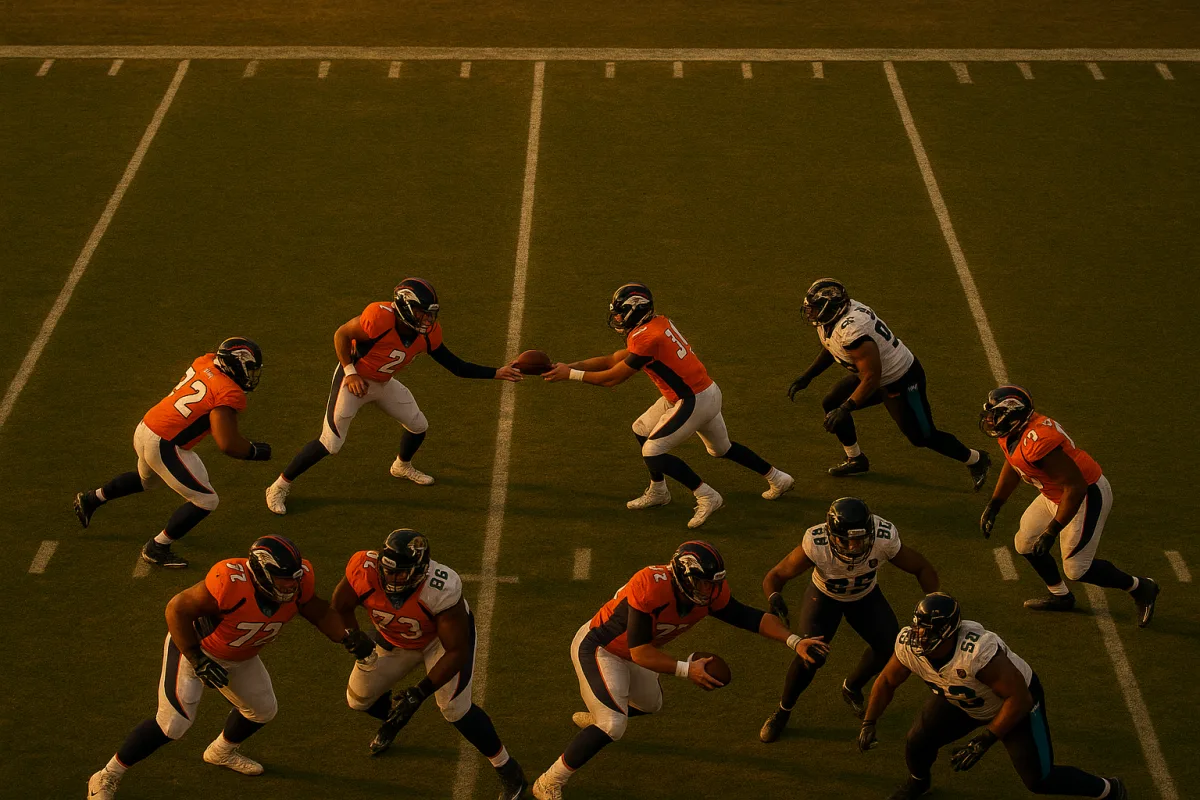
The more sustainable part of the win was the attempt to make the running game part of the offensive architecture. Denver Sports reported that Payton acknowledged a concerted effort to run more, particularly after a weak Week 1 rushing performance. [4]
Payton’s own explanation was revealing. He said Denver is built “a little bit more under center” and framed a good run game as one of a quarterback’s two greatest allies, alongside defense. That is not code for hiding Nix.
It is a recognition that Nix does not need every drive to begin with empty formations, long-yardage throws, and a pass rush with no reason to hesitate. Early-down runs and under-center actions can create more manageable second and third downs.
What Denver actually changed after halftime
There is a temptation to describe every comeback as a halftime schematic masterpiece. The available sources do not support that claim. Neither Payton nor the reporting provides a detailed list of altered formations, personnel packages, or call-sheet tendencies.
What is supported is simpler. Denver stayed with the things it had identified as working, increased its commitment to balance, and received stronger play-calling from offensive coordinator Davis Webb after an uneven Week 1. [4][7]
Nix said the offense found run concepts it liked and continued calling them, particularly on base downs. He also credited Webb for not panicking when the early offense did not produce points in the first quarter.
That matters because the Broncos were not completely stalled before halftime. Payton said Denver moved the ball on multiple possessions but hurt itself near the scoring area. The distinction between moving the ball and finishing drives is central to this game.
Denver trailed 13-3, not 27-3. That margin allowed the staff to retain its plan rather than abandon the run and turn the afternoon into a high-volume passing game. The defense’s work made the offensive adjustment viable.
The red-zone interception remains part of the evaluation. Payton called it a good defensive play against a zero-blitz look, explaining that Jacksonville used combination coverage and the nickel defender fell off to make the interception.
That is more useful than branding Nix’s interception a simple accuracy failure. The Jaguars presented pressure, Denver had receivers split wide, and Jacksonville handled the route combination effectively. Still, the result was a lost scoring opportunity.
Nix’s 288 passing yards therefore need context. They show meaningful production and a willingness to attack downfield, especially through Waddle. They do not erase the five sacks Jacksonville recorded or make every offensive possession clean. [2]
The defense: improved, but not beyond scrutiny
The Week 1 narrative centered on Denver’s tackling and run defense, concerns amplified by reports detailing a record-setting tackling failure and broader problems against the run. [5][8] The Jaguars game was a better response, particularly in key downs.
Denver’s players repeatedly emphasized third down and getting off the field in the Denver Broncos’ locker-room video. Payton made the same point after the game, saying the Broncos got off the field against an offense he considers capable of making plays.
Still, the basic pass-rush totals should temper claims that Denver dominated Trevor Lawrence snap after snap. The official NFL game center lists two Broncos sacks, while Jacksonville sacked Nix five times. [2]
Riley Moss’s interception changed momentum and helped give Denver a shorter path back into the game. But one takeaway does not establish a dominant takeaway defense, especially because Denver also threw one interception. [2]
There is also a data issue worth flagging. Available reporting lists both teams with one interception, yet turnover-differential reporting has Jacksonville at plus-two and Denver at minus-one. Those figures do not reconcile from the available official turnover events.
That discrepancy should not be used to build an argument for either team. Until the turnover accounting is clarified, the cleanest description is that each quarterback threw an interception, while Denver’s situational defense helped prevent Jacksonville from extending its lead.
The closing drive was more meaningful than the final score
The game’s most useful late-game evidence was not merely that Denver scored 20 points. It was that the offense possessed the ball for the final approximately 4:30, according to Denver players in the postgame locker-room coverage.
That is where Denver’s shift toward balance met situational execution. With injuries affecting the running-back room, the Broncos needed young ball carriers to protect the football, remain in bounds, and understand that a first down mattered more than an extra few yards.
Payton specifically praised the late-game awareness from his rookie back, describing the in-bounds decision as the type of detail that does not always receive enough practice repetitions. That is a small play with a large effect.
The Jaguars never received the ball back with a chance to tie or win. For a defense that had been asked to compensate for Week 1 mistakes, that outcome matters as much as any sack total.
Who each option suits
The balanced, under-center offensive approach suits Denver best when the Broncos can keep games within one score. It helps the line play downhill, keeps the quarterback out of obvious passing situations, and makes play-action and shot concepts more credible. [4]
Waddle-centered explosive passing suits Denver when opponents commit safeties to intermediate routes or play man coverage without enough help over the top. His Week 2 production provides evidence of that ceiling, though not proof it will appear weekly. [3]
A Nix-led spread passing game suits situations where Denver must chase points, but Week 2 showed why it should not be the default. Five sacks are a reminder that more dropbacks do not automatically mean a better offense. [2]
The defensive formula suits Denver when it can create long-yardage situations and let its rush affect quarterback timing. The Jaguars game was progress from Week 1, but the Broncos still need to show that improved tackling and run defense travel week to week. [5][8]
Denver’s comeback was not a story about toughness replacing analysis. The Broncos won because their defense kept the margin manageable, their coaches leaned into a more stable offensive structure, and Waddle supplied the explosive plays that structure was designed to create.
Frequently Asked Questions
How did the Denver Broncos adjust their offense in Week 2 against the Jaguars?
The Broncos emphasized a more balanced offense after halftime, leaning harder into the run and using more under-center plays. This approach helped them keep the game close, possess the ball longer, and create cleaner passing opportunities for quarterback Bo Nix. While no detailed play-by-play changes were reported, the adjustment focused on sustaining drives and avoiding difficult down-and-distance situations.
What role did Jaylen Waddle play in the Broncos' Week 2 comeback win?
Jaylen Waddle was the clear difference-maker in the passing game, catching 8 of 10 targets for 138 yards, including a 49-yard contested catch that set up a touchdown. This marked a significant improvement from his Week 1 performance and gave the Broncos a reliable vertical and intermediate receiving threat that stressed opposing coverage.
How did Bo Nix perform in the Broncos' Week 2 game versus the Jaguars?
Bo Nix completed 22 of 31 passes for 288 yards, with one touchdown and one interception. His performance was a step forward compared to Week 1, benefiting from a steadier offensive structure and improved play-calling. However, he still faced pressure, taking five sacks, and his red-zone interception indicated room for further improvement.
What defensive improvements did the Broncos make in their Week 2 win?
Denver’s defense showed better tackling and run defense compared to Week 1, particularly in third-down situations. The Broncos recorded two sacks and one interception, though the Jaguars still managed five sacks on Bo Nix. While the defense improved situationally, it did not fully resolve all issues from the previous week.
Was the Broncos' Week 2 win a result of coaching adjustments or big plays?
The win was a combination of both coaching adjustments and key plays. Sean Payton’s staff committed to a more balanced offense with a stronger running game, which helped sustain drives and reduce pressure on Bo Nix. At the same time, explosive plays, especially from Jaylen Waddle, contributed significantly to scoring opportunities. The comeback reflects progress but not a complete fix of all problems.
How we researched this
This article was assembled from 4 video sources across 2 channels, 2 published articles, 8 cited references.
Nothing here is based on hands-on testing. Where a figure or finding appears, it belongs to the source cited beside it, and the writing says so rather than implying otherwise. Every source is listed below so you can check it.
Sources
The Broncos Ruin the Jaguars — ThatsGoodSports
QB Bo Nix on Broncos' win vs. Jaguars: 'We played with great grit today' — Denver Broncos
HC Sean Payton on Broncos’ win over Jaguars: ‘It was really a tale of two halves’ — Denver Broncos
Broncos players react to comeback win vs. Jaguars | Inside the Locker Room — Denver Broncos
Game balls for the Broncos 20-13 win over the Jaguars — SB Nation
Broncos rise to occasion; topple Jaguars in hard-fought gridiron battle — SB Nation
Jacksonville Jaguars at Denver Broncos 2026 REG 2 - Game Center
Broncos' Jaylen Waddle: Breakout performance in Week 2 win - CBS Sports
Sean Payton and the Broncos had a more concerted effort to run the ball – Denver Sports
Denver Broncos Send Alarming Message With Record-Setting Tackling Failure - TWSN
The Broncos’ poor run defense and tackling are major concerns - Yahoo Sports
Watch Denver Broncos' Week 2 Comeback Win Over Jaguars on Youtube
Also from the sources
Related Articles
Bo Nix Key Plays Fuel Broncos Comeback Over Rams
Explore how Bo Nix's key plays and Broncos' adjustments led to their comeback win over the Rams.

NFL Week 3 Quarterback Insights and Offensive Analysis
Explore NFL Week 3 quarterback insights and offensive strategies from media, including Bo Nix, Joe Burrow, and C.J. Stroud’s performances.
San Francisco 49ers Week 4 Preview and Player Updates
Get the San Francisco 49ers Week 4 preview with injury updates and analysis on handling Denver's pressure defense.
Buffalo Bills Week 1 Defensive Highlights and Team Outlook
Explore Buffalo Bills Week 1 defensive highlights, player insights, and the impact of the new stadium on their 2026 season opener.