J.J. McCarthy Giants Breakout Performance vs Texans Analysis
Analyze J.J. McCarthy's efficient and mobile breakout performance in his first Giants start against the Texans, highlighting offensive strategy and key
Giants’ J.J. McCarthy breakout was really a shift toward a more sustainable offensive structure
The shift is real, but it is smaller than the breakout label suggests
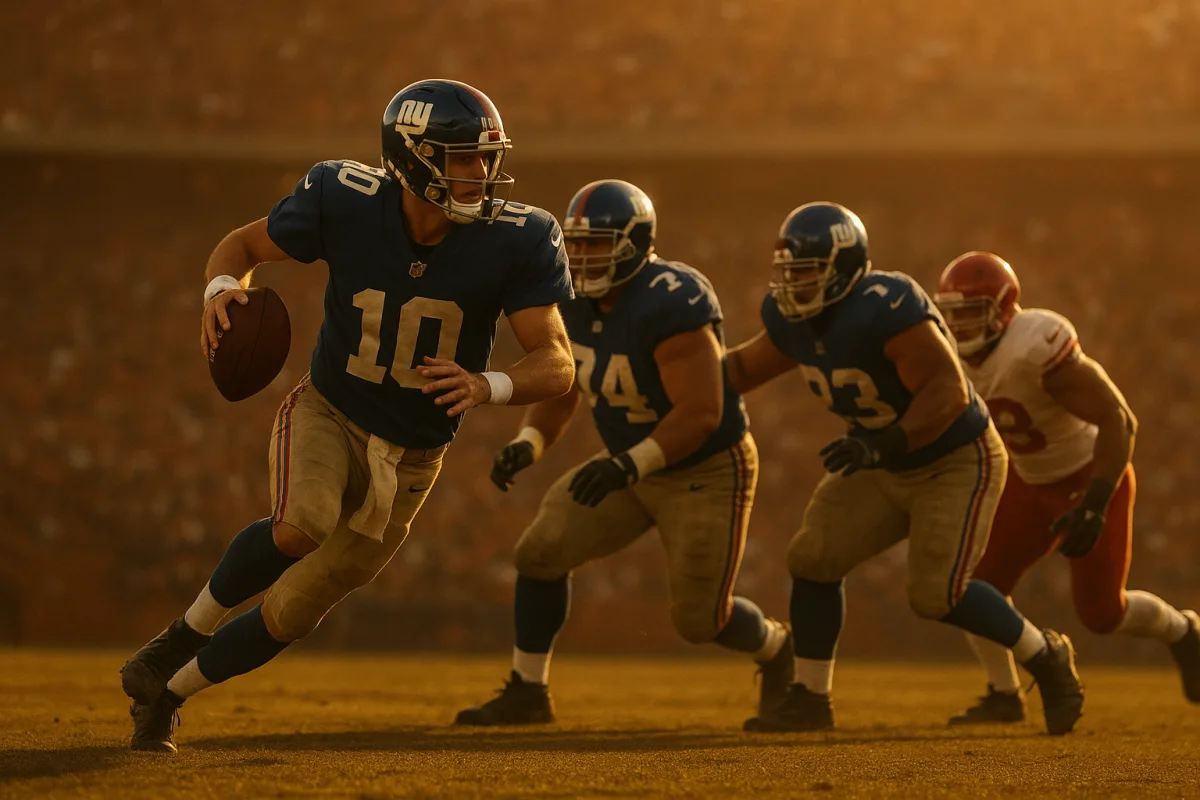
The Giants have shifted from treating J.J. McCarthy as an in-game answer to treating him as the quarterback around whom the weekly offense can be built. His first start, a 27-21 overtime win over the Texans on October 25, was evidence of that change. [6][8]
That does not mean McCarthy carried the entire offense or delivered the 400-yard performance some NFL.com analysts forecast before the game. He completed 20 of 28 throws for 252 yards, with no passing touchdowns or interceptions. [1][6]
The more useful interpretation is that New York constructed a game in which McCarthy could operate efficiently while the physical burden was spread across the offensive line, fullback usage and running backs. That is a more repeatable development plan than simply asking a new starter to throw 40 times.
Several independent outlets reached versions of that conclusion. NBC Sports emphasized the win and McCarthy’s efficient production, while SI and Yahoo Sports framed it as a successful first start rather than a finished product. [6][11][13]
The cautionary voices matter, too. Draft Sharks identified McCarthy as a more volatile option than veteran Jameis Winston, and NextDyne’s dynasty recommendation came with the same basic warning: the talent is apparent, but the weekly floor remains uncertain. [9][10]
That balance is important because the word “breakout” can obscure what happened. McCarthy played well enough to validate the Giants’ decision, but the game was won through complementary football, not a quarterback-driven explosion.
The Giants changed the workload before they changed the quarterback narrative
McCarthy’s box score was clean in the passing game, but the most important number from Houston may have been 188. The Giants ran for 188 yards, including 72 in overtime, according to the New York Giants’ postgame show. [6]
That production changed the math of the game. Houston could not consistently play as if McCarthy would have to drop back into obvious passing situations, and that gave New York more manageable down-and-distance scenarios throughout the afternoon.
The official Giants postgame analysis highlighted the role of Pat Ricard, the offensive line and a three-back rotation. Cam Skattebo’s 42-yard overtime run set up Devin Singletary’s 30-yard winner, a sequence built on blocking leverage rather than quarterback heroics.
That is the first trend worth watching. The Giants are not merely handing McCarthy a playbook and hoping his arm talent fixes the offense. They are using the run game to prevent defenses from dictating the terms of his dropbacks.
The Week 7 tape discussion on the Giants’ broadcast pointed to quarterback-read elements, including the early touchdown run by Tyrone Tracy. McCarthy’s presence as a possible runner held the defensive end and widened the lane for the back.
That is not a gimmick, and it does not require McCarthy to become a high-volume rushing quarterback. It is a constraint play, forcing an unblocked edge defender to respect the quarterback before crashing toward the running back.
The tape showed decisiveness, not just arm strength
NFL on NBC’s Week 7 panel focused on McCarthy’s decisiveness. The relevant point was not that he made every throw perfectly, but that he got the ball out after identifying coverage rather than drifting into indecision.
NFL on ESPN’s film segment made a similar observation from a different angle. Tim Hasselbeck highlighted throws to Malachi Fields, noting that McCarthy drove comeback routes and found a narrow hole against two-deep zone coverage.
Those throws matter because they are not empty-yardage completions. A comeback outside the numbers requires anticipation and velocity, while a throw between a sinking corner and deep safety requires placement rather than raw arm strength.
The Giants also used Malik Nabers as an early stabilizer. Nabers finished with seven receptions for 111 yards, his fourth consecutive 100-yard game according to the team’s postgame broadcast, despite catching passes from multiple quarterbacks this season.
That receiver production should not be used as proof that quarterback changes do not matter. Rather, Nabers gives a new quarterback a practical answer against pressure or tight coverage, because he can adjust to imperfect placement and win after contact.
McCarthy’s value in this game was that he recognized those available throws and delivered them on time. The tape did not show a quarterback forcing contested downfield attempts simply to manufacture a statement performance.
The pressure picture keeps this from being a finished product
The Giants’ offensive line was not operating at full strength. Marcus Mbow was out with a knee injury, Josh Sills was inactive, and McCarthy was sacked three times against Houston. [7][6]
That context makes his 71.4 percent completion rate more meaningful, but it should not be stretched into an argument that the protection problem is solved. One efficient start does not erase the effects of an undermanned line.
Nor was the game actually turnover-free. McCarthy did not throw an interception, but he lost a fumble on his only rushing attempt, a one-yard carry. [1]
That distinction matters. A quarterback can protect the ball well in the pocket and still expose it when extending plays or entering traffic. For McCarthy, ball security remains part of the evaluation, not a footnote to ignore after a win.
His prior NFL body of work supports the caution. During his 2025 Vikings tenure, McCarthy started 10 games and threw 11 touchdowns against 12 interceptions, a record that explains why Draft Sharks remains wary of projecting stable weekly output. [9]
The Houston tape was encouraging because McCarthy did not compound pressure into reckless passing decisions. But the Giants still need to reduce the number of snaps in which he must solve protection problems after the play has already broken down.
Why this is happening now
The timing is not accidental. McCarthy arrived from Minnesota on September 28, giving him limited time to learn a new offense while the Giants were still trying to navigate injuries and instability at quarterback. [2][8]
His Week 6 relief appearance against New Orleans created the opening. In roughly 11 minutes, McCarthy went 11-for-21 for 243 yards, one touchdown and one interception, showing the explosive side of his game along with the volatility. [1]
The Giants then chose the larger sample over the veteran default. Official team reporting confirmed McCarthy would start against Houston, a decision that placed development value alongside the immediate need to win a difficult road game. [8]
John Harbaugh’s postgame comments to the New York Giants channel centered on operational control. He pointed to the absence of procedural penalties, clock issues and formation errors, which is meaningful for a quarterback making his first start with a new team.
That does not prove McCarthy has mastered the offense. It does show the staff had enough confidence in his command to expand beyond a stripped-down emergency package, even if the run game remained the primary support system.
The Giants also benefited from not requiring him to manufacture all of their explosive plays. A quarterback’s first start becomes much more manageable when the offense can create yardage through run-game explosives, receiver talent and field position.
What the stat line does and does not show
A 99.1 passer rating tells a useful but incomplete story. It captures McCarthy’s completion rate, yards, touchdowns and interceptions, but it does not account for the lost fumble or identify how much the ground game shaped coverage. [1]
Likewise, 252 passing yards is solid production, especially in a first start on the road against Houston. It is not the 400-yard eruption predicted by some pregame analysts, and it should not be presented as one. [6]
McCarthy also did not throw a touchdown pass. That is not inherently a negative when the Giants scored through the running game, but it limits how far anyone should push the idea that he independently transformed the red-zone offense.
The better metric from this game is situational efficiency. McCarthy completed 71.4 percent of his attempts, avoided interceptions, and kept the offense functional long enough for New York’s rushing attack to take over in overtime. [1][6]
That is a strong first-start profile. It is not yet evidence that he can consistently carry an offense when the run game is stalled, the receivers are covered, and the defense forces obvious passing downs.
The next evaluation point is not whether McCarthy can repeat 252 yards. It is whether the Giants can keep his passing menu broad enough to punish defenses without exposing him to the turnover patterns that appeared in Minnesota.
What other teams should take from the Giants’ approach
For teams planning a young-quarterback project, the Giants offer a practical template. Start with a real run-game foundation, use quarterback movement selectively, and make sure the first read includes a receiver capable of winning contested situations.
The goal is not to hide the quarterback. The Giants did allow McCarthy to make intermediate and boundary throws, which matters because a development plan becomes limiting if defenses never have to defend the full width of the field.
New York also avoided a common mistake: confusing more attempts with more confidence. McCarthy attempted 28 passes, enough to make meaningful decisions and create rhythm, but not so many that every offensive possession became a referendum on his arm. [1]
The offensive staff should continue to use play-action, read elements and early-down runs, particularly while the line remains unsettled. That approach gives McCarthy cleaner pictures and prevents opponents from building their entire game plan around simulated pressure.
There is also a roster-building lesson. Nabers’ production offers a quarterback-friendly target, while Ricard’s blocking and the late contributions from Skattebo and Singletary gave the Giants ways to win after the passing game had done its share.
That kind of support matters more than a week of public enthusiasm. Young quarterbacks improve through repeatable answers, not through being asked to create highlight plays against every coverage and every protection breakdown.
The next trend line is consistency
The Giants have enough evidence to keep McCarthy in the starting role. He handled the operation, completed efficient throws, survived pressure often enough, and helped New York beat a capable opponent on the road. [6][8]
They do not yet have enough evidence to declare the quarterback question settled. McCarthy’s former turnover issues, the lost fumble against Houston and the instability in front of him all remain factors in the weekly projection. [1][7][9]
The useful expectation is not that every game will look like Week 7. It is that the Giants now have a clearer model for how McCarthy can help them win while he continues to develop.
If the rushing efficiency holds, the protection improves and McCarthy continues to make fast, defined decisions, the Week 7 victory will look less like a surprise and more like the beginning of a credible offensive identity.
Frequently Asked Questions
How did J.J. McCarthy perform in his first start for the Giants?
In his first start on October 25, 2026, against the Texans, McCarthy completed 20 of 28 passes for 252 yards with no touchdowns or interceptions, achieving a 99.1 passer rating. He helped the Giants win 27-21 in overtime, showing efficiency but also losing a fumble on his lone rushing attempt and taking three sacks.
What was notable about J.J. McCarthy's breakout game against the Texans?
McCarthy’s breakout was characterized by efficient passing combined with a strong running game, as the Giants rushed for 188 yards including 72 in overtime. The offense was structured to reduce McCarthy’s volume and pressure, relying on complementary football rather than a high-volume passing attack.
How did the Giants use J.J. McCarthy's mobility in their offensive game plan?
The Giants used McCarthy’s mobility as a strategic constraint to influence defensive alignment, forcing defenders to respect his running threat and thereby opening lanes for the running backs. This approach helped create more manageable passing situations without requiring McCarthy to be a high-volume rushing quarterback.
What were the strengths and weaknesses of J.J. McCarthy's Week 7 performance?
McCarthy showed decisiveness and efficient passing, completing 71.4% of his throws and making accurate intermediate and outside-the-numbers throws. However, he lost a fumble on a rushing attempt and was sacked three times, highlighting ongoing concerns about ball security and handling pressure.
How did the Giants balance the run and pass game with J.J. McCarthy as QB?
The Giants balanced the offense by pairing McCarthy’s efficient passing with a strong run game supported by the offensive line, fullbacks, and running backs. This balance prevented defenses from focusing solely on McCarthy’s passing, creating more favorable down-and-distance situations and reducing his exposure to difficult snaps.
How we researched this
This article was assembled from 4 video sources across 3 channels, 3 published articles, 13 cited references.
Nothing here is based on hands-on testing. Where a figure or finding appears, it belongs to the source cited beside it, and the writing says so rather than implying otherwise. Every source is listed below so you can check it.
Sources
Postgame Interviews: John Harbaugh, J.J. McCarthy, Cam Skattebo, Malachi Fields, Micah McFadden — New York Giants
Will J.J. McCarthy lead Giants to NFC East title? + Seattle overwhelms Mahomes and KC | SC with SVP — NFL on ESPN
Postgame Recap & Analysis: Giants vs. Texans | Week 7 | New York Giants — New York Giants
NFL Week 7 headlines: J.J. McCarthy leads Giants, Falcons upset 49ers | Sunday Night Football Final — NFL on NBC
How 49ers fans believe the team should approach the 2026 NFL trade deadline — Yahoo Sports
Packers By The Numbers: Stats from the Week 7 loss to the Lions — SB Nation
Week 7 Stock Up, Stock Down: Jordan Mason's runway has cleared — NBC Sports
NY Giants to start QB J.J. McCarthy in Week 7 matchup against Houston Texans | ESPN Tri-Cities
J.J. McCarthy Makes Brief Debut in Giants' Week 5 Game Against Commanders | Tixel
Last 10 Years NFL Rookie Quarterbacks First Game Stats | StatMuse
Giants’ J.J. McCarthy Wins First Start Without a TD Pass and Doesn’t Care - Athlon
McCarthy throws for 252, wins first Giants start - NBC Sports
New York Giants Injury Report and Status 2026-27 - CBS Sports
J.J. McCarthy Dynasty Outlook as Giants Starting QB | NextDyne
J.J. McCarthy Delivers a Winning Debut as Giants Starter, Beating Texans in Overtime
J.J. McCarthy Delivers a Winning Debut as Giants Starter, Beating Texans in Overtime - Yahoo Sports
Watch Giants' J.J. McCarthy Shocks Texans with Breakout Performance on Youtube
Also from the sources
Related Articles
NFL Week 3 Quarterback Insights and Offensive Analysis
Explore NFL Week 3 quarterback insights and offensive strategies from media, including Bo Nix, Joe Burrow, and C.J. Stroud’s performances.
Denver Broncos Week 2 Comeback Win Over Jaguars Analysis
Detailed analysis of the Denver Broncos' Week 2 comeback win over the Jaguars, focusing on offensive adjustments and key player performances.
Cleveland Browns Week 4 Performance and Key Player Impact
Analyze the Cleveland Browns' Week 4 performance, key player impacts, and strategic adjustments in their win over the Steelers.
San Francisco 49ers Week 4 Preview and Player Updates
Get the San Francisco 49ers Week 4 preview with injury updates and analysis on handling Denver's pressure defense.