
Packers vs Lions Week 7 Recap and Penalty Controversies
Detailed Packers vs Lions Week 7 recap covering game events, key penalties, and controversies that shaped the 20-17 Lions victory.
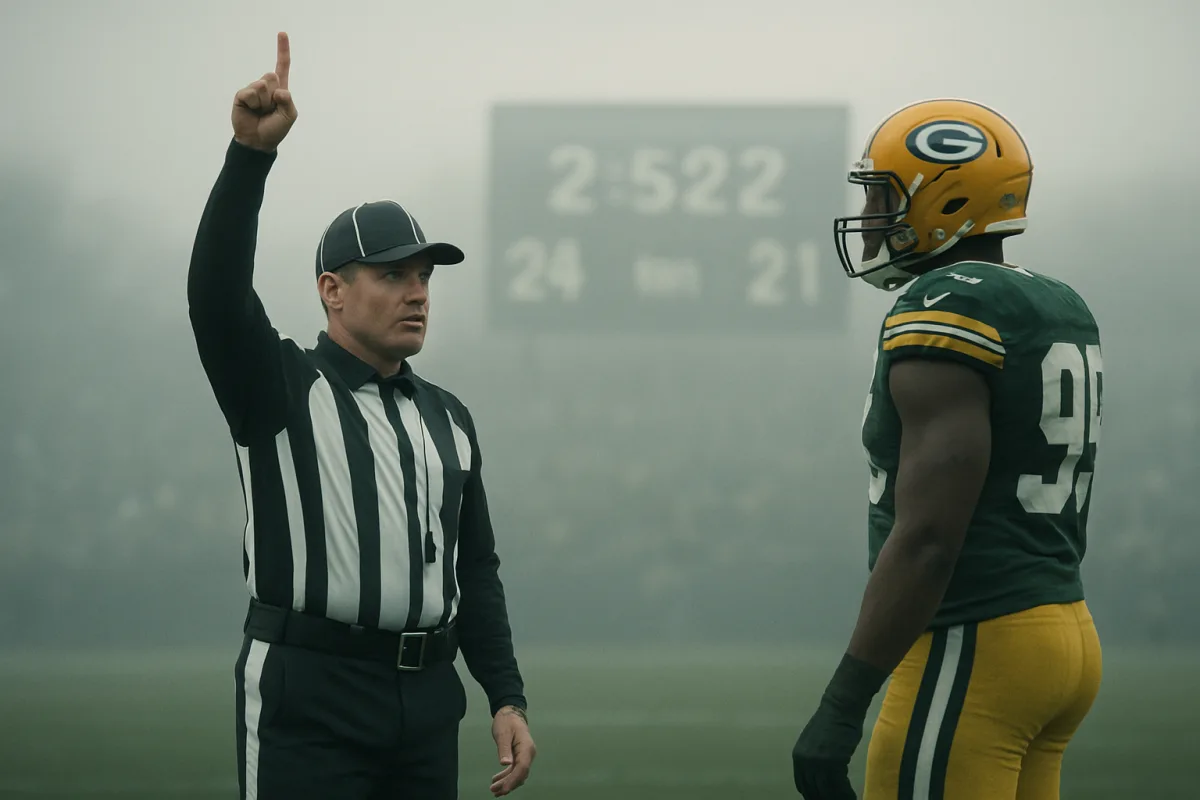
Packers vs. Lions: Why Two Roughing Calls Became the Game’s Defining Issue
The score settled the standings, not the argument
Detroit’s 20-17 Week 7 victory over Green Bay on Oct. 25 will be recorded as another tight Lions-Packers game, decided by a Jake Bates walk-off field goal. The film-and-snap-count conversation, however, starts earlier than the kick. [1]
Green Bay had multiple chances to create a more comfortable margin for error. The most concrete self-inflicted problem came in the second quarter, when Matt LaFleur elected to go for fourth-and-4 from Detroit’s 7-yard line rather than kick a field goal that would have tied the game. [1]
That is not an argument that coaches should always take three points. A fourth-and-4 inside the 10 can be a defensible aggression decision, especially if a team trusts its passing concept and matchup. But the result changes the late-game math.
A converted field goal would not have erased the disputed penalties, nor would it guarantee a Packers win. It would have changed Detroit’s final-drive requirements and given Green Bay one more way to survive a close finish.
The Packers also lost continuity where an offense can least afford it. Starting center Sean Rhyan and reserve Jacob Monk were injured, pushing John Williams into his NFL debut at center under game conditions. [1]
Center is not simply another interior-line spot. The player has to identify the front, communicate protections, execute the snap cleanly, and then block a defender who often has immediate access to the A gaps.
That matters especially against a defense that can disguise late safety rotation, mug linebackers in the interior gaps, or shift the front after the quarterback begins the cadence. A first-time center must process those pictures at NFL speed.
Green Bay’s offensive shortcomings should not be erased because the officiating became the postgame story. The loss had a tactical price before the late controversy, including the missed chance to bank three points near the goal line. [1]
Roughing the passer is a mechanics rule
The game’s central controversy was not just that Green Bay was penalized. It was that the Packers were flagged twice for roughing the passer, adding to a season total of eight such penalties through Week 7. [1]
To understand why players react so strongly to those calls, it helps to separate the legal act of rushing from the prohibited finish. A defender is allowed to beat a blocker, chase a quarterback and make a legal tackle.
The rule becomes difficult at the moment the quarterback releases the ball. Officials must decide whether the hit was avoidable, late, forcible to a prohibited area, or delivered in a way that puts excessive body weight on the passer.
That last element is the most contested one. A defender is often moving at full speed with a blocker attached, another rusher arriving nearby, and a quarterback who may duck, drift or release the ball late.
The league’s standard has long tried to distinguish a tackle from a defender using the quarterback as the ground. The Competition Committee has emphasized that flags should be limited to hits where a defender applies most or all of his body weight. [2]
That is a sensible principle in a rulebook. It is much harder to apply from one sideline angle in real time. A defender can be driving through a block, trying to wrap the passer, then forced by momentum to land on him.
Officials are asked to make a rapid judgment about several separate questions: Was the passer still a runner? Did the rusher have a reasonable chance to avoid contact? Did the defender lead with the shoulder or helmet? Did he drive or fall?
The outcome can look arbitrary because the foul is determined by sequence rather than by the mere visual violence of a hit. A hard legal hit may stand, while a less spectacular takedown may draw a flag because of where and how the defender lands.
That is also why “just let them play” is not a complete policy answer. Removing the standard altogether would invite defenders to finish quarterbacks with their full weight after throws. The league is trying to prevent that specific finishing action.
Still, the Competition Committee’s public expectation was that roughing calls would decline, with officials focusing on the most obvious body-weight violations. [2] Green Bay’s eight penalties through seven weeks sit awkwardly beside that stated direction. [1][2]
The proper question is not whether every Packers roughing call has been wrong. The available public information does not support a complete case-by-case ruling on all eight. The question is whether the threshold has been applied consistently.
The Packers’ Week 7 total matters because the calls arrived in a one-score division game, where a 15-yard automatic first down can be more valuable than a routine completion. It extends possession and changes down-and-distance immediately.
The Karl Brooks penalty and Parsons’ response
The late fourth-quarter roughing call on Green Bay defensive lineman Karl Brooks was the one that turned frustration into a national discussion. It extended Detroit’s drive and became directly connected to the finish. [3]
Packers edge rusher Micah Parsons, who was on the physically unable to perform list, responded publicly on social media rather than from the playing field. His post criticized the NFL and NFL Officiating after the Brooks penalty. [3]
Parsons wrote, “let’s just go to flag football if every time a QB gets touched it’s roughing the passer!” [3] That is an understandable player reaction, but it is also broader than the rule’s actual language.
The rule does not prohibit all quarterback contact. It prohibits particular categories of contact and finishing mechanics. The practical complaint from defenders is that the standard can feel broader than its language when calls are made on borderline landings.
Parsons’ wording could carry disciplinary risk because the league can fine players for public criticism of officiating. The Times of India reported speculation about a potential fine, but no NFL disciplinary action or official response had been confirmed. [6]
That distinction matters. It is fair to say Parsons exposed himself to the possibility of discipline. It is not accurate to report that he has been fined, suspended or formally notified when no such league action has been announced. [6]
Safety Xavier McKinney expressed a similar postgame frustration from inside Green Bay’s locker room, criticizing calls that “don’t even make any sense,” including a personal foul assessed to defensive lineman Devonte Wyatt. [1]
McKinney’s complaint points to a larger defensive issue. Players can prepare for an opponent’s route concepts and protections. They cannot easily adjust their technique if they believe the officiating threshold shifts from series to series.
The solution is not to excuse avoidable late hits. It is for the league to make the standard teachable and repeatable. If “most or all body weight” is the key, the league needs to apply it with enough consistency that defenders can alter behavior.
Detroit’s rushing narrative needs a correction
Detroit’s win will invite familiar explanations about a powerful Lions running game and a physical offense taking over. The roster is certainly built to threaten defenses on the ground, but the numbers do not show a new 2026 rushing-volume surge. [4][7]
Through five games, Detroit averaged roughly 26 rushing attempts per game, essentially consistent with its 2025 usage. Its 4.2 yards per carry was down from 4.6 the previous season. [4][7]
That does not mean the run game is unimportant. It means “they ran more” is not an explanation supported by the available data. Volume and efficiency are separate measurements, and both need context from score, opponent and game situation.
The Lions changed offensive coordinators to Drew Petzing in 2026, but there is not yet reliable evidence tying that staffing change to a wholesale alteration of Detroit’s run-game philosophy. [7] A coordinator change alone is not proof of schematic revolution.
Detroit’s win was better explained by situational football than by a blanket rushing narrative. The Lions stayed close enough for Bates to decide the game, while Green Bay left points available and then could not survive the late penalty sequence. [1]
This was also the first Week 7 meeting between the teams in the 2021-25 period, despite Detroit holding a 6-4 edge across their last 10 matchups. [5] That historical series record provides context, not an explanation for this particular finish.
The Packers have a valid grievance over how roughing-the-passer calls were enforced, particularly given the league’s own stated preference for fewer marginal flags. But the tape-based accounting cannot stop there.
Green Bay’s fourth-down decision, its disrupted center situation and its inability to build a larger scoring cushion all helped create the conditions where two officiating decisions could dominate the final result. [1]
Frequently Asked Questions
What were the key moments in the Packers vs Lions Week 7 game?
Detroit’s 20-17 win was decided by Jake Bates’ walk-off field goal. A critical moment for Green Bay was their failed fourth-and-4 attempt from the Lions’ 7-yard line in the second quarter, where opting not to kick a field goal changed the late-game dynamics. Additionally, injuries to Packers’ starting center Sean Rhyan and backup Jacob Monk forced John Williams into his NFL debut at center, affecting offensive continuity.
How did roughing the passer penalties impact the Packers in Week 7?
The Packers were penalized twice for roughing the passer in Week 7, contributing to their season total of eight such penalties through seven weeks. These calls extended Detroit’s drives and influenced the game’s outcome, becoming a defining issue in the Packers’ narrow loss.
What controversies surrounded the Packers vs Lions Week 7 game?
The main controversy centered on two roughing-the-passer penalties called against Green Bay. Critics, including Micah Parsons, argued that the calls were questionable, especially regarding the application of body weight and landing mechanics. The difficulty of judging these hits in real time contributed to debate about the officiating standards.
How did injuries affect the Packers offense against the Lions in Week 7?
Injuries to starting center Sean Rhyan and backup Jacob Monk forced John Williams into his NFL debut at center. This disrupted the Packers’ offensive line continuity, as the center must manage protections, communicate adjustments, and execute snaps under pressure, all of which became more challenging for a first-time player at that position during the game.
Why were the roughing the passer calls against the Packers controversial?
The controversy stems from the complexity of the rule, which penalizes defenders who apply most or all of their body weight on the quarterback during a hit. Officials must make split-second judgments about timing, contact, and body mechanics, which can be difficult from limited angles. Critics argue that some calls, including those against the Packers, may have been marginal or inconsistent with the NFL Competition Committee’s goal to reduce such penalties.
How we researched this
This article was assembled from 2 video sources, 6 published articles, 7 cited references.
Nothing here is based on hands-on testing. Where a figure or finding appears, it belongs to the source cited beside it, and the writing says so rather than implying otherwise. Every source is listed below so you can check it.
Sources
The BEST plays from the Detroit Lions in the alternate uniforms — Detroit Lions
David Corrao meets with the media | October 23, 2026 — Detroit Lions
Jake Bates' walk-off FG gives Lions wacky 20-17 win over Packers — Detroit Free Press
Packers rip officiating after roughing penalties prove costly in loss — ESPN
How 49ers fans believe the team should approach the 2026 NFL trade deadline — Yahoo Sports
Aaron Rodgers passes Peyton Manning as Steelers top Saints in Paris — CBS Sports
Packers’ Micah Parsons calls out NFL, officials amid wild 4th quarter vs. Lions — Yahoo Sports
Cowboys at Eagles 'Monday Night Football' betting odds, picks and predictions: Best bets, player props — Yahoo Sports
Detroit Lions vs Green Bay Packers Head-to-Head: Lions Lead 6-4 Since 2021: StatsNext
Detroit Lions 2026 Updated Offensive Depth Chart After Roster Cuts
Watch Packers vs Lions Week 7 Game Recap and Controversies on Youtube
Also from the sources
Related Articles
Washington Commanders Offensive Line Analysis and Season
In-depth Washington Commanders offensive line analysis and 2026 season prep, covering injuries, depth, and run game strategy.
Los Angeles Rams and Chargers Week 6 Outlook and Analysis
Get a detailed Week 6 outlook for the Los Angeles Rams and Chargers, including key challenges, player analysis, and game predictions.
Dallas Cowboys Team Updates and Media Insights for Week 6
Get the latest Dallas Cowboys team updates, injury status, and media insights ahead of Week 6 against Green Bay Packers.
Cleveland Browns Week 4 Performance and Key Player Impact
Analyze the Cleveland Browns' Week 4 performance, key player impacts, and strategic adjustments in their win over the Steelers.