Dallas Cowboys Team Updates and Media Insights for Week 6
Get the latest Dallas Cowboys team updates, injury status, and media insights ahead of Week 6 against Green Bay Packers.
The quick list
Best overall: Dallas Cowboys’ Players Lounge, for readers trying to understand what may change defensively before Green Bay.
Best for team history: Dallas Cowboys’ Cowboys Crosstalk, for fans who value former-player perspective on leadership and standards.
Best avoided for Dallas scouting: Green Bay Packers’ Jordan Love press-conference transcript, for Packers offensive context only, not Cowboys team news.
The decision is not which Cowboys show is more entertaining. It is which update helps explain Sunday’s matchup against Green Bay, what Dallas can actually change in a week, and which talking points remain unsupported.
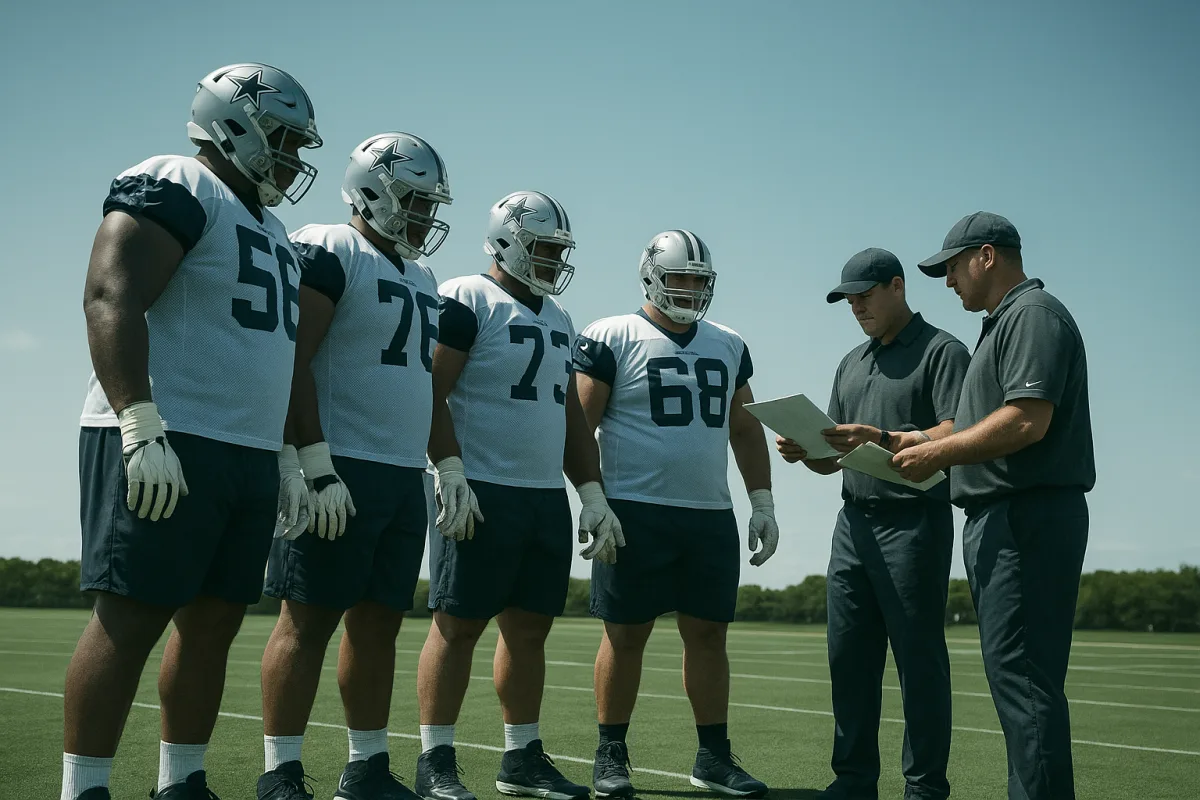
Dallas enters the Oct. 18 Packers game with a healthier quarterback room than many midseason teams, but a less certain offensive-line picture. Guyton and Shelton are both listed as questionable, and that matters more to the game plan than generalized claims about momentum. [1][2]
Guyton is listed as the starting left tackle, while Shelton is his backup. Tyler Smith, Cooper Beebe, Tyler Booker and Terence Steele remain the projected starters elsewhere, with T.J. Bass, Ajani Cornelius and Broderick Jones providing the listed depth. [1]
That structure means a Guyton absence would not simply be one player missing. It can alter the protection menu, the help assigned to the edge, the number of routes Dallas releases, and Prescott’s ability to hold the ball for deeper concepts.
Comparison table
| Option | Format and layout | Price or access detail | Most useful for | Main trade-off |
|---|---|---|---|---|
| Dallas Cowboys’ Players Lounge | Studio panel with former players Barry Church, Anthony Dorsett and DeMontre Moore alongside host Newy Scruggs | No price was stated in the supplied material | Defensive coaching changes, sideline versus booth play-calling, organizational pressure | Much of the discussion is informed opinion, not a confirmed personnel announcement |
| Dallas Cowboys’ Cowboys Crosstalk | Live audience-style radio show from The Star, hosted by Bobby Belt and Patrick Walker with Nate Newton and guest Tony Casillas | No price was stated in the supplied material | Team culture, franchise history and veteran perspective | Limited Week 6 scheme detail in the provided excerpt |
| Green Bay Packers’ Jordan Love press-conference transcript | Player media availability, though the supplied transcript includes inconsistent speaker references and non-Packers material | No price was stated in the supplied material | Green Bay’s own passing-game and protection themes, only if independently verified | Not a Dallas source, and unsuitable for projecting Cowboys personnel or coaching decisions |
The promotional framing around the two Cowboys productions also needs a small correction. Cowboys Crosstalk names Blockchain.com and Geico as sponsors, and both relationships have publicly documented roots, although financial terms were never disclosed. [5][6][7]
The program also mentions SWBC Mortgage, but available research does not confirm a 2026 Cowboys partnership. That does not make the on-air mention false by itself, but it is not a verified team-business update readers should repeat as settled fact.
What the defensive discussion actually tells us
The Players Lounge’s central football point was that Christian Parker’s location during games could change. Newy Scruggs said Brian Schottenheimer had not confirmed a move to the booth, despite an earlier public suggestion that Parker would call plays from upstairs.
That distinction matters. A coordinator working from the booth can see offensive substitutions, formations and motion more cleanly, especially when the field-level sideline becomes crowded after changes of possession or injuries.
Former Cowboys safety Barry Church made the practical case for the booth: the elevated view can help a coordinator identify personnel and substitutions before the snap. That is plausible football logic, but it is not itself evidence that the defensive calls will improve.
The narrative that moving upstairs fixes a defense is too easy. If Dallas is late getting aligned, unable to win one-on-one matchups, or allowing quarterbacks clean early-down throws, the booth may improve recognition without repairing the underlying problem.
The wider performance context supports that caution. Dallas has ranked last in expected points added per drive over a 22-game stretch, a result too large to assign solely to where the coordinator stands during a game. [8]
A defense can lose EPA through explosive passes, repeated third-down failures, poor red-zone sequencing, or simply a shortage of available players. A booth change is a process adjustment, not a personnel upgrade and not a substitute for better execution.
The Players Lounge panel also framed the possible arrival or increased involvement of Mike Payton as an organizational attempt to stop the season from sliding. That reading is sensible as interpretation, but the supplied material does not independently establish Payton’s precise title, authority, or game-day responsibilities.
That uncertainty should shape how readers use the update. Treat it as evidence that Dallas is examining its defensive operation, not proof that Parker has been displaced or that a new coach will direct the unit against Green Bay.
Why health and roster deployment matter more than rhetoric
The official tone around a team often emphasizes resilience and next-man-up responses. Dallas does have depth-chart answers at tackle, but a depth-chart name is not identical to a game-ready replacement with a full menu of pass-protection responsibilities. [1]
If Guyton cannot play, Dallas may need to decide whether Shelton can handle the assignment, whether Broderick Jones becomes part of the tackle solution, or whether the staff protects the edge through chips, condensed formations and quicker concepts. [1][2]
Those are not interchangeable choices. Leaving a replacement tackle isolated preserves more receivers in the pattern, while adding tight-end or running-back help reduces immediate route options and can make an offense easier to defend.
Prescott’s availability removes one common source of uncertainty. He is healthy and active, and Sam Howell is listed as the healthy primary backup, so there is no reporting basis for claims that quarterback injury is driving Dallas’ preparation. [1][2]
There is, however, a broader availability concern. At least four Cowboys players were reportedly affected by illness, including DaRon Bland, Caelen Carson and Jonathan Mingo, with some absences from practice. [10]
The effect of illness cannot be quantified from a practice report alone. Still, it can disrupt installation reps, special-teams work and secondary communication, all of which matter when a defense is already searching for cleaner operational answers.
What Crosstalk adds, and what it does not
Cowboys Crosstalk took a different route. Bobby Belt, Patrick Walker, Nate Newton and former Cowboys defensive tackle Tony Casillas spent the supplied segment discussing Hall of Fame recognition and the internal standards of the 1990s Cowboys.
Newton argued that former Dallas linemen Erik Williams and Mark Stepnoski, along with safety Darren Woodson, deserve greater recognition. Casillas reinforced the larger point: elite teams tend to retain institutional memory because former players understand what weekly accountability looked like.
That is valuable context for a franchise that regularly invokes its championship history. It is not, however, scouting. Neither Hall of Fame arguments nor nostalgia tells us whether Dallas can prevent Green Bay from creating favorable matchups in the middle of the field.
The useful connection is narrower. Casillas and Newton described a locker room in which players handled roles, standards and shared responsibility without requiring constant public explanation. That is the benchmark Dallas is trying to reach, not evidence it has reached it.
Recent reporting complicates the clean unity narrative. Prescott was publicly frustrated after a stadium worker characterized an Oct. 8 loss as embarrassing, and outside reporting has described both illness concerns and pressure around defensive leadership. [9][10]
None of that proves a fractured locker room. It does mean readers should resist treating official positivity as a complete diagnosis of the team’s condition, particularly while a struggling defense undergoes visible structural discussion.
A reported players-only defensive meeting also drew criticism from Steelers coach Mike Tomlin, according to Archysport. The relevant lesson is not that player meetings are inherently bad, but that meetings do not carry value unless subsequent snaps show cleaner alignment and more dependable situational execution. [11]
The Packers transcript is context, not Cowboys evidence
The Green Bay Packers channel’s supplied transcript is labeled around Jordan Love and Christian Watson, but its text includes references to Tua Tagovailoa, Miami personnel and other mismatched material. That makes it especially unsuitable as a clean primary source.
Where the transcript is coherent, it offers a familiar offensive principle: two-high coverage shells do not automatically erase vertical offense. Quarterbacks can still find shots if protection holds, route combinations stress safeties, and contested-catch players finish targets.
That principle is relevant to the Cowboys-Packers matchup only at a general level. Dallas cannot defend Green Bay simply by declaring it will play split safeties, because the coverage call must fit the front, the pressure plan, and the offense’s personnel grouping.
The more relevant takeaway for Dallas is protection. The Packers transcript emphasizes firmer pockets, better blitz identification and more precise offensive-line technique. Those are exactly the details Dallas must monitor while Guyton and Shelton remain questionable. [1][2]
Who each option suits
Dallas Cowboys’ Players Lounge suits the reader looking for the best available explanation of a possible defensive adjustment. It is the strongest option when the question is whether play-calling procedure, communication, or the coordinator’s vantage point might change.
Dallas Cowboys’ Cowboys Crosstalk suits the reader who wants organizational context from people connected to the franchise’s championship era. It gives texture on standards and leadership, but readers seeking Packers-specific analysis should pair it with injury reports and depth-chart information. [1][2]
The Green Bay Packers channel transcript suits a reader researching Green Bay’s offensive themes, only after checking the underlying media availability because the supplied text is internally inconsistent. It should not be used as a Dallas roster, injury or coaching source.
For the actual Week 6 decision, start with Guyton and Shelton’s game status, then watch whether Dallas changes protection help and defensive communication. Those are observable adjustments. General claims about urgency, unity or a booth move only matter if the snap-to-snap football changes with them.
Frequently Asked Questions
What are the latest Dallas Cowboys injury updates for Week 6?
Offensive linemen Tyler Guyton (left tackle) and Drew Shelton (swing tackle) are both listed as questionable for the Week 6 game against the Green Bay Packers. Dak Prescott and the quarterback room remain healthy with no injuries affecting preparation. Illness has affected at least four players on the team, but no further injury details were provided.
How is the Dallas Cowboys offensive line shaping up for the Green Bay game?
The offensive line features Tyler Guyton as the starting left tackle and Drew Shelton as his backup, both questionable for Week 6. Other projected starters include Tyler Smith (LG), Cooper Beebe (C), Tyler Booker (RG), and Terence Steele (RT), with backups T.J. Bass, Ajani Cornelius, and Broderick Jones providing depth. Guyton’s potential absence could impact protection schemes and passing concepts.
What defensive changes are being discussed for the Dallas Cowboys?
The Dallas Cowboys’ Players Lounge discussed possible changes in defensive communication and play-calling structure, including the uncertain role of Christian Parker, who may move to the booth. However, no definitive confirmation was given about Parker’s move or Mike Payton’s exact role, leaving the defensive adjustments unclear.
Who are the key players questionable for the upcoming Dallas Cowboys game?
The main questionable players are offensive linemen Tyler Guyton and Drew Shelton. No other specific players were identified as questionable, though illness has affected several team members. Dak Prescott and the quarterback backups are healthy and expected to play.
What insights do Dallas Cowboys media shows provide about the team?
The Players Lounge offers the most relevant football discussion focusing on defensive coaching and communication changes. Cowboys Crosstalk provides valuable historical and cultural insights from former players but less detail on current game plans. Official Cowboys programming emphasizes team cohesion, but broader reporting reveals ongoing defensive struggles, illness, and internal tensions not fully addressed in official media.
How we researched this
This article was assembled from 3 video sources across 2 channels, 11 cited references.
Nothing here is based on hands-on testing. Where a figure or finding appears, it belongs to the source cited beside it, and the writing says so rather than implying otherwise. Every source is listed below so you can check it.
Sources
Jordan Love on Christian Watson's success: 'It's fun to watch' — Green Bay Packers
LIVE: Cowboys Crosstalk | 10-14-26 | Dallas Cowboys 2026 — Dallas Cowboys
What's Changing For the Cowboys | Player's Lounge — Dallas Cowboys
Dallas Cowboys Injury Report and Status 2026-27 - CBS Sports
First in Football: Blockchain.com Becomes The Official Digital Asset Platform of The Dallas Cowboys
Dallas Cowboys' partnership with Blockchain.com signals more mainstream crypto exposure | TechCrunch
Geico Expands DFW Footprint With Third Location and Dallas Cowboys Partnership - D CEO Magazine
DaRon Bland addresses Cowboys' locker room urgency following Buccaneers loss — Wire Report
Dak Prescott was miffed after man called loss 'embarrassing' - Los Angeles Times
At least four Dallas Cowboys have caught illness, as 2 players miss practice - AOL
Mike Tomlin Criticizes Dallas Cowboys Players-Only Meeting - Archysport
Watch Dallas Cowboys Media and Team Updates on Youtube
Also from the sources
Related Articles
NFL Week 3 Team Preparations and Media Availability Updates
Get the latest NFL Week 3 team preparations, player statuses, and media availability insights to understand upcoming game strategies and key updates.
San Francisco 49ers Week 4 Preview and Player Updates
Get the San Francisco 49ers Week 4 preview with injury updates and analysis on handling Denver's pressure defense.
NFL Week 3 Key Player Injury Analysis and Confirmed Status
Get an in-depth NFL Week 3 key player injury analysis with confirmed statuses and impact on team roles for Brian Burns, Breece Hall, and De'Von Achane.
San Francisco 49ers Early Season Performance and Injury
Get insights on the San Francisco 49ers' early season performance and key injury updates including Brock Purdy's accuracy and Nick Bosa's status.