
Jalen Hurts Injury Update and Eagles QB Situation Explained
Get the latest on Jalen Hurts' injury, medical details, IR rules, and how the Eagles' quarterback situation is evolving.
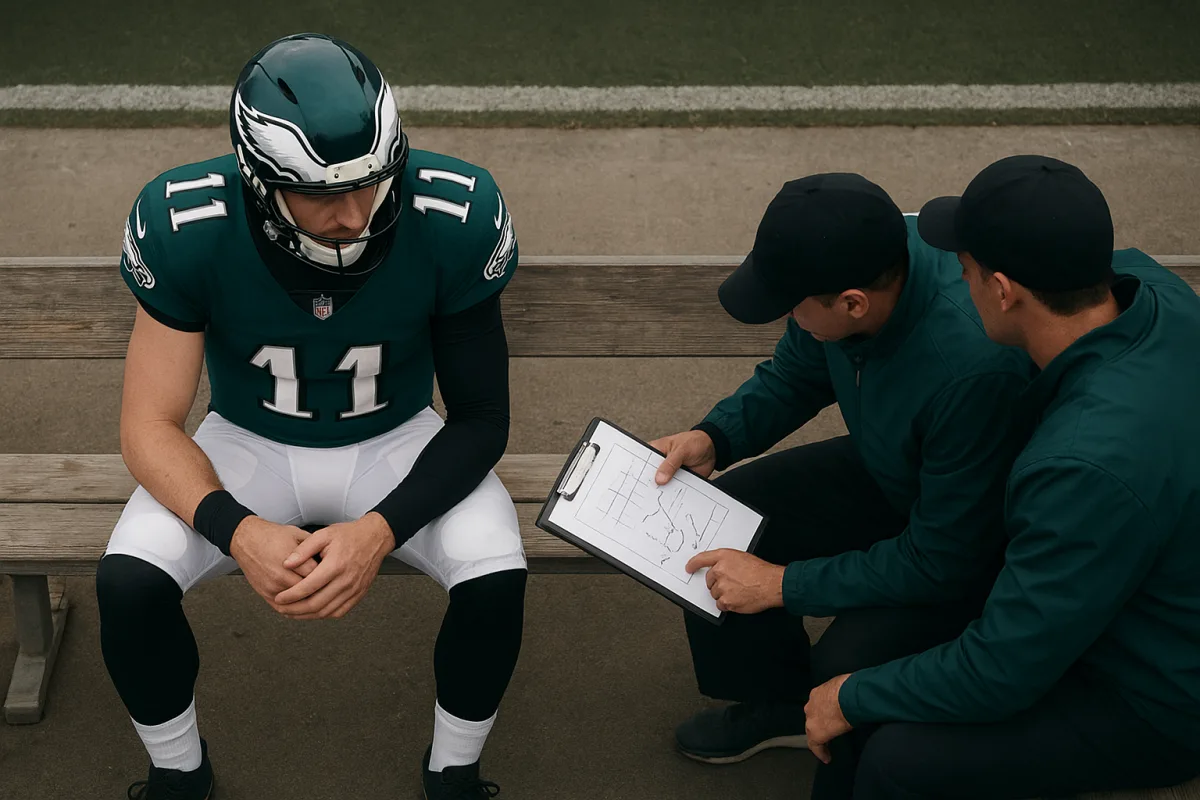
Jalen Hurts’ IR Clock Is Simple. His Medical Timeline Is Not.
The important distinction: injured reserve is a roster mechanism, not a medical prognosis
The cleanest way to understand Philadelphia’s quarterback situation is to separate two clocks that are being treated as one. One is the NFL’s injured-reserve clock. The other is Jalen Hurts’ medical clearance process. They overlap, but they do not answer the same question.
The injured-reserve rule is straightforward. Once the Eagles placed Hurts on IR on October 17, he became ineligible for at least four games. There is no blood-clot exception, accelerated designation or separate return rule for this condition. [2][4]
That four-game minimum covers matchups with Carolina, Dallas, Washington and the New York Giants, followed by Philadelphia’s bye. Pro Football Talk reported that a return after the bye is possible, but Hurts is currently considered out indefinitely, which is the language that matters more than the schedule. [3]
IR creates a floor, not a target date. The Eagles could activate Hurts when the four-game requirement ends if he is medically cleared, but the league does not require them to activate him then. His roster eligibility and his ability to play are separate decisions.
That distinction matters because the public framing of this injury can get too neat. “Out four games” is accurate as a transaction fact. It is not the same as saying he will be ready in four games, or that his condition should resolve in four games.
The independent research brief found no NFL-specific return-to-play protocol for superficial vein thrombosis as of October 2026. The league’s formal return-to-participation structure is primarily built around concussion management, not vascular conditions. Hurts’ return will therefore be managed individually, through imaging, symptoms and treatment.
That is why Philadelphia’s decision to use IR should not automatically be read as evidence of a worst-case diagnosis. It does show that the club and its medical staff did not view a one-week absence as an adequate planning window after the clot showed movement.
What “superficial” means, and why movement changes the equation
Hurts has been diagnosed with a superficial blood clot, also called superficial thrombophlebitis or superficial vein thrombosis. The word “superficial” refers to the location, a vein near the surface underneath the skin, rather than a declaration that the issue can be ignored. [3]
CBS Sports interviewed Dr. Henry Han, a cardiologist and vascular-medicine specialist at UT Southwestern, who explained that these clots commonly appear in a leg or arm. The affected area can become red, warm and tender because the vein itself becomes inflamed. [3]
The critical comparison is with deep vein thrombosis, or DVT. A DVT occurs in a deeper vein and carries a more serious risk because a clot can travel, including to the lungs, where it may cause a pulmonary embolism. Superficial clots are generally less dangerous, but they need monitoring. [3]
In Hurts’ case, the Eagles said he requested treatment for his calf four days after the Week 4 loss to the Los Angeles Rams. He believed he had been kicked or cleated during that game, though CBS Sports correctly noted that trauma cannot be identified publicly as the definitive cause. [3]
Trauma is medically plausible. Dr. Han told CBS Sports that irritation or damage to a vein can trigger superficial thrombophlebitis, as can circumstances that slow blood flow. Long flights, certain medications and other factors can matter as well. [3]
The detail that changed the football decision was not merely the original diagnosis. Hurts played in the London loss to Jacksonville after the team initially cleared him, but a follow-up ultrasound revealed movement in the clot. That prompted treatment and ultimately the IR placement. [3]
Movement is not a synonym for catastrophe, and outside observers should not diagnose it from a team statement. But it is exactly why a superficial clot cannot be reduced to a routine calf injury with a presumed week-to-week timetable.
The supplied medical research brief estimates that superficial vein thrombosis can progress to DVT in roughly 25% of cases. That is a general medical figure, not quarterback-specific data, and it should not be used to claim a 25% chance that Hurts’ condition will worsen.
That difference is important. A population-level risk figure identifies why clinicians monitor the condition. It does not forecast one player’s result, especially when the public does not know the clot’s location, size, symptoms, imaging details or treatment plan.
There is at least one published football-specific case report, involving thrombosis of the greater saphenous vein in a collegiate place kicker, but that is a case report rather than an NFL return-to-play model. It cannot supply a timeline for Hurts. [1]
The treatment question that affects football most: anticoagulants
The practical issue for an NFL quarterback is not just whether a clot is painful. It is whether the medical staff considers blood-thinning medication necessary. That decision can transform the risk profile of a player taking hits every Sunday.
Dr. Han told CBS Sports that uncomplicated superficial thrombophlebitis is often initially managed conservatively. That can include anti-inflammatory medication, activity, elevation and compression, followed by repeat imaging within roughly seven to 14 days. [3]
The follow-up scan is the key part of that process. Doctors are looking for whether the clot remains self-contained, extends, changes character or appears in deeper veins. A stable superficial finding can support a different plan than a clot that is progressing. [3]
If a clot lengthens, produces severe symptoms or raises concern about deeper-vein involvement, anticoagulants can become appropriate. Dr. Han said treatment for superficial thrombophlebitis can run about 45 days when blood thinners are needed, though individual cases vary substantially. [3]
The football cost is obvious. A quarterback on anticoagulants is not merely managing a sore leg. Contact creates an elevated bleeding risk, including internal bleeding, which makes clearance for NFL action a serious safety decision rather than a pain-tolerance question. [3]
That does not establish that Hurts is on blood thinners. The Eagles have not publicly disclosed his exact treatment, and reporting should not fill that gap with assumptions. It does explain why no responsible medical analysis can promise a post-bye return.
The public comparison point also needs care. Carolina right tackle Taylor Moton’s reported blood clots in his lungs are a substantially different and more serious situation than the superficial clot reported for Hurts. CBS Sports made that distinction clearly. [3]
Tanner McKee does not need to become Jalen Hurts
With Hurts unavailable, Tanner McKee becomes the starter, Joe Milton is the backup after joining Philadelphia on October 16, and rookie Cole Payton remains third on the depth chart. [4][5]
The Eagles’ adjustment should begin with what McKee can execute repeatedly, not with a cosmetic attempt to run Hurts’ entire menu. Quarterback changes alter the math of an offense even when the coordinator keeps the same terminology and formation families.
Hurts affects defenses before the snap because opponents must account for designed quarterback runs, zone-read decisions and his ability to convert broken plays into rushing production. Removing that element lets edge defenders play more aggressively against the running back.
That does not mean Philadelphia has to abandon the ground game. It means the Eagles must be more deliberate about how they create numbers advantages, using formations, motion, tight-end surfaces and run-pass options that do not ask McKee to be a primary ball carrier.
The quarterback replacement also changes third-down management. A team with Hurts can be more willing to call concepts where the quarterback can escape pressure or add a rushing answer. A team with McKee should prioritize protection integrity and defined throwing pictures.
McKee’s available preseason line, 34 completions on 54 attempts for 263 yards, two touchdowns and one interception, is limited evidence rather than a complete evaluation. It indicates he has taken meaningful preseason snaps, not that it predicts how he will handle a regular-season defensive plan. [5]
Milton’s regular-season body of work is not available in the supplied research. His presence matters because it stabilizes the depth chart, but there is not enough recent NFL game evidence to make him the basis for a serious contingency forecast.
Payton’s preseason sample is smaller still: five completions on 12 attempts for 47 yards and one touchdown, plus 45 rushing yards on three carries. Those numbers show mobility and limited exposure, not readiness for a large regular-season workload. [5]
Philadelphia also elevated its running-back depth after placing Hurts on IR. The Eagles signed Jaydon Blue from the practice squad while Saquon Barkley was ruled out and two other backs were already on IR, leaving Blue with Dameon Pierce and Carson Steele available against Carolina. [4]
That context makes the Panthers game more than a quarterback test. If the Eagles cannot establish a credible run game with a depleted backfield, McKee will face more obvious passing situations, where defenses can pressure without respecting the quarterback-run component.
The standings are still viable, but the error margin changed
The Eagles entered this stretch at 2-3, and the four-game IR window is not season-ending by itself. Philadelphia’s schedule provides divisional games that can shift the NFC East race quickly, which is why the backup plan has immediate significance. [3]
Simulation models still place the Eagles’ playoff chances between 47% and 57.2%, with division-winning probabilities ranging from 35% to 46.4%. Those figures describe a team that remains competitive, not one insulated from quarterback loss. [6][7][8]
Betting markets similarly listed Philadelphia’s Super Bowl odds in a range from +1600 to +3000, while playoff odds remained slightly negative. Markets are not medical authorities or football truth, but they capture the basic reality that the Eagles remain live without Hurts. [9]
The useful expectation is not that McKee must carry Philadelphia like an established starter. It is that the Eagles must keep games structurally manageable: avoid turnovers, stay ahead of the chains, protect a thinner backfield and let the defense avoid playing from constant short fields.
Hurts’ four-game IR requirement gives Philadelphia a clear roster calendar. His follow-up imaging, symptoms and treatment determine the more consequential calendar, the one that decides whether he can safely resume taking NFL contact.
Frequently Asked Questions
What is Jalen Hurts' current injury status?
Jalen Hurts has been diagnosed with a superficial blood clot, also known as superficial vein thrombosis, located near the surface of a vein in his calf. He is currently on injured reserve and considered out indefinitely, with his return dependent on medical clearance rather than a fixed timeline.
How long will Jalen Hurts be on injured reserve?
Hurts must miss at least four games due to the NFL's injured reserve rules, starting from October 17, 2026. However, this four-game minimum is a roster rule and not a prediction of his recovery; his actual return will depend on his medical progress.
What is a superficial blood clot and how does it affect NFL players?
A superficial blood clot forms in a vein near the skin's surface and causes inflammation, redness, warmth, and tenderness. While generally less dangerous than deep vein thrombosis, it requires careful monitoring because it can progress or extend, which changes treatment and risk, especially for contact-sport athletes like NFL players.
Who is the Eagles' backup quarterback during Hurts' absence?
Tanner McKee is the Eagles’ starting quarterback in Hurts’ absence, with Joe Milton recently added as a backup and Cole Payton third on the depth chart. McKee’s preseason stats include 34 completions on 54 attempts for 263 yards, 2 touchdowns, and 1 interception.
What are the medical risks associated with Jalen Hurts' injury?
The main risk is that the superficial clot could extend or progress to a deep vein thrombosis, which carries a higher risk of serious complications such as pulmonary embolism. This risk necessitates cautious, individualized medical management since no standardized NFL return-to-play protocol exists for this condition.
How we researched this
This article was assembled from 3 published articles, 11 cited references.
Nothing here is based on hands-on testing. Where a figure or finding appears, it belongs to the source cited beside it, and the writing says so rather than implying otherwise. Every source is listed below so you can check it.
Sources
Eagles sign RB Jaydon Blue to active roster with Jalen Hurts officially on IR — Pro Football Talk
Jalen Hurts blood clot: Expert weighs in on Eagles' situation, and when QB could return to the field — CBS Sports NFL
Jalen Hurts will go on injured reserve, miss at least four games and possibly more — Pro Football Talk
Thrombosis of the greater saphenous vein in a collegiate football place kicker.
Philadelphia Eagles | Official Site of the Philadelphia Eagles
Philadelphia Eagles Updated QB Depth Chart Following Addition of Joe Milton - Athlon
Philadelphia Eagles 2026 Playoff Scenarios & Odds · PlayoffRace
Philadelphia Eagles Depth Chart 2026-27 | Starters and Backup Players
Related Articles
Caleb Williams Injury Update and Bears QB Status for Week 3
Get the latest on Caleb Williams' hamstring injury and the Bears' QB status for Week 3, including possible replacements and recovery outlook.
NFL Week 2 Injury Updates
Get the latest NFL Week 2 injury updates including Sam Darnold’s status and how injuries impact teams and roster decisions.
NFL Week 3 Key Player Injury Analysis and Confirmed Status
Get an in-depth NFL Week 3 key player injury analysis with confirmed statuses and impact on team roles for Brian Burns, Breece Hall, and De'Von Achane.
Arizona Cardinals Week 2 Injury Updates and Preparations
Get the latest Arizona Cardinals Week 2 injury updates and player news as they prepare for their game against the Seahawks.