
NFL Week 2 Injury Updates
Get the latest NFL Week 2 injury updates including Sam Darnold’s status and how injuries impact teams and roster decisions.
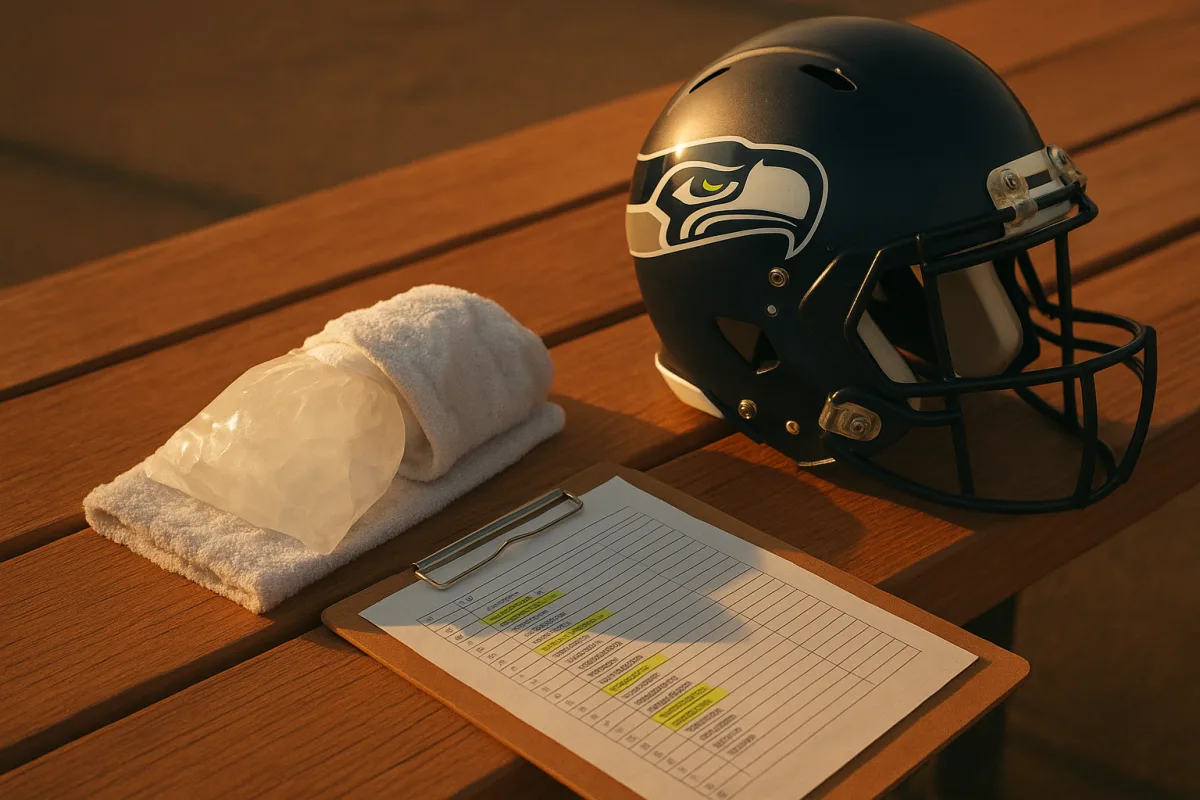
NFL Week 2 Injury Report: What Sam Darnold’s IR Decision Actually Tells Us
Seattle’s decision is more informative than a projected timetable
The most important Week 2 injury update is not a recovery estimate for Seattle Seahawks quarterback Sam Darnold. It is the Seahawks’ decision not to place him on injured reserve while ruling him out against the Arizona Cardinals. [2][3]
NFL Network reported that Seattle calls the problem a “very unique” soft-tissue injury in Darnold’s glute, with no firm timeline for his return. The team has also said the hip joint itself is unaffected. [3]
That distinction eliminates one easy assumption, but it does not establish a clean timetable. “Soft tissue” describes broad categories of muscle, tendon and connective-tissue problems, not a single diagnosis with a standard return-to-play calendar.
CBS Sports reported that Darnold left Seattle’s opener during the first drive, initially with the injury called a hip issue before it was more specifically described as a glute problem. Drew Lock replaced him and is set to start Week 2.
The temptation is to translate Seattle declining to use injured reserve into “Darnold will be back soon.” That is too confident. The decision gives the team flexibility, but it is not a medical update.
ABC News and NFL Network both reported no firm return date. Reports describing the absence as potentially short-term should be treated as context, not a commitment from the club or a guarantee that Darnold will make a particular start. [2][3]
How injured reserve works, and why it shapes injury reporting
For players moved to injured reserve after final roster cuts, the current NFL rule requires a minimum absence of four games before they can return. That is the basic cost Seattle avoided by keeping Darnold on its active roster. [4]
If Darnold were placed on IR before Week 2, he would be unavailable for Weeks 2 through 5 at minimum. He could not play against Arizona, Washington, the Los Angeles Chargers or San Francisco.
That four-game clock is why IR decisions cannot be read as a simple measure of pain tolerance or injury severity. A team may believe a player has a chance to recover in two or three games and decline IR.
There is a roster cost to that patience. An active-roster player who cannot practice or play still occupies one of the club’s regular roster spots, which can limit the team’s ability to carry injury replacements elsewhere.
IR creates the opposite tradeoff. It opens a roster place immediately, but the club loses the player for at least four games and must later manage the procedural path to activate him.
Teams can designate up to eight players to return from IR or the non-football injury list during a season, and an individual player may receive two designations. Those are meaningful limits, especially for contenders expecting injuries later in the year. [4]
There is also a separate wrinkle for players placed on IR before final roster cuts. Such placements have generally meant season-ending status, though a 2025 rule change allowed teams to bring back two of those players. [4]
Seattle’s choice, then, does not prove Darnold will miss fewer than four games. It shows the Seahawks are not yet willing to voluntarily lock themselves into a four-game minimum or consume roster-management options unnecessarily.
That is particularly relevant because Darnold’s injury is not being framed as a standard hip injury or a publicly defined muscle strain. When the team itself calls it unique, outside estimates should become less certain, not more. [3]
The Week 2 football consequence: Drew Lock changes the operating conditions
Lock’s first start since returning to Seattle in 2023 comes at Arizona, and the tape question is not whether he can reproduce every element of Darnold’s operation. It is what the Seahawks can make easier.
CBS Sports reported that Lock completed 16 of 22 passes for 187 yards and a touchdown after entering the Week 1 win over New England. His headline play was a 45-yard touchdown to Jaxon Smith-Njigba on fourth-and-1.
That is useful production, but relief appearances and planned starts ask different questions. A backup entering midgame benefits from a narrowed menu, while a full week of opponent preparation exposes protection checks, third-down answers and red-zone adjustments.
Seattle’s practical answer is likely to be structural rather than dramatic. The club can lean on condensed formations, play-action, defined reads and throws that let Lock operate on schedule instead of asking him to repeatedly create outside the design.
That makes Cooper Kupp’s back injury worth watching beyond a generic designation. RotoWire and FanDuel Research reported that Kupp was limited in Wednesday practice ahead of the Cardinals game. [5][6]
Kupp played 78 percent of Seattle’s offensive snaps in Week 1, according to the injury reporting summarized by RotoWire. That snap share does not prove he will play Sunday, but it does show he was not merely a situational receiver. [5]
If Kupp is active, his value to Lock includes route detail and formation flexibility. A veteran receiver who can align inside or outside helps a coordinator keep similar personnel on the field while presenting different pictures before the snap.
If Kupp cannot play or is restricted, Seattle may need a more concentrated target plan around Smith-Njigba and its remaining active receivers. That is not automatically a drop in passing-game quality, but it narrows the margin for error.
The Week 1 touchdown to Smith-Njigba illustrates why Seattle can still threaten a defense vertically with Lock. It does not establish that the offense can maintain the same volume of explosive plays over a full game.
Seattle also listed guard Anthony Bradford, tackle Josh Jones and safety Nick Emmanwori as limited in practice, according to CBS Sports. Those statuses matter because a reserve quarterback is more vulnerable when protection continuity weakens.
Detroit’s injuries show why two offensive-line absences are not simply two replacements
The Detroit Lions have ruled out starting right tackle Blake Miller with a knee injury and starting left guard Christian Mahogany with a hip injury for the Buffalo Bills matchup. CBS Sports listed both starters as out. [9]
Detroit expects veteran Larry Borom to start at right tackle and Ben Bartch at left guard, according to reporting from Pride of Detroit. The early expectation is that Miller and Mahogany could return in Week 3. [7]
The immediate analysis often becomes a talent-ranking exercise. Which backup is better? That misses the main operational problem when injuries remove starters at two different positions on the same line.
Offensive-line play is a five-man communication system. Every snap requires decisions about the front, linebacker location, potential pressure, slide direction and which defender becomes the responsibility of a tight end or running back.
At left guard, Bartch’s work affects the interior structure around center and left tackle. He must be synchronized on combination blocks in the run game and recognize when a defensive tackle or linebacker changes the protection picture.
At right tackle, Borom takes on a different set of issues. Tackles work in more space against edge rushers, but the right tackle also has to coordinate with the right guard, tight ends and backs when the offense uses chips or extra protection.
The cost is not only that Detroit loses Miller and Mahogany’s individual snaps. The Lions lose two established sets of pre-snap calls, shared block timing and adjustments to late movement from a Buffalo front.
That is why Jared Goff’s protection cannot be judged only by sacks. A quarterback can be kept clean but still face a more conservative game plan if the offense retains more blockers or avoids longer-developing concepts.
Likewise, a rushing average can conceal the problem. Detroit might produce a strong run on one well-blocked call, yet still have fewer viable run concepts if the backup combination struggles with movement, double teams or second-level blocks.
CBS Sports also listed Lions defensive back D.J. Reed as questionable with a foot injury. That matters, but the offensive-line losses are more likely to reshape Detroit’s baseline offensive structure from the first snap. [9]
Other Week 2 absences need restraint, not guesses
Several high-profile players entered Week 2 on injured reserve, including New England Patriots receiver A.J. Brown with a right ankle sprain, Philadelphia Eagles guard Landon Dickerson with a knee injury and Los Angeles Rams edge rusher Myles Garrett after knee surgery. [8]
Those placements establish one clear point: none can return before serving the four-game minimum applicable to in-season IR. Beyond that, the available reporting does not provide detailed Week 2 recovery updates or reliable strategic forecasts. [4][8]
That lack of detail matters. It is reasonable to say Brown’s absence removes a receiver from New England’s active lineup, or that Dickerson’s absence forces Philadelphia to replace a starting guard. It is not responsible to invent precise production losses.
In Pittsburgh, cornerback Joey Porter Jr. was listed as limited with a non-injury-related conditioning designation after missing Week 1, according to CBS Sports. Yahoo Sports’ trade report is only a brief excerpt and does not establish a completed move or a Week 2 resolution.
Arizona also presents a difficult opponent for Lock’s first start. CBS Sports noted that the Cardinals opened their season with a 26-14 upset of the Los Angeles Chargers, but one result does not fully define their defensive quality.
For Week 2, the cleanest read is still Seattle’s roster choice. Darnold’s non-IR status keeps open a short return path, while the “unique” nature of the injury prevents anyone outside the building from credibly assigning an exact date. [2][3]
Frequently Asked Questions
What is the latest NFL Week 2 injury update for Sam Darnold?
Sam Darnold is out for Seattle’s Week 2 game at Arizona due to a "very unique" soft-tissue injury in his glute. The Seahawks have not placed him on injured reserve, so there is no firm timeline for his return. The injury does not affect his hip joint, but the team has not provided a specific recovery estimate.
How does the injured reserve rule affect NFL Week 2 player availability?
Players placed on injured reserve after final roster cuts must miss a minimum of four games before returning. This means a player put on IR before Week 2 would be unavailable for at least Weeks 2 through 5. Teams can designate up to eight players to return from IR during a season, with each player allowed two return designations.
Which key NFL players are injured ahead of Week 2 games?
Besides Sam Darnold, Cooper Kupp is limited in practice due to a back injury and his Week 2 status is uncertain. The Detroit Lions will be without offensive linemen Blake Miller and Christian Mahogany, who are both out for Week 2 with knee and hip injuries respectively, replaced by Larry Borom and Ben Bartch.
How will Sam Darnold’s injury impact the Seahawks in Week 2?
With Darnold sidelined, Drew Lock will start at quarterback for Seattle in Week 2. Cooper Kupp’s limited practice status adds uncertainty to the receiving corps, potentially requiring the Seahawks to rely more on other receivers like Jaxon Smith-Njigba. The injury disrupts Seattle’s veteran offensive structure and could affect offensive performance.
What are the roster implications of placing a player on injured reserve in the NFL?
Placing a player on injured reserve opens a roster spot immediately but requires the player to miss at least four games. The team must manage the procedural steps to activate the player later and is limited to eight return designations per season, with each player allowed two. Keeping a player off IR preserves roster flexibility but occupies an active roster spot even if the player cannot practice or play.
How we researched this
This article was assembled from 5 published articles, 10 cited references.
Nothing here is based on hands-on testing. Where a figure or finding appears, it belongs to the source cited beside it, and the writing says so rather than implying otherwise. Every source is listed below so you can check it.
Sources
NFL Week 2 injury report: Lions down two starting offensive lineman vs. Bills, including Blake Miller — CBS Sports NFL
Seahawks rule out Sam Darnold for Week 2, but potential timetable for return emerges — CBS Sports NFL
Sam Darnold Injury Update: Latest Seahawks Decision Offers New Clue About When Quarterback Could Return — NDTV Sports
Steelers and Cowboys Could Make Joey Porter Jr. Trade, but There Could be Issue — Yahoo Sports
Limited practice for Cooper Kupp — USA TODAY Sports
Seahawks' Sam Darnold has a soft tissue injury and the timeline for his return is unclear - ABC News
Cooper Kupp Limited in Practice Ahead of Week 2 Against Cardinals | FanDuel Research
Christian Mahogany injury update: Detroit Lions get good initial news | Pride Of Detroit
NFL Week 2 Injury Report 2026: A.J. Brown, Darnold, Murray | Football Nation
Related Articles
NFL Week 3 Key Player Injury Analysis and Confirmed Status
Get an in-depth NFL Week 3 key player injury analysis with confirmed statuses and impact on team roles for Brian Burns, Breece Hall, and De'Von Achane.
Arizona Cardinals Week 2 Injury Updates and Preparations
Get the latest Arizona Cardinals Week 2 injury updates and player news as they prepare for their game against the Seahawks.
NFL Week 2 Injury Status Meanings
Understand NFL Week 2 injury status meanings and what 'questionable' really means for players like Puka Nacua and RJ Harvey.
Rams Injury Updates and Monday Night Football Preview
Get the latest Rams injury updates and a detailed Monday Night Football preview ahead of their game against the Giants.