Arizona Cardinals Week 2 Injury Updates and Preparations
Get the latest Arizona Cardinals Week 2 injury updates and player news as they prepare for their game against the Seahawks.
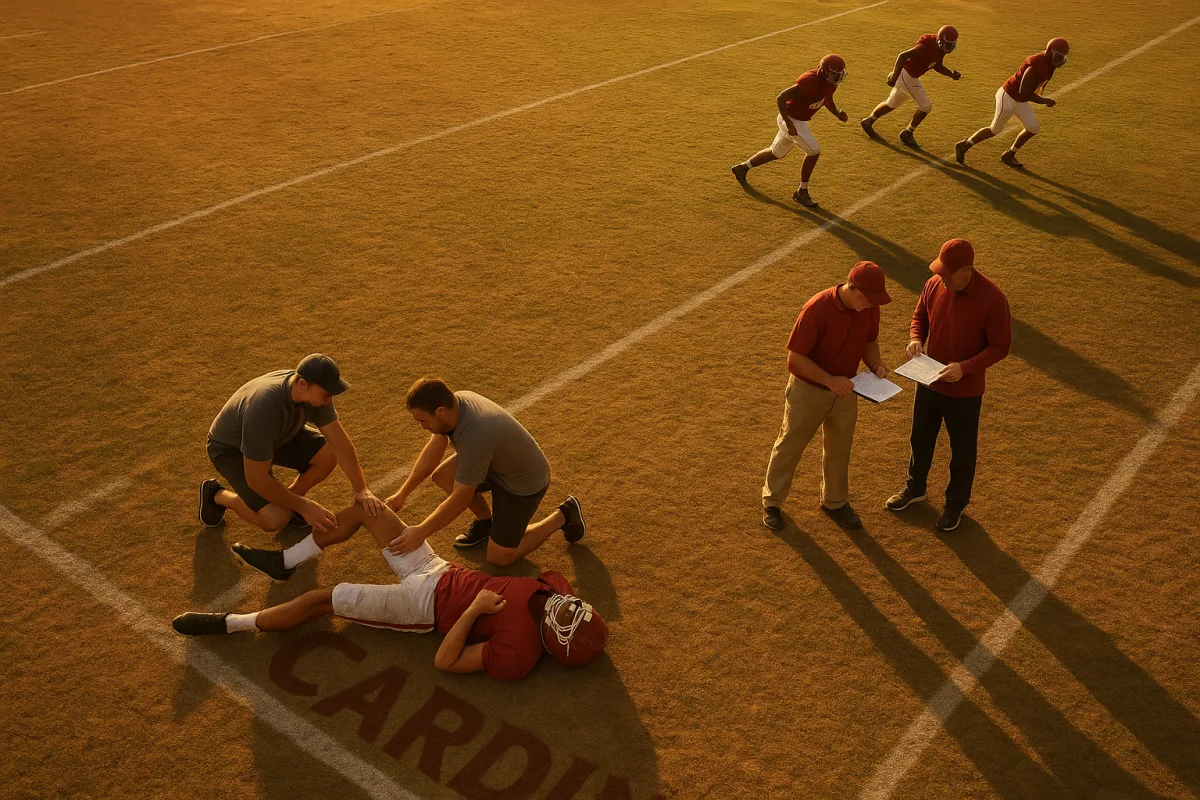
Start with the calendar and the available information
Arizona’s home opener against the Seattle Seahawks is scheduled for Sunday, September 20, at 1:25 p.m. Pacific time at State Farm Stadium in Glendale. Seattle’s official Game Center confirms the Week 2 date, site and kickoff window. [4]
The practical point is that Wednesday media availability is not a lineup announcement. It establishes the questions that will shape practice, but the injury report, Friday participation designations and Sunday inactive list will settle more of them.
That distinction matters most on the offensive line. Head coach Mike LaFleur did not publicly name a Week 2 starting right guard during the Arizona Cardinals’ September 16 press conference. He said Isaiah Adams would practice and be evaluated daily.
LaFleur also made clear that incumbent John Gaines had done positive work. That is not the same thing as declaring Gaines the starter, and it is not a confirmation that Adams has lost the job.
The independent reporting is more specific about the present uncertainty. Adams is questionable with a groin injury, while second-round rookie Chase Bisontis is also in the competition. No official report has established a definitive Week 2 starter. [2][9]
For readers following this as a game-planning issue, do not focus only on the name announced Sunday. Watch whether Arizona can maintain its combination blocks, particularly on inside runs and backside cutoffs, with whichever guard is paired with center Hjalte Froholdt.
The right guard question is about more than one injured player
LaFleur’s comments framed the right guard situation as both a health decision and a performance decision. He praised Adams’ camp progression and his early work against Las Vegas, but he stopped short of treating availability as automatic reinstatement.
That is the proper lens for the Seahawks matchup. Seattle’s front is difficult because it makes offenses play sound football across all five eligible blockers, rather than simply dedicating protection resources to one edge rusher.
Brissett described Seattle as physical, versatile and disciplined in the Arizona Cardinals’ September 16 availability. He specifically noted that Mike Macdonald’s defense presents different personnel groupings and looks while remaining disciplined within its rules.
That means a guard change can show up before a sack does. A late climb to the second level, a missed handoff on a double team or a failed pickup against a simulated pressure can leave Arizona behind schedule.
Arizona’s likely starters elsewhere offer some stability. Paris Johnson Jr. is expected at left tackle, Isaac Seumalo is expected at guard, and Froholdt is expected at center, according to published depth-chart reporting. [7][8]
Still, it would be wrong to call the line settled. The Seahawks will test communication, especially if Arizona uses tight ends and backs in protection, shifts formations late or changes the surface of the formation before the snap.
Arizona’s Week 1 production needs a more careful reading
The Cardinals’ Week 1 offense produced enough to win, but Brissett rejected the idea that it had peaked. His first corrections were operational: getting in and out of the huddle, getting calls cleanly and executing the details of the plan.
LaFleur’s assessment matched that. He said Arizona was slow and sluggish at points in its operation, then added that the offense left “a lot” on the field after the snap.
The red-zone number requires context. LaFleur pointed to Arizona’s late first-half sequence, when the Cardinals reached the scoring area without timeouts and Jacoby Brissett escaped edge pressure to preserve the opportunity.
That possession may register as a failed red-zone chance, but it should not be evaluated like a normal first-and-goal series with a full menu of calls. The more useful question is whether Arizona creates cleaner early-down situations near the goal line.
The run game is the other correction. LaFleur said Arizona could improve its combination blocks and that coaching clarity had to help make the intended run-game pictures come to life.
That is a more informative answer than simply saying Arizona needs more rushing yards. Total rushing yardage can be distorted by quarterback scrambles, late-game clock management and a few explosive plays that hide inefficient normal-down runs.
Brissett’s explanation of the Week 1 three-tight-end usage is worth carrying into Sunday. Arizona used heavy personnel to be multiple and to give its bigger players opportunities to impose themselves at specific points in the game.
Seattle will force the Cardinals to prove those sets can function as more than a run declaration. If Arizona brings three tight ends onto the field, the key is whether it can create credible play-action, bootleg and intermediate route answers from those formations.
Trey McBride remains the matchup Arizona must protect
Tight end Trey McBride is not merely a volume receiver in this offense. He led the NFL in 2025 with 126 receptions, 1,239 receiving yards and 11 touchdowns, then opened 2026 with nine catches, 95 yards and a touchdown. [10]
The Week 1 tape, as described by McBride in his Cardinals media availability, showed how Arizona can create access for him. The offense opened with a 27-yard completion after a coverage look matched the call, giving Brissett an immediate intermediate-window throw.
Seattle’s task will be to avoid allowing McBride easy catches while also keeping numbers available against Arizona’s run game. That is why Arizona’s heavy packages matter, even if McBride himself is the principal receiving threat.
For Arizona, the actionable standard is not simply feeding McBride targets. It is forcing Seattle to declare how it will cover him. If the Seahawks use a safety or nickel defender to bracket him, the Cardinals need efficient answers elsewhere.
Brissett praised wide receiver Kendrick Bourne’s understanding of offensive spacing and route locations. That familiarity can matter against a defense that changes fronts and coverage presentations, because receivers must adjust without breaking the quarterback’s timing.
McBride offered the most sensible sample-size warning in his own availability. One good game does not establish the viability of an offense. Arizona needs several weeks of clean operation against different defensive structures before broader conclusions are justified.
Drew Lock changes the quarterback, not necessarily the Seahawks’ identity
Seattle will start Drew Lock with Sam Darnold unavailable, but LaFleur did not describe the Seahawks as an offense Arizona can dismiss. He cited Lock’s 28 career starts and 41 career appearances, along with a Week 1 line of 16 completions on 22 attempts for 187 yards and a touchdown.
Those figures should not be treated as a complete scouting report. They do establish that Lock is not a first-time emergency quarterback who needs the game called as though every dropback is a survival drill.
Safety Jalen Thompson said much the same in Arizona’s Sideline Exchange feature. He called Lock an NFL quarterback with the arm strength, vision and progression ability to run the Seahawks offense rather than forcing a wholesale change.
Arizona’s defense needs to connect its rush and coverage. Thompson explained the relationship accurately: a coverage unit cannot assume the rush will always arrive, and rushers cannot assume defensive backs will cover forever.
That is especially important after a turnover-driven Week 1 defensive performance. Takeaways are valuable, but they are not reliably repeatable week to week. Pressure rate, third-down outcomes and the number of clean throwing windows are steadier indicators.
If Arizona gets ahead, Thompson’s comments suggest the secondary can become more aggressive because the opponent must throw more often. But that only works if the front keeps its rush lanes disciplined and does not give Lock escape routes.
The defensive-line health issue could shape every coverage call
Roy Lopez is questionable with a groin injury, and Zachary Carter is on injured reserve with a knee injury expected to keep him out until at least Week 5. [1][2][3] That makes the interior rotation one of Arizona’s central Week 2 concerns.
Published depth charts list Lopez, Walter Nolen, Josh Sweat and Dante Stills among Arizona’s primary front players. [7][8] The concern is not that Arizona lacks starters on paper. It is the reduced cushion if a starter is limited or unavailable.
When an interior rotation gets thin, the effect is often cumulative. The defense may have fewer fresh pass-rush snaps late in drives, less flexibility to match bigger personnel and less appetite for pressure calls that expose the middle of the field.
That does not mean Arizona must abandon aggression. It means coordinator Vance Joseph has to balance the value of attacking Lock with the need to keep coverage connected behind those calls. Specific Week 2 pressure plans have not been publicly disclosed.
Conditioning is a real issue, but do not invent a crisis from it
Arizona adjusted its 2026 camp schedule around Phoenix heat, holding five of seven open practices at 4 p.m. The club also emphasized hydration and fan safety measures at State Farm Stadium. [6]
There is no public evidence of a special player-conditioning protocol beyond those schedule adaptations. That is important because broad claims about a dramatically altered conditioning program would go beyond the available reporting.
McBride gave a more useful football answer. He said practice conditioning cannot fully replicate football shape, particularly when an offense stacks long drives and players must execute late in possessions while fatigued.
Arizona held the ball for 37 minutes in Week 1, a number McBride acknowledged can create its own physical demands. Possession time is beneficial when it rests the defense, but long drives still test offensive execution and substitution discipline.
The Seahawks game will provide a cleaner test than the Week 1 result alone. Arizona needs to show that its tempo, protection communication, heavy personnel packages and late-drive execution remain intact against one of the league’s more disciplined defenses.
Frequently Asked Questions
What is the injury status of Arizona Cardinals players for Week 2?
Isaiah Adams, the right guard, is questionable with a groin injury. Roy Lopez, a left defensive tackle, is also questionable with a groin injury. Safety Kitan Crawford was placed on injured reserve with an ankle injury as of September 18 and is expected to return after Week 5. Defensive tackle Zachary Carter remains on injured reserve with a knee injury.
Who might start at right guard for the Cardinals in Week 2?
The starting right guard for Week 2 is uncertain. Isaiah Adams currently holds the spot but is questionable due to a groin injury. Rookie Chase Bisontis is competing for the position, and no official announcement has confirmed the starter.
How do injuries affect the Cardinals' Week 2 game plan?
Injuries at key positions like right guard and defensive tackle limit depth and may force adjustments in blocking schemes and defensive rotations. The uncertainty at right guard could impact the offense’s combination blocks and run-game execution. Defensively, the absence or limited availability of players like Roy Lopez and Zachary Carter reduces the margin for error against Seattle’s offense.
What player updates are available for the Cardinals before Week 2?
Isaiah Adams is questionable with a groin injury and competing for the right guard position. Roy Lopez is questionable with a groin injury on defense. Safety Kitan Crawford is on injured reserve with an ankle injury and expected to return after Week 5. Zachary Carter remains on injured reserve with a knee injury.
How is Trey McBride expected to impact the Cardinals' Week 2 game?
Trey McBride, who led the NFL in receptions, yards, and touchdowns in 2025, is a significant offensive threat for Seattle. The Cardinals’ defensive coordinator is likely to use a combination of pass rush and coverage schemes to contain McBride while pressuring quarterback Drew Lock. Specific defensive strategies have not been publicly disclosed.
How we researched this
This article was assembled from 5 video sources across 2 channels, 10 cited references.
Nothing here is based on hands-on testing. Where a figure or finding appears, it belongs to the source cited beside it, and the writing says so rather than implying otherwise. Every source is listed below so you can check it.
Sources
Lions at Bills Week 2 | Detroit Lions Live CURE Auto Insurance Postgame Show — Detroit Lions
HC Mike LaFleur Press Conference 9.16.26 | AZ Cardinals — Arizona Cardinals
New Teams, INTS and Hair Care | Sideline Exchange — Arizona Cardinals
QB Jacoby Brissett Press Conference 9.16.26 | AZ Cardinals — Arizona Cardinals
Trey McBride Press Conference 9.16.26 | AZ Cardinals — Arizona Cardinals
2026 Arizona Cardinals Injuries | Pro-Football-Reference.com
Official Latest NFL Injury Report for Players - Week 2 of the 2026 Season | NFL.com
Seahawks at Cardinals Game Center | Seattle Seahawks – Seahawks.com
Cardinals vs. Seahawks Week 2 Preview: NFC West Test in Ariz
Arizona Cardinals announce open practice dates for 2026 training camp at State Farm Stadium
Arizona Cardinals Depth Chart (2026) - Every Position, Starters & Backups
Arizona Cardinals Injury Report and Status 2026-27 - CBS Sports
Cardinals Have One Major Threat to Seahawks' Defense in Week 2
Watch Arizona Cardinals Week 2 Preparations and Player Updates on Youtube
Also from the sources
Related Articles
San Francisco 49ers Week 4 Preview and Player Updates
Get the San Francisco 49ers Week 4 preview with injury updates and analysis on handling Denver's pressure defense.
NFL Week 3 Key Player Injury Analysis and Confirmed Status
Get an in-depth NFL Week 3 key player injury analysis with confirmed statuses and impact on team roles for Brian Burns, Breece Hall, and De'Von Achane.
NFL Week 3 Team Preparations and Media Availability Updates
Get the latest NFL Week 3 team preparations, player statuses, and media availability insights to understand upcoming game strategies and key updates.
NFL Week 2 Injury Updates
Get the latest NFL Week 2 injury updates including Sam Darnold’s status and how injuries impact teams and roster decisions.