NFL Rookie Impact Analysis: Early Roles and Contributions
Explore NFL rookie impact analysis covering early roles, key plays, and how rookies contribute in their first games of the 2026 season.
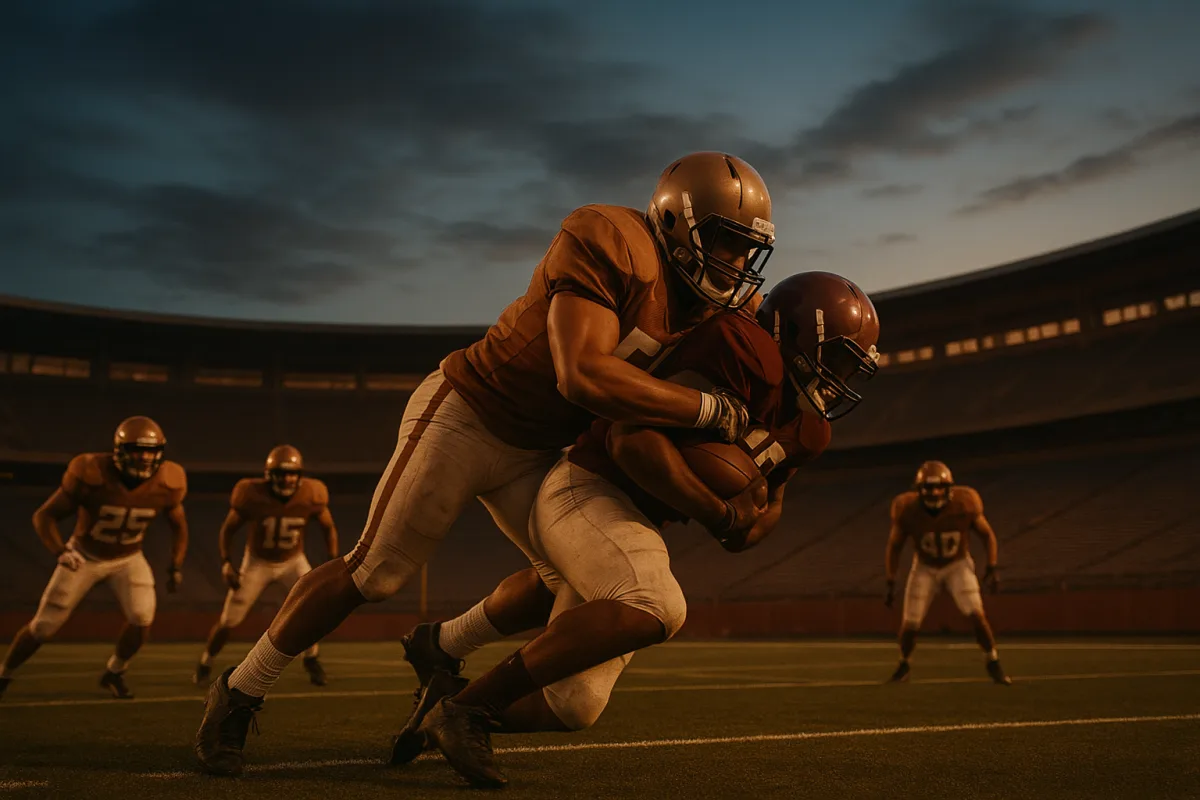
Early returns suggest the 2026 rookie class is making its first impact through role clarity, not volume. The players getting on the field immediately are doing one or two specific jobs cleanly, whether that is closing the post, carrying the green dot, or covering kicks.
The shift is toward defined early roles
The early 2026 trend is not that rookies have suddenly become instant stars. It is that teams are giving young players narrow, meaningful assignments earlier, then expanding the menu only when the player shows he can handle the first one.
That distinction matters. A rookie can start in Week 1, return kicks, wear the green dot, or play in a three-receiver package without being asked to carry an entire unit. Coordinators are finding ways to use them without building the call sheet around them.
Las Vegas rookie safety Treydan Stukes is the clearest example. The Raiders started him in their opener against Miami, and he finished the 27-13 victory with six tackles and an interception. [3][4]
The interception was the play that traveled, and it should. Stukes told the Raiders’ Paul Gutierrez that his first thought as the ball hung in the air was simply not to drop it. That is a useful detail because it fits the play.
A deep safety does not get credit merely for catching a poor throw. He has to stay patient under the ball, avoid mistiming the jump and finish through traffic. Stukes did that, which is a positive first NFL data point.
But the interception alone does not prove he dominated the game. Pro Football Focus graded Stukes at 59.9 overall, 58.1 in coverage and 64.4 against the run, placing him roughly in the middle of the qualifying safety group in Week 1. [6]
That is not a knock on the debut. It is the useful correction to the headline. Stukes allowed two catches in coverage and a 70.1 passer rating, so the film-and-snap question now is whether Las Vegas keeps him in the same assignments. [6]
Stukes’ path also explains the early readiness
The Raiders’ own interview material provides context for why Stukes may have been more prepared for a Week 1 workload than a conventional rookie. He entered the league as an older player after six college seasons, including COVID and injury eligibility.
Stukes also described a route that began with track offers and a plan to walk on in football after high school. The Raiders’ team channel noted his background in hurdles, long jump and triple jump, then his eventual walk-on opportunity at Arizona.
That background does not automatically translate to NFL safety play. The relevant connection is coordination. Stukes specifically pointed to one-foot explosion and body control from triple jump training, traits that show up when a defender has to locate the ball and finish at its high point.
Still, teams do not start safeties because of a track résumé. They start them because the player can communicate, fit the run correctly and avoid coverage busts. The next few weeks will tell more than the opening interception.
For someone trying to identify the next early rookie contributor, that is the template. Find the player with a stable role first. Then ask whether his splash plays came from repeatable process, positioning and technique rather than a single broken play.
Tampa’s rookie linebacker case is stronger, but still incomplete
Tampa Bay’s Josiah Trotter offered a different kind of Week 1 impact. On the Buccaneers’ team program, Casey Phillips and Scott Smith highlighted an 11-tackle game that also included a sack and an interception returned for a touchdown.
The stat line placed Trotter in rare company. The Buccaneers said he became the first player in franchise history to record a pick-six in his NFL debut, while only Trotter and T.J. Watt have posted a sack, interception and at least five tackles in a debut over the last decade.
That is real production, and it is more informative than a single tackle total because it includes work in more than one phase. The sack came on a blitz, which tells us the coaching staff trusted him with a pressure responsibility, not just base-down cleanup work.
The interception matters for a separate reason. Phillips noted that the pre-draft concern around Trotter was limited coverage exposure, not necessarily a belief that he could not cover. Those are different evaluations, and too often they get treated as the same thing.
A linebacker who was not frequently asked to match route concepts may need projection. That does not mean he lacks the movement skill to do it. Trotter’s first interception is encouraging evidence, but it remains only one coverage snap sequence.
The Buccaneers themselves supplied the right caveat. Their discussion repeatedly returned to the fact that Week 1 is one game. That is the correct frame, particularly for a linebacker whose future value will depend on third-down viability.
Trotter’s next test is not whether he can reproduce an 11-tackle box score. It is whether Tampa can leave him on the field against spread personnel, use him in pressure packages and trust his eyes when offenses attack the intermediate middle.
Production is increasingly tied to coordinator deployment
The Buccaneers’ offensive usage showed the same broader idea, even without centering on a rookie. Tampa ran 43 of 52 offensive plays from 11 personnel in its opening loss to Cincinnati, according to the team’s broadcast.
That is not a revolutionary formation choice. It is a reminder that coaches will simplify a game plan around the players available. With Jalen McMillan absent, Tampa still leaned heavily on three receivers, and Ted Hurst produced a solid debut within that structure.
The number does not prove 11 personnel will define Tampa’s season. Game state affected the plan, particularly after the Buccaneers lost four fumbles. But it shows a coordinator using a familiar structure rather than forcing a broad personnel experiment in September.
That matters for rookie analysis. A young receiver’s early production can reflect a stable package more than a permanent place in the offense. If a player gets 30 snaps in 11 personnel, those snaps may be highly valuable without making him the second option.
The same caution applies to pass-rush statistics. Tampa’s broadcast pointed to interior defender Calijah Kancey generating pressure on 18.5 percent of his pass-rush snaps, despite the Buccaneers producing only one sack as a defense.
Pressure rate and sack totals are measuring related but different things. A quick interior win can disrupt a quarterback even when a teammate does not finish the play. Conversely, a blitzing linebacker can record a sack without proving the four-man rush has improved.
Opportunity is also being created below the 53-man roster
Cleveland’s addition of Jimmy Horn Jr. is less glamorous than a rookie starter, but it may be more representative of how teams are managing young depth. Horn joined the Browns’ practice squad after Carolina waived him following Week 1. [10]
CBS Sports reported that Horn had opened the year as Carolina’s primary kick returner and handled five kickoff touches plus two punt returns in the opener. He also muffed a punt, which is part of the evaluation, not an incidental footnote. [10]
The Browns are not signing Horn because of nostalgia for his Colorado connection with quarterback Shedeur Sanders. They may benefit from that familiarity eventually, but the immediate roster case is more practical: speed, return ability and developmental receiving depth.
NBC Sports reported Horn landed on Cleveland’s practice squad September 17 after the Carolina release. [10] The route to a game-day role likely depends on return needs, practice performance and whether Cleveland needs depth because of injuries.
NFL rules allow clubs to elevate up to two practice-squad players for a game, with each player eligible for three standard elevations during the regular season. [11] That gives teams a way to test a specialist without immediately making a permanent 53-man commitment.
Horn’s situation is a useful warning against overreading college chemistry. A connection with Sanders could help if both are active, but Horn first has to win a role on special teams or as a situational receiver. Those are separate hurdles.
The evidence is promising, not broad enough for a league-wide verdict
There is enough evidence to say teams are trusting rookies in clearly defined roles early. Stukes started at safety, Trotter handled impact linebacker responsibilities, and Horn has a viable path through return work and practice-squad elevation.
There is not enough evidence to claim a universal youth movement or declare this rookie class unusually dominant. Two games with splash plays do not establish a multi-month trend, and practice-squad movement is often about weekly roster math.
The Arizona Cardinals’ team channel made that point indirectly while reviewing its defense after the Week 1 win over the Chargers. The Cardinals emphasized improved communication, physicality and in-game adjustment, not one player’s stat line.
Veteran linebacker Mack Wilson Sr. was central to that discussion because he wore the green dot and organized the defense. Arizona’s staff and players credited his ability to get the front, secondary and linebackers aligned before the snap.
That is the environment in which young players can contribute. A rookie defender does not need to become the communicator immediately if a veteran handles the checks, gets the call in and reduces the number of variables after the huddle breaks.
The Steelers’ German-language team podcast offered a similar, if less on-field, insight. An unnamed rookie described veterans helping rookies with daily preparation, position questions and the basic logistics of NFL life rather than leaving them to learn alone.
That is not evidence of a breakout player. It is evidence of the support structure that makes early contributions possible. Rookie performance is not simply about talent, particularly in systems demanding fast communication and precise situational work.
Availability and information discipline still matter
The strongest early-season analysis also separates confirmed information from narrative. NFL teams can be guarded about injuries, but reporters and analysts should not fill gaps with certainty simply because a player’s status affects a game.
The NFL’s concussion protocol requires removal and evaluation when concussion signs are suspected, followed by additional assessment and an individualized five-phase return-to-participation process. There is no fixed public timetable for every player. [7]
That is relevant to Tampa safety Miles Killebrew, who was listed as limited with a concussion in the Buccaneers’ team broadcast. No public information in the supplied reporting establishes his recovery timetable, so any prediction would be speculation.
The same principle applies to league drug testing. Arizona’s broadcast joked about Mack Wilson Sr. receiving a postgame test after a strong performance, but public information does not show that standout performances trigger targeted testing.
The league’s testing details are confidential, and reporting describes extensive year-round testing rather than a public player-by-player trigger system. One estimate cited approximately 2,400 regular-season tests, 600 offseason tests and 300 playoff tests. [9]
For roster planners and analysts, the actionable lesson is straightforward. Follow deployment before reputation. Watch who is trusted on third down, in coverage checks, on pressure calls and on special teams, because those snaps usually arrive before the bigger box-score breakout.
Frequently Asked Questions
How are NFL rookies contributing in their first games?
NFL rookies are making their initial impact by performing specific, well-defined roles rather than handling large workloads. For example, Las Vegas rookie safety Treydan Stukes started in Week 1 and recorded six tackles and an interception, showing promise without dominating the game. Similarly, Tampa Bay’s Josiah Trotter made a splash with tackles, a sack, and a pick-six, indicating trust in his abilities across multiple phases.
What roles do NFL rookies typically play early in the season?
Rookies often begin with narrow, meaningful assignments such as covering kicks, carrying the green dot (communication responsibilities), or playing in limited defensive or offensive packages. Teams avoid asking rookies to manage entire units initially, instead expanding their roles as they demonstrate reliability in these focused tasks.
How should early rookie interceptions be evaluated in the NFL?
An early interception by a rookie should be seen as evidence that the player has earned a playable role rather than proof that they have mastered NFL coverage. For instance, Treydan Stukes’ Week 1 interception was a positive sign but his overall coverage grade was average, indicating the interception was part of a broader learning process rather than a definitive statement of dominance.
What factors determine a rookie's early playing time in the NFL?
A rookie’s early playing time depends on their ability to handle specific assignments with clarity and consistency. Coaches look for stable alignment, snap role, and assignment difficulty before using statistics like tackles or interceptions to confirm performance. Background factors such as prior experience, communication skills, and technique also influence readiness, as seen with Stukes’ extended college career and coordination skills.
How do NFL teams use rookies on special teams?
NFL teams increasingly value rookies who can contribute on special teams, using them for roles like kick coverage and returns. This utility can accelerate a rookie’s relevance and roster status, as demonstrated by practice-squad receiver Jimmy Horn Jr., who gained attention through his special teams assignments and kick return ability.
How we researched this
This article was assembled from 5 video sources across 5 channels, 1 published article, 12 cited references.
Nothing here is based on hands-on testing. Where a figure or finding appears, it belongs to the source cited beside it, and the writing says so rather than implying otherwise. Every source is listed below so you can check it.
Sources
Is Sam Leavitt Really Injured Or Is Lane Kiffin Playing Mental Games? — The Pat McAfee Show
Treydan Stukes’ Improbable Path Pays off in Raiders Debut — Raiders
Josiah Trotter: “A Force To Be Reckoned With” | Bucs Insider | Tampa Bay Buccaneers — Tampa Bay Buccaneers
Cardinals Underground: Bourne Ready, Defense Rests, And Trey McPlays | Arizona Cardinals 2026 — Arizona Cardinals
Dieser NFL-Rookie hatte das verrückteste Draft-Erlebnis | 🇩🇪 Steelers-Podcast mit Icke Dommisch — Pittsburgh Steelers
Browns expected to sign Shedeur Sanders' college WR teammate Jimmy Horn Jr. — CBS Sports NFL
Treydan Stukes Stats, Height, Weight, Position, Draft, College | Pro-Football-Reference.com
How Often Are NFL Players Drug Tested? The Truth Behind NFL's Rigorous Policies
Watch Player and Rookie Spotlights on Youtube
Also from the sources
Related Articles
Puka Nacua NFL Wide Receiver Status and 2026 Performance
Explore Puka Nacua's rising NFL wide receiver status with 2026 stats, strengths, and comparison to peers like Jaxon Smith-Njigba.
San Francisco 49ers Key Player Performances and Dominance
Explore the San Francisco 49ers' 2026 dominance with key player performances from Brock Purdy, Mike Evans, and their adaptive defense.
Washington Commanders Upset Win Over Seattle Seahawks
Detailed analysis of the Washington Commanders' upset win over the Seattle Seahawks, focusing on quarterback performance and key game factors.
Washington Commanders Week 1 Defensive Breakdown and Hustle
Analyze the Washington Commanders' Week 1 defensive breakdown and key hustle plays, including Tyler Owens' special teams tackle.