Washington Commanders Week 1 Defensive Breakdown and Hustle
Analyze the Washington Commanders' Week 1 defensive breakdown and key hustle plays, including Tyler Owens' special teams tackle.
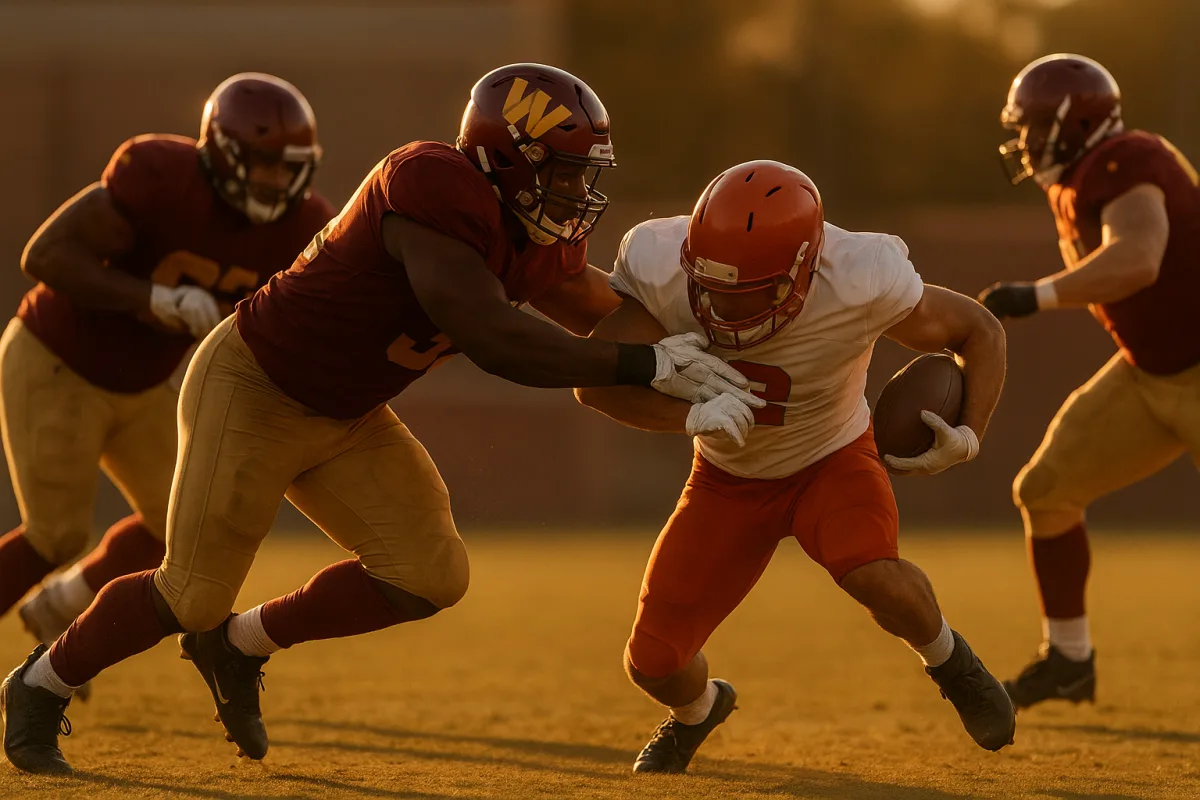
Washington Commanders Week 1: Why Space, Not Effort, Decided Too Many Snaps
The Week 1 lesson was about usable space
The easy Week 1 story is that the Washington Commanders played hard, unveiled a new defense, and got a viral special-teams moment from safety Tyler Owens. All true, but none identifies why snaps succeeded or failed.
The more useful lens is space. On a kickoff or punt coverage snap, space means maintaining leverage while defeating blocks. On offense, it means putting receivers far enough apart that one defender cannot cover two options.
That is the connection between Owens’ tackle against Philadelphia returner Britain Covey and Washington’s uneven offensive film. Owens created a lane where Washington needed one. The offense occasionally removed its quarterback’s lanes by crowding routes together.
It also explains why calling the Commanders’ defense “improved” after one result would be premature. The unit may have changed its structure, personnel and language. Those are inputs. The Eagles game supplied mixed evidence on execution. [3][7]
FOX Sports’ preliminary Week 1 data lists Washington allowing 318 total yards and three touchdowns in its 24-22 loss to Philadelphia. Those numbers are incomplete early-season data, and they do not establish an official league ranking. [3]
Still, the specific failures matter more than the raw total. Philadelphia rushed for more than 130 yards, converted two fourth downs, and got a consequential 22-yard Jalen Hurts scramble. Those are all space-and-leverage losses. [8]
Tyler Owens turned a blocked coverage rep into a tackle
Owens’ play went viral because it looked excessive in the best football sense. He fought through a double-team block, stayed involved after initial contact, reached Covey and completed the tackle with unusual force. [4][6]
But calling it merely a hustle play risks missing the technical part. Coverage teams do not need every player to make the tackle. They need each player to preserve a relationship to the ball and avoid opening a return lane.
A return unit wants to create a crease through numbers. It uses blockers to widen coverage players, turn them away from the returner, or simply keep them occupied long enough for the runner to clear the first wave.
The double-team is especially useful because it creates a math problem. If two blockers can neutralize one coverage player, the return team can gain an extra body at the point where the returner intends to cut.
Owens’ job was not necessarily to win cleanly. The first requirement was to avoid being washed entirely outside or backward. A coverage player who remains square enough to fight through contact can still affect the return late.
That distinction is why his effort was more than a highlight. A player who loses a block by two yards may be out of the rep. A player who loses it by inches can force a cut, narrow a lane, or make the tackle.
Owens told ESPN’s SportsCenter that he was trying to get blockers off him after believing he had been held on the preceding play. He described the finish more simply: his teammates emphasize finishing the play.
That explanation fits the clip. There is no need to invent a specialized drill or claim Owens freelanced into the tackle. Owens himself said there was no drill for that exact sequence, only the requirement to execute when it appeared.
Former NFL defensive end J.J. Watt called it “one of the greatest football plays” he had seen, according to Bleacher Report. That is fair praise for the effort, although it is an evaluation, not a special-teams statistic. [9]
No public reporting provides verified reach, impressions, repost totals or engagement figures for the clip. It went viral in the ordinary sense that it spread broadly through football media, not in a way that can be quantified responsibly. [4][9]
The larger point is that special teams rewards delayed relevance. A player can be blocked at the start, irrelevant at the middle, then decisive at the finish. Owens stayed connected to the play long enough to matter.
Daronte Jones changed the menu, not the laws of leverage
Washington hired Daronte Jones as defensive coordinator on Jan. 30, bringing a scheme described as flexible between 3-4 and 4-3 fronts, with an emphasis on versatile players. [7][12]
That matters because front labels can be misleading. A 3-4 is not automatically a three-man rush, and a 4-3 is not automatically four down linemen. Modern defenses shift bodies before and after the snap.
The practical goal is to change the offense’s blocking picture. If an offense cannot identify which defender has the edge, which linebacker is fitting an interior gap, or who is dropping into coverage, it has less certainty.
But multiplicity carries a cost. Every player must understand the call, the adjustment, the gap he owns and the gap he becomes responsible for if the front shifts. Flexibility without clean communication creates open space.
Washington reportedly could have as many as eight new starters after an offseason overhaul designed to repair a defense that finished last in 2025. That makes early execution especially important, and early volatility unsurprising. [1][7][12]
A defense can look more athletic, more multiple and more aggressive while still giving up efficient offense if its fits are late. Scheme is the map. The players still must arrive at the correct landmark together.
The Eagles’ rushing production and Hurts’ 22-yard scramble are the Week 1 reminders. A quarterback scramble is not always a pass-rush failure, and it is not always a coverage failure. Often, it is both. [8]
Rush lanes must close without opening a vertical escape hatch. Coverage defenders must maintain leverage long enough for the rush to finish. Once Hurts found daylight, the defense had lost the geometry of the down.
Washington also recorded no defensive-line sacks, its first such game in a 40-game span under the previous Vic Fangio-coordinated framework, according to The Washington Sun. That says pressure did not become finishes. [8]
It does not prove the new front cannot rush the passer. Sack totals are volatile, particularly over one game. It does establish that Washington cannot point to the opener as evidence its front disruption problem has been solved.
Cornerback Mike Sainristil’s reported line, seven receptions allowed on nine targets for 83 yards and a touchdown, is more actionable than a broad “secondary struggled” claim. Targets show the Eagles found a repeatable matchup. [8]
Still, even that stat needs context. A target can result from man coverage, zone spacing, a coverage bust, a short completion conceded by design, or a quarterback simply choosing the open side of a concept.
Without a full publicly available snap-by-snap defensive film breakdown, it would be irresponsible to assign every one of those receptions to Sainristil alone. The documented result identifies where Philadelphia threw, not every assignment behind it.
Washington’s offense had the opposite spacing problem
The ESPN film segment on Washington’s offense identified a different version of the same issue. On several concepts, the underneath routes arrived in nearly the same defensive area, allowing one defender to affect both options.
That is bad distribution. A pass concept is not successful just because every eligible receiver runs a credible route. The routes must force defenders to make choices, preferably choices that leave another receiver uncovered.
Think of two receivers settling five yards apart against zone coverage. If both stop in the same window, the quarterback does not have two throws. He has one congested throwing lane with two targets occupying it.
The analyst’s point was not that Jayden Daniels simply missed open receivers. It was that on some snaps the structure gave him too few clean answers, especially when pass protection was already under stress.
Daniels acknowledged that Washington committed two delay-of-game penalties and said the offense needed work in a new system. Those are operational errors, but they belong in the same conversation about getting aligned and playing on schedule.
ESPN also cited Daniels’ 40 percent pressure rate since the start of last season, second highest among qualifying quarterbacks with at least 200 dropbacks. Pressure is not solely an offensive-line statistic. [1]
Quarterbacks can hold the ball, receivers can fail to separate, play callers can ask protections to handle difficult looks, and linemen can lose individual matchups. The number identifies a problem, not one guilty party.
The Week 1 result, 295 total offensive yards with 132 rushing and 164 passing, reinforces the need for caution. Those yards describe Washington’s output, not its defensive performance, and they do not explain why each drive stalled.
The offense does not need every concept redesigned. It needs better landmarks and timing. The receiver running a spot route must settle in open grass, and the crossing route must clear that grass rather than occupy it.
That is what Jacksonville’s offensive film, also reviewed by ESPN, demonstrated more cleanly. Horizontal motion altered the defense’s alignment, then vertical routes attacked the space created between the numbers and the hash marks.
The concepts themselves were not exotic. ESPN’s analysts described them as simple plays dressed differently. Their effectiveness came from route distribution, motion and receivers understanding which defender they were trying to influence.
Washington’s version needs that same clarity. Give Daniels two distinct levels, two distinct landmarks and a defined answer versus man or zone. That will not erase pressure, but it will make the ball come out faster.
Owens’ tackle and Washington’s offensive spacing issue look unrelated only if football is reduced to highlights and box scores. Both are about whether a player creates usable space or allows an opponent to control it.
Washington’s Week 1 defense has new personnel and a new coordinator, which makes the structural change real. The opener’s rushing leakage, fourth-down failures and lack of sacks make any claim of completed improvement unsupported. [7][8]
Owens, meanwhile, provided the more definitive Week 1 proof of concept. He did not beat the double team because a statistic guaranteed it. He beat it because he refused to let the block end his snap.
Frequently Asked Questions
What defensive issues did the Washington Commanders face in Week 1?
The Commanders struggled with space and leverage, allowing Philadelphia’s run game to gain more than 130 yards and convert two fourth downs. Their secondary showed vulnerabilities, with cornerback Mike Sainristil giving up 7 receptions on 9 targets for 83 yards and a touchdown. Additionally, the defensive line did not record a sack for the first time in 40 games under the previous coordinator.
How did Tyler Owens' hustle play impact the Commanders' special teams?
Tyler Owens made a notable tackle on a kickoff return by fighting through a double-team block without abandoning his lane, ultimately finishing the tackle with force. This play helped preserve coverage leverage and prevented a potential return lane, demonstrating technical execution beyond just hustle. Owens’ effort was praised as a key moment on special teams, though it did not produce measurable statistics.
What changes did Daronte Jones bring to the Commanders' defense in Week 1?
Daronte Jones introduced a flexible defensive scheme mixing 3-4 and 4-3 alignments, emphasizing versatility. The defense also underwent a significant roster overhaul, potentially adding eight new starters to improve from last year’s last-place ranking. However, the Week 1 game showed mixed evidence on execution despite these structural changes.
Why did space and leverage affect the Commanders' Week 1 performance?
Space and leverage were central to the Commanders’ struggles, as defensive fits left room for the Eagles’ run game to succeed and allowed key plays like a 22-yard scramble by Jalen Hurts. On offense, the Commanders sometimes condensed passing windows, limiting effectiveness. Owens’ special teams tackle exemplified the importance of maintaining proper leverage to prevent big plays.
How effective was the Washington Commanders' defense against the Eagles in Week 1?
Preliminary data show the Commanders allowed 318 total yards and three touchdowns in a narrow 24-22 loss, but these numbers are early and incomplete. The defense allowed significant rushing yards, multiple fourth-down conversions, and a critical scramble, indicating room for improvement. One game’s results do not provide a reliable forecast of the season or definitive ranking.
How we researched this
This article was assembled from 2 video sources, 12 cited references.
Nothing here is based on hands-on testing. Where a figure or finding appears, it belongs to the source cited beside it, and the writing says so rather than implying otherwise. Every source is listed below so you can check it.
Sources
FILM BREAKDOWN of the Jaguars & Commanders' offense in Week 1 🎥 | NFL Live — NFL on ESPN
Tyler Owens discusses the VIRAL REACTION to his hustle play vs. Eagles | SportsCenter — NFL on ESPN
2026 NFL Defense Rankings: Team Pass and Rush Stats | FOX Sports
Tyler Owens calls viral special teams play just a normal football play - Nachedeu
Tyler Owens Laying The Smack Down On Viral Special Teams Play
Commanders All-22: What Went Wrong in Washington’s Week 1 Loss - The Washington Sun
JJ Watt Reacts to Tyler Owens' Viral Video, 'Legitimately One of the Greatest Football Plays'
Tyler Owens Goes Viral: Commanders Safety Stuns NFL With "Greatest" Special Teams Play - Archysport
Watch Washington Commanders Week 1 Hustle Play and Defensive Film Breakdown on Youtube
Also from the sources
Related Articles
Week 1 NFL Defensive Highlights and Impact Plays
Explore Week 1 NFL defensive highlights and impact plays, featuring key performances and game-changing defensive moments.
Washington Commanders Upset Win Over Seattle Seahawks
Detailed analysis of the Washington Commanders' upset win over the Seattle Seahawks, focusing on quarterback performance and key game factors.
NFL Rookie Impact Analysis: Early Roles and Contributions
Explore NFL rookie impact analysis covering early roles, key plays, and how rookies contribute in their first games of the 2026 season.
Buffalo Bills Week 1 Defensive Highlights and Team Outlook
Explore Buffalo Bills Week 1 defensive highlights, player insights, and the impact of the new stadium on their 2026 season opener.