
Panthers Recent Struggles and Coaching Responses Explained
Explore the Panthers' recent struggles, defensive issues, and coaching responses after their Week 7 loss to Tampa Bay.
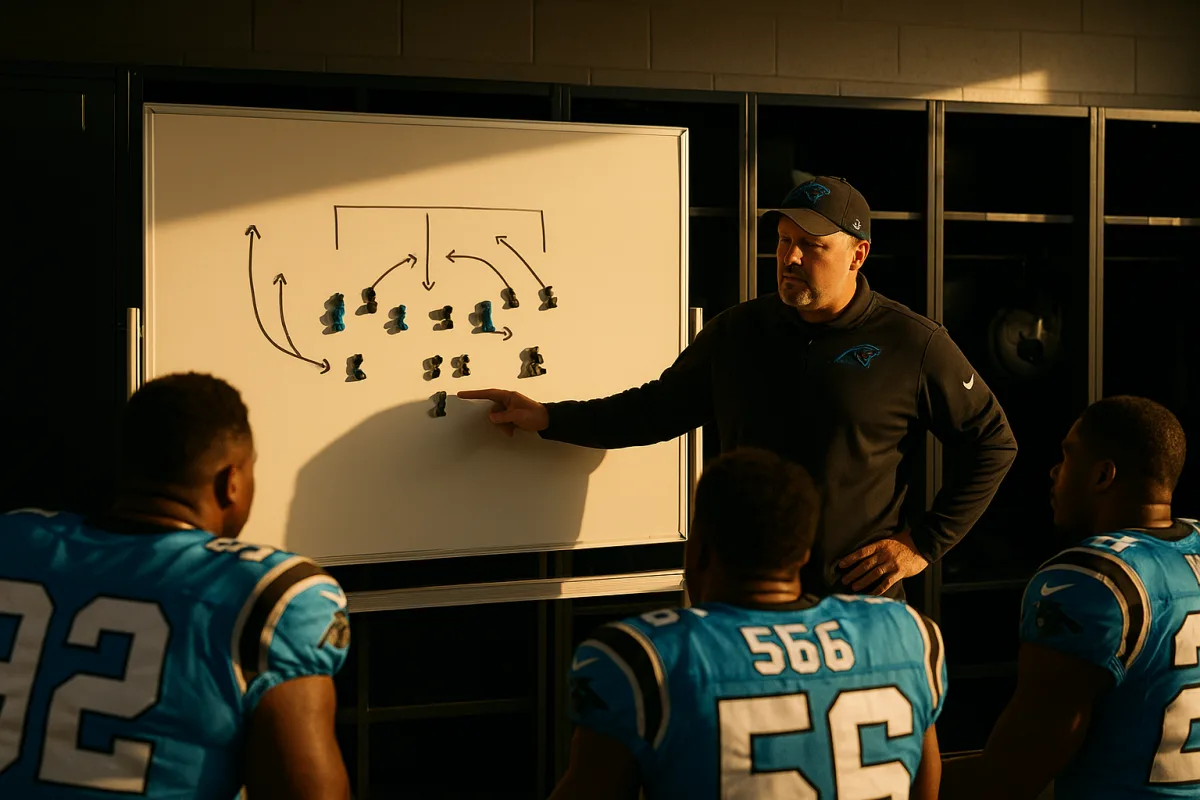
The Panthers’ Tampa Bay Loss Exposed a Repeatable Problem, Not Just a Bad Sunday
The shift is real, but it is narrower than the score suggests
The Panthers did not merely lose a division game to Tampa Bay. They were beaten in the areas that usually determine whether a game remains structurally competitive: turnovers, explosives, short-yardage situations, red-zone execution and run defense.
That is the meaningful shift after the 43-13 loss. Carolina entered the week at 3-2 and left at 3-3, still atop the NFC South but with a much clearer defensive vulnerability for opponents to study. [8]
The score itself can overstate a single Sunday. Four turnovers and a blocked extra point returned for points will make almost any NFL loss look worse. Dave Canales pointed directly to those plays afterward on the Panthers’ Panther Talk program.
But the turnover total does not explain the whole afternoon. Canales said Tampa Bay produced 10 explosive plays to Carolina’s five, won the third- and fourth-down situations, and finished more red-zone possessions with touchdowns.
Those are independent indicators of control. Turnovers can be volatile from week to week. A team repeatedly creating more explosives, converting key downs and staying ahead of the chains is imposing a game script.
That distinction matters because the Panthers cannot treat the loss as simply a ball-security failure. Their season turnover margin was only minus-1 through Week 7, with 0.8 turnovers committed per game, so the Tampa Bay result was worse than the broader profile. [4]
Still, the Bucs did not need a fluky takeaway parade to establish the central issue. They ran with patience, forced Carolina to account for the edges, and made a defense that knew the run was coming fail to consistently close space.
Tampa Bay found a run-game answer that travels
Canales’ own description of the tape was more useful than a generic claim that the Panthers were out-physicaled. He credited Tampa Bay offensive coordinator Zac Robinson and the Bucs’ offensive line for the rhythm of the run plan.
On the Carolina Panthers’ Panther Talk program, Canales said Tampa Bay’s backs were patient, the offense kept committing to the ground game, and the Panthers’ problems were a combination of coaching, run fits and physical tackling.
That is a more serious diagnosis than missed tackles alone. Tackling is often the final visible failure. The earlier breakdown is usually spatial: a defender gets displaced, an edge is lost, a safety arrives late, or support is forced to cover too much grass.
Canales used the same language in his press conference carried by the Carolina Panthers channel. He said the Panthers needed to reduce space, fit blocks correctly, get off single blocks and maintain leverage when the ball reached the perimeter.
Those details point to why Tampa Bay’s approach worked. The Bucs did not simply call runs repeatedly and hope the Panthers wore down. They built runs off each other, created hesitation, and kept backs patient enough to exploit late-arriving support.
Canales specifically noted that Carolina’s defense is designed to prevent runs from bouncing outside. When he says Tampa Bay “bounced a couple” to the sideline, that identifies a failure in containment and pursuit structure, not merely effort.
The NFL on NBC program Chris Simms Unbuttoned arrived at a similar conclusion from a less technical direction. Chris Simms described Tampa Bay’s offensive line and running backs as able to do what they wanted, particularly behind a continued commitment to the ground game.
Simms’ commentary should not be treated as a charting study, and it was intentionally blunt. But it aligns with Canales’ far more specific account: Tampa Bay won the line-to-secondary geometry and never had to abandon the plan.
That alignment across the Panthers’ coaching review and outside film-oriented commentary is what makes the concern credible. It was not one isolated critique based on final score optics.
This is not proof that Carolina’s scheme is broken
There is a temptation after a 43-13 loss to label every structural problem permanent. That is usually lazy analysis, especially in a league where one game can be distorted by field position, special teams and turnovers.
Canales was asked about the Panthers having allowed more than 200 rushing yards in 12 games over the past three seasons. He did not disclose the specific adjustments under consideration, but he did say the staff must coach and plan better collectively.
That answer is revealing in two ways. First, it acknowledges that Carolina cannot explain the Tampa Bay performance exclusively as player error. Second, it does not establish that the Panthers are changing fronts, personnel groupings or coverage rules.
The public evidence on tactical changes remains thin. Reporting after the loss has not documented a specific adjustment to Carolina’s defensive scheme, practice format, personnel deployment or play-calling for the Packers game. [5]
So the accurate read is not that Canales has “fixed” the problem, or that the Panthers have torn up their defensive approach. The accurate read is that the staff has identified the issues and has a compressed schedule to address them.
That distinction matters for anyone scouting Carolina. Assume the Panthers will emphasize edge-setting, block destruction and run fits. Do not assume they will unveil a fundamentally different defense without evidence.
Canales also mentioned personnel options, including safety Lathan Ransom’s physicality, when asked about defensive changes. But he framed personnel as one option among several, not as a declared solution to the Tampa Bay game.
The Panthers’ upcoming opponent should therefore prepare for modest, targeted countermeasures. More direct run support, different safety usage, altered edges or better anticipation are plausible. A wholesale scheme change is not established by the available reporting.
The offensive narrative needs more discipline
Carolina’s offense was poor against Tampa Bay, and the four turnovers made that impossible to hide. But the broader claim that the Panthers cannot finish drives is contradicted by the season’s red-zone data.
Through Week 7, Carolina averaged 2.80 red-zone scores per game, fifth in the NFL, and converted 55.56 percent of red-zone trips into touchdowns, sixth in the league. [3] The league averages were 1.90 scores and a 47.51 percent touchdown rate.
That does not erase what happened against Tampa Bay. It means the Tampa Bay game should be evaluated as a breakdown in execution against a specific opponent and game script, not as proof that Carolina’s red-zone offense is fundamentally deficient.
The more pressing offensive concern is whether the Panthers can stay on schedule after losing Moton. The veteran right tackle returned against Tampa Bay after missing the first four games of the season because of blood clots in his right lung. [1]
He then suffered a fibula fracture and major ankle ligament damage. Canales confirmed through the Carolina Panthers channel that Moton would undergo ankle surgery and miss the remainder of the season.
The team placed Moton on injured reserve, which formally requires at least a four-game absence, though that is irrelevant to the immediate season-ending designation. [1] The Panthers have not released the precise surgical procedure or an official recovery timeline.
General medical recovery estimates should not be presented as Moton’s prognosis. The only confirmed football implication is that Carolina loses a veteran tackle and expects rookie Monroe Freeling to take on a larger starting role. [1]
Canales said Freeling finished the Tampa Bay game and played with physicality, but a short turnaround changes the challenge. Green Bay can test the rookie with movement, simulated pressure and late front changes before and after the snap.
Canales’ response is about process, not rhetoric
Canales’ response after the loss has been consistent across his press availability and the Panthers’ radio program. He called for accountability, reviewed the critical failures immediately, then moved the team onto the Packers because the Thursday schedule left little alternative.
He described holding a “tell-the-truth Monday” meeting immediately after the game. That was not a declaration that the Panthers skipped the loss entirely. It was an attempt to address the evidence without consuming the limited installation time before Green Bay.
The short week matters here. Canales said the Panthers would operate in walkthrough mode, compressing the normal Wednesday-through-Friday preparation rhythm while allowing players time to recover and coaches time to establish the base plan.
That process is sensible, but it has limits. A condensed practice week can reinforce rules and identify what opponents may copy. It is less suited to installing a large new package or solving communication failures through full-speed repetition.
Canales made the copycat-league point himself on Panther Talk. If a team has success using certain concepts against an opponent, the next opponent will study and test those same concepts.
For Green Bay, that means the Packers do not need to replicate Tampa Bay play for play. They need to ask the same questions: Can Carolina set the edge, fit interior runs cleanly, hold leverage on the perimeter and generate enough negative plays to change the offensive call sheet?
The market reflects a competitive but cautious view. Green Bay opened as a 3.5-point favorite at Lambeau Field, with the Packers at minus-192 on the moneyline and Carolina at plus-160. The over-under was 47.5 points in late-October reporting. [6]
Outside projections are split. SportsLine backed Green Bay to cover, while Covers leaned toward Carolina against the spread. [6][7] That disagreement is reasonable because the central variables are difficult to price: injuries, short-week preparation and whether Tampa Bay exposed a repeatable defensive weakness.
What the Panthers must show against Green Bay
The first benchmark is not the final score. It is whether Green Bay can dictate the game on the ground without meaningful resistance. If the Packers repeatedly reach the edge or turn patient runs into chunk gains, the Tampa Bay concern becomes a pattern.
The second benchmark is situational defense. Carolina did not force a takeaway against Tampa Bay, and Canales’ own postgame accounting showed the Bucs winning the critical down-and-distance moments. The Panthers need stops that force opponents out of their preferred script.
The third is offensive protection. Freeling does not need to become Moton in one week. Carolina needs to build a plan that gives the rookie workable answers, including help when necessary and a manageable menu of protections.
Finally, the Panthers need cleaner football without pretending that ball security alone solves everything. Four turnovers and a blocked extra point return are enough to lose almost any NFL game. They are not enough to explain why Tampa Bay controlled the geometry of the game.
Carolina’s 3-3 record still leaves room for recovery, and there is no credible reporting of locker-room discord or a morale issue after the loss. But absence of those reports is not evidence that the Panthers have answered the football questions.
The real trend is more practical. Tampa Bay supplied a blueprint, Canales acknowledged the underlying run-defense issues, and Green Bay now gets the first opportunity to test whether Carolina’s response is visible on the field rather than only in the meeting room.
Frequently Asked Questions
What caused the Panthers' defensive collapse against Tampa Bay?
The Panthers’ defensive collapse was primarily due to breakdowns in run fits, leverage, and coaching preparation. Tampa Bay’s offense committed to the run with patience, creating edge space and forcing Carolina’s defense to cover long drives without benefiting from turnovers. The Panthers struggled to maintain containment and pursuit, allowing Tampa Bay to exploit space on the perimeter.
How has Dave Canales responded to the Panthers' recent struggles?
Dave Canales acknowledged issues with run fits, leverage, and coaching preparation but has not publicly confirmed any schematic or tactical changes. He emphasized the need for better coaching and planning collectively rather than attributing the problems solely to player errors. No specific adjustments have been reported ahead of the following game.
What are the main issues in the Panthers' run defense?
The main issues include failures in spatial control such as losing edge containment, defenders being displaced, and late-arriving support. The Panthers’ defense is designed to prevent runs from bouncing outside, but Tampa Bay managed to "bounce a couple" runs to the sideline, exposing weaknesses in containment and pursuit structure rather than effort alone.
Is Carolina Panthers' defensive scheme changing after Week 7?
There is no public evidence that the Panthers are changing their defensive scheme, personnel groupings, or coverage rules after Week 7. Dave Canales has not disclosed any specific tactical adjustments, and reporting has not documented changes in practice or play-calling following the loss to Tampa Bay.
How does the Panthers' offense perform despite recent losses?
Despite the loss to Tampa Bay, the Panthers’ offense remains strong in red-zone efficiency, ranking sixth in the NFL with a 55.56% touchdown conversion rate through Week 7. Their offensive struggles in the Tampa Bay game should not overshadow their overall effectiveness in scoring opportunities inside the 20-yard line.
How we researched this
This article was assembled from 5 video sources across 2 channels, 12 cited references.
Nothing here is based on hands-on testing. Where a figure or finding appears, it belongs to the source cited beside it, and the writing says so rather than implying otherwise. Every source is listed below so you can check it.
Sources
Dave Canales on responding to adversity and preparing for the Packers | Carolina Panthers — Carolina Panthers
Losses from Jets, Panthers lead Chris Simms’ NFL Week 7 headlines | Chris Simms Unbuttoned — NFL on NBC
"We all got to take responsibility" | Panther Talk | Carolina Panthers — Carolina Panthers
Luke Kuechly receives his Ring of Excellence from the Pro Football Hall of Fame in halftime Ceremony — Carolina Panthers
Panther Talk | October 26, 2026 — Carolina Panthers
Offensive: Conversions · Red zone scores · All 32 NFL Teams, 2026 | NFL Lines
Panthers vs Packers Prediction, Picks & Early Odds: Thursday Night Football
How boos replaced MVP chants on a very bad day for the Panthers
Latest panthers taylor moton season ending ankle surgery - ESPN News
Panthers right tackle Taylor Moton will have season-ending ankle surgery | Beat Chuck Newsroom
Panthers vs. Packers Prediction, Odds, Spread, Injuries, Trends for NFL Week 8
Watch Panthers' Recent Struggles and Coaching Responses on Youtube
Also from the sources
Related Articles
Packers Week 3 Loss Analysis and Fan Reaction
In-depth Packers Week 3 loss analysis covering offensive struggles, fan reactions, and impact of Josh Jacobs' absence.
Washington Commanders Week 1 Defensive Breakdown and Hustle
Analyze the Washington Commanders' Week 1 defensive breakdown and key hustle plays, including Tyler Owens' special teams tackle.
Seattle Seahawks vs Kansas City Chiefs Analysis
Detailed Seattle Seahawks vs Kansas City Chiefs analysis highlighting defensive strategy and offensive balance in the 2026 game.
Los Angeles Rams Struggles and 2026 Playoff Outlook
Explore the Los Angeles Rams struggles, key issues, and their 2026 playoff outlook with detailed analysis of offense, defense, and coaching adjustments.