
Seattle Seahawks vs Kansas City Chiefs Analysis
Detailed Seattle Seahawks vs Kansas City Chiefs analysis highlighting defensive strategy and offensive balance in the 2026 game.
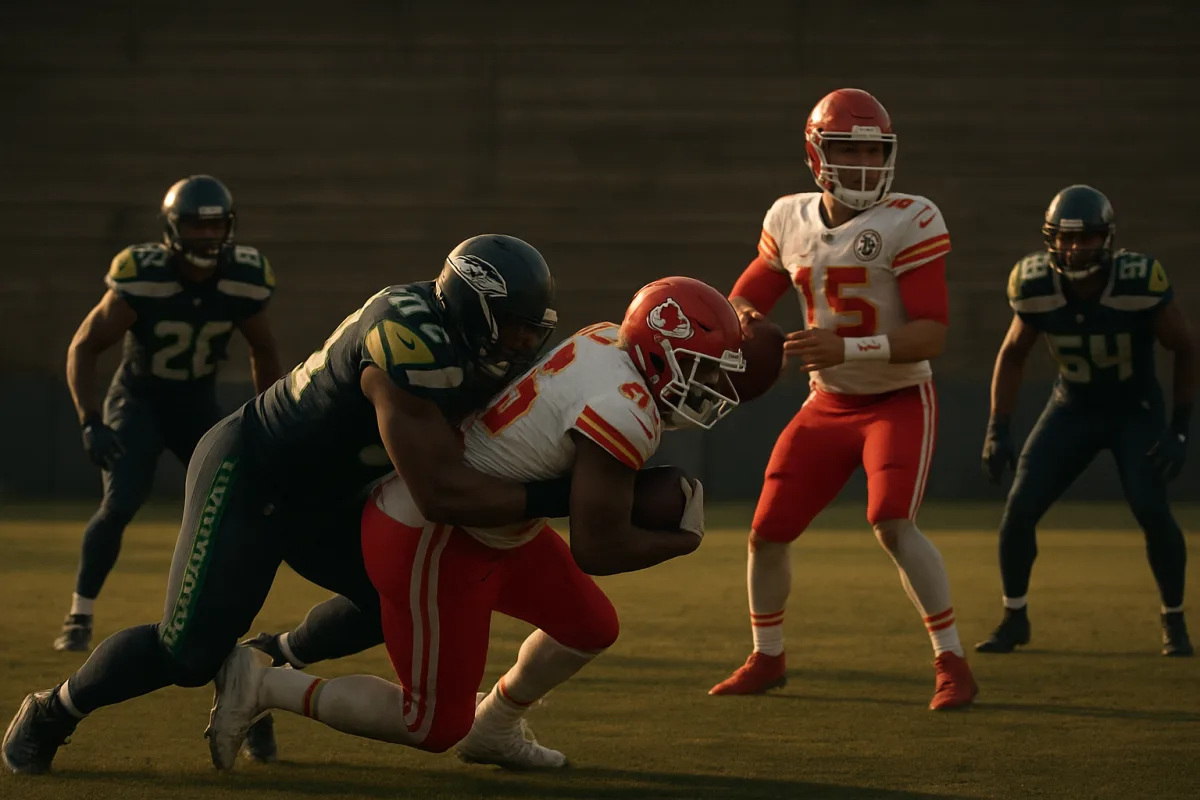
The number that explains the game: 36 rushing yards
The headline from Seattle’s 20-3 win over Kansas City was Walker’s line: 14 carries, 36 yards. That is 2.6 yards per carry, and it was the first number that changed every other part of the Chiefs’ night. [4]
Walker entered Week 7 as Kansas City’s offensive stabilizer. The supplied research brief, using the more complete six-game CBS Sports sample, lists him at 701 rushing yards, or 116.8 per game, through Week 6.
Other databases listed Walker at 133 yards per game, but those figures appear to use different game totals or updates. The precise pregame average is less important than the usable conclusion: Seattle cut a highly productive runner to 36 yards. [1][2]
That gap matters because a run game is not simply a separate column on a stat sheet. It determines whether an offense can call its full playbook on second-and-medium, third-and-short, and inside the red zone.
Kansas City had leaned on Walker to create easy downs and explosive plays. If a back turns first-and-10 into second-and-four, the quarterback can use play-action, quick throws, boot action, screens, and shot plays without asking receivers to win difficult routes.
Seattle’s objective, as cornerback Devon Witherspoon explained on NFL on NBC’s postgame show, was to contain Walker, stop the run, and make Kansas City prove it could move the ball through the air. That is a normal defensive idea. Executing it against a productive runner is the hard part.
Safety Nick Emmanwori told Pro Football Talk that Walker’s return gave Seattle’s defense extra motivation, particularly amid criticism of the club’s decision to let him leave in free agency. Motivation does not make a tackle, but it can sharpen a weekly priority. [4]
The tape descriptions supplied by NFL Daily point toward the more useful explanation. Seattle consistently got multiple defenders to the ball when Walker attempted to bounce runs outside, turning his preferred escape lanes into crowded sidelines rather than open grass.
What it means to “set the edge”
Stopping an NFL run begins before the ball carrier reaches the line. Defenders have assigned gaps, the spaces between offensive linemen, and assigned leverage, the shoulder they must keep free to prevent a runner from escaping.
Against outside-oriented runs, the edge defender has a particularly important job. He cannot simply sprint inside after the ball. If he loses outside contain, the back can turn the corner and force defensive backs to make open-field tackles.
That is where Seattle made Kansas City play left-handed. Walker is dangerous when a designed run becomes a broken-field run, especially when he reaches the perimeter with a blocker in front and only one defensive back to beat.
The Seahawks did not allow that clean picture often enough. An edge defender set the boundary, interior players compressed the running lane, and pursuing defenders arrived before Walker could convert a modest crease into a chunk gain.
That approach has a cost. Committing bodies to the run can leave fewer defenders available for coverage, especially if safeties trigger downhill early. It also creates vulnerability to play-action, quick throws behind linebackers, and quarterback scrambles.
Seattle accepted those costs because of Kansas City’s personnel situation and the game’s central calculation. The Chiefs could not consistently punish the defense through their wide receivers after Walker was removed from the equation.
Witherspoon said Seattle initially saw Kansas City complete some quick throws, then responded by playing tighter coverage on the early reads. The important phrase is early reads. Mahomes is most dangerous when his first answer is clean and immediate.
The real target was Kansas City’s early-down efficiency
The popular version of this game will say Seattle “made Mahomes throw.” That is true but incomplete. No defense wants Mahomes throwing freely on favorable downs, with the run threat active and the quarterback able to dictate protection.
Seattle wanted Mahomes throwing after the run had failed. Those are very different snaps. Second-and-eight and third-and-seven place more stress on pass protection, require receivers to separate against prepared coverage, and increase the chance that the quarterback holds the ball.
Mahomes still made plays. NFL’s game highlights showed him extending downs, escaping pressure and finding Travis Kelce on several conversions. Seattle did not eliminate improvisation, and the available evidence does not support pretending otherwise.
But the Chiefs had too few routine answers. Their leading receivers were tight ends Travis Kelce and Noah Gray, according to NFL Daily’s recap, while wide receiver Cyrus Allen finished with one catch for 18 yards. [4]
That is the consequence of denying an offense its efficient base offense. Mahomes can create a completion, and Kelce can uncover in space, but an offense cannot live on quarterback escape drills and isolated third-down conversions.
Seattle’s season-long defensive profile supports the result without proving every tactical detail. Through seven games, the Seahawks ranked second in expected points added allowed per play at minus-0.138, according to the supplied research brief. [3]
EPA is not a grading system for toughness or a count of highlight plays. It estimates how much a snap changes a team’s expected scoring outcome. A strong EPA figure means Seattle had repeatedly made opponents less likely to score.
The Chiefs finished with three points, so the one-game result was emphatic. But the better process takeaway is that Seattle’s defense converted its general strength into a specific plan: fit the run first, tighten early throwing windows, and force difficult passing downs.
Why Seattle’s offense was balanced without being conservative
Seattle’s offensive answer was not to become a ground-and-pound team overnight. Through seven games, the Seahawks had run 165 times and passed 198 times, a run-pass ratio of 0.83. They remained a pass-leaning offense. [3]
That distinction matters. “Balanced” is often misused to mean equal carries and passes. Real offensive balance means a defense must honor enough viable options that it cannot overplay the quarterback, the primary receiver, or the run fit.
Emanuel Wilson’s 24 carries for 100 yards and a touchdown supplied that missing option against Kansas City. Seattle rushed for 153 yards as a team, more than three times Kansas City’s total, according to Pro Football Talk. [4]
Wilson’s final touchdown illustrated the value of the running game late. NFL’s highlights showed him run behind two tight ends and a backup tackle, with Kansas City’s front leaving a crease that Seattle had patiently worked to create.
That does not mean the Seahawks suddenly found an automatic rushing identity. One game is not enough evidence for that. Seattle had averaged 3.9 yards per rushing attempt through seven games, a figure that still describes an inconsistent run game. [3]
What Seattle did gain was play-call flexibility. If Wilson can take early-down carries without producing constant second-and-long situations, Darnold does not need to manufacture the entire offense through high-difficulty throws to Smith-Njigba.
Smith-Njigba remained the passing-game centerpiece. NFL’s broadcast highlights showed Seattle repeatedly using motion before finding him on intermediate routes, sideline throws, and red-zone opportunities. Kansas City could not consistently give him single coverage without consequences.
But Wilson changed the defensive math. A safety who cheats toward Smith-Njigba risks arriving late against the run. A lighter box can help coverage, but it gives Seattle more favorable blocking angles and fewer bodies near the ball.
Darnold’s role was to keep the machine moving
Darnold’s stat line was efficient: 20 completions on 28 attempts, 257 passing yards, one touchdown, 17 rushing yards, and two scrambles that converted first downs. [4] He did not need to play hero ball for Seattle to control the game.
The scrambles deserve attention because they were not designed quarterback runs. They came when Kansas City’s coverage and rush did not finish the play, allowing Darnold to step up and convert instead of forcing a contested throw.
There was still a costly-looking mistake. Before halftime, Darnold threw an interception in the end zone after Seattle had driven into scoring position. NFL Daily described open options in the back of the end zone, making the decision and timing difficult to defend.
Seattle survived because Kansas City did not turn that turnover into points. Harrison Butker’s 58-yard field-goal attempt fell short in the final seconds of the half, preserving Seattle’s lead and preventing the Chiefs from gaining real momentum. [4]
That sequence is why “dominance” needs a qualifier. Seattle dominated the game’s structure, especially defensively, but it left points on the field. It also faced several third-and-long situations and settled for field goals where touchdowns would have ended the game earlier.
The Seahawks converted 68.75 percent of their third downs, an excellent result, but that number does not mean the offense was flawless. Repeated third-down conversions can reflect composure, or they can reveal that early-down execution created avoidable work. [4]
What Seattle proved, and what it did not
Seattle proved it can win by dictating the terms of a game against a previously unbeaten opponent. It stopped the run, kept Mahomes from finding easy rhythm, ran effectively enough to protect its quarterback, and got explosive production from Smith-Njigba. [4]
It did not prove that every future opponent can be handled with the same plan. A deeper receiving group, a more efficient quick-game offense, or a team that punishes aggressive run support with play-action will create different costs.
It also did not prove that Seattle discovered a new exotic Mahomes defense. The supplied research found no reliable snap-by-snap account establishing specific pressure packages, coverage calls, or blitz rates from this game. That restraint matters.
The clearest evidence is simpler and stronger. Seattle took away the element Kansas City most needed, forced the Chiefs into harder passing situations, and used a credible running game to keep its own offense from becoming predictable.
That is how a 20-3 game is built. Not through a single speech, a revenge-game narrative, or a quarterback suddenly becoming someone else, but through favorable down-and-distance, disciplined run fits, and an offense that made every defender account for more than one threat.
Frequently Asked Questions
How did the Seattle Seahawks defend against Kenneth Walker III?
The Seahawks focused on containing Kenneth Walker III by setting the edge and compressing running lanes to prevent him from turning outside runs into big gains. They consistently brought multiple defenders to the ball, forcing Walker into crowded areas and limiting his ability to break free. This approach held him to just 36 rushing yards on 14 carries, well below his season average.
What defensive strategies did the Seahawks use to limit the Chiefs' offense?
Seattle employed a disciplined run-and-cover plan that prioritized stopping the run first, forcing Kansas City into longer, less efficient passing drives. They played tighter coverage on the Chiefs’ early passing reads after initial completions and relied on maintaining leverage and gap discipline to contain runs. Although they did not rely on constant blitzing, their defense pressured Mahomes indirectly by making him throw in difficult down-and-distance situations.
How did Seattle balance their offense against Kansas City?
Seattle’s offense was balanced in function rather than run-heavy, with Emanuel Wilson rushing for 100 yards to keep Kansas City’s defense honest. This balance prevented the Chiefs from focusing solely on stopping the pass or targeting Jaxon Smith-Njigba on every snap. Sam Darnold managed the offense efficiently, completing 20 of 28 passes for 257 yards and one touchdown, while also contributing key scrambles.
What was the impact of limiting the Chiefs' running game on the outcome?
Limiting Kenneth Walker III’s rushing yards disrupted Kansas City’s down-and-distance efficiency and narrowed their quick passing options. With the run threat diminished, the Chiefs faced longer second- and third-down situations that made passing more difficult and less efficient. This forced Patrick Mahomes to win the game through a depleted receiving corps on longer drives, contributing significantly to Seattle’s 20-3 victory.
How did Patrick Mahomes perform against the Seahawks defense in 2026?
Patrick Mahomes made several impressive plays by extending downs and escaping pressure, connecting with tight ends Travis Kelce and Noah Gray on key conversions. However, the Seahawks’ defense limited his routine passing opportunities by forcing him into difficult down-and-distance scenarios after the run game was stifled. As a result, Mahomes was unable to generate sustained offensive success, and the Chiefs managed only three points.
How we researched this
This article was assembled from 5 video sources across 2 channels, 2 published articles, 4 cited references.
Nothing here is based on hands-on testing. Where a figure or finding appears, it belongs to the source cited beside it, and the writing says so rather than implying otherwise. Every source is listed below so you can check it.
Sources
Kansas City Chiefs vs. Seattle Seahawks Game Highlights | NFL 2026 Season Week 7 — NFL
Devon Witherspoon unpacks Seahawks' defensive strategy vs. Chiefs | Sunday Night Football Final — NFL on NBC
Seattle Seahawks were ‘at their best’ in win over Kansas City Chiefs | Pro Football Talk — NFL on NBC
Seattle Seahawks displayed balanced offense against Kansas City Chiefs | Pro Football Talk — NFL on NBC
Nick Emmanwori: Seahawks' defense was motivated to stop Kenneth Walker — Pro Football Talk
Nick Emmanwori: Seahawks' defense was motivated to stop Kenneth Walker — ProFootball Talk on NBC Sports
Kansas City Chiefs at Seattle Seahawks: Game Analysis & Odds | Week 7, 2026 | SportsHawk
Watch Seattle Seahawks' Dominance Over Kansas City Chiefs on Youtube
Also from the sources
Related Articles
Broncos vs Chiefs Week 1 Preview: Key Matchups and Analysis
Get a detailed Broncos vs Chiefs Week 1 preview with key matchups, player updates, and game analysis for the 2026 NFL season opener.
San Francisco 49ers Key Player Performances and Dominance
Explore the San Francisco 49ers' 2026 dominance with key player performances from Brock Purdy, Mike Evans, and their adaptive defense.
Washington Commanders Upset Win Over Seattle Seahawks
Detailed analysis of the Washington Commanders' upset win over the Seattle Seahawks, focusing on quarterback performance and key game factors.
Seattle Seahawks 2026 Season Preview and Coach Mike
Get a detailed Seattle Seahawks 2026 season preview with insights on Coach Mike Macdonald, roster changes, and key player roles.