Seattle Seahawks 2026 Season Preview and Coach Mike
Get a detailed Seattle Seahawks 2026 season preview with insights on Coach Mike Macdonald, roster changes, and key player roles.
Start with the matchup, not the rematch label
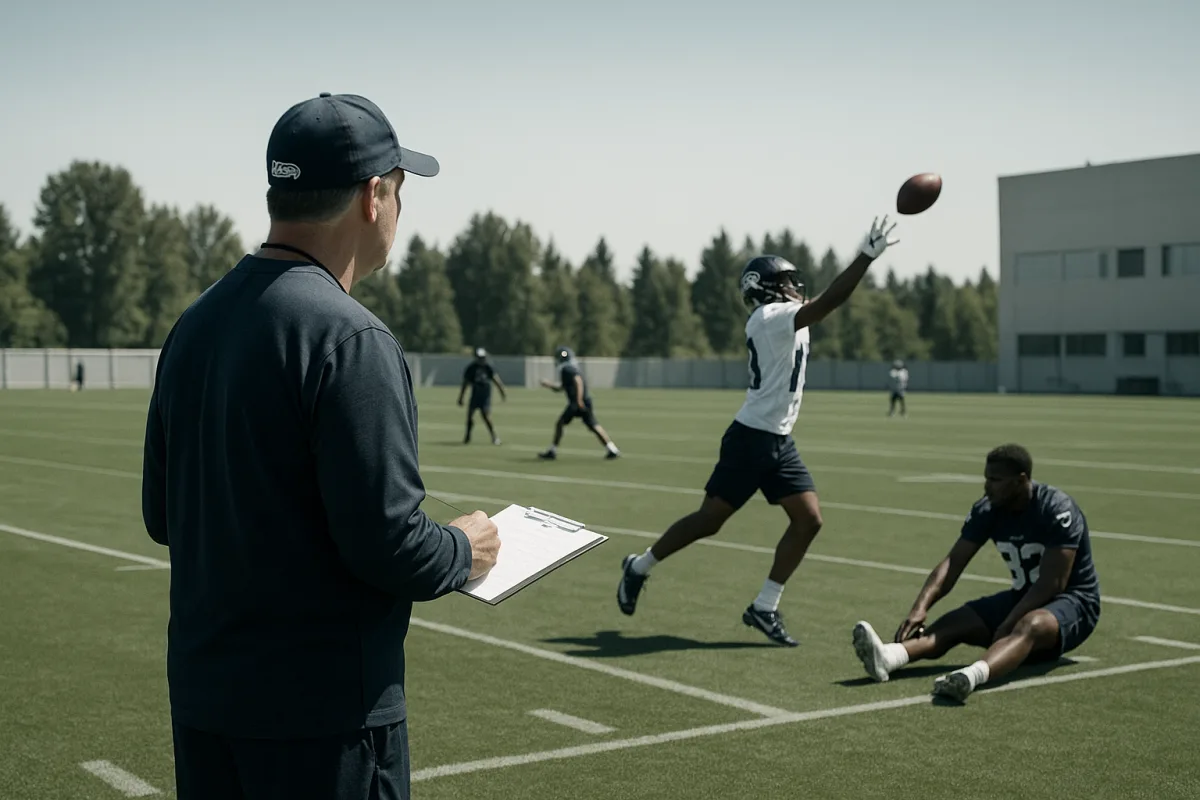
Seattle opens the 2026 season against the New England Patriots, a matchup the Seahawks’ Hawk Talk podcast frames as a Super Bowl LX rematch. That history will dominate pregame coverage, but it has limited predictive value for Week 1.
The useful question is what has changed since those teams last played. Seattle’s offense has a new coordinator, a remade running-back room and a rookie receiver who pushed his way onto the 53-man roster. New England, meanwhile, enters with familiar core names but meaningful roster turnover.
The Seahawks’ official Hawk Talk preview cited New England’s 2025 finish as third in total offense, sixth in rushing and second in scoring. Those are useful baseline numbers, but they describe last year’s unit, not necessarily the group Seattle will see in the opener.
Statistics from the previous season can identify a threat. They cannot tell readers whether a team will use the same personnel packages, whether protection rules have changed, or whether a new receiver is ready for a full route tree.
That distinction matters against quarterback Drake Maye. If New England again leans on its efficient run-pass balance, Seattle’s defense has to win early downs without overcommitting coverage resources or giving up cheap access throws behind the linebackers.
Seattle’s own 2025 defensive reputation was built more on preventing points than chasing box-score volume. Hawk Talk’s Michael Bumpus argued that raw rushing-defense rankings understated Seattle because opponents kept running into game scripts that required volume carries.
That is a reasonable film question for Week 1: can Seattle set edges, fit interior gaps and force New England into second-and-long situations? If it can, Macdonald can call the pressure and simulated-pressure looks that put more stress on a young quarterback’s protection identification.
Know what Seattle’s offense is actually changing
Klint Kubiak is out as offensive coordinator, and Brian Fleury has taken over before the 2026 season. The evidence available does not support calling this an offensive overhaul. Fleury has emphasized continuity with the existing West Coast structure. [4]
For the opener, that means readers should not expect the Seahawks to unveil a completely different offense. Watch the details instead: how often Seattle uses motion before the snap, whether it creates favorable run fronts, and which players stay on the field in third-down packages.
The basic objective remains familiar: use the running game and quick passing game to create manageable downs, then take selective shots when coverage structure dictates it. That is a framework, not a guarantee of success.
A short completion can look safe in the stat sheet while still being a poor offensive play if it comes on third-and-eight against soft coverage and produces fourth-and-four. Conversely, a two-yard run can be productive if it forces a defense to tighten its structure before play action.
Fleury’s first game should therefore be evaluated through sequencing. Did Seattle create answers when New England took away the first read? Did the offense stay ahead of the sticks? Did the coordinator find ways to help a changing backfield in pass protection?
The Seahawks’ own preseason and roster conversation has highlighted continuity along the offensive line. That is more important than any claim that the line “looked good” in August, because the opening-game test will be New England’s ability to alter fronts and force communication errors.
Prepare for a different running-back equation
The largest practical personnel change is simple: Kenneth Walker III is no longer in Seattle. He left after the 2025 season and signed with the Kansas City Chiefs, ending the Seahawks’ ability to lean on his explosive-play profile. [6]
Seattle responded by drafting Jadarian Price in the first round of the 2026 draft and signing free agent Emanuel Wilson. [6] Price is the player to monitor first, but a first-round label does not establish his Week 1 workload or prove he is ready for every protection responsibility.
The depth chart is also complicated by health. Zach Charbonnet is on the physically unable to perform list after an ACL tear and is expected back around midseason, while Kenny McIntosh is on injured reserve. Seattle signed D.K. Kaufman as a replacement. [6]
That means the Patriots game may reveal how Seattle divides snaps more than it reveals who its permanent lead back is. Pay attention to who handles third downs, who is used in two-minute offense, and who stays in against pressure looks.
Those snaps matter because they show coaching trust. An early-down carry can be scripted. Leaving a back in the game when the defense can blitz is a more direct indication that Seattle believes he can identify fronts, scan for rushers and protect the quarterback.
The Seahawks should not force a Walker replacement through sheer volume. The better Week 1 plan is likely to use formations, quick-game throws and personnel variation to keep New England from keying on Price before he has established a rhythm.
Track Montorie Foster’s role realistically
Montorie Foster is another player readers will hear about early. The 25-year-old Michigan State product moved from Seattle’s 2025 practice squad to the 2026 53-man roster after a strong preseason. [5]
Foster led the August 15 preseason opener with five catches for 36 yards and a touchdown. [5] That earned attention, and it helped make the roster decision understandable. It does not establish that he will reproduce that output against New England’s regular-season coverage plans.
His case for a meaningful opening role is tied to injuries elsewhere at receiver, including Tory Horton. [5] If Foster plays substantial snaps, watch his alignment and route assignments before judging the production.
A receiver running quick outs, shallow crossers and screens has a different job from one asked to win isolated routes on third-and-long. Snap count, personnel grouping and target location tell more about a rookie’s actual role than a single reception total.
Seattle’s Hawk Talk hosts specifically pointed to Foster as a roster standout after he beat out Cody White for a spot. That is useful background, but the regular-season standard changes immediately. New England’s Christian Gonzalez is the type of corner who can erase easy perimeter throws and force quarterbacks to work elsewhere.
Use fourth down as the coaching checkpoint
Macdonald’s defense will understandably receive most of the attention, but the most revealing coaching decision in the opener may come on offense. He received criticism in 2025 for conservative fourth-down choices, especially field-goal decisions on fourth-and-short. [8]
The point is not that every fourth-down decision should be aggressive. Field position, score, clock, opponent strength and offensive personnel all matter. The criticism is about whether Seattle’s choices align with its own probability of converting short-yardage situations.
If Seattle faces fourth-and-one near midfield, note the personnel and formation before judging the result. A decision to kick may be reasonable if the offensive line is struggling or a key back is unavailable. It is harder to defend if the offense has controlled the line of scrimmage.
Macdonald’s own public comments suggest he views the work as a collective problem-solving process rather than a coach imposing every answer alone. In the NFL on NBC interview, he described faith as important amid the uncertainty of building a roster, training camp plan and staff process.
That language should not be reduced to a slogan. Macdonald’s stated approach is that relationships, clarity of purpose and admitting that a staff does not have every answer can help a team solve problems. The test is whether that process produces better game-management decisions.
Understand how Macdonald got here
Seattle named Mike Macdonald its ninth head coach on January 31, 2024. [1] He arrived as a young defensive coach with a reputation for adaptable game plans, but his early Seahawks tenure has not been a straight climb.
The 2024 team opened 3-0, then lost four of its next five games. That stretch fed the concern that Macdonald, despite his coaching pedigree, remained unproven as a head coach capable of sustaining week-to-week consistency. [4]
The 2025 record, 10-7, did not eliminate that question. It showed a competitive team, but it also left enough uneven stretches and conservative situational decisions for critics to argue that Seattle had not fully matched its talent level. [4][8]
Macdonald’s NFL on NBC interview offers useful context for how he sees leadership. He said he found his coaching voice at Michigan, where he had autonomy to build his unit and learned that the team’s cohesion validated the way he wanted to operate.
That is the foundation of the faith-driven leadership angle: not a claim that belief removes uncertainty, but Macdonald’s own description of using faith and relationships to operate through it. He described the first years of his Seattle tenure as containing “a lot of fog.”
He also talked about the long game after becoming a father, including a greater awareness of the language and example he sets when his son may eventually watch him. That does not tell fans whether Seattle will convert a third-and-two. It does explain why Macdonald repeatedly frames culture as part of the work.
Keep the contract conversation factual
Macdonald remains under a long-term contract, but Seattle has not publicly disclosed its salary, total value or contract length. [2][7] Any precise number circulating online is speculation rather than confirmed team information.
That absence of contract detail should not become a referendum on job security before Week 1. The more relevant measure is whether Macdonald’s third Seahawks season shows progress in the areas where head coaches are judged most directly: situational decisions, player development, staff coordination and consistency.
The Patriots opener will not settle those questions. It can, however, show whether Seattle has translated its stated continuity on offense and its collaborative culture under Macdonald into a practical early-season plan.
For readers watching the game, start with early-down efficiency, the backfield snap split, Foster’s usage and fourth-down choices. Those are the places where Seattle’s offseason changes will be visible before the final score supplies a narrative.
Frequently Asked Questions
What are the key changes for the Seattle Seahawks in the 2026 season?
The Seahawks must replace Kenneth Walker III, who left after the 2025 season, and manage injuries to returning running backs Zach Charbonnet and Kenny McIntosh. Brian Fleury has taken over as offensive coordinator, emphasizing continuity with the West Coast offense rather than an overhaul. Rookie receiver Montorie Foster earned a roster spot and may have a larger role depending on injuries among other receivers.
How will Mike Macdonald's coaching impact the Seahawks in 2026?
Mike Macdonald remains the Seahawks' head coach under a long-term contract as of 2026. His leadership focuses on building collaborative systems and accountability, but the team still needs better solutions on short fourth downs after criticism for conservative decisions in 2025. His tenure has shown some inconsistency, but he continues to shape the team’s approach.
Who will replace Kenneth Walker III as the Seahawks' lead running back?
Seattle drafted Jadarian Price in the first round of the 2026 draft and signed free agent Emanuel Wilson to help replace Kenneth Walker III. However, injuries to other backs like Zach Charbonnet and Kenny McIntosh complicate the depth chart, and the team’s Week 1 running back usage may reflect a division of snaps rather than a clear lead back.
What offensive changes are expected for the Seahawks in 2026?
Brian Fleury, the new offensive coordinator, is maintaining the West Coast offense foundation of running and short passing. The focus is on continuity rather than a new playbook, with attention to details like pre-snap motion and third-down personnel. The offense aims to create manageable downs and take selective shots based on coverage rather than radically changing its scheme.
What role will Montorie Foster play in the Seahawks' 2026 offense?
Rookie receiver Montorie Foster earned a roster spot after strong preseason production, including a touchdown in the preseason opener. His Week 1 role depends largely on injuries to other receivers, so while he is expected to have a larger role than in 2025, his exact impact will be influenced by team health and game situations.
How we researched this
This article was assembled from 2 video sources across 2 channels, 8 cited references.
Nothing here is based on hands-on testing. Where a figure or finding appears, it belongs to the source cited beside it, and the writing says so rather than implying otherwise. Every source is listed below so you can check it.
Sources
Seahawks head coach Mike MacDonald's journey fueled by faith | FNIA | NFL on NBC (FULL INTERVIEW) — NFL on NBC
Super Bowl LX Rematch To Kick Off The 2026 Season | Hawk Talk Podcast — Seattle Seahawks
Mike Macdonald Contract, Salary, and Net Worth: How Much Is the Seahawks HC Getting Paid in 2026?
Montorie Foster News: One of five WRs to make team for Seahawks | RotoWire
Seahawks coach Mike Macdonald has to stop playing Surrender Ball on 4th & short
Watch Seattle Seahawks Season Kickoff and Coach Mike MacDonald on Youtube
Also from the sources
Related Articles
Washington Commanders Offensive Line Analysis and Season
In-depth Washington Commanders offensive line analysis and 2026 season prep, covering injuries, depth, and run game strategy.
Los Angeles Rams Struggles and 2026 Playoff Outlook
Explore the Los Angeles Rams struggles, key issues, and their 2026 playoff outlook with detailed analysis of offense, defense, and coaching adjustments.
Washington Commanders Upset Win Over Seattle Seahawks
Detailed analysis of the Washington Commanders' upset win over the Seattle Seahawks, focusing on quarterback performance and key game factors.

Broncos vs Chiefs Week 1 Preview: Key Matchups and Analysis
Get a detailed Broncos vs Chiefs Week 1 preview with key matchups, player updates, and game analysis for the 2026 NFL season opener.