Washington Commanders Offensive Line Analysis and Season
In-depth Washington Commanders offensive line analysis and 2026 season prep, covering injuries, depth, and run game strategy.
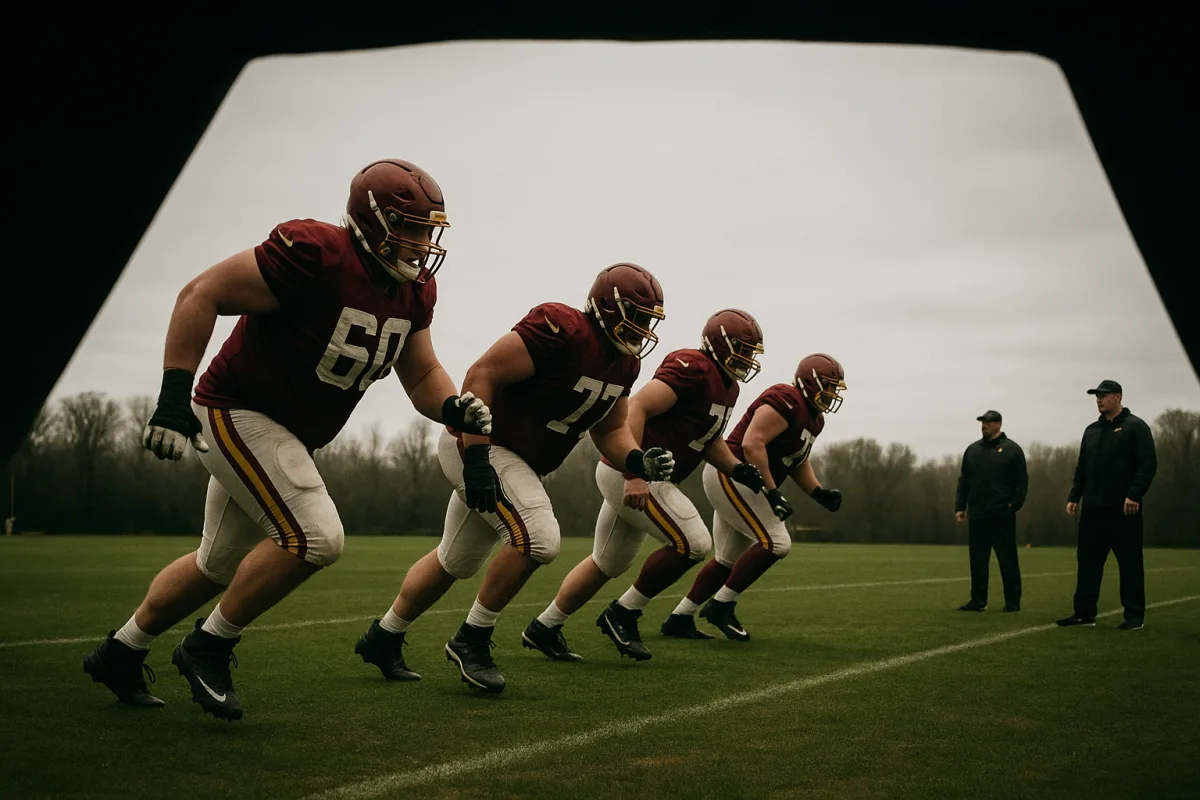
Start with who is actually available
The first mistake in evaluating Washington’s offensive line is treating every preseason projection as current information. The group that looked plausible when the club added and extended veterans is not the same group entering the opener.
Laremy Tunsil’s torn triceps is the defining development. The Washington Post reported that Tunsil is on injured reserve and out for the season, removing the tackle whose two-year, $60.2 million extension had lowered his 2026 cap number from $24.9 million to $11.9 million. [2][9][10]
That matters beyond the obvious loss of talent. Tunsil was supposed to give the Commanders a stable answer at a premium position, allowing the rest of the line to settle into complementary roles instead of asking young players to absorb the toughest matchups.
The official depth chart has Josh Conerly Jr. at starting right tackle, although roster projections have not been entirely consistent and some listings have included Tyler Cooper among projected starters. [3][4] That is not a minor bookkeeping issue in the week before Philadelphia.
A team can survive an unsettled backup competition in August. It cannot afford communication ambiguity when facing a defense that changes fronts, creates one-on-ones for its edge rushers and makes offenses declare protection before the snap.
Nick Allegretti is the other practical concern. Washington moved him from guard to center to address the middle of the line, but his calf strain has limited his practice availability, according to the Washington Post. [2]
The Commanders therefore need to plan as though Allegretti’s status will affect more than his own snaps. If he plays, the question is whether he can execute the full protection menu. If he does not, the line loses its intended pivot.
Separate the encouraging tape from the current roster reality
Washington’s in-house film breakdown with former NFL lineman Logan Paulsen makes a fair point: there is more athleticism in this line than the broad “they cannot block” narrative suggests. But the tape needs to be read for what it is.
On outside-zone concepts, Paulsen highlighted Brandon Coleman’s ability to work back across a defender and create space for the back’s initial track. He also showed Chris Paul creating displacement at the line before climbing to a linebacker. [11]
That is useful evidence. Outside zone is not a play where a lineman can merely be big and occupy space. Tackles and guards must reach leverage, keep their shoulders controlled and avoid allowing defenders to cross their face.
Conerly’s clips were also encouraging in that narrow context. Paulsen pointed out a backside reach block in which Conerly initially yielded ground, recovered his hat placement and prevented a three-technique from chasing the ball down the line. [11]
That is the trait Washington needs from its younger blockers. The play does not require a pancake block. It requires enough horizontal control to give the runner a cutback lane, then enough body control not to lose the defender late.
The same film showed a coordinated element that matters more than one individual block. On wide-zone looks, Washington’s blockers appeared to understand the intended landmark and the sequence of the combination blocks, rather than chasing defenders independently.
That is a better sign than a single highlight rep, because zone runs fail when one player wins physically but another misses the timing of the climb to the second level. The film showed the potential for coordinated movement.
Still, potential is not the same as a settled Week 1 line. Those clips included Coleman, Conerly, Paul and Allegretti, but Tunsil’s season-ending injury and Allegretti’s limited work materially change how much confidence anyone should take from earlier positive snaps. [2][11]
Identify what the run game can realistically lean on
If Washington wants to protect Jayden Daniels early against Philadelphia, the run plan should not be built around repeatedly moving the Eagles’ front vertically. The more realistic path is to use movement, angles and constraint.
The outside-zone tape supports that approach. Paulsen’s examples repeatedly showed the line winning by reaching defenders, stretching the front horizontally and letting the runner press the track before choosing a vertical crease. [11]
That is particularly important against a large interior defender such as Jordan Davis. Washington’s tape included a rep in which Coleman used hand placement and leverage on the backside rather than attempting to overpower Davis outright. [11]
The coaching point for the backs is equally clear. The blocking can create the cutback, but the runner must take it. Paulsen noted a play where the backside lane appeared available after Conerly and Coleman did their work, but the ball did not find it. [11]
For Week 1, watch Washington’s early-down distribution. If the Commanders are consistently reaching second-and-long after runs that never threaten the backside, the scheme is not functioning as designed, regardless of the final rushing total.
A respectable rushing-yard number can mislead. A quarterback scramble, a late explosive run or successful short-yardage attempts can inflate the total while the offense still fails to generate efficient early-down runs against standard defensive fronts.
The better indicators are whether Washington creates second-and-manageable, whether Daniels has play-action opportunities on schedule and whether the backs are reaching the second level before contact. Those outcomes tell more about line functionality than raw rushing yards.
The pass-protection test is harder
The best pass-protection clip in Washington’s film package showed Coleman staying square against Eagles edge rusher Nolan Smith. Paulsen emphasized Coleman’s length, patience and ability to force the rusher off a clean path to the quarterback. [11]
That rep should temper the assumption that Coleman cannot play tackle. His pass sets on that tape were controlled, and he did not open the gate early or chase the rusher past the quarterback’s launch point.
Chris Paul also had an encouraging one-on-one against Davis, using a firm base and early contact to stop the interior rusher from building power. The tape supports calling Paul a functional run blocker with enough strength to compete inside. [11]
But individual wins are not the same as solving the whole protection problem. The Commanders’ own clips often included a tight end chip, a running-back responsibility or help from an adjacent lineman. That is normal football, not an indictment.
It does mean Washington should be deliberate with its protection menu. If the offense keeps a tight end attached or chips an edge rusher, it is buying time for Daniels and protecting a tackle. It is not necessarily signaling fear.
The risk comes when those resources are required on both edges and inside pressure still reaches the quarterback. That shrinks the route structure, reduces available receiving options and makes the offense easier for a defense to crowd.
NBC Sports characterized Washington’s line as “inoperable” in a joint practice against Baltimore, while an independent ranking placed the unit last in the league after Tunsil’s injury. [7][8] Those reports are warnings, not final-grade evidence.
There are no meaningful 2026 regular-season sack, pressure or run-blocking numbers yet. Preseason and joint-practice reports can reveal assignment problems and matchup trouble, but they cannot establish how this line will perform over a full schedule. [5][7]
Center communication is the pressure point
Allegretti’s value in the film package was not just physical. Paulsen highlighted a pressure look with seven potential rushers against six protectors, where Allegretti checked the linebacker’s drop and redirected to help the back handle the actual threat. [11]
That is the sort of snap that decides whether a protection looks sound or disastrous. The offense cannot account for every possible rusher one-on-one, so the center and guards must diagnose which defenders are truly coming.
If Allegretti is active but restricted, Washington should simplify where necessary. That does not mean abandoning protection adjustments. It means avoiding a game plan that requires a player with limited practice reps to make constant late redirects.
Philadelphia will test that. The Eagles do not need to blitz recklessly to create stress. They can threaten pressure, force the line to communicate and then win with their front when protection slides or help assignments move elsewhere.
The most revealing early snaps may not be sacks. Watch for free runners who force Daniels to throw hot, guards turning late toward stunts, or a back stepping into the wrong gap. Those are operation failures.
Washington’s film did show encouraging awareness from the younger players. Paulsen noted Conerly recovering when his initial rusher dropped and then helping inside, while Coleman maintained a square posture to assist on a stunt. [11]
That should be the baseline, not the headline. The line does not need every blocker to dominate Philadelphia’s front. It needs five players, plus the tight ends and backs when called upon, to identify threats consistently.
What Quinn’s preparation can and cannot solve
Dan Quinn said Washington’s camp included long drives, two-minute situations and more plays within the same number of practices because players returned in strong condition. [11] The stated goal was to make the team operate while fatigued.
Quinn also described frequent competitive periods, including fourth-down, red-zone and two-point situations. Those periods matter because they force players to execute in the parts of the field where protection mistakes are magnified. [11]
More notably, Quinn said the staff used unscripted situations. Instead of players knowing whether the next period would feature runs, dropback protection or a specific down-and-distance, coaches introduced changing scenarios and expected immediate responses. [11]
That is relevant to an offensive line dealing with transition. A new center arrangement, injury-driven adjustments and a Week 1 opponent capable of changing the picture all demand rapid communication, not merely mastery of isolated drills.
Quinn’s explanation also applies to the coordinators. A second-and-15 after a penalty, or a late-clock call in two-minute, cannot be fully rehearsed through a static script. The camp format was designed to stress the decision-makers too. [11]
Still, avoid overstating it. Publicly available reporting does not establish a documented year-over-year conditioning overhaul, nor does it show that a demanding camp has fixed the line’s depth problem. [2][13]
Kurt Warner’s recollection of Super Bowl XXXVI is a useful reminder here. He described New England’s defense as stymieing the Rams’ high-powered offense, and said the Rams struggled to finish drives despite their talent. That is what front disruption does.
Preparation can help Washington identify protections, maintain composure and keep calls clean. It cannot manufacture a healthy left tackle, create experienced depth overnight or erase a matchup disadvantage when an elite rusher wins quickly.
Use the opener as a diagnostic, not a referendum
The first game should answer specific questions. Can Conerly hold his pass-set landmarks without constant help? Can Coleman handle reach blocks and pass rushes without compromising the rest of the protection? Can Paul sustain inside movement?
Most of all, can the center set the front cleanly and get the line pointed in the same direction? If Allegretti plays, track whether Washington trusts him with full checks and changes. If he does not, note how much the menu narrows.
Do not overreact to one sack. A sack may be a coverage play, a quarterback holding the ball, a designed deep concept or a protection loss. The film must identify who was responsible and whether the call had an answer.
Likewise, do not accept a clean stat line without context. Daniels can avoid pressure with mobility, and quick throws can prevent sacks from appearing. The relevant question is whether the line gives the offense usable downfield options.
Washington’s best route through this opening stretch is clear from the available tape and reporting: use the athleticism shown in zone concepts, protect the edges with coordinated help when needed and make center communication the non-negotiable priority.
Frequently Asked Questions
What injuries are affecting the Washington Commanders offensive line in 2026?
Laremy Tunsil is on injured reserve with a torn triceps and will miss the entire season. Additionally, center Nick Allegretti is dealing with a calf strain that has limited his practice availability and may affect his readiness for Week 1.
How is the Washington Commanders offensive line shaping up for the 2026 season?
The offensive line is facing significant challenges due to injuries and depth concerns. While some younger players like Brandon Coleman, Josh Conerly Jr., and Chris Paul have shown athleticism and movement skills in outside-zone concepts, the loss of Tunsil and limited practice from Allegretti have raised doubts about the line’s overall effectiveness.
What challenges does the Washington Commanders offensive line face entering Week 1?
The main challenges include uncertainty at right tackle, with Josh Conerly Jr. listed as the starter but some projections including Tyler Cooper, and the questionable availability and effectiveness of Allegretti at center. The line must also handle complex defensive fronts and protection calls without the stability Tunsil would have provided.
How does the Washington Commanders offensive line impact their run game strategy?
The line’s ability to execute outside-zone blocking is crucial for creating running lanes. Film analysis shows that players like Coleman and Paul can create space and displacement, which is important for the Commanders’ running backs to find cutback lanes and maintain horizontal control on blocks.
Who are the key players on the Washington Commanders offensive line in 2026?
Key players include Laremy Tunsil (tackle, injured reserve), Nick Allegretti (center, dealing with a calf strain), Josh Conerly Jr. (projected starting right tackle), Brandon Coleman (guard), and Chris Paul (guard). The stability and performance of these players will be critical to the line’s success.
How we researched this
This article was assembled from 3 video sources across 2 channels, 13 cited references.
Nothing here is based on hands-on testing. Where a figure or finding appears, it belongs to the source cited beside it, and the writing says so rather than implying otherwise. Every source is listed below so you can check it.
Sources
THE TRUTH about the Commanders O-Line…WATCH THE FILM 👀 | Washington Commanders | NFL — Washington Commanders
Kurt Warner reflects on Super Bowl XXXVI with St. Louis Rams | NFL Live — NFL on ESPN
Counting Down To Commanders Kickoff With HC Dan Quinn | Washington Commanders | The Gameplan | NFL — Washington Commanders
The Commanders’ offensive line was a strength. Now it’s a question mark. - The Washington Post
2025 Washington Commanders Team Vegas Lines | Pro-Football-Reference.com
Commanders' Offensive Line Concerns Cast Doubt on Projected Win Total - Fantasy Nerds
Washington o-line 'inoperable' in joint practice - NBC Sports
Commanders Offensive Line Ranked Last After Tunsil Injury as Week 1 Nears | ENFELL
Laremy Tunsil contract: Commanders extend OT, becomes highest-paid OL in NFL history - CBS Sports
2026-27 Washington Commanders Salaries and Contracts - SalaryLeaks
Commanders Finally Have Real O-Line Depth. Training Camp Will Decide How It Fits
Watch Washington Commanders Season Preparation and Offensive Line Analysis on Youtube
Also from the sources
Related Articles
Washington Commanders Upset Win Over Seattle Seahawks
Detailed analysis of the Washington Commanders' upset win over the Seattle Seahawks, focusing on quarterback performance and key game factors.
Seattle Seahawks 2026 Season Preview and Coach Mike
Get a detailed Seattle Seahawks 2026 season preview with insights on Coach Mike Macdonald, roster changes, and key player roles.
Dan Quinn Washington Commanders Coaching Challenges in 2026
Explore the coaching challenges Dan Quinn faces with the Washington Commanders, including game management and operational errors in 2026.
Los Angeles Rams Struggles and 2026 Playoff Outlook
Explore the Los Angeles Rams struggles, key issues, and their 2026 playoff outlook with detailed analysis of offense, defense, and coaching adjustments.