
Arizona Cardinals Week 7 Injury Updates and Game Prep
Get the latest Arizona Cardinals Week 7 injury updates and how they shape the team's game preparation against Denver.
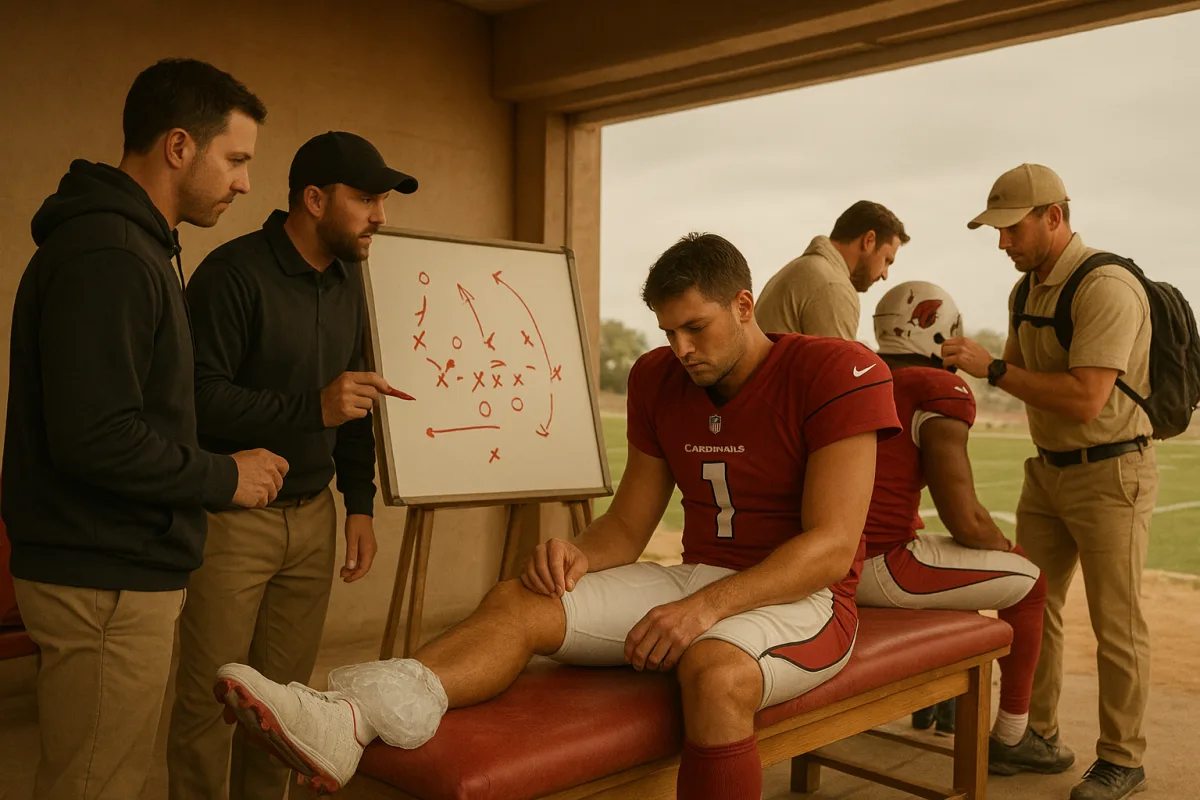
Start with the availability board, because the personnel answers shape the plan
The first issue for Arizona entering Sunday’s home game against Denver is not a hidden matchup or a clever tendency. It is who can practice enough to be trusted with a full workload against one of the league’s most disruptive defenses.
Running back Jeremiyah Love remains the clearest concern. He injured his left ankle in Week 4, played 36 offensive snaps in Week 5, then missed the Rams game and did not practice Wednesday. [1][2] That sequence matters more than a broad claim that he is “improving.”
Head coach Mike LaFleur said Love was feeling better but would not return him until he was fully ready. That is sensible language, but it is not a Week 7 availability declaration. The Cardinals have also indicated they do not plan to place him on injured reserve, which suggests they view this as a shorter-term absence. [1]
Still, there is a difference between avoiding injured reserve and being able to plant, cut and pass protect on Sunday. The independent reporting around Love’s injury indicates it has limited his cutting and passing-game role, two areas that become especially relevant against Denver’s pressure packages.
Arizona should build the initial plan as though Love might be unavailable or restricted. That means putting the remaining backs through the full menu of protection calls during the week, not merely preparing them for carries. Denver’s front can turn one missed scan or late pickup into a drive-ending play.
Safety Budda Baker offers a more positive, but still incomplete, update. Baker missed Wednesday with a groin issue and illness, then participated fully Thursday. He remained questionable for Sunday. [3] Full participation improves the odds, but it does not erase the designation or permit anyone to assume his normal snap count.
The Cardinals also need contingency reps at safety because Andrew Wingard is dealing with a knee injury and Wydett Williams Jr. has been in concussion protocol. [3] This is not only a depth-chart issue. It affects communication against a Denver offense that can use formations and tempo to force coverage adjustments.
Offensive lineman Jedrick Wills Jr. was among the players absent Wednesday because of illness, according to LaFleur. The later reporting does not provide a clear practice-participation update for him, so it would be irresponsible to label him either available or out. Arizona needs a prepared alternate offensive-line combination until the final report settles it.
Other Wednesday absences included defensive lineman Walter Nolen III, guard Isaac Seumalo, outside linebacker Josh Sweat, cornerback Garrett Williams and Wingard. [3] Seumalo and Sweat were listed for rest, which should not be treated the same as an injury absence, while Nolen, Williams and Wingard present genuine roster questions.
The broader injury list has been active all season, including Isaiah Adams on injured reserve and tight end Tip Reiman on the physically unable to perform list. [5] The useful takeaway is not that injuries explain everything. It is that practice reps and game-day roles may be dictated by who can execute assignments cleanly, not by name recognition.
Do not mistake last week’s field-goal volume for offensive control
Arizona beat the Rams 18-16, ended a four-game losing streak and got Chad Ryland’s 43-yard walk-off field goal. Those are meaningful results. They do not make the red-zone operation acceptable.
The Cardinals reached the red zone five times against Los Angeles and converted none into touchdowns. Three possessions became first-and-goal situations, yet every one ended with a Ryland field goal. The offense also produced four drives of at least 10 plays, including two that consumed more than eight minutes. [Arizona Cardinals, Cardinals Underground]
That is the tape-and-snap-count distinction worth keeping. Arizona was not dysfunctional between the 20s. Jacoby Brissett repeatedly moved the offense, and the protection was solid enough to sustain possessions. But the shorter field changes the math.
Defenses no longer have to protect deep space, throwing lanes tighten and condensed formations create more bodies near the ball. The Cardinals cannot merely import their open-field calls and expect the same answers inside the 20.
Brissett’s explanation was appropriately simple: Arizona did not finish. He described it as a play here or there, not a magical correction. That should be read as an execution diagnosis, not a claim that the solution will arrive automatically.
Trey McBride made a related point in his Wednesday press conference. The tight end said he still likes Arizona’s red-zone plan, but cited penalties, missed assignments and player execution as possible reasons the unit failed to complete drives. That is more specific than blaming either the quarterback or the play caller for every failed possession.
For practical preparation, Arizona should first examine first down in the red zone. A penalty, negative run or incompletion immediately creates a long-yardage environment where Denver can lean into its pass rush and coverage disguises. Avoiding second-and-goal from distance is not glamorous, but it changes the rest of the series.
The Cardinals also need their heavier personnel packages to create actual advantages. McBride said 13 personnel, one back and three tight ends, has been productive because it can generate favorable run and pass matchups. Brissett said the grouping cleans up the pre-snap picture by clarifying possible defensive responses.
That package does not work by existing on the call sheet. It requires the tight ends to block at the point of attack when Denver responds with larger fronts, and it requires Arizona to punish a defense that stays in base personnel with a pass matchup. McBride acknowledged both sides of that assignment.
The Denver challenge starts with pressure, not just coverage
Denver arrives with 18 sacks, second in the NFL, and seven interceptions, first in the league. [6] Those numbers establish the type of game Arizona is preparing for, but they do not tell the whole story.
Sack totals do not mean every pressure is a blitz. Interception totals do not prove that every turnover comes from a quarterback forcing a throw. The Cardinals have to identify whether pressure is arriving with four rushers, simulated looks or extra rushers, then align the protection and route timing accordingly.
LaFleur described Denver defensive coordinator Vance Joseph’s unit as smart, physical and unified, with an old-school element to its coverage approach. He emphasized that the Broncos play hard and execute their system without apology. That is coach-speak only until it translates to the operational problem it creates.
The operational answer is to avoid letting the defense dictate the quarterback’s internal clock. Brissett said the plan must mix quick game, shot plays and movement throws, while the quarterback works through progressions and feels the pocket. That is the correct framework against a defense built to create havoc.
Arizona should not read “be aggressive” as permission for low-percentage throws into coverage. Broncos quarterback Bo Nix described his own needed adjustment as balancing aggression without being reckless. The same principle applies to Brissett against Denver’s seven interceptions. [6]
A shot play has value when protection, route leverage and coverage structure justify it. A hurried throw after a free rusher wins is simply a turnover opportunity. The Cardinals’ best counter is not abandoning deeper concepts. It is earning them with protection and efficient early-down offense.
The Rams game supplied a useful baseline. Brissett credited the offensive line, backs and tight ends for recognizing not just defensive looks but how those looks were being set up. That is the work Arizona must repeat, especially if Love’s ankle limits a back who might otherwise handle pass-protection duties.
Use man-coverage answers, but demand better detail at the catch point
LaFleur said Arizona had opportunities to call better plays against man coverage, but also saw receivers create separation without completing the play. Brissett agreed that the group made progress getting open in key spots. That is a useful admission because it avoids the lazy conclusion that every incomplete pass is a coverage-win problem.
Denver has talented coverage players, including cornerback Patrick Surtain II, and McBride highlighted edge rushers, defensive lineman Zach Allen and the Broncos’ linebackers as major challenges. The Cardinals should expect tight windows and contested catches even when the design creates an initial advantage.
The answer is not necessarily to force targets toward a single player. McBride is Arizona’s premier receiving weapon, as Sean Payton noted, but Denver can build calls around taking away the first read. That places value on route precision from secondary receivers and on Brissett reaching his next progression on time.
Jaylen Brooks’ Rams performance is a relevant example of the required mindset. He had a difficult drop, then later made the catch that drew a 15-yard penalty and moved Arizona into range for Ryland’s winner. McBride credited Brooks’ response and his work on the scout team for earning opportunities.
That does not guarantee Brooks a larger role Sunday. It does show the standard Arizona needs from receivers who may not see many targets. A complementary target cannot spend the rest of the game reacting to one miss, because a pressure-heavy opponent may offer only one clean man-coverage look.
Keep the win in perspective, then make it useful
Brissett put the Cardinals’ emotional reset in the right place. Arizona won last week, then immediately began preparing for a Broncos team that does not care about that result. He pointed out that the previous Arizona win was followed by a four-game losing streak.
Momentum is real only if it changes the next week’s work. The Cardinals can carry forward the confidence from their final drive against the Rams, especially the calm sideline communication that got Ryland on the field for the decisive kick. They cannot carry forward the assumption that six field goals are a repeatable winning formula.
LaFleur has shifted Arizona’s on-field practices later in the day, an approach designed to give players more rest and improve focus. [4] The team has not disclosed special practice changes specifically tied to its current injury volume, so any claim of a dramatic injury-management overhaul would go beyond the available information.
What Arizona can control is more basic. Get the available backs fluent in protection, make the red-zone first down cleaner, use 13 personnel only when it creates a real matchup edge, and keep Brissett operating on time against Denver’s pass rush.
That is the Week 7 preparation checklist. It is not flashy, but the Cardinals do not need a narrative correction. They need a healthier game-day roster, cleaner details in scoring territory and fewer snaps where Denver’s defense gets to play on its terms.
Frequently Asked Questions
What is the injury status of Jeremiyah Love for Week 7?
Jeremiyah Love remains sidelined with a lingering left ankle injury and did not practice as of Wednesday before Week 7. Head coach Mike LaFleur indicated Love is feeling better but will only return when fully ready, with no official timetable given. The Cardinals do not plan to place him on injured reserve, suggesting a shorter-term absence, but his availability for Week 7 is uncertain.
Which Arizona Cardinals players are questionable or out for Week 7?
Key questionable players include Jeremiyah Love (ankle), Budda Baker (groin and illness), Andrew Wingard (knee), and Wydett Williams Jr. (concussion protocol). Tight end Tip Reiman remains on the Physically Unable to Perform list. Several other players missed practice for rest or illness, but the primary injury concerns affecting Week 7 depth are at running back and safety.
How might Budda Baker's injury affect the Cardinals' defense in Week 7?
Budda Baker practiced fully on Thursday but remains questionable, so the Cardinals must prepare safety depth for multiple outcomes. With Andrew Wingard also dealing with a knee injury and Wydett Williams Jr. in concussion protocol, the team faces challenges in communication and coverage adjustments against Denver’s offense, which uses formations and tempo to force defensive changes.
What impact do injuries have on the Cardinals' Week 7 game plan?
Injuries have forced the Cardinals to prepare backups for key roles, particularly at running back and safety, and to emphasize clean execution over individual star power. The uncertainty around Love’s availability means the offense must ready other backs for full protection duties, especially against Denver’s strong pass rush. Defensive communication and coverage flexibility are also affected by injuries in the secondary.
Who are the potential replacements for injured Cardinals players in Week 7?
While the article does not name specific replacements, the Cardinals are preparing their remaining running backs to handle full protection responsibilities if Jeremiyah Love is unavailable. At safety, backups must be ready to step in due to injuries to Budda Baker, Andrew Wingard, and Wydett Williams Jr. The team is also preparing alternate offensive-line combinations given some players missed practice due to illness.
How we researched this
This article was assembled from 5 video sources across 2 channels, 2 published articles, 8 cited references.
Nothing here is based on hands-on testing. Where a figure or finding appears, it belongs to the source cited beside it, and the writing says so rather than implying otherwise. Every source is listed below so you can check it.
Sources
QB Bo Nix ahead of Week 7 vs. Cardinals: 'I feel like I can play better' — Denver Broncos
HC Mike LaFleur Press Conference 10.21.26 | AZ Cardinals — Arizona Cardinals
Cardinals Underground - Seeing Red (Zone), Blitz Happy, And 11 Forever | Arizona Cardinals 2026 — Arizona Cardinals
TE Trey McBride Press Conference 10.21.26 | AZ Cardinals — Arizona Cardinals
QB Jacoby Brissett 10.21.26 | AZ Cardinals — Arizona Cardinals
Cardinals RB Jeremiyah Love remains out of practice — Pro Football Talk
Broncos run game woes mostly a running back issue — SB Nation
Jeremiyah Love Remains Sidelined Ahead of Week 7 - NFL News | Fantasy Football
New Practice Schedule Hot Topic For First-Year Coach Mike LaFleur
2026 Arizona Cardinals Injuries | Pro-Football-Reference.com
Denver Broncos at Arizona Cardinals 2026 REG 7 - Game Center
Arizona Cardinals Injury Report and Status 2026-27 - CBS Sports
Terrorífica Semana 6 para los receptores de la NFL; siete figuras terminaron lastimadas
Watch Arizona Cardinals Week 7 Preparation and Injury Updates on Youtube
Also from the sources
Related Articles
Arizona Cardinals Week 2 Injury Updates and Preparations
Get the latest Arizona Cardinals Week 2 injury updates and player news as they prepare for their game against the Seahawks.
NFL Week 3 Team Preparations and Media Availability Updates
Get the latest NFL Week 3 team preparations, player statuses, and media availability insights to understand upcoming game strategies and key updates.
Arizona Cardinals Week 1 Media Availability and Team Outlook
Get insights from Arizona Cardinals Week 1 media availability, injury updates, and team outlook ahead of the 2026 season opener.
San Francisco 49ers Week 4 Preview and Player Updates
Get the San Francisco 49ers Week 4 preview with injury updates and analysis on handling Denver's pressure defense.