
J.D. Vance Bengals Visit Highlights NFL's Political Access
Explore J.D. Vance's Bengals visit and how NFL teams now manage political figure access during practice sessions.
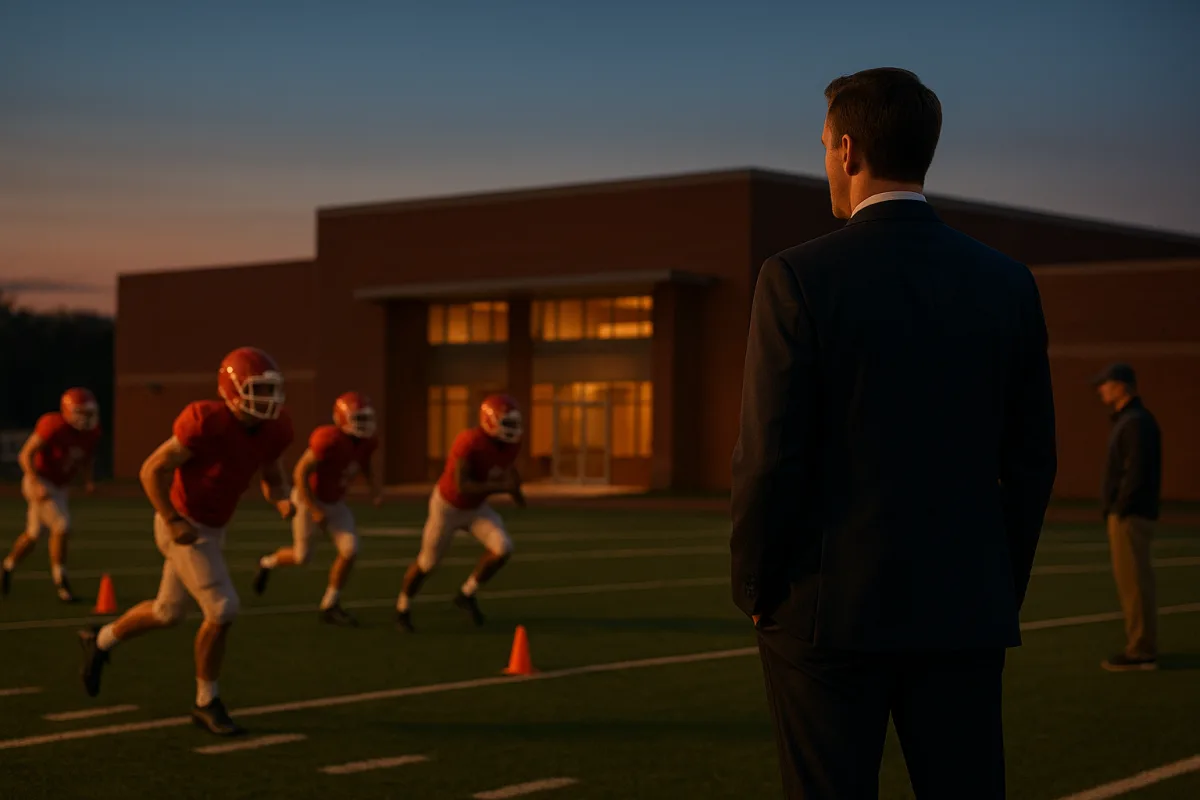
J.D. Vance’s Bengals Visit Shows the NFL Is Becoming More Careful About Political Access
The shift is from ceremonial access to managed access
The plain shift is this: NFL teams are increasingly treating political figures as visitors to be managed, rather than honorary insiders automatically entitled to a stage. The Bengals’ handling of Vice President J.D. Vance’s October 21 practice visit made that visible. [1][2]
That does not mean the league has adopted a formal anti-politics position. It means teams understand that a practice facility has a football purpose first, with tightly timed meetings, rehab blocks, walk-throughs and player preparation dictating who gets access.
The available footage from Cincinnati does not show a dramatic showdown. It shows Vance standing near Bengals players as many move past him, while tight end Drew Sample briefly greets Vance and his son. Head coach Zac Taylor also shakes Vance’s hand. [1]
That distinction matters. A video of players walking by is evidence that they walked by. It is not clean evidence that every player intended a political statement, disliked Vance, or had been instructed to ignore him.
Still, the broader pattern is real enough to examine because several outlets independently focused on the same on-camera fact: there was no obvious, organized player reception. The Daily Beast, BVM Sports, Yahoo Sports and HuffPost all framed the encounter around players passing Vance rather than gathering around him. [1][2]
Those are not four independent sets of locker-room reporting. They are largely separate publications reacting to the same public video and the same unusually restrained scene. That is an important limitation, especially when a clip starts driving its own narrative.
What the tape establishes, and what it cannot
NBC 5 Cincinnati sports director Charlie Clifford captured the visit on video, and BVM Sports reported that the clip quickly surpassed two million views. That scale turned a routine-looking facility moment into a national political and sports-media story. [2]
From a football reporting standpoint, this is similar to evaluating a single rep from an All-22 cut-up. A rep can be meaningful. It cannot, by itself, tell readers the entire game plan, reveal every assignment, or establish the emotional temperature of a building.
The visible facts are narrower. Vance, an Ohio native and longtime Bengals fan, visited the team’s Cincinnati facility without public advance notice. Sample briefly engaged him, Taylor shook his hand, and many other players did not stop for a visible greeting. [1][2]
Quarterback Joe Burrow supplied the most relevant follow-up. Yahoo Sports reported that Burrow said he did not interact with Vance and did not know the vice president would be at practice. [7]
That is more revealing than social-media speculation, but it still should not be overstated. Burrow’s lack of advance knowledge does not establish that Bengals leadership deliberately kept the visit secret from every player, or that the team had an internal dispute.
No detailed public comments from Bengals players, Taylor, the club or the NFL have explained the visit’s planning. There is no reported internal memo, player directive, sponsor connection or league instruction that fills in those blanks. [1][4][7]
The absence of that reporting matters because political stories invite people to write motivations into body language. Some viewers saw a deliberate snub. Others saw players simply moving through a workday. The evidence supports neither certainty.
Why the reception looked different from a normal team appearance
The NFL has always hosted public figures. Presidents have appeared at games, members of Congress have attended team functions, and clubs routinely accommodate governors, mayors, military guests and community leaders. The difference is timing, control and political polarization.
A game-day suite appearance is built for ceremonial access. A practice field is different. Players may be heading to position work, treatment, strength sessions, meetings or media obligations. The number of seconds available for an unscheduled greeting can be close to zero.
That is where football logistics matter more than the optics-first reading of the clip. A player does not need to make a political calculation to keep walking at practice. He may simply be following the day’s schedule.
At the same time, a vice president’s arrival changes the calculation. Players know any interaction can be filmed, reposted, interpreted as an endorsement, or used as a political symbol. In that setting, a brief greeting can carry more public meaning than intended.
The Bengals also had no obvious institutional reason to convert a fan visit into a roster-wide event. Research has found no reported financial or sponsorship relationship between Vance and the Bengals or between Vance and the NFL. [4]
There is also no publicly disclosed NFL-wide protocol governing domestic visits from political officials. The league has public partnerships with government entities, including a State Department initiative centered on global sports diplomacy, but that is not a published rulebook for facility access. [5]
That leaves the practical decisions with individual clubs. Who knows the visitor is coming, where the visitor can go, whether cameras are present, and whether players are asked to participate can all vary by team and occasion.
The media trend is real, but the evidence is thin
The media trend is not that reporters suddenly discovered politics in football. The trend is that short, visually legible interactions now get covered as evidence of institutional alignment or player resistance, even when the underlying reporting remains limited.
Yahoo Sports, HuffPost, Yahoo News Singapore and the Daily Beast each emphasized the unexpected coolness of the visible reception. The shared editorial judgment was understandable because a vice president visiting his hometown favorite team is inherently newsworthy. [1][2]
But the coverage also demonstrates how quickly a viral clip can flatten the football context. It is easier to show players walking past than to document meeting schedules, access protocols, personal preferences or the fact that many players may not have known a visit was planned.
That is why Burrow’s comment is useful. It does not prove a coordinated effort, but it directly undercuts a common assumption that the entire roster had been briefed and chose a collective response. [7]
The right phrasing is that the Bengals did not provide Vance a visible teamwide welcome in the footage that circulated. The wrong phrasing is that the Bengals roster formally rejected him. There is no public evidence for the latter.
This is a familiar problem in NFL coverage. A stat can tell you that a receiver had two catches. It cannot tell you whether he was bracketed, whether the quarterback missed him twice, or whether he was asked to block on the primary concepts.
Likewise, the Vance video provides a countable on-camera result: limited visible engagement. It does not provide the hidden variables. There are no snap counts for attention, no access log for every conversation, and no public account of off-camera interactions.
Why it is happening now
This kind of story is happening now because the NFL is more continuously exposed to politics than it was a decade ago. Players have large individual platforms, games are always online, and every team facility interaction can become national content within minutes.
The league also remains under pressure from competing political constituencies. Reporting around Commissioner Roger Goodell and the Rooney Rule has shown how NFL diversity policies themselves can become a political target, regardless of what happens on the field. [3]
Separately, the NFL has had to publicly address questions about federal enforcement activity around major events. Yahoo Sports reported that the league said there were no planned ICE enforcement activities at Super Bowl 2026 after comments from Homeland Security Secretary Kristi Noem. [6]
Those stories are different from the Bengals visit, but they share a common operational problem. The NFL cannot keep politics entirely outside its business, so clubs must decide how much access, messaging and visibility they can responsibly control.
The cleanest response is not to pretend politics do not exist. It is to separate football operations from ceremonial access. Players should not be surprised at practice, and visitors should not be placed in a setting where a lack of staged interaction becomes the story.
What other teams should take from Cincinnati
For a team planning a visit from any elected official, celebrity or politically charged public figure, advance notice is the first requirement. Players do not need to be compelled to participate, but they should know who will be present and why.
Second, clubs should decide whether the visit is operational or ceremonial. If it is ceremonial, use a controlled space, designate the club representatives, set a short window and make participation clearly voluntary.
Third, teams should identify the media terms in advance. The Cincinnati episode became controversial because public video supplied just enough information to invite interpretation, while the team offered little context to resolve it. [1][2]
Fourth, do not confuse a facility visit with a football event. A club that interrupts position meetings or sends players into an impromptu photo line risks creating resentment, distraction and a misleading impression that participation represents a team political position.
The Bengals example also argues for restraint from outside observers. Sample’s brief greeting and Taylor’s handshake show that the encounter was not universal hostility. Burrow’s account shows that it was not a fully staged team function either. [1][7]
That middle ground is less satisfying than a viral narrative, but it fits the available evidence. In NFL terms, this was not a unanimous locker-room statement. It was an unexpected visitor meeting a working team, with cameras catching who did and did not break stride.
Frequently Asked Questions
What happened during J.D. Vance's visit to the Bengals practice?
J.D. Vance made an unannounced stop at the Cincinnati Bengals’ practice facility on October 21, 2026. The visit was brief and informal, with Vance standing near players while most continued their activities. Tight end Drew Sample briefly greeted Vance and his son, and head coach Zac Taylor shook his hand.
How did Bengals players react to J.D. Vance's visit?
Most Bengals players did not stop to engage with Vance and walked past him during practice. The widely circulated video shows a largely muted reception, though it does not definitively prove the players’ motives or feelings toward the visit.
Did Joe Burrow interact with J.D. Vance during the Bengals visit?
No, Joe Burrow said he did not interact with J.D. Vance and was unaware that the visit was happening. This suggests the visit was not a coordinated team event.
Why was J.D. Vance's visit to the Bengals considered controversial?
The controversy arose because the visit was unannounced, and many players appeared to ignore Vance, which some interpreted as a political statement. The viral video showing players walking by Vance without greeting him sparked public debate, although there is no clear evidence of an organized snub.
How are NFL teams managing visits from political figures like J.D. Vance?
NFL teams are increasingly managing political visits carefully by setting boundaries such as advance notice, voluntary participation, and media rules. They treat political figures as visitors rather than insiders, prioritizing the football activities and preparation occurring at practice facilities.
How we researched this
This article was assembled from 1 video source, 4 published articles, 7 cited references.
Nothing here is based on hands-on testing. Where a figure or finding appears, it belongs to the source cited beside it, and the writing says so rather than implying otherwise. Every source is listed below so you can check it.
Sources
NFC East Without Jalen Hurts & What's Next for the Colts? | 40s and Free Agents — NFL
JD Vance Meets His Favorite NFL Team, but Most Players Walk Past — Yahoo Sports
JD Vance Visits His Favorite NFL Team – And The Reception Wasn’t What You’d Expect — HuffPost
JD Vance Visits His Favorite NFL Team – And The Reception Wasn’t What You’d Expect — Yahoo News Singapore
JD Vance Gets Frosty Welcome From Hometown Team in New Video — The Daily Beast
JD Vance Gets Frosty Welcome From Hometown Team in New Video
JD Vance Visits Bengals Practice as Players Walk Past Him - BVM Sports
Despite pressure from Florida AG Uthmeier, NFL's Goodell has no plans to scrap 'Rooney Rule' | WUSF
NFL, State Department launch public-private partnership promoting global sports diplomacy
Joe Burrow says he didn't interact with VP Vance during Bengals practice visit - Yahoo Sports
Watch J.D. Vance's Controversial NFL Team Visit on Youtube
Related Articles
NFL Roster Building Insights from Coaches and GMs
Explore NFL roster building insights from coaches and GMs on team construction, roster decisions, and managing the 53-man roster effectively.
Dan Quinn Washington Commanders Coaching Challenges in 2026
Explore the coaching challenges Dan Quinn faces with the Washington Commanders, including game management and operational errors in 2026.
Week 5 NFL Game Previews and Injury Impact Analysis
Get detailed Week 5 NFL game previews with injury updates and tactical analysis to understand how player availability shapes matchups.
NFL Week 3 Team Preparations and Media Availability Updates
Get the latest NFL Week 3 team preparations, player statuses, and media availability insights to understand upcoming game strategies and key updates.