
NFL Roster Building Insights from Coaches and GMs
Explore NFL roster building insights from coaches and GMs on team construction, roster decisions, and managing the 53-man roster effectively.
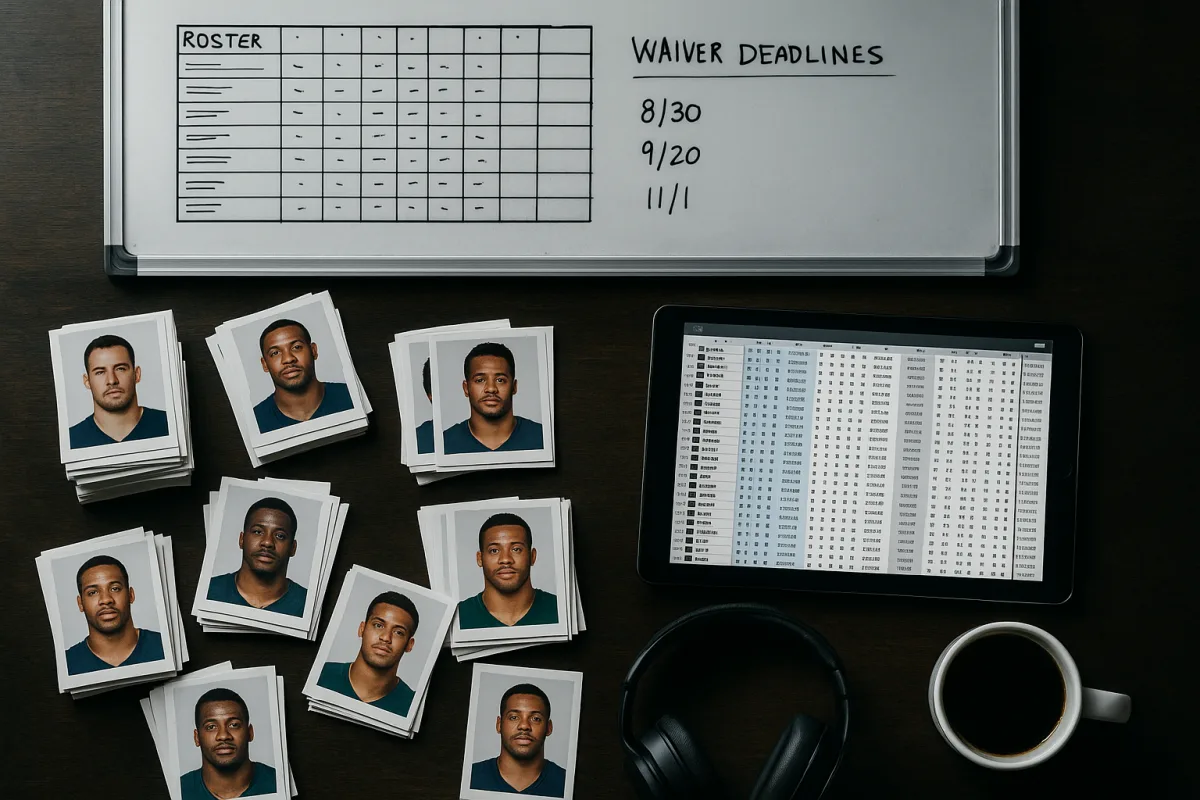
The initial 53 is an operating roster, not a final ranking
Coaches often say roster construction is ongoing because that is literally how the rules force them to work. The first 53 identifies the players a club is willing to carry through Week 1, not necessarily its 53 best pure athletes.
Denver Broncos general manager George Paton called the roster “a puzzle” and “fluid” after cutdown day. That is more precise than the familiar claim that a team simply keeps the best players available.
A general manager is filling jobs, not creating a power ranking. The jobs include early-down offense and defense, third-down packages, special teams, emergency depth, developmental positions and the inevitable replacements for players who get hurt.
That is why the bottom of a roster can look counterintuitive. A club may release a more talented receiver to retain a fourth running back who covers kicks, protects in pass protection and can function if the starter leaves Sunday’s game.
The public tends to treat a cut as a final scouting verdict. Paton’s explanation of the Broncos’ release of fifth-round rookie tight end Justin Jolie offered a better model: Denver still liked the player, but considered him raw and behind after missing offseason time.
That distinction matters at positions with heavy mental and technical demands. A rookie tight end must learn formations, motions, route adjustments, run-blocking surfaces, protection rules and special-teams jobs, often while competing against veterans who already handle several of them.
A preseason catch total does not reveal whether the player made correct protection calls or blocked the right edge defender. A preseason sack total does not explain whether an outside linebacker was assignment-sound against the run. The 53 is assembled with those hidden snaps in mind.
What changes at the cutdown deadline
The 2026 deadline required clubs to cut from 90 players to 53 in one move. [8] That compression creates a league-wide market immediately after every team has made its internal decisions.
CBS Sports’ cutdown tracker counted approximately 1,184 players released league-wide, with 512 eligible for waivers. [9] The important part is not the raw total. It is that every front office must evaluate its own cuts while studying hundreds of players released elsewhere.
A player subject to waivers is temporarily available to the rest of the league. A club that wants him places a claim, and the player goes to the claiming team rather than returning to his original club’s practice squad.
That is the real cost of cutting a young player. Denver can believe Jolie has an NFL future, but it cannot preserve him automatically. Paton acknowledged the risk that released draft picks could be claimed and said the club had weighed it.
The waiver system makes positional scarcity decisive. A developmental tight end may be difficult to retain because other teams value size and upside. A veteran long snapper can present a different calculation, particularly if his contract status lets a team re-sign him without waiver exposure.
Paton described Denver’s plan to place long snapper Mitchell Fraboni on the practice squad as a way to create flexibility. The aim was not to pretend the club did not need a snapper. It was to preserve an active-roster slot until game-week needs became clearer.
That is where the phrase “53-man roster” can mislead. The active list, practice squad and the pool of recently released players function as one larger personnel system, even though each category carries different restrictions and different risks.
Why practice-squad planning shapes the 53
The practice squad is where a front office tries to retain players it does not need on Sunday but may need by October. Paton said Denver started building that group immediately after the initial roster was set.
The practical value is depth without committing every player to the active roster. A young offensive lineman can continue taking scout-team snaps, learning the playbook and developing physically while the club uses the active spot on a player who can cover multiple game-day roles.
But the practice squad is not a private farm system. Other clubs can sign eligible players to their active rosters. So every decision requires an estimate of outside demand, not merely an internal projection.
Paton made that point when discussing claims, noting that the Broncos would monitor the waiver wire while hoping to bring several released players back. A club is simultaneously buyer and seller in that window.
The number of practice-squad candidates also affects preseason playing time. Coaches need enough late-game snaps to judge the players competing for the final places, but they also need to protect starters and core contributors from unnecessary August injury risk.
That explains a revealing exchange in the New York Giants’ team-channel cutdown availability. When asked whether players who sat out or played sparingly in the final preseason game had more secure jobs, coach John Harbaugh said that inference was fair.
It is not absolute proof. A player can be held out for health reasons, a planned workload or a pending transaction. Still, late-preseason usage is often a useful clue because coaches rarely need another evaluation on players already slotted into defined Week 1 roles.
The better reading of preseason snaps is therefore role-based. Ask who played with the first units, who took core special-teams snaps, who was trusted in protection situations and who remained on the field after the starters exited.
The fourth running back decision is not about rushing yards
Paton’s account of Denver’s final running back choice showed why raw preseason production is inadequate. He said the finalists were good runners with different skill sets, and specifically identified special teams and third-down value as relevant factors.
A fourth back may play few offensive snaps in Week 1. Yet he could be the personal protector on the punt team, the kickoff coverage player who prevents a hidden-yardage swing, or the only reserve trusted to recognize a blitz pickup.
That is a more valuable role than it sounds. If a team loses its starting running back in the first quarter, the backup must handle not just handoffs but route adjustments, pass protection and the game’s tempo. Coaches cannot solve that problem with a rushing average.
The same roster logic informed Denver’s decision to keep three quarterbacks. Paton said the Broncos did not want to risk losing reserve quarterback Sam Ehlinger after what the club regarded as a strong offseason, camp and preseason.
A third quarterback occupies a spot that could go to a receiver, cornerback or defensive lineman. The club accepts that cost because quarterback is unusually difficult to replace midseason, and because the backup’s command of the offense has value that is mostly invisible in box scores.
This is why front offices do not evaluate every position with the same arithmetic. Keeping seven defensive linemen may make sense for a team that rotates heavily up front. Keeping only four outside linebackers may be manageable if versatile players can cover those snaps.
Paton identified offensive and defensive line depth as organizational priorities and linked those groups to Denver’s recent success. That is a roster-building preference expressed through allocation, not a slogan about toughness.
A small trade can reveal the same logic
The Giants’ acquisition of interior defender C.J. Okoye for a 2028 seventh-round pick was the other side of the cutdown process. Instead of waiting to see whether a desired player became available, the club paid a minimal draft cost to secure him.
Harbaugh described Okoye as an A-gap and B-gap defender, a run stopper and pocket pusher. That role description is important because it identifies a specific use, not a generic belief that one more defensive tackle improves the roster.
Okoye played 214 snaps in 2025, recording 10 solo tackles and two pressures, while Pro Football Focus graded him 50.2, 98th among 134 qualifying interior defensive linemen. [7] Those numbers suggest limited proven production, not an established solution.
The tape-and-snap-count question is whether he can take meaningful early-down interior work without compromising the defense. A player with 214 snaps has shown enough to be evaluated, but not enough to erase uncertainty about a larger workload.
Harbaugh did not frame the trade as a finished answer. He said the Giants would continue looking across the roster landscape. That is the appropriate posture after a late-August depth move, especially at a position where injuries and short-yardage roles can rapidly change weekly needs.
The roster is built for September, then revised by evidence
The first month of the season supplies information preseason cannot. Coaches learn whether a reserve can execute against disguised coverages, whether a rookie’s special-teams role transfers to live games and whether an injury return will force a roster squeeze.
That is also why a team may retain a player it knows will not be immediately available. The roster is not only about opening day. It is an inventory of players, rights and contingencies for the weeks that follow.
The Aaron Donald contract situation with the Los Angeles Rams illustrates a separate but connected form of roster management. Donald’s reported deal carries a $20 million base value and can reach $30 million through incentives, but the precise cap breakdown has not been made public. [1]
The 2026 NFL cap is a hard $301.2 million per club. [2] A team can create room by converting salary into signing bonus or using voidable years, but that does not make the cost disappear. It shifts cap charges into future years. [4][5]
Incentive classification matters, too. Incentives considered likely to be earned count on the current cap, while not-likely-to-be-earned incentives are charged if earned, generally in the following year. [3] That is why a headline contract value does not automatically equal this season’s cap charge.
Still, the public should resist filling in unknown contract details with assumptions. Reporting has established the broad Donald terms, but not the exact signing-bonus amount, void-year structure or final 2026 cap hit. [1] Those details determine the actual accounting.
The same restraint applies to roster predictions. A preseason standout is not automatically a Week 1 contributor, and a player released on cutdown day is not automatically a mistake. The evidence arrives in usage, assignments and repeated regular-season snaps.
That is the lesson inside the coaches’ and general managers’ cautious language. The initial 53 is not a trophy for surviving camp. It is the first version of a weekly plan, revised whenever the waiver wire, injury report and game tape demand it.
Frequently Asked Questions
How do NFL coaches and GMs approach building the 53-man roster?
Coaches and GMs view the 53-man roster as an operating roster rather than a final ranking of the best players. They fill specific roles such as early-down starters, special teams contributors, emergency depth, and developmental spots. The roster is fluid and designed to manage weekly game-day needs and injuries, not simply to list the top athletes.
What factors influence NFL roster decisions beyond player talent?
Roster decisions consider positional needs, special-teams utility, mental and technical demands of positions, and the ability to survive early-season attrition. Teams also weigh developmental status and outside demand for players on waivers or practice squads, balancing immediate contributions against future potential.
Why is the NFL 53-man roster considered an operating roster?
The 53-man roster is the group of players a team commits to carry through Week 1, serving as a foundation for weekly adjustments. It reflects a combination of role coverage, depth, and flexibility rather than a definitive power ranking, with the understanding that roster construction continues throughout the season.
How do NFL teams use the practice squad in roster building?
Teams use the practice squad to retain players who are not needed on game day but may be required later in the season. It provides developmental opportunities and depth without occupying active roster spots. However, practice squad players can be signed by other teams, so clubs must consider outside interest when making decisions.
What role do preseason snap counts play in NFL roster decisions?
Preseason snap counts help coaches evaluate players’ ability to perform specific roles, contribute on special teams, and handle the mental and technical aspects of their positions. Coaches balance giving enough snaps to assess candidates for final roster spots while protecting starters from injury risk during August games.
How we researched this
This article was assembled from 5 video sources across 3 channels, 1 published article, 12 cited references.
Nothing here is based on hands-on testing. Where a figure or finding appears, it belongs to the source cited beside it, and the writing says so rather than implying otherwise. Every source is listed below so you can check it.
Sources
How will Aaron Donald navigate return to NFL action with Rams? | PFT PM | NFL on NBC — NFL on NBC
How will Aaron Donald navigate return to NFL action with Rams? | PFT PM | NFL on NBC — NFL on NBC
How will Aaron Donald navigate return to NFL action with Rams? | PFT PM | NFL on NBC — NFL on NBC
John Harbaugh: 'It's the beginning of the journey' | New York Giants — New York Giants
GM George Paton on building the Broncos’ roster: ‘It’s ongoing’ — Denver Broncos
8 winners and losers from Patriots roster cuts — SB Nation
NFL Void Years, Explained: How Teams Borrow Against Next Year's Cap — Daybreak Wire
NFL Signing Bonuses and Cap Proration Explained - LegalClarity
NFL salary cap officially set at $301.2M; Giants need to create space | Big Blue View
2026 NFL Roster Cuts: 53-Man Deadline, Rules & Printable Tracker
2026 NFL roster cuts tracker: Every move made on cutdown day as teams get down to 53 - CBS Sports
Watch Insights from NFL Coaches and GMs on Team Building and Roster Decisions on Youtube
Also from the sources
Related Articles
Giants Roster Moves and Odell Beckham Jr. Status Explained
Explore the Giants' roster moves and Odell Beckham Jr.'s status, focusing on practice squad roles and special teams impact.

NFL Week 3 Quarterback Insights and Offensive Analysis
Explore NFL Week 3 quarterback insights and offensive strategies from media, including Bo Nix, Joe Burrow, and C.J. Stroud’s performances.
NFL Week 1 Player Leadership Insights and Media Availability
Explore NFL Week 1 player leadership insights and media availability, highlighting key veterans, captains, and roster readiness for the season opener.
NFL Week 1 Quarterback Outlooks and Team Analysis
Explore NFL Week 1 quarterback outlooks with insights from coaches and analysts on team strategies and player readiness for the 2026 season opener.