
NFL Roster Cuts 2026: Key Player Moves and Team Strategies
Explore NFL roster cuts 2026 with analysis of key player moves, team strategies, and impacts on depth charts and season outlooks.
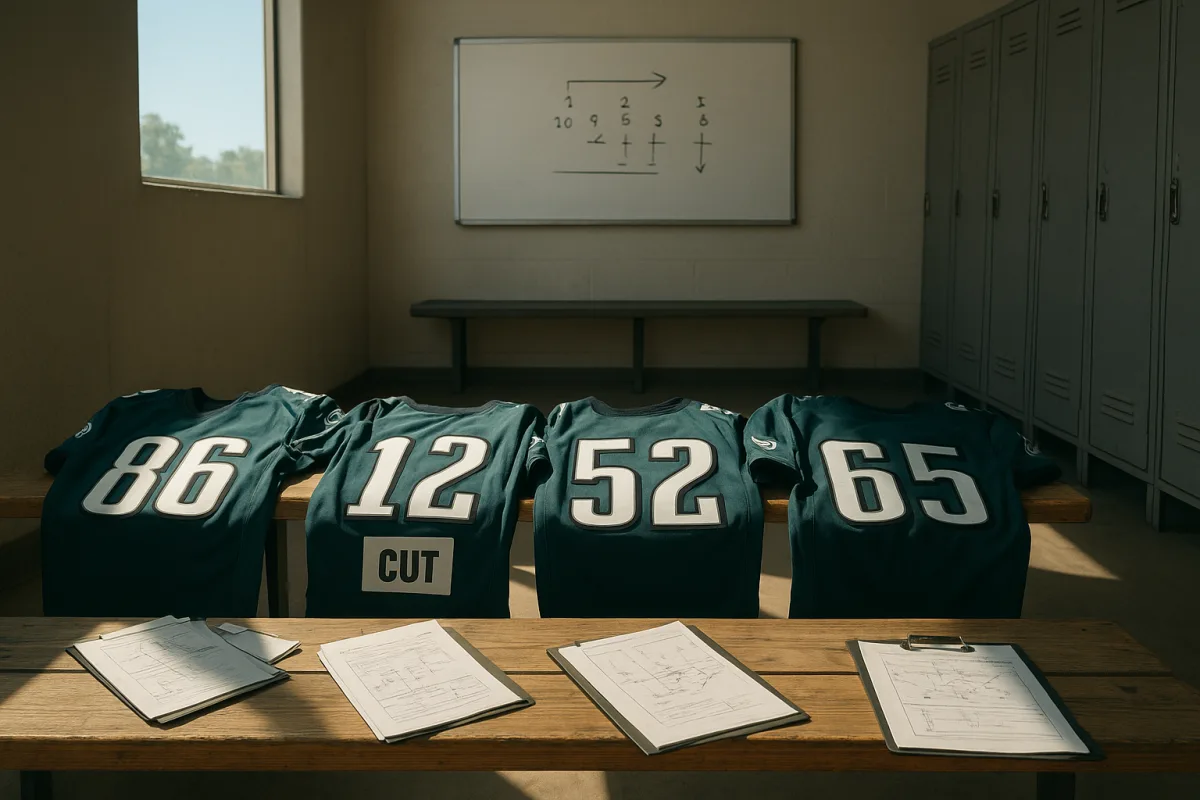
NFL roster cuts roundup: What the final moves say about team-building
The quick list
- Best overall: Cleveland Browns’ four-quarterback roster, for teams protecting young developmental passers while preserving immediate depth.
- Best value: New York Giants’ planned Braxton Berrios release-and-return maneuver, for clubs using veteran contract rules to keep a return specialist available without spending an initial 53-man slot. [4]
- Best for small spaces: Dallas Cowboys’ leaner running back room, for teams prioritizing concentrated roles over developmental depth, with clear durability risk. [2][3]
The reader’s real question on cutdown weekend is not which player “won” August. It is which roster decisions will still make sense once injuries, special teams workloads and Week 1 game plans start consuming snaps.
That distinction matters because a 53-man roster is not a depth chart. It is a set of active-roster slots, practice-squad options, waiver rules and contingency plans. The clubs that kept extra quarterbacks or traded for linemen are not necessarily declaring those players starters. They are deciding where they can least afford to lose an asset.
| Team and move | Reported price or transaction cost | Roster-space effect | Immediate football purpose | Primary trade-off |
|---|---|---|---|---|
| Browns keep Deshaun Watson, Shedeur Sanders, Dillon Gabriel and Taylen Green | No trade compensation reported | Four of 53 spots devoted to quarterbacks | Protect developmental passers and preserve emergency depth | Less room at another position, especially special teams depth [1] |
| Cowboys waive Jaydon Blue and Phil Mafah | No compensation reported | Clears two running-back spots | Consolidates reserve work behind Javonte Williams and Malik Davis | Less young depth, more injury exposure for Davis [2][[3]](https://www.rotoballer.com/player-news/phil-mafah-waived-by-cowboys/1919891?utm_source=openai "Phil Mafah Waived by Cowboys - NFL News |
| Giants release Braxton Berrios with plan to return him | No compensation reported | Temporarily opens one 53-man spot | Allows flexibility before Week 1 while retaining a return-game option | Another team can sign him immediately [[4]](https://www.foxsports.com/stories/nfl/2026-nfl-roster-cutdown-day-moves-releases-cuts-trades?utm_source=openai "2026 NFL Roster Cutdown Day Moves: Tracking Every Notable Move Around The League |
| Chargers place Branson Taylor on injured reserve | No purchase price, minimum four-game absence | Preserves a roster path after IR designation | Clarifies left guard picture around Kayode Awosika | Los Angeles loses a young interior-line option early [[4]](https://www.foxsports.com/stories/nfl/2026-nfl-roster-cutdown-day-moves-releases-cuts-trades?utm_source=openai "2026 NFL Roster Cutdown Day Moves: Tracking Every Notable Move Around The League |
| Cowboys acquire Broderick Jones Jr. from Steelers | Compensation not reported in supplied transactions | Adds an offensive-line roster slot | Invests in line depth rather than another back | Requires a corresponding cut and acclimation time [6] |
| Saints acquire Zamir White, trade Deion Jones to 49ers | Compensation not reported | Reallocates spots from linebacker toward backfield depth | Addresses positional needs through trade rather than waiver priority | New players must learn terminology quickly [6] |
The roster move that carries the most Week 1 risk: Dallas at running back
Dallas waived Jaydon Blue, its 2025 fifth-round pick, after a limited rookie season in which he recorded 38 carries for 129 yards and one touchdown across five appearances. The Cowboys also waived Phil Mafah, a 2025 seventh-round selection who had five carries for 18 yards and a touchdown in one injury-limited game. [2][3]
Neither stat line proves either back should have made the team. Blue’s 3.4 yards per carry is not a strong standalone argument, and Mafah’s sample is too small to establish much at all. The notable part is the roster construction that follows.
The reported result is a room led by Javonte Williams with Malik Davis as the primary backup. That is a much narrower arrangement than carrying two recent draft choices behind the starter. It also makes Davis more important than the nominal backup label suggests. [2][3]
Running back is a collision position, and the No. 2 back often has to contribute beyond carries. He may be the two-minute back, a pass-protection option, a kickoff participant or the player who closes a game if the starter is managing a snap count.
The Cowboys did not simply choose veterans over rookies. They traded developmental runway for immediate clarity and likely for a different kind of roster flexibility elsewhere. That can work if Williams remains available and Davis can handle the non-starter workload. It is a more fragile setup if either condition changes.
Dallas also made a more traditional roster-building move by acquiring offensive lineman Broderick Jones Jr. from Pittsburgh on Aug. 29. [6] Taken together, those moves suggest the Cowboys preferred investing a scarce roster resource in the offensive line rather than holding younger running backs through another season.
Cleveland keeps quarterback inventory, not just quarterbacks
The Browns’ decision to carry Deshaun Watson, Shedeur Sanders, Dillon Gabriel and Taylen Green on the initial 53 is the weekend’s clearest example of a club protecting multiple timelines. Watson is set to start Week 1 against Jacksonville, while Sanders, Gabriel and Green create layers of developmental and emergency depth. [1]
Green is the key to understanding the move. The sixth-round rookie did not make his preseason debut until the finale and played 48 percent of Cleveland’s offensive snaps in that game. He completed 5 of 7 passes for 27 yards and ran eight times for 66 yards, including a 30-yard scramble. [1]
Those numbers show athletic tools and a limited opportunity, not readiness to operate an NFL offense for four quarters. Green’s 5-for-7 line came on only seven throws. His rushing output is more informative about what he can create when a play breaks down than about whether he is ready for full-field progression work.
Cleveland’s own preseason evaluation also pointed toward operational details. The staff publicly emphasized clean operation for Green and Gabriel, while noting that the meaningful errors came on a bobbled fly-sweep exchange and a fumbled snap rather than widespread quarterback command issues. That is the sort of tape-based threshold that can justify retaining a developmental passer.
The cost is simple. Four quarterbacks occupy four active-roster places on a team that may need depth at tight end, cornerback and elsewhere. But quarterbacks are unusually difficult to stash if a club believes another team will claim them. Cleveland chose the protection cost.
The Browns also added veteran edge defender Derek Barnett late in camp. The practical appeal is not that he instantly replaces a starter. It is that he has experience in a similar defensive structure and can play on either side of the front, reducing the scheme-transition burden of a late acquisition.
The Giants’ veteran-release strategy is about timing
The Giants reportedly planned to release wide receiver Braxton Berrios, then bring him back for the opener or place him on the practice squad before elevating him against Dallas. Berrios joined the Giants after Gunner Olszewski tore his Achilles during the offseason program and had been listed atop the preseason punt-return depth chart. [4]
This is where cutdown vocabulary gets sloppy. A release is not always a final verdict, particularly for a vested veteran. Under the 2026 rules, players with four or more accrued seasons are not subject to waivers. Their contracts terminate immediately, and they can sign with any active roster or practice squad. [6]
That gives the Giants flexibility, but not control. New York can open an initial 53-man slot while it sorts through injuries or waiver opportunities. Berrios, however, is free to accept a job elsewhere. The mechanism is useful precisely because it is not a guaranteed handshake agreement.
The practice squad is also not merely a holding pen. Teams can carry up to 16 players, including no more than six veterans regardless of experience. Most practice-squad players receive $13,750 per week, while eligible veterans can negotiate weekly salaries from $18,350 to $22,850. [6]
A player can be elevated three times in a season without a full active-roster signing. After a third elevation, the club must sign him to the 53 to use him again. For a specialist such as Berrios, that gives a team a way to match roster availability to weekly game-plan needs.
The Giants also released quarterback Brandon Allen, reportedly leaving Jaxson Dart and Jameis Winston as their two active-roster quarterbacks, with recently signed Jake Haener also a possible release candidate. [4] Allen’s 19 career games and 10 starts make him a logical practice-squad consideration, but that depends on whether he prefers New York’s plan to outside opportunities.
New York’s other late moves included sending defensive tackle C.J. Okoye to Baltimore and offensive lineman Joshua Ezeudu to Kansas City. [6] Those transactions are better read as roster-shape decisions than headline trades. Teams near the bottom of a 53 often prefer a targeted exchange to exposing a player to a waiver claim.
The line injuries and veteran cuts that change depth charts
The Chargers’ placement of Branson Taylor on injured reserve is more consequential than a late-summer injury designation because Taylor had been among the options at left guard. He must miss at least four games, and Kayode Awosika is now the likely starter next to Jake Slaughter, who is replacing injured center Tyler Biadasz. [4]
That is not one substitution. It is a three-position communication issue. Guards and centers handle combination blocks, interior pressure identification and protection calls in tight quarters. A new starter at guard beside a new center can function, but the margin for missed exchanges is smaller.
Los Angeles also released veteran safety Tony Jefferson, 34, who had returned from a previous retirement to spend the past two seasons with the Chargers. [4] The move is a reminder that a veteran’s experience has to fit the active game-day structure. Teams generally dress limited defensive backs, and special-teams value can decide the final safety spot.
San Francisco released linebacker Deion Jones shortly after he arrived, while league transactions show that the Saints had traded him to the 49ers on Aug. 26. [4][6] That short tenure is not enough evidence to make a sweeping judgment about Jones’ play. It does illustrate how quickly a trade-acquired veteran can lose a roster spot if the fit or numbers change.
The Saints also waived receiver Brock Rechsteiner, while the 49ers moved running back Zamir White to New Orleans. [4][6] The Dolphins and Rams swapped receiver Tutu Atwell and running back Jarquez Hunter, and New England acquired running back Corey Kiner from Arizona. [6] These are position-specific bets, not broad declarations about roster strength.
Colts competition shows what preseason evidence can actually decide
Indianapolis entered its final preseason game with a genuine kicking competition between Blake Grupe and Spencer Shrader. The Colts’ internal discussion, as reflected in team coverage, centered on game kicks carrying particular weight after both kickers produced strong camps. [4]
Shrader’s case was the late trend. He made a 61-yard kick in New England and followed it with a 60-yarder indoors against Detroit. Grupe made both of his final preseason attempts, though one struck the upright before going through. Those makes matter, but a few long field goals still do not fully answer consistency under regular-season pressure. [4]
The Colts also saw late-round rookies make visible cases through multiple phases. Edge defenders George Gums and Kaden Curry produced impact plays, while seventh-round running back Seth McGowan continued to show reserve-back potential. The deciding tape, however, is likely special teams for players in that range, not a single sack or broken run.
That is the same roster math facing every team this weekend. A fourth running back, fifth safety or sixth receiver needs a game-day role. If he cannot cover kicks, return, protect or fill a specific sub-package, his preseason production has to be unusually strong to justify the space.
Who each option suits
The Browns’ four-quarterback approach suits teams that believe multiple young passers have claim-risk value and can afford to borrow depth from another position. It is most defensible when the developmental quarterbacks have shown clean operation even in limited preseason snaps. [1]
The Cowboys’ pared-down backfield suits a club confident in its starter and primary backup, particularly if it needs roster capital for the offensive line. It does not suit a team that expects to rotate backs heavily or lacks a credible contingency plan after an injury. [2][3]
The Giants’ Berrios maneuver suits teams with vested veterans who fill specialized roles and understand the temporary-release arrangement. It works only if the player is willing to return and no other club offers a better immediate path. [4][6]
The Chargers’ reshuffled interior line suits a team willing to prioritize continuity between the available starters over preserving an injured reserve option for September. The early-season trade-off is clear: Awosika and Slaughter must get protection communication right quickly. [4]
The late-August trade market suits clubs with a clearly identified positional shortage. Dallas seeking Broderick Jones Jr., New Orleans adding Zamir White, Miami acquiring Jarquez Hunter and New England bringing in Corey Kiner are all examples of teams choosing a targeted fit over waiting for the waiver wire. [6]
Frequently Asked Questions
What are the key NFL roster cuts for the 2026 season?
Notable cuts include the Dallas Cowboys waiving running backs Jaydon Blue and Phil Mafah, which reduces depth behind Javonte Williams and Malik Davis. The New York Giants released Braxton Berrios with plans to re-sign him, using veteran contract rules to maintain roster flexibility. The Browns opted to carry four quarterbacks, emphasizing developmental depth and asset protection.
How do NFL teams manage roster cuts and player moves?
Teams balance active roster spots, practice squad options, waivers, and trades to optimize depth and flexibility. For example, some teams trade for specific positional needs rather than claim players off waivers. Clubs also use maneuvers like releasing vested veterans temporarily to create roster space, then re-signing them to practice squads or active rosters.
Which NFL players were waived or traded during 2026 roster cutdowns?
The Cowboys waived Jaydon Blue and Phil Mafah at running back. Trades included Dallas acquiring offensive lineman Broderick Jones Jr. from the Steelers, the Giants trading Joshua Ezeudu to the Chiefs, and the Saints acquiring Zamir White while trading linebacker Deion Jones to the 49ers. Several other players were waived or released across teams like the Dolphins, Eagles, Browns, and Steelers.
What impact do NFL roster cuts have on team depth and strategy?
Roster cuts force teams to prioritize certain positions and developmental players while managing injury risk. For instance, the Cowboys’ lean running back group increases injury exposure but focuses roles, while the Browns’ four-quarterback roster protects young passers but limits depth elsewhere. These decisions reflect strategic trade-offs between immediate needs and long-term development.
How do NFL practice squads and waivers affect roster decisions?
Practice squads can hold up to 16 players, including a maximum of six veterans, allowing teams to retain developmental and experienced players. Players can be elevated from the practice squad to the active roster up to three times per season without a full roster contract. Vested veterans are not subject to waivers when released and can sign immediately with any team, which influences how teams manage veteran contracts and roster flexibility.
How we researched this
This article was assembled from 3 video sources across 2 channels, 8 published articles, 6 cited references.
Nothing here is based on hands-on testing. Where a figure or finding appears, it belongs to the source cited beside it, and the writing says so rather than implying otherwise. Every source is listed below so you can check it.
Sources
Todd Monken Press Conference | August 29th, 2026 — Cleveland Browns
Tytus Howard Press Conference | August 29th, 2026 — Cleveland Browns
Rookies shine as Colts drop preseason finale to Detroit Lions | Instant Reaction — Indianapolis Colts
Report: Giants to release Braxton Berrios, but plan to bring him back — Pro Football Talk
49ers release recent arrival LB Deion Jones — Pro Football Talk
Cowboys to waive 2025 fifth-rounder Jaydon Blue — Pro Football Talk
Giants release QB Brandon Allen — Pro Football Talk
Saints waive Brock Rechsteiner, son of WWE Hall of Famer Scott Steiner — Pro Football Talk
Report: Browns will keep four QBs, Taylen Green makes initial 53-man roster — Pro Football Talk
Chargers to put OL Branson Taylor on IR — Pro Football Talk
Chargers cut veteran safety Tony Jefferson — Pro Football Talk
Browns announce initial 53-man roster heading into the 2026 season
Cowboys to waive 2025 fifth-rounder Jaydon Blue - NBC Sports
2026 NFL Roster Cutdown Day Moves: Tracking Every Notable Move Around The League | FOX Sports
2026 NFL League Transactions - Trades Waivers, Signings & more.
Watch NFL Roster Cuts and Player Moves on Youtube
Also from the sources
Related Articles
New York Giants Roster Cuts and Preseason Finale Analysis
Detailed analysis of the New York Giants' 2026 preseason finale and roster cuts, including key player evaluations and roster decisions.
NFL Training Camp Roster Battles and Preseason Media
Explore NFL training camp roster battles and coach media sessions revealing player evaluations and preseason roster decisions.
Cleveland Browns Preseason Roster Cuts and Player Analysis
Detailed Cleveland Browns preseason roster cuts and player performances shaping the 2026 team ahead of the final 53-man deadline.
Giants Roster Moves and Odell Beckham Jr. Status Explained
Explore the Giants' roster moves and Odell Beckham Jr.'s status, focusing on practice squad roles and special teams impact.