
NFL Training Camp Roster Battles and Preseason Media
Explore NFL training camp roster battles and coach media sessions revealing player evaluations and preseason roster decisions.
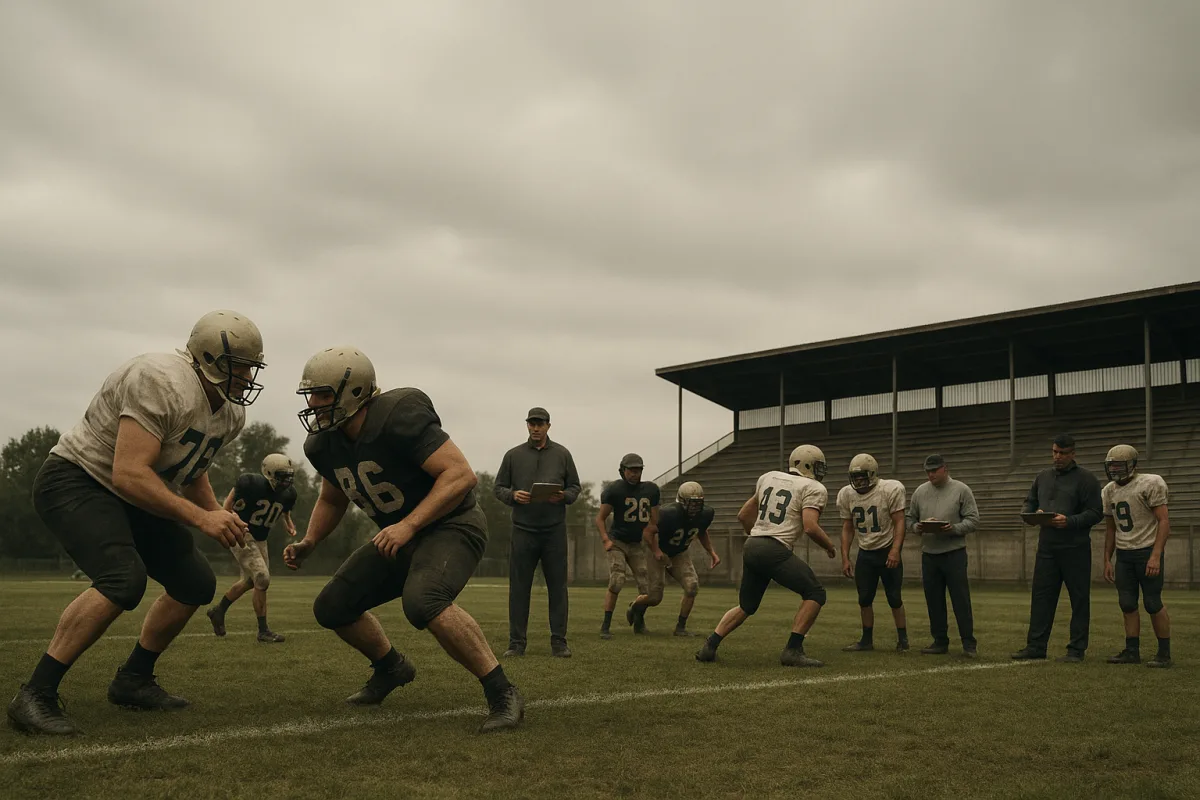
What camp talk can actually tell you before cutdown day
The useful question coming out of the final week of training camp is not which coach sounded most optimistic. It is which roster competitions still require preseason snaps, which players have earned roles that can survive the cut to 53, and which teams are changing their practice structure to solve a real September problem.
Across Detroit, Las Vegas, Chicago, Los Angeles and Pittsburgh, the common theme is that the last preseason game is less about a traditional dress rehearsal than it is about role definition. Coaches are sorting out whether a player can handle a complete assignment, whether he can stay on the field across down-and-distance changes, and whether he can cover a special-teams role when he is not among the top 11 on offense or defense.
That is the roster math that matters. Teams must reduce from 90 players to 53 by 6 p.m. ET on Aug. 30, then establish practice squads of up to 16 players by Aug. 31. An International Player Pathway exemption can make that 17. [1] [2] The bottom of the roster therefore is not simply a depth-chart exercise. It is a question of versatility, waiver exposure and whether a player can immediately fill an emergency role.
Players with fewer than four accrued seasons must pass through waivers when released, while veterans with at least four accrued seasons become free agents immediately. [3] That distinction shapes decisions at positions where a team may want to retain a young developmental player but also cannot afford to keep him inactive on game days.
Detroit’s defensive-line battle is about flexibility, not a single prototype
Detroit Lions coach Dan Campbell gave the clearest description of what a genuine late-August competition looks like. In the Detroit Lions media session, Campbell said the defensive-line room remained open at “a number of spots,” with veterans, younger players and raw traits all competing for finite roster space.
That is not empty coach-speak when it comes with a positional explanation. Campbell identified defensive line as the club’s most unsettled unit, ahead of the back end of the offensive line and the final receiver spots. The Lions are not merely looking for the best pass rusher or the biggest run defender. They are trying to preserve enough positional coverage to play their preferred personnel without creating a hole elsewhere on the 53.
That is why Campbell’s comments on defensive lineman Ben Stille were more revealing than a generic reference to effort. Campbell described Stille as able to work at big end, nose and, if necessary, three-technique. That kind of inside-out flexibility is often the separator for a fifth or sixth lineman. It gives the defense a usable answer when an opponent changes personnel, and it limits the need to dress a specialist who offers only one narrow skill.
There was also an important schematic correction in Campbell’s remarks. A question framed Detroit’s lighter interior defenders as potential gap shooters in a nickel-heavy defense. Campbell rejected that premise, saying the Lions do not build their front around shooting gaps. Their rush plan can change in passing situations, but their core approach still asks players to control their responsibilities and get back into gaps when movement is called.
That matters because body type alone does not explain usage. A smaller defensive tackle is not automatically an upfield penetrator, and nickel personnel is not automatically a declaration that the defense will surrender the run. Campbell’s point was that Detroit will use the best available group, whether that means nickel, base, dime or another package. The coordinator’s adjustment is personnel-first rather than ideology-first.
The trade-off is clear. A defender like Stille can help a team survive multiple fronts and injury contingencies, but he still has to show that flexibility translates against NFL-level blocking. Detroit’s final preseason tape matters because a player can look versatile in drills yet fail to hold up when offenses target him in the run game or force him to communicate within a shifting front.
Las Vegas is treating the final preseason game as a depth-chart test
The Las Vegas Raiders’ media session showed a different kind of competition. Offensive coordinator Klint Kubiak did not publicly name winners at guard or quarterback, but he was direct about the stakes: the final preseason game would be important in the guard battle between Jackson Powers-Johnson and Caleb Rogers, and both players were expected to contribute during the season.
The key word is contribute. A competition does not have to produce one player who disappears from the weekly plan. Offensive lines require redundancy because injuries, game plans and subpackage demands can force changes quickly. If both guards are expected to play, the actual decision may be less about choosing a permanent winner and more about identifying which player is ready for the opening lineup, which one can cover multiple spots, and whether either can help on special teams or as an eligible blocker.
Kubiak’s remarks about the Raiders’ receiver room fit the same pattern. He acknowledged that the group had a rough practice when assignments became an issue, but he did not turn one poor day into a sweeping indictment. That is the right framing. Camp reports can identify whether a mistake was technical, mental or recurring, but one practice does not establish a season-long trend. The relevant question is response: did the player correct the alignment, route adjustment or sight-read issue when the same coverage appeared again?
The Raiders also appear to be assigning substantial roster value to fourth-down work. Kubiak said reserve running backs Dylan Laube and Dario Gunter would need to contribute on special teams, while special-teams coordinator Joe DeCamillis emphasized the head coach’s commitment to that phase. That is a practical roster preference, not a slogan. A third or fourth running back who cannot protect, cover kicks or return effectively creates a game-day problem because he occupies a spot that could otherwise go to a linebacker, defensive back or offensive lineman.
The uncertainty around injured running back Ashton Jeanty also illustrates what can and cannot be learned from camp media availability. Kubiak said only that Jeanty was “on the mend” and declined to detail the injury. That should not be turned into either a clean bill of health or a prediction of injured reserve. NFL teams retain broad control over training-camp injury disclosures, and Reserve/PUP status carries a minimum four-game absence if a player begins the season there. [6]
Chicago is emphasizing operational growth, not just highlight plays
Chicago Bears tight end Cole Kmet provided the most player-specific definition of development. His assessment of quarterback Caleb Williams centered on “operation of the huddle,” rapport with the coaching staff and the ability to run the offense with more command. Those are meaningful markers because quarterback progress is not limited to throws that circulate online.
A quarterback can make a difficult completion and still struggle with the operation that precedes it: getting the call in, identifying the front, setting protections, communicating a check and getting the offense aligned before the play clock becomes an issue. Kmet’s account suggests Chicago is measuring Williams’ growth through those details.
Kmet also explained why the Bears have used extended-drive periods late in camp. The point is not conditioning for its own sake. It is to make players hear the call, apply their rules and execute after eight, nine, 10 or 11 plays, when fatigue makes mental processing slower. That is particularly relevant for younger players, who are already carrying more assignment uncertainty than veterans.
The Bears’ development model therefore contrasts with Detroit’s roster-flexibility model. Detroit is deciding who can cover multiple front roles. Chicago is pressing players to make correct decisions while tired and under simulated communication stress.
Kmet’s description of rookie defender Dylan Theim’s improvement was also appropriately specific. He said Theim began camp with some hesitation in recognition and positioning, then improved his processing speed and became more physical against the run. That is a more credible development arc than saying a rookie has “looked like a star.” The NFL transition is usually about reducing hesitation. Talent gets a player to the right neighborhood. recognition, communication and trust in technique get him there on time.
Chicago’s tight-end personnel also presents a schematic trade-off. Kmet said defenses may struggle to match rookie Colston Loveland because defensive backs may lack the size to cover him while linebackers may lack the movement ability. But the real advantage comes only if Chicago can punish the response. If a defense uses smaller bodies, the offense must run effectively from heavier personnel. If it stays big, the tight end has to win against slower coverage players. A mismatch is not a matchup advantage until the offense can force the defense to choose.
The Rams and Steelers are evaluating complete roles
Los Angeles Rams coach Sean McVay is applying the same all-phase logic to his backup quarterback and running back decisions. In the Los Angeles Rams media session, McVay said he was still working through how to distribute preseason quarterback snaps among Ty Thompson, Stetson Bennett and Matthew Caldwell. He praised Thompson’s operational command and decision-making, while highlighting Bennett’s ability to extend plays and create outside the original progression.
Those are different quarterback profiles, and the roster decision will not necessarily be based on a single preseason stat line. Completion percentage does not show whether a quarterback identified pressure correctly, made the appropriate protection adjustment or passed up a risky throw. Conversely, a scramble drill highlight may demonstrate athletic instinct but does not automatically prove a quarterback can manage the full offense.
McVay also made the case for running back Ronnie Rivers in terms coaches actually use when deciding reserve jobs: pass protection, run-scheme understanding, checkdowns and screen-game feel. That is the profile of a functional No. 3 runner. The reserve does not need to replicate the starter’s best trait. He needs to allow the offense to call its normal game without advertising run or pass based on who is in the huddle.
Pittsburgh Steelers coach Mike McCarthy made the same point more directly in discussing the battle for the third running-back role. McCarthy said the preference is for players who can contribute on all four downs, meaning offense or defense plus special teams. He noted that a back who only plays in obvious passing or running situations creates tendencies for opposing defenses.
That is where special teams becomes the tiebreaker. Two running backs may be close as ball carriers, but the player who can protect on third down, cover kicks and handle core special-teams assignments gives the coaching staff more usable options on game day.
McCarthy’s larger camp emphasis was situational football, pressure packages and the snap-to-snap adjustment between offense and defense. Those are the practice periods closest to the regular season because they demand communication and response rather than scripted execution. The Steelers also are considering quarterback-room depth with an unusually open mind. McCarthy said keeping four quarterbacks would not necessarily hinder development because the regular-season schedule allows for work before and after practice.
That is a useful counterpoint to the assumption that every team must carry only two or three passers. The right number depends on roster opportunity cost, the quality of the room and whether the club has enough practice reps and developmental structure to keep each player progressing.
Who these approaches suit
Detroit’s approach suits a team with legitimate defensive-line depth and enough scheme flexibility to keep players who cover multiple interior and edge roles. The decisive trait is not one flashy preseason rep, but whether a defender can execute across packages without becoming a liability in the run game.
Las Vegas’ model suits a younger roster where competition itself is part of development. The Raiders are asking players to earn roles through assignment consistency, positional readiness and special-teams value, particularly at guard, receiver and running back.
Chicago’s camp structure suits a team trying to turn talent into dependable offensive operation. The Bears are emphasizing fatigue, communication and recognition, which is the work required for a young quarterback and young defenders to become reliable rather than merely promising.
The Rams’ approach suits a roster with defined stars and meaningful depth questions behind them. McVay’s evaluations of quarterbacks and reserve runners are built around whether backups can keep the offense structurally intact, not whether they can duplicate a starter’s headline production.
Pittsburgh’s approach suits a team willing to use the final preseason week to identify complete players. For the Steelers, the roster bubble is not about finding specialists. It is about finding players who can handle first, second and third down responsibilities, then justify a game-day spot with fourth-down production.
Frequently Asked Questions
What do NFL coaches look for during training camp roster battles?
Coaches focus on which players can handle complete assignments, stay on the field across various down-and-distance situations, and contribute on special teams. Versatility, the ability to fill emergency roles, and positional flexibility are key factors, especially for players competing for the final roster spots.
How do preseason games impact NFL roster decisions?
Preseason games serve as role-definition tests rather than traditional dress rehearsals. Coaches use these games to evaluate whether players can perform consistently in their assigned roles, handle multiple positions, and contribute on special teams, helping to finalize the 53-man roster.
What role do media sessions play in understanding NFL training camp progress?
Media sessions provide insight into the status of roster competitions, player versatility, and coaching strategies. However, coaches often give measured responses, focusing on ongoing competitions and player development rather than definitive conclusions, making media remarks a useful but limited source of information.
How do NFL teams evaluate player versatility during training camp?
Teams value players who can perform multiple roles, such as playing different positions on the defensive line or contributing on special teams. Versatility helps teams manage injuries and personnel changes without creating gaps, making such players more likely to survive roster cuts.
What factors influence NFL roster cutdown decisions before the season?
Decisions hinge on roster math involving versatility, waiver exposure, and the ability to fill emergency roles. Teams must reduce from 90 to 53 players by the deadline, balancing the need to keep young developmental players who must clear waivers with veterans who become free agents immediately upon release. Special teams contributions also weigh heavily in these decisions.
Sources
Dan Campbell Press Conference | 2026 Training Camp Day 17 — Detroit Lions
Klint Kubiak, Joe DeCamillis, Jordan Meredith and Brandon Cleveland Presser - 8.25.26 — Raiders
Cole Kmet, Cam Lewis on finishing training camp strong | Press Conference — Chicago Bears
Sean McVay Speaks On Backup Quarterback Spot, Ronnie Rivers' Impact, Competition at Practice & More — Los Angeles Rams
Coach Mike McCarthy Press Conference (August 25) | Pittsburgh Steelers — Pittsburgh Steelers
Timeline of how Niners owner Jed York’s prostitute nightmare unfolded — and how it all exploded in his face — NY Post Sports
Odell Beckham Jr. turns back the clock with one-handed Giants practice catch — NY Post Sports
Myles Garrett’s mysterious knee injury is starting to raise eyebrows at Rams camp — NY Post Sports
2026 NFL 53-Man Roster Cutdown Deadline Essential Information
What To Know About Chargers Ahead of 2026 NFL 53-Man Roster Cutdown Deadline
Seahawks' Bud Clark: Out 'multiple months' with fractured ankle - CBS Sports
Seahawks safety Clark, offensive lineman Richman placed on injured reserve | FOX Sports
NFLPA report card: Eagles players praise coaches, rip team travel
Watch Training Camp and Preseason Player and Coach Media Sessions on Youtube
Also from the sources
Related Articles
NFL Roster Cuts 2026: Key Player Moves and Team Strategies
Explore NFL roster cuts 2026 with analysis of key player moves, team strategies, and impacts on depth charts and season outlooks.
New York Giants Roster Cuts and Preseason Finale Analysis
Detailed analysis of the New York Giants' 2026 preseason finale and roster cuts, including key player evaluations and roster decisions.
Evaluating NFL Preseason Joint Practices and Final Games
Learn how to evaluate NFL preseason joint practices and final games for player performance and roster decisions.
Washington Commanders Offensive Line Analysis and Season
In-depth Washington Commanders offensive line analysis and 2026 season prep, covering injuries, depth, and run game strategy.