
Arizona Cardinals Week 1 Media Availability and Team Outlook
Get insights from Arizona Cardinals Week 1 media availability, injury updates, and team outlook ahead of the 2026 season opener.
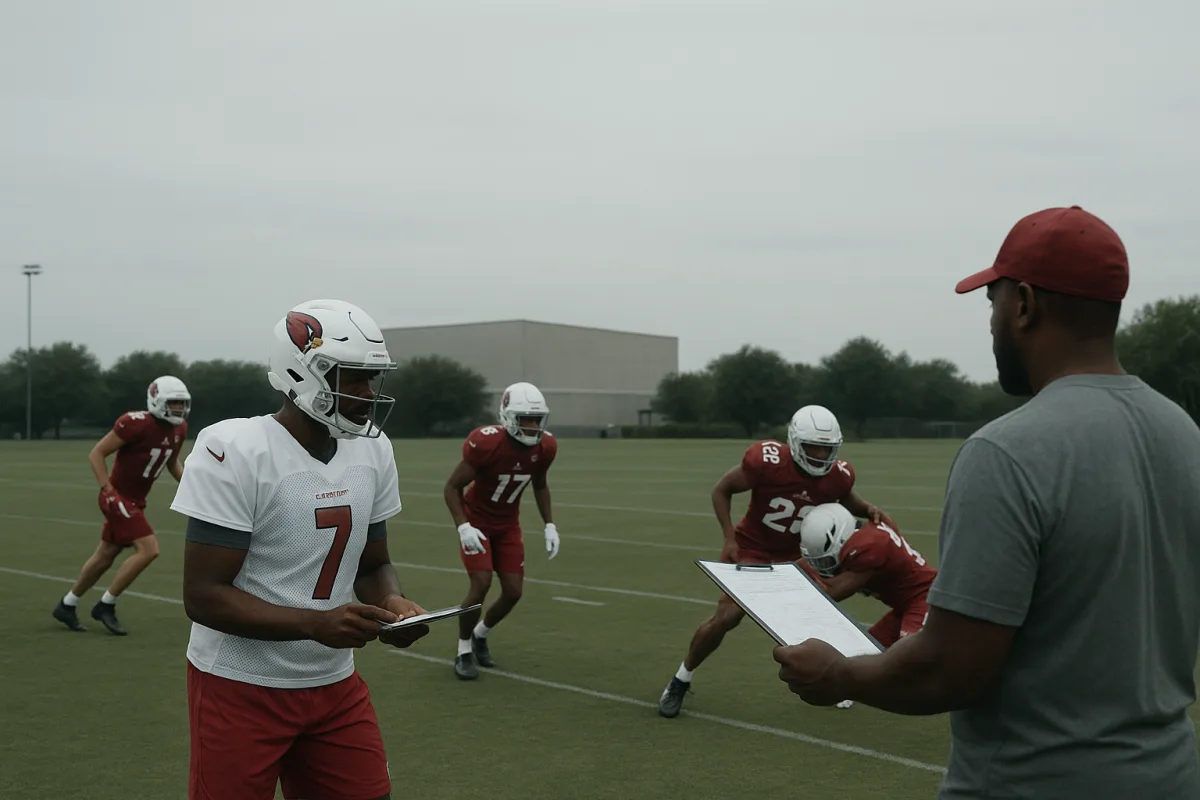
The quick list
- Best overall: Jacoby Brissett, for readers deciding whether Arizona has enough quarterback stability to make its new offensive structure functional.
- Best matchup swing: Marvin Harrison Jr., for readers looking for the player most capable of changing the Chargers’ coverage calls.
- Best defensive barometer: Budda Baker, for readers evaluating whether Arizona’s defense can play faster and tackle cleaner than its 2025 results.
- Best long-term variable: Mike LaFleur, for readers judging whether the Cardinals’ coaching reset produces better weekly operation rather than immediate stylistic novelty.
The actual Week 1 decision: Is Arizona’s floor higher?
The question entering Arizona’s opener at the Los Angeles Chargers is not whether the Cardinals can talk themselves into a breakout. Every team has attractive camp narratives in September. The practical question is whether this roster has raised its operational floor enough to compete when the first script ends.
Arizona changed more than the title on the head coach’s office. Mike LaFleur was hired in January on a five-year deal after Jonathan Gannon’s three seasons ended with a 15-36 record. Nathaniel Hackett replaced Drew Petzing as offensive coordinator, while Nick Rallis remained defensive coordinator. [2][3][7]
That turnover makes Week 1 unusually hard to forecast from last season’s tape. It also means the team’s own media availability needs some sorting. Players and coaches repeatedly described concepts, preparation and trust, but none of that proves the Cardinals have solved their depth, pass-rush or defensive performance issues.
ESPN’s roster ranking placed Arizona 29th in the league, with concerns centered on projected starters and depth. Independent reporting has also flagged receiver depth and defensive reinforcements, especially pass rush, as unfinished parts of the roster. [3][7]
Those concerns matter more than a generic “underdog” label. Arizona does not need to win the offseason argument Sunday. It needs to avoid asking Brissett to create an offense from obvious passing downs while asking an undermanned defense to survive too many snaps.
Comparison table: The four Week 1 cases
| Option | What the Cardinals said | What the tape and role suggest | Main trade-off | Price, size and layout equivalent |
|---|---|---|---|---|
| Jacoby Brissett at quarterback | Brissett described the plan as identifying what Arizona does well and avoiding what it does not. | Veteran experience and under-center play-action comfort fit a controlled, distribution-based plan. | Stability is not the same as explosive creation when protection fails. | Cost: no contract figure supplied. Size: 6-foot-4 listed by Chargers coach Jim Harbaugh. Layout: under-center, play-action, pocket operation. |
| Marvin Harrison Jr. at wide receiver | Harrison called the offense “simple but complicated,” with similar presentations creating stress for defenses. | He is the primary coverage-forcing receiver and a downfield target for Brissett. | A top target can be bracketed if other receivers do not win their snaps. | Cost: no figure supplied. Size: not supplied. Layout: receiver spacing, play-action routes and coverage leverage. |
| Budda Baker at safety | Baker emphasized pursuit, tackling, turnovers and sacks as the defense’s desired identity. | His downhill play can help erase perimeter run issues and trigger pressure looks. | A safety cannot cover for a pass rush that does not affect the quarterback. | Cost: no figure supplied. Size: not supplied. Layout: second-level run support, disguise and post-snap pursuit. |
| Mike LaFleur as head coach | LaFleur emphasized adaptable scripting, clean huddle operation and response to packages. | The first test is game management and whether the offense has answers after the Chargers show their real structure. | A new staff has limited regular-season evidence together. | Cost: five-year contract reported, without financial terms. [2][3] Size: staff-wide responsibility. Layout: head-coach oversight with a new offensive staff. |
The “price, size and layout” framing does not map literally onto a football availability. None of these people is a consumer product, and no credible source provided contract values for the players. The useful comparison is role cost, physical or structural profile, and how each figure fits the football layout.
Best overall: Brissett gives Arizona a usable offensive floor
Brissett is the most important Week 1 option because he determines whether Arizona can play the kind of game its personnel and coaching comments suggest. Harrison pointed specifically to Brissett’s processing after turning his back in under-center play-action, a real quarterbacking skill rather than a buzzword.
In shotgun, a quarterback can track safety rotation through the snap. Under center, the quarterback sells the run with his back to the defense, then must reset his vision and diagnose the post-snap picture quickly. Harrison’s explanation was technically sound: disguise becomes more consequential when the quarterback loses that initial visual information.
The available statistical case for Brissett is efficiency, not volume. TWSN noted his 1.4 percent career interception rate across 2,246 attempts and cited his previous under-center experience with Cleveland as a reason he fits a play-action-based structure. [6]
That number does not establish that Brissett will be an elite starter, or that Arizona will suddenly generate explosive plays. It does indicate he has generally avoided the drive-killing mistake that ruins a run-game and play-action plan. That is an important distinction.
Brissett’s own comments supported a restrained approach. He said the staff’s Week 1 process has been to identify what the offense does well, retain it, and stay away from what it does not do well. That is the correct early-season framing for a new operation.
LaFleur also said early calls would be adaptable to defensive packages rather than confined to a traditional fixed number of scripted plays. That matters against a Chargers defense with a new play-caller. Arizona should expect unfamiliar fronts, coverage rotations and pressure answers, not assume last year’s film supplies a complete answer.
The trade-off is simple. Brissett can keep the structure intact, but he is not being asked to replicate the off-schedule game of every other quarterback in the league. If Arizona loses early downs, lets the Chargers’ edge defenders dictate protection, or creates repeated third-and-long situations, veteran calm alone will not solve it.
LaFleur called Chargers edge players Tuli Tuipulotu and Khalil Mack “heavy” edges who are hard to move. That is a tape-based concern, not coach-speak. The Cardinals’ early-down run efficiency and their ability to keep those players from winning the edge will define how much of the intended offense remains available.
Best matchup swing: Harrison is the coverage test
Harrison is the player most likely to force Los Angeles to modify its plan, but Arizona should resist treating that as a one-man solution. The Arizona Cardinals receiver described the scheme as simple for its own players but complicated for opponents because multiple concepts can begin with similar presentations.
That description points toward the real objective of a Shanahan-family-adjacent offense, though public reporting has not established the precise differences between Arizona’s 2026 structure and prior seasons. The goal is not an encyclopedic call sheet. It is making a defense hesitate between run fits, play-action responsibilities and route distribution.
Harrison’s role inside that approach is not merely to accumulate targets. His alignment, motion and vertical capacity can determine whether a safety stays deep, a corner travels, or the defense allocates a second defender outside. Those reactions can create cleaner run boxes and intermediate windows for everyone else.
The limitation is personnel depth. Harrison named Michael Wilson, Trey McBride, Jeremiah Love, Kendrick Bourne and others as weapons, but outside analysis still identifies receiver depth as a concern behind Harrison and Wilson, with Bourne a possible third option. [3][7]
That does not mean Bourne cannot contribute. It means Arizona needs him and its other complementary pieces to win enough individual snaps that defenses cannot live in Harrison-focused coverages. A successful Harrison game might include fewer targets than fans expect if those targets pull help away from McBride or the run game.
Harrison also framed his personal goal correctly, focusing on health rather than declaring a “breakout” season. He is listed healthy for Week 1, along with Brissett and Baker. [1] Availability matters because Arizona’s margin for error shrinks sharply if its premier receiver is not a full-time threat.
Best defensive barometer: Baker and the tackling count
Baker’s media availability offered the most useful defensive benchmark: he wants opponents to see 11 Cardinals running to the football, playing fast, creating sacks and creating turnovers. The first three elements are measurable on tape. The last two cannot simply be demanded into existence.
Arizona retained Rallis despite the defense’s poor 2025 performance, and outside assessments have questioned whether the team did enough to improve its defensive talent, particularly its pass rush. [3][7] That means Baker’s leadership cannot be evaluated solely through a captaincy or pregame rhetoric.
The first tape question is tackling. Baker specifically identified Week 1 tackling as an issue because defenders have fewer full-contact reps during the offseason and preseason. That is especially relevant against the Chargers, who present a physical run-game identity and a running back in Omarion Hampton whom Baker described as powerful after contact.
The second question is rush integrity against Justin Herbert. Baker noted that Herbert’s height, strength and pocket mobility make mere pressure insufficient. Los Angeles Chargers coach Jim Harbaugh similarly described Baker as a downhill back-end playmaker while praising Arizona’s disguise and multiplicity.
Pressure rate alone will not settle this matchup. If Arizona produces pressure but loses containment, Herbert can still extend plays. If the Cardinals rush with discipline but cannot force altered throws, coverage players will eventually run out of time. The useful count is pressures that actually disrupt the quarterback’s platform, timing or throwing lane.
Baker can affect both sides of that equation with disguise, blitz timing and cleanup pursuit. But Arizona needs its front to make those calls viable. A safety blitz is effective when it attacks a protection weakness. It is less effective when the line sees it cleanly and the rush loses leverage.
Best long-term variable: LaFleur’s first game management test
LaFleur should not be evaluated on whether his offense resembles a previous coaching stop. He said as much, noting that an offense must fit the quarterback rather than replicate another team’s system. The independent reporting supports only broad conclusions about a strategic shift, not a detailed public blueprint. [3][7]
That caution is necessary because even the public descriptions have not been perfectly clean. LaFleur is the head coach, Hackett is the offensive coordinator, and LaFleur said he is focused on game preparation and situational execution. [3][7] The practical issue is not who receives credit for each concept, but whether the entire staff communicates cleanly in live conditions.
LaFleur gave a revealing answer when asked what sharp football would look like. He cited getting in and out of the huddle, having the right people on the field, avoiding panic and eliminating errors the team controls. Those are not cosmetic details in a first game. They decide possessions.
Arizona’s historical road record against the Chargers adds context but not predictive force. The Cardinals were 1-7 in regular-season road games against the Chargers through the referenced historical record, though they won 17-15 on the road on October 21, 2024. [4][5]
That recent win is a reminder that historical series records do not block Sunday’s outcome. The 1-7 number includes different coaches, quarterbacks and rosters. It is background, not evidence that the current Cardinals will fail at SoFi Stadium.
Who each option suits
Jacoby Brissett suits readers looking for a credible Week 1 foundation. His value is in processing, decision-making and keeping a play-action offense on schedule. Watch early-down success rate, sacks, negative plays and third-down distance before judging his passing-yardage total.
Marvin Harrison Jr. suits readers looking for the clearest individual upside. He can be Arizona’s best route to explosive plays and coverage stress, but his impact may show up in defensive attention as much as a box-score target count. Health and supporting receiver performance are the conditions.
Budda Baker suits readers looking for proof that Arizona’s defense has changed in substance. Watch missed tackles, pursuit angles, rush discipline and whether the defense creates pressured throws. A few splash plays do not outweigh poor down-to-down structure.
Mike LaFleur suits readers deciding whether the Cardinals’ organizational reset is working. The evidence will be operational: personnel usage, clock management, answers to new looks and the offense’s ability to recover after a bad series. Week 1 cannot validate a five-year plan, but it can show whether the plan functions under live pressure.
Frequently Asked Questions
What did Arizona Cardinals players say during Week 1 media availability?
Players described the offense as focusing on identifying what the team does well and avoiding weaknesses. Marvin Harrison Jr. called the offense “simple but complicated,” aiming to create stress for defenses through similar presentations. Budda Baker emphasized the defense’s identity around pursuit, tackling, turnovers, and sacks.
What is the injury status of key Arizona Cardinals players for Week 1?
As of September 10, 2026, Budda Baker, Marvin Harrison Jr., and Jacoby Brissett are listed as fully healthy and expected to play in Week 1. The team entered the week without injury concerns for these key players, though final injury designations can still change in the days leading up to the game.
How does the Arizona Cardinals coaching staff approach Week 1 game management?
Head coach Mike LaFleur emphasized adaptable scripting, clean huddle operation, and responsiveness to opposing packages. The focus is on game management, substitutions, situational decisions, and adjustments rather than unveiling a large play sheet in the opening quarter. The new staff aims to raise the team’s operational floor rather than immediate stylistic novelty.
What are the Arizona Cardinals' strengths and weaknesses entering Week 1?
Arizona’s strengths include Jacoby Brissett’s veteran experience and play-action comfort, and Marvin Harrison Jr.’s ability to force coverage and stretch defenses. Weaknesses include thin wide receiver depth beyond the top targets, limited pass rush, and concerns about defensive reinforcements. ESPN ranks the roster 29th in the league, highlighting issues with projected starters and depth.
How does Jacoby Brissett fit into the Arizona Cardinals Week 1 game plan?
Jacoby Brissett is expected to start at quarterback, fitting well into Mike LaFleur’s offense that emphasizes under-center play-action and controlled distribution. His veteran experience and low interception rate support a plan focused on stability and avoiding errors rather than explosive creation under pressure.
How we researched this
This article was assembled from 5 video sources across 2 channels, 7 cited references.
Nothing here is based on hands-on testing. Where a figure or finding appears, it belongs to the source cited beside it, and the writing says so rather than implying otherwise. Every source is listed below so you can check it.
Sources
Jim Harbaugh & Justin Herbert On Week 1 vs. Arizona Cardinals | LA Chargers — Los Angeles Chargers
WR Marvin Harrison Jr. Media Availability 9.9.26 | AZ Cardinals — Arizona Cardinals
HC Mike LaFleur Press Conference 9.9.26 | AZ Cardinals — Arizona Cardinals
QB Jacoby Brissett Press Conference 9.9.26 | AZ Cardinals — Arizona Cardinals
S Budda Baker Press Conference 9.9.26 | AZ Cardinals — Arizona Cardinals
Official NFL Injury Report for Players - Week 1 of the 2026 Season | NFL.com
Cardinals round out coaching staff under Mike LaFleur - Arizona Sports
Chargers Matchup History Arizona Cardinals | Los Angeles Chargers - chargers.com
What Should the Arizona Cardinals Expect From Jacoby Brissett in 2026? - TWSN
Watch Arizona Cardinals Week 1 Media Availability and Team Outlook on Youtube
Also from the sources
Related Articles
Arizona Cardinals Week 7 Injury Updates and Game Prep
Get the latest Arizona Cardinals Week 7 injury updates and how they shape the team's game preparation against Denver.
NFL Week 3 Team Preparations and Media Availability Updates
Get the latest NFL Week 3 team preparations, player statuses, and media availability insights to understand upcoming game strategies and key updates.
Detroit Lions Week 5 Win Analysis and Player Media Coverage
In-depth Detroit Lions Week 5 win analysis with player and coach media coverage, highlights, and tactical breakdowns from the Arizona game.
Arizona Cardinals Week 2 Injury Updates and Preparations
Get the latest Arizona Cardinals Week 2 injury updates and player news as they prepare for their game against the Seahawks.