
Ravens Week 8 Preview and Player Media Availability
Get the latest Ravens Week 8 preview, injury updates, and player media availability ahead of their game against the Bills.
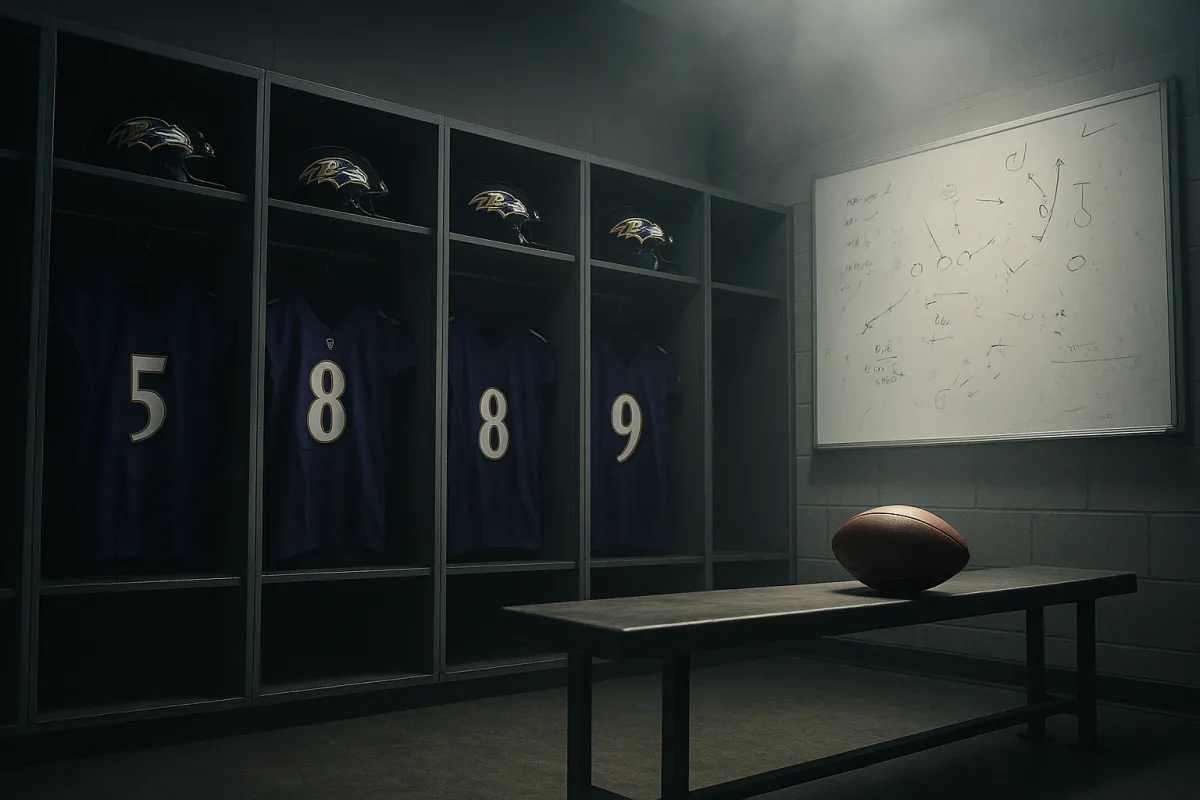
The shift is from quarterback uncertainty to contingency preparation
The Ravens’ Week 8 preparation has shifted plainly: Baltimore is no longer operating as though Lamar Jackson’s absence is a settled expectation, but it also cannot prepare as though his return is guaranteed. That is a meaningful middle ground.
Multiple independent reports have pointed in the same direction. RotoWire and Heavy both reported that Jackson was trending toward a Week 8 return against Buffalo, while Statchasers characterized the situation as improving rather than final. [1][2][3]
That consistency matters, but it does not equal confirmation. As of October 28, Jackson’s practice participation and game-day designation remained unresolved, and Ravens head coach Jesse Minter described him as being in a “decent spot,” not as definitively available.
For a coaching staff, that creates a split-week workload. The Ravens must install the full Jackson offense, including the option elements and empty formations that change defensive math, while keeping enough of the Tyler Huntley plan available to function if needed.
The difference is not cosmetic. Huntley has started Baltimore’s last three games, going 1-2, and the Ravens’ Week 7 loss to Cincinnati exposed the limits of an offense that could not consistently force defenses to account for quarterback run threats. [1][8]
PFF’s Ravens-Bills preview made a useful point beneath its broader quarterback discussion: Baltimore produced 6.8 yards per play with Jackson in the offense, compared with 4.9 with Huntley. That is a major structural drop, even if the precise splits need broader context.
The statistic does not prove Huntley was solely responsible for every stalled drive. Opponents adjust personnel, coverage and blitz frequency when a replacement quarterback starts. But it does show why Baltimore’s run game looks different when the passing and quarterback-run threats are both credible.
The Bills game will test Baltimore’s protection more than its identity
The instinct after Baltimore’s 35-13 loss to Cincinnati is to focus on points, but the tape-level concern is more specific. The Ravens did not consistently create clean pockets or enough early-down efficiency to keep the full offense available.
Baltimore remains fourth in the NFL in rushing yards and sixth in yards per carry through seven games. It also ranks fifth in yards per play, even with the recent downturn, which is why the argument that the Ravens’ offense has fundamentally failed is too broad. [8]
The better reading is that Baltimore has remained efficient when it can dictate. The problem against Cincinnati was that the Ravens too often played from unfavorable down-and-distance situations, limiting their ability to use motion, play action and quarterback movement as complementary threats.
That is where Jackson’s possible return changes Buffalo’s preparation. If he plays, Buffalo cannot simply commit extra resources to stopping Derrick Henry and accept isolated coverage outside. The defense must assign a player to Jackson on many run concepts.
If Huntley starts, the Bills can still respect his mobility, but the historical evidence from the last three games suggests opponents have been more willing to compress Baltimore’s running lanes and challenge the passing game to punish them. That is a different defensive equation.
PFF’s preview also highlighted Baltimore’s uneven offensive-line performance, particularly on the interior. The production grades cited by the outlet are not a complete evaluation of every block, but they match the more obvious issue: pressure has disrupted the offense before routes develop.
That makes guard Olaivavega Ioane’s injury particularly relevant. Ioane is listed as doubtful with an MCL sprain, leaving Baltimore potentially short-handed in an area already under scrutiny. [4][5]
The project for Baltimore is therefore not simply “run Henry more.” Henry is listed as questionable with an ankle injury, and even if active, a run-heavy approach only works if Baltimore can avoid predictable second-and-long situations. [4][5]
There is also an important correction to some loose national framing. Derrick Henry is a Ravens running back, not a Bills player. Buffalo’s featured back is James Cook, while the Bills’ injury picture includes receiver DJ Moore as questionable with a shoulder injury. [11][12]
Buffalo’s offensive stress points are familiar, but difficult to solve
Baltimore’s defense is ninth in rushing yards allowed and seventh in yards allowed per carry, which should make it better equipped than most teams to handle Cook’s early-down role. [9] The larger problem is Buffalo’s ability to turn hesitation into quarterback-created offense.
Josh Allen’s value is not limited to designed runs. When pass rush lanes widen or coverage defenders turn their backs, Allen can convert a structurally sound call into an unscheduled first down. Baltimore must rush with discipline, particularly on third down.
That is why the Bengals game raised a more serious concern than the final score alone. Baltimore did not generate enough pressure to force the quarterback into hurried decisions, and coverage-only defense becomes difficult when the passer has time to access every level.
PFF’s preview focused on Buffalo tackle Dion Dawkins and edge rusher Greg Rousseau as central players in the matchup. The larger takeaway is sound: Buffalo can protect Allen long enough to challenge a defense that has been middle of the league overall.
The Ravens rank 18th in both points and yards allowed. [9] That does not mean they are a poor defense, and their run metrics say otherwise. It means they have not consistently prevented opponents from sustaining drives or converting their favorable opportunities.
Injury availability could tighten those margins. Defensive tackle Broderick Washington Jr. is questionable with an ankle issue, safety Jaylinn Hawkins is questionable with a knee issue, cornerback T.J. Tampa is on injured reserve, and linebacker Tavius Robinson is also on injured reserve. [4][5]
Those absences matter differently. Washington affects rotational durability inside, Hawkins affects secondary flexibility, Tampa reduces depth at cornerback, and Robinson removes an edge option. A coordinator can cover one absence, but multiple losses constrain sub-package choices.
Against Allen, Baltimore’s best approach is unlikely to be a constant blitz plan. Blitzing without winning quickly can open throwing lanes and remove a needed defender from the second level. The Ravens need coordinated rush lanes and coverage that closes Allen’s first read.
The media trend is real in content, not in access
There is a smaller trend around Ravens coverage that deserves a more cautious reading. The organization is expanding former-player analysis through Michael Pierce’s role on “Ravens Daily,” a local weekday program carried through team media channels. [10]
Pierce, speaking on the Baltimore Ravens’ official program, described his objective as bringing a player’s technical perspective to interviews and game analysis. That can improve the specificity of discussion around fronts, leverage, communication and situational football.
It does not, however, demonstrate that the Ravens have changed their player media-availability policies. The available reporting offers no evidence that Pierce’s involvement has produced additional access, different interview rules or a new relationship between the roster and reporters. [10]
That distinction is worth making because team-produced programming and independent beat reporting serve different functions. A former player may explain why a nose tackle aligns in a particular shade. A beat reporter is more likely to establish who practiced and who did not.
There is also a factual conflict in the available material. Pierce’s Ravens media appearance frames his move as a post-playing transition, while the current research brief lists him as active and expected to play, with no Week 8 injury designation. [4][5][10]
The responsible approach is not to smooth over that contradiction. Treat the current injury reporting as the more relevant game-week information, while recognizing that the media transcript cannot establish Pierce’s present roster status by itself.
For readers planning their own Ravens analysis, the useful lesson is to separate access from insight. A player’s explanation can sharpen film study, but it should not be used as evidence of an organizational change unless the team formally announces one.
What Baltimore’s tendencies say about the Week 8 plan
SB Nation’s pregame examination of Ravens tendencies points toward the right framework: Baltimore’s identity remains built around forcing defenses to defend width, motion and the quarterback run game, rather than simply handing off from static formations. [4]
The numbers support that broad description. Baltimore is fifth in yards per play but only 12th in points per game, an imbalance that suggests the offense has generated movement between the 20s without converting every promising possession into touchdowns. [8]
That is not necessarily a red-zone-only problem. Penalties, sacks, negative runs and missed third-down chances can all turn efficient overall offense into a middling scoring total. The Week 8 task is to avoid the drive-killing plays that make every snap predictable.
If Jackson plays, expect Baltimore to test Buffalo’s edge discipline early. That does not require repeated quarterback carries. Zone-read looks, boot action and movement throws can all force defenders to hesitate, which is often enough to improve Henry’s running lanes.
If Jackson does not play, Baltimore should resist pretending the plan is unchanged. Huntley can provide mobility, but the Ravens may need more condensed formations, quicker throws and defined reads to keep Buffalo from attacking protection with its front.
Zay Flowers remains a major part of either version. PFF credited Flowers with 3.73 yards per route run and 320 yards after contact, figures that describe both his efficiency and his ability to create after the catch. Those are useful traits against pressure.
But Flowers’ production should not become an excuse to abandon balance. Asking one receiver to repeatedly solve tight coverage after the catch is not sustainable offensive design. Baltimore needs protection answers and early-down success before it needs heroic individual plays.
The final injury report will determine how much of this is theoretical. Jackson’s status is central, but so are Henry’s ankle, Ioane’s likely absence and the defensive depth questions. Early reports establish probabilities, not a completed lineup. [1][4][5]
Frequently Asked Questions
What is Lamar Jackson's injury status for Week 8?
Lamar Jackson is trending toward a return for Week 8 but has not been officially cleared as of October 28. Head coach Jesse Minter described him as being in a "decent spot," but his practice participation and game-day status remain unresolved. Evaluations should rely on the final practice report closer to game day.
How will the Ravens prepare for the Bills in Week 8?
The Ravens are preparing with contingency plans that include both Lamar Jackson’s full offense and Tyler Huntley’s system. This dual approach is necessary because Jackson’s availability is uncertain, so the team must be ready to operate effectively with either quarterback. The Bills are expected to stress Baltimore’s pass rush and coverage rather than just loading the box against Derrick Henry.
Which Ravens players are questionable or doubtful for Week 8?
Key players listed on the injury report include guard Olaivavega Ioane (knee MCL sprain, doubtful), defensive tackle Broderick Washington Jr. (ankle, questionable), safety Jaylinn Hawkins (knee, questionable), and cornerback T.J. Tampa (knee, on injured reserve). Linebacker Tavius Robinson is also on injured reserve. Michael Pierce is not on the injury report and is expected to play.
What impact do injuries have on the Ravens' offensive line for Week 8?
Injuries on the interior offensive line could affect Baltimore’s rushing efficiency, which remains their clearest offensive advantage. The ability to protect the quarterback and create running lanes will be critical against Buffalo’s defensive front, making the health of the offensive line a key factor in the game.
Has the Ravens' media access policy changed for player interviews?
There is no public evidence that Michael Pierce’s new media role has altered the Ravens’ player availability, interview rules, or team messaging. Media access policies remain managed by the official PR and coaching staff, and appearances by players should not be interpreted as a change in policy.
How we researched this
This article was assembled from 2 video sources across 2 channels, 2 published articles, 12 cited references.
Nothing here is based on hands-on testing. Where a figure or finding appears, it belongs to the source cited beside it, and the writing says so rather than implying otherwise. Every source is listed below so you can check it.
Sources
Josh Allen CLASSIC incoming? Can the Ravens bounce back? Ravens vs. Bills Preview | PFF NFL Show — Pro Football Focus
Michael Pierce Joins The Lounge to Talk About the Launch of 'Ravens Daily' | Baltimore Ravens — Baltimore Ravens
Commanders' defender a top 25 NFL trade candidate — Commanders Wire
Examining biggest Ravens tendencies before Week 8’s game vs. Bills — SB Nation
Lamar Jackson Injury: Trending toward return in Week 8 | RotoWire
Bills Face Lamar Jackson Injury Question Ahead of Week 8 Ravens Showdown
Baltimore Ravens Injury Report and Status 2026-27 - CBS Sports
How to watch NFL 2026: FREE live streams, broadcast details and Week 7 games
Baltimore Ravens 2026 Defensive Splits | Pro-Football-Reference.com
Why Michael Pierce Came Back to Baltimore Again, This Time Behind the ‘Ravens Daily’ Mic
Bills Depth Chart 2026 — Week 8 Starters & Backups · FantasyTools.ai
Watch Ravens Week 8 Preview and Player Media Availability on Youtube
Also from the sources
Related Articles
NFL Week 3 Team Preparations and Media Availability Updates
Get the latest NFL Week 3 team preparations, player statuses, and media availability insights to understand upcoming game strategies and key updates.
Arizona Cardinals Week 7 Injury Updates and Game Prep
Get the latest Arizona Cardinals Week 7 injury updates and how they shape the team's game preparation against Denver.
San Francisco 49ers Week 4 Preview and Player Updates
Get the San Francisco 49ers Week 4 preview with injury updates and analysis on handling Denver's pressure defense.
NFL Week 2 Injury Status Meanings
Understand NFL Week 2 injury status meanings and what 'questionable' really means for players like Puka Nacua and RJ Harvey.