
Cleveland Browns Week 4 Performance and Key Player Impact
Analyze the Cleveland Browns' Week 4 performance, key player impacts, and strategic adjustments in their win over the Steelers.
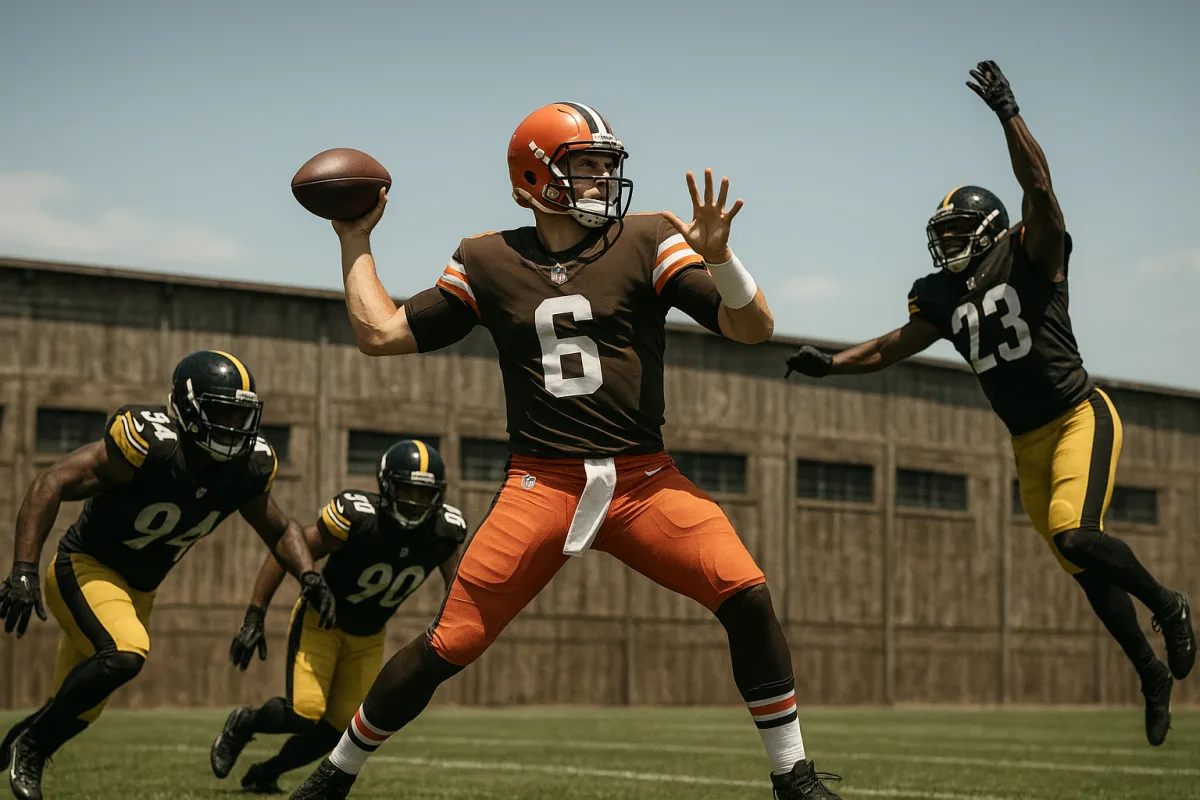
The shift is real, but it is narrower than the headline
The Browns have changed their position in the AFC North. They beat Pittsburgh 27-24 on October 1, moved to 3-1, and did so after an opening-week performance that created questions about the quarterback, coaching staff and overall direction. [4]
That is a meaningful change because Pittsburgh entered the game 2-1, and because this rivalry has long leaned Steelers. Pittsburgh holds an 83-65-1 series advantage, according to the historical rivalry record, so a Cleveland home win is important without being an indictment of the entire Steelers operation. [6]
The better reading is that Cleveland has become more functional in high-leverage moments. Watson has led late winning drives in three straight games, according to Browns coach Todd Monken’s postgame comments. That is not a repeatable stat by itself, but it does reflect a practical change.
A quarterback cannot lead fourth-quarter drives if the offense is constantly behind schedule, unable to communicate, or asking him to solve every snap from a long-yardage pocket. Cleveland was not perfect against Pittsburgh, but it created enough manageable situations to keep the game within Watson’s control.
That is the trend. The Browns are not suddenly an explosive, top-tier offense. They are a team finding ways to manufacture answers late, with the quarterback operating more comfortably inside a structured plan.
What the film showed Cleveland changed
The Browns did not beat the Steelers by asking Watson to take seven-step drops and win a volume passing contest against T.J. Watt. The game flow showed a more varied menu: perimeter throws, motion before the snap, play-action movement, running back touches and opportunities for Watson to change the launch point.
Those details matter against Pittsburgh. Watt can wreck a game when an offense presents predictable edges, especially when the quarterback is sitting at a fixed depth. Cleveland still allowed disruptive plays, including a Watt-created fumble on a zone-read exchange, but the offense did not live in that bad environment.
The adjustment was not simply “get the ball out quickly.” It was making the Steelers defend the width of the field. Cleveland used receivers in motion, attacked outside leverage and found space on intermediate cross-field concepts when Pittsburgh’s coverage expanded.
The broadcast sequence around rookie receiver Denzel Boston illustrated the point. Cleveland generated a deep completion, then returned to throws that made the Steelers defend the sideline and underneath space. That is how an offense prevents a pass rush from turning every third down into a one-on-one contest.
Watson also had designed and improvised movement opportunities. Rolling the pocket changes the picture for an edge rusher, but it also changes the quarterback’s read structure. The offense can create a high-low read on the perimeter, reduce the defense to fewer coverage defenders, and let Watson use his legs when the coverage holds.
That is a better use of a quarterback whose career has always included off-schedule ability. It is also not the same as saying Cleveland should become a quarterback-run offense. The Watt fumble was the counterexample. Monken acknowledged after the game that calling zone read toward Watt was a poor decision.
That self-scouting matters. The Browns can use quarterback movement without repeatedly placing the ball in the hands of an elite edge defender. Designed movement, boot action and sprint-outs are useful tools. Read-option calls into Watt’s side are a different calculation.
Watson has improved in efficiency, not necessarily in scale
The simplest national narrative will be that Watson is “back.” The evidence does not support that conclusion yet. It supports a smaller and more defensible claim: Watson has played efficiently enough for Cleveland to win close games.
Through Week 4, Watson has completed 68.3 percent of his passes, thrown for 587 yards, produced five touchdown passes against one interception, and posted a 104.1 passer rating. [3] Those are respectable efficiency numbers, particularly the touchdown-to-interception ratio.
But the yardage matters too. Watson’s 587 passing yards through four games works out to fewer than 147 yards per game. Cleveland’s offense is scoring only 18 points per game, which ranks 24th in the league. [3]
That means the Browns have not established sustained offensive dominance. They have made enough throws at the right time, benefited from improved situational execution, and avoided the total offensive collapse that defined the opener.
The distinction is important. Completion percentage can rise because an offense uses more quick game, more screens, more defined throws and fewer aggressive downfield attempts. That is not a criticism. It can be exactly what a team needs while an offensive line develops chemistry.
But it also means the next test is whether Watson can continue producing when opponents compress those easy access throws. The Steelers began to create pressure and disruption later in the game. Better defenses will force Cleveland to win from longer distances and tighter windows.
Monken’s postgame comments reflected that reality. He praised the response but acknowledged the Browns still had alignment issues and turnovers. That is a coordinator evaluating process, not declaring a finished product.
The supporting cast made the plan work
Cleveland’s offensive plan worked because it spread responsibility beyond Watson. Quinshon Judkins provided physical runs and receiving value near the goal line. Raheim Sanders gave the offense a change-of-pace element on the edge. Boston and fellow rookie receiver KC Concepcion supplied yards after catch and motion versatility.
Harold Fannin Jr.’s touchdown also fit the broader structure. Cleveland’s young skill players were not asked to win only isolated matchups outside. They were moved, layered into route concepts and given chances to create after the catch.
That is a useful approach for a young offense. Instead of demanding that every rookie become a high-volume target immediately, the coordinator can create touches through formation and spacing. A receiver can run a shallow route, block on the perimeter, threaten jet motion or pull a defender away from a run fit.
The Browns also received a significant special-teams contribution. Punter Corey Bojorquez’s 81-yard punt was specifically cited by Monken among the game-ball performances. Field position is not cosmetic in a three-point division game. It changes which calls a defense can make and how much of the playbook the opponent can use.
Grant Delpit’s final interception sealed the result, while Denzel Ward’s earlier interception shifted the game when Pittsburgh held a 7-0 lead. The Browns then built a 21-7 advantage before halftime. Cleveland’s official recap confirms the 27-24 final and the decisive nature of the late defensive stop. [4]
Ward’s interception was the defensive turning point
The game’s most important defensive play was Ward’s interception of Aaron Rodgers in the second quarter. It came after Pittsburgh’s opening touchdown drive and after Cleveland had failed to convert early opportunities.
That matters because the Steelers were using motion and quick throws to blunt Cleveland’s front. Rodgers found DK Metcalf and Jaylen Warren on short-to-intermediate throws, and Pittsburgh’s opening possession showed a clear desire to make Browns defenders tackle in space.
Ward’s interception interrupted that script. It gave Cleveland a short-field opportunity, changed the score pressure, and forced Pittsburgh to play from behind rather than dictate tempo. Monken identified Ward’s play as the momentum swing afterward, and Ward said he hoped Rodgers would keep testing him.
The broader lesson is that a takeaway is not merely a box-score event. It changes the calls both teams can make. With a lead, Cleveland could become more selective about pressure, disguise coverage and make Rodgers operate in longer-yardage situations.
Still, the Browns should be careful about assuming one good defensive night solves their front-seven questions. The independent roster picture is less stable than the final score suggests.
The Mason Graham report needs to be treated carefully
One postgame report said defensive tackle Mason Graham left the stadium on crutches with a knee brace and did not return against Pittsburgh. That account should not be repeated as established fact.
The official NFL Week 4 injury report does not list Graham, and no confirmed update or recovery timetable is available through the official injury reporting record. [2] Until Cleveland or the league confirms an injury, the responsible description is simple: his status is unverified.
That does not eliminate Cleveland’s defensive-line concerns. It just prevents an unsupported injury story from becoming the foundation of the analysis.
The Browns already have reason to worry about depth. Sports Illustrated identified the defensive line among Cleveland’s thinnest position groups, citing Alex Wright’s season-ending injury, Maliek Collins’ return from a prior season-ending injury, and a larger workload for players such as Mike Hall Jr., Adin Huntington, Derek Barnett and Sam Williams. [5]
The trade of Myles Garrett to the Rams makes that depth problem more consequential. A team can survive rotation injuries when it has a dominant edge player who changes protections. Cleveland no longer has that built-in answer.
That means the Browns need their secondary, especially Ward and Delpit, to keep creating favorable downs. It means Collins and Hall must hold up inside. It also means Monken’s offense has a role in defensive sustainability, because longer Cleveland possessions reduce the number of snaps a thin front must play.
What Cleveland should carry forward
For the Browns, the project is not to chase the highlight version of Watson. It is to keep building a reliable offense around the things that worked against Pittsburgh: defined reads, movement before the snap, perimeter stress, complementary run-game touches and better late-game operation.
The offensive line remains a key variable. Monken said after the game that the unit is still under construction, while noting Cleveland has used schematic help to support it. That is the correct approach against strong pass rushers.
A developing line does not need to win every snap cleanly. It needs the offense to avoid leaving it isolated over and over. Chips, condensed formations, moving pockets, play-action and quick throws are not concessions. They are part of intelligent game planning.
Cleveland’s 3-1 start deserves credit because it reflects a team that has improved after a poor opener. [4] But the evidence is not yet strong enough to say the Browns have fixed the offense, settled the defensive front or turned Watson into a high-volume passing engine.
The better conclusion is more useful. Cleveland has found a viable weekly formula: protect the quarterback through structure, let young skill players create in space, use timely takeaways to change games, and avoid asking a thin defensive line to carry every possession.
Frequently Asked Questions
How did the Cleveland Browns perform in Week 4 of the 2026 NFL season?
The Browns won a close game against the Pittsburgh Steelers, 27-24, improving their record to 3-1. This victory was significant given the historical dominance of the Steelers in the rivalry, but the Browns’ offense still ranks 24th in scoring at 18 points per game.
What impact did Deshaun Watson have in the Browns' Week 4 win?
Deshaun Watson played efficiently, completing 68.3 percent of his passes with five touchdowns and one interception through four games. In Week 4, he led a late winning drive for the third consecutive game, operating more comfortably within a structured offensive plan rather than dominating the game with high volume passing.
What offensive adjustments did the Browns make against the Steelers in Week 4?
The Browns used a varied offensive approach including perimeter throws, receiver motion before the snap, play-action, and designed quarterback movement to reduce static dropbacks against edge rusher T.J. Watt. These adjustments helped create manageable situations for Watson and forced the Steelers to defend the entire width of the field.
How did the Browns' defense contribute to their Week 4 victory?
While the Browns’ defense created a key second-quarter interception by Denzel Ward that shifted momentum, the defense overall remains a concern due to thin depth on the defensive line following injuries and the departure of Myles Garrett. Specific defensive statistics from the game are not publicly available.
What is the significance of Mason Graham's injury report after Week 4?
There is no official or verified injury report listing Mason Graham as injured after Week 4. Despite outside claims about him leaving the stadium on crutches, the official NFL injury report does not mention Graham, so no conclusions should be drawn about his health based on unverified information.
How we researched this
This article was assembled from 5 video sources across 3 channels, 4 published articles, 6 cited references.
Nothing here is based on hands-on testing. Where a figure or finding appears, it belongs to the source cited beside it, and the writing says so rather than implying otherwise. Every source is listed below so you can check it.
Sources
Pittsburgh Steelers vs Cleveland Browns Game Highlights | 2026 NFL Season Week 4 — NFL
2026 Cleveland Browns Press Conference — Cleveland Browns
Watt, McCarthy & Rodgers Postgame Press Conference (Week 4 at Browns) | Pittsburgh Steelers — Pittsburgh Steelers
Todd Monken Press Conference | Week 4 vs. Pittsburgh Steelers — Cleveland Browns
Todd Monken Press Conference | Week 4 vs. Pittsburgh Steelers — Cleveland Browns
Mason Graham left Thursday's game on crutches and wearing a knee brace — Pro Football Talk
Darren Rizzi: Special teams coaches want NFL to change rule for holders on kickoffs — Pro Football Talk
Todd Monken: Week 1 was tough, our guys trusted the process — Pro Football Talk
Denzel Ward: I hope Aaron Rodgers keeps throwing at me — Pro Football Talk
Official NFL Injury Report for Players - Week 4 of the 2026 Season | NFL.com
2026 Cleveland Browns Advanced Stats | Pro-Football-Reference.com
Browns vs. Steelers Recap | Cleveland Browns - clevelandbrowns.com
Ranking the 5 Thinnest Position Groups on Cleveland Browns' 2026 Roster
Watch Cleveland Browns' Strong Week 4 Performance and Key Player Impact on Youtube
Also from the sources
Related Articles

NFL Week 3 Quarterback Insights and Offensive Analysis
Explore NFL Week 3 quarterback insights and offensive strategies from media, including Bo Nix, Joe Burrow, and C.J. Stroud’s performances.
Buffalo Bills Week 1 Defensive Highlights and Team Outlook
Explore Buffalo Bills Week 1 defensive highlights, player insights, and the impact of the new stadium on their 2026 season opener.
Vikings Week 1 Win Over Packers Hinged on Fourth-and-One
Explore how the Vikings' Week 1 win over the Packers was shaped by a crucial fourth-and-one defensive stop and Carson Wentz's steady play.
Deshaun Watson Named Browns Starting Quarterback for 2026
Learn why Deshaun Watson was named the Browns starting quarterback in 2026, including performance, contract impact, and offensive strategy insights.