
Marvin Harrison Jr. Trade Update and Status Report
Get the latest Marvin Harrison Jr. trade update, including status, likely destination, and why he was inactive for the Cardinals game.
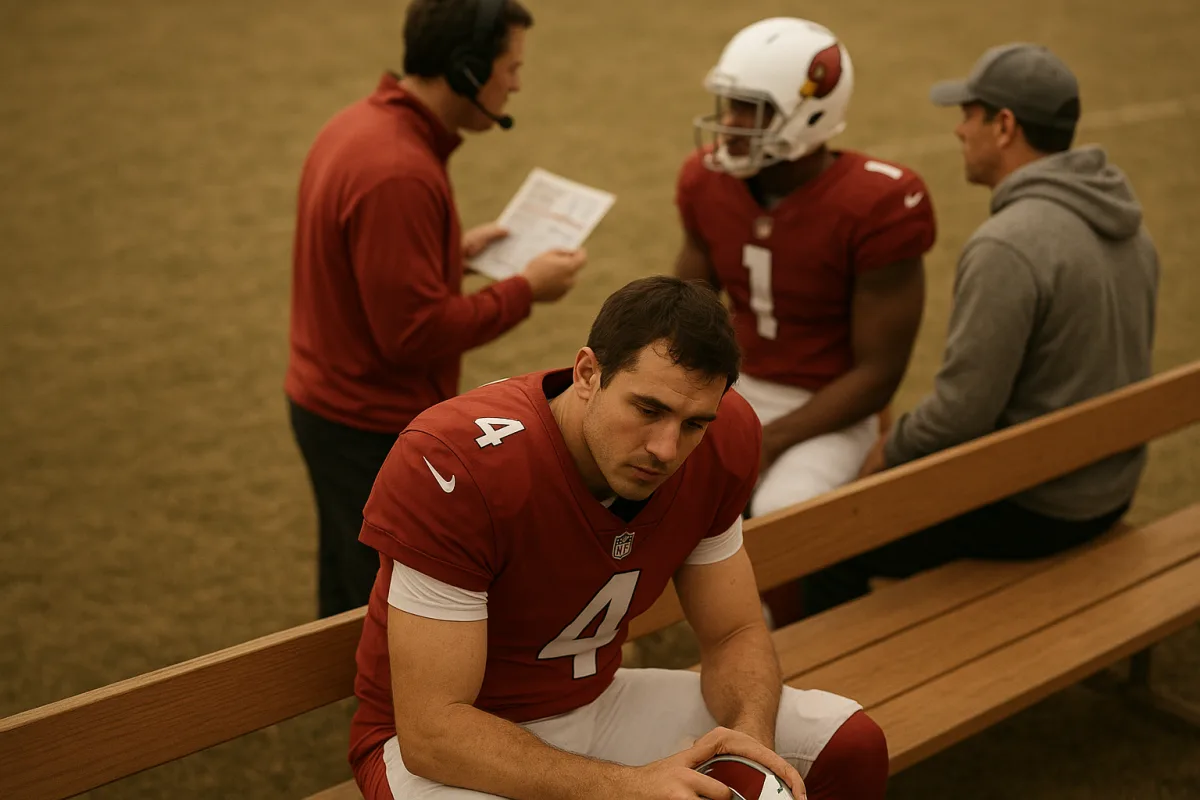
The shift is from rumor to roster management
The important change in the Marvin Harrison Jr. story is not that he has been linked to another team. Star receivers are linked to other teams whenever production dips or an organization loses. The shift is that Arizona reportedly treated him as unavailable for football operations while trade discussions advanced. [2]
FOX Sports reported, through an Associated Press source, that Harrison would be inactive against Detroit as trade rumors intensified. Pro Football Talk, citing ESPN’s Josh Weinfuss, reported that Harrison was absent from Cardinals team meetings Saturday night and had been told he would not be active. [2][8]
Those reports describe the same operational signal: Arizona was not preparing its 2024 fourth overall pick for a normal game week. That is stronger evidence than anonymous roster-fit speculation, because inactives and meeting attendance affect how a club allocates practice and game-plan reps.
Still, the evidence has a limit. Neither the Cardinals nor the Texans has publicly announced an agreement, and there has been no official confirmation that Harrison has been traded as of October 11. Reports that a deal is being finalized should be read as an active process, not a transaction record. [1][8]
That distinction matters because a Sunday inactive can mean several things. A team may be protecting a player during negotiations, avoiding a pre-trade injury, managing a separate health question, or simply choosing not to activate him. The league does not mandate an inactive designation during trade talks. [3]
The Cardinals’ decision is therefore informative precisely because it was discretionary. Arizona appears to have judged that the downside of playing Harrison outweighed the benefit of his snaps against Detroit. That is a personnel decision, not proof that paperwork had already been filed.
Multiple outlets are pointing to Houston, with an important caveat
Houston has emerged as the clear trend line in the reporting. NBC Sports identified the Texans as the likely destination, while other reports have continued to connect a possible deal to a reunion between Harrison and Texans quarterback C.J. Stroud, his former Ohio State teammate. [1][6]
That connection has obvious surface appeal, but it should not be mistaken for a complete football argument. College chemistry can ease communication and trust, especially on option routes and timing throws, yet NFL offenses are built around present personnel, terminology and protection rules.
The stronger roster argument is that Houston would be acquiring a young perimeter receiver with premium draft pedigree rather than betting on an aging veteran. Harrison is still playing on the cost-controlled portion of a rookie contract, even if his top-four-pick salary carries a substantial cap charge.
The Texans also would not need to make him the entire offense on Day 1. In the right structure, Harrison could work as an isolated boundary target, a backside dig or over-route player off play action, and a red-zone matchup piece.
But there is no snap-count or tape-based evidence in the available reporting that says Houston has identified a specific role Harrison cannot fill in Arizona. That is where rumor coverage can get ahead of the football. A destination fit is not evidence of an imminent transaction.
Las Vegas has been mentioned as a possible lurking team, including in Raiders-focused coverage. [9] The problem is that no substantial reporting establishes the Raiders as having made an offer, entered advanced negotiations, or received permission to discuss terms with Harrison.
That does not rule out a Raiders bid. It simply means the current evidence does not support treating Las Vegas and Houston as equally probable outcomes. Houston is the reported leader. Las Vegas is a hypothetical competitor until reporting becomes more concrete.
Why Arizona would be open to moving a recent top-four pick
The production line explains part of the timing, though it should not be used as a full evaluation. Harrison has five receptions for 85 yards and one touchdown in four games this season. [5] That is a small sample, not enough by itself to declare that a receiver cannot play.
Five catches do not tell us target quality, coverage leverage, route depth, quarterback decision-making, pass protection breakdowns or whether a receiver was being used as a clear-out player. Without those details, the raw stat identifies a problem in output, not its cause.
The larger context is that Harrison’s value is reportedly lower than it was when Arizona selected him fourth overall in 2024. Multiple executive assessments cited in trade reporting put his market nearer a late second-round selection or a quality Day 3 return than early first-round value. [7]
That kind of valuation gap is why this is a difficult trade to finish. The Cardinals spent an elite asset on Harrison, but another club is buying the player’s current production, contract, fit and risk profile. Draft position is part of the file, not the final price.
Arizona’s broader record also makes the timing understandable. The Cardinals finished with a franchise-worst 14 losses in 2025, according to the trade reporting. [5] Rebuilding teams regularly reassess whether a talented player fits their timetable, cap plan and preferred offensive identity.
Harrison’s September 23 decision to hire Athletes First agents Todd France and Tory Dandy added another data point. [5] Hiring representation does not mean a player has demanded a trade, but it commonly signals that contract, team situation or future options require professional attention.
There is no public reporting establishing a locker-room conflict, a medical issue driving this move, or a disciplinary reason for the inactive decision. Those gaps matter. The public case for a trade is underperformance and organizational direction, not a confirmed interpersonal breakdown.
The reported negotiation is about timing as much as compensation
The reported disagreement is not merely over whether Houston will surrender a second-round pick. Arizona is said to want a 2027 second-rounder, while Houston has reportedly offered a 2028 second-rounder. [6] One draft year can materially change the deal’s value.
A 2027 selection is closer, more useful for an Arizona club trying to reshape its roster, and easier to place into a current planning horizon. A 2028 choice delays the return another year and adds uncertainty around Houston’s future performance.
That is why a trade can look close in public reporting while remaining unfinished in the building. If the clubs agree that a second-round level return is appropriate but disagree on the draft year, they still have a real valuation gap to bridge.
Arizona can also wait. The NFL’s 2026 trade deadline is November 10 at 4 p.m. Eastern, leaving the Cardinals several weeks to take calls, compare offers and see whether receiver injuries elsewhere create urgency. [4] A reported Sunday-night framework is not the only available window.
The risk in waiting is that Harrison’s value may not rise if he remains inactive or returns without producing. The leverage calculation is straightforward: Arizona wants another team to value his talent more than it values the uncertainty attached to his recent results.
For Houston, a future second-round offer would represent an attempt to buy low without surrendering the type of immediate first-round capital that normally accompanies a young former top-five pick. That is logical negotiating behavior, not necessarily a sign the Texans doubt the player.
What the football fit would actually require
If Houston acquires Harrison, the key question would not be whether Stroud and Harrison played together at Ohio State. The question would be whether the Texans can create clean, repeatable access throws that keep Harrison from living in contested boundary situations.
A receiver with Harrison’s profile benefits when the offense can dictate coverage through formation, motion and route combinations. Stacking releases, using reduced splits and pairing vertical routes with underneath crossers can prevent defenses from simply squatting on isolated outside concepts.
That does not mean he needs to be protected from man coverage. It means the offense should make opponents declare their coverage and force defensive backs to navigate traffic. The best receiver usage is usually about creating leverage before the ball is thrown.
Arizona’s five-catch, 85-yard sample cannot tell us whether Harrison’s issue has been separation, target competition, quarterback placement or offensive design. [5] Any claim that the trade proves Arizona believes he cannot win outside would be unsupported by the available evidence.
A Houston acquisition also would not automatically fix the Texans’ offense. Receiver trades frequently create an adjustment period because route language, sight adjustments and protection checks are learned through practice reps, not through college familiarity or highlight-package assumptions.
The same caution applies to the Raiders. Las Vegas may make sense as a generic destination for a young receiver, but there is no reporting that identifies a role, compensation package or formal pursuit. [9] The football case remains less developed than the Houston case.
What to watch before treating this as done
The next meaningful evidence will be transactional rather than conversational. Watch for an official Cardinals or Texans announcement, a corresponding roster move, a confirmed compensation package, and whether Harrison reports to a new team in time for a normal practice week.
Until then, the reported inactive status is the best indicator that Arizona is seriously exploring a deal. It is not a substitute for confirmation. The distinction is especially important in a deadline season, when one injury elsewhere can change bidding leverage quickly.
The current trend is real: several outlets are reporting that Harrison’s Arizona status has shifted from routine participation to trade-related uncertainty. [1][2][8] The conclusion should remain narrower than the noise around it: Houston is the leading candidate, but no completed trade has been publicly confirmed.
Frequently Asked Questions
What is the latest update on Marvin Harrison Jr.'s trade?
As of October 11, 2026, no official trade has been announced. Reports indicate that the Arizona Cardinals are finalizing a deal, but the transaction has not been publicly confirmed by either the Cardinals or the Houston Texans. Trade talks are ongoing, and the situation remains fluid.
Why was Marvin Harrison Jr. inactive for the Cardinals game?
The Cardinals chose to make Harrison inactive amid trade negotiations, a discretionary team decision rather than an NFL requirement. This move signals Arizona's intent to protect him during the trade process and manage his participation while talks continue.
Which team is likely to acquire Marvin Harrison Jr.?
The Houston Texans are the most frequently reported and likely destination for Harrison. This is supported by multiple sources and the football fit with Texans quarterback C.J. Stroud, Harrison’s former college teammate. Other teams, like the Las Vegas Raiders, have been mentioned but without confirmed interest.
What draft picks are involved in the Marvin Harrison Jr. trade talks?
Negotiations reportedly center on a second-round draft pick, with the main point of disagreement being whether the pick will be in 2027 or 2028. The Texans have offered a 2028 second-round pick, while the Cardinals prefer a 2027 second-round pick.
How we researched this
This article was assembled from 3 published articles, 10 cited references.
Nothing here is based on hands-on testing. Where a figure or finding appears, it belongs to the source cited beside it, and the writing says so rather than implying otherwise. Every source is listed below so you can check it.
Sources
Marvin Harrison Jr. wasn't present for Cardinals team meetings on Saturday night — Pro Football Talk
Rams aren't likely to return Myles Garrett to practice this week — Pro Football Talk
Packers will honor Mike Ditka with a moment of silence before Sunday's game vs. Bears — Pro Football Talk
Texans are the likely destination for Marvin Harrison Jr. - NBC Sports
Marvin Harrison Jr. trade proposals: What Cardinals could get for first-round WR - CBS Sports
Report: NFL Teams Reveal Marvin Harrison Jr.’s Trade Value | NFL Trade Rumors
Cardinals reportedly finalizing deal to trade Marvin Harrison Jr. - AOL
Latest Marvin Harrison Jr. News Fuels Trade Rumors - Raiders Beat
Cardinals finalizing Marvin Harrison Jr. trade: WR inactive vs. Lions - CBS Sports
Related Articles
Marvin Harrison Jr. Performance and Confidence Amid
Explore Marvin Harrison Jr.'s 2026 performance and confidence amid criticism, with analysis of targets, effort, and team perspectives.
Arizona Cardinals Week 2 Injury Updates and Preparations
Get the latest Arizona Cardinals Week 2 injury updates and player news as they prepare for their game against the Seahawks.
Jalen Hurts Injury Update and Eagles QB Situation Explained
Get the latest on Jalen Hurts' injury, medical details, IR rules, and how the Eagles' quarterback situation is evolving.
Detroit Lions Week 5 Win Analysis and Player Media Coverage
In-depth Detroit Lions Week 5 win analysis with player and coach media coverage, highlights, and tactical breakdowns from the Arizona game.