
Marvin Harrison Jr. Performance and Confidence Amid
Explore Marvin Harrison Jr.'s 2026 performance and confidence amid criticism, with analysis of targets, effort, and team perspectives.
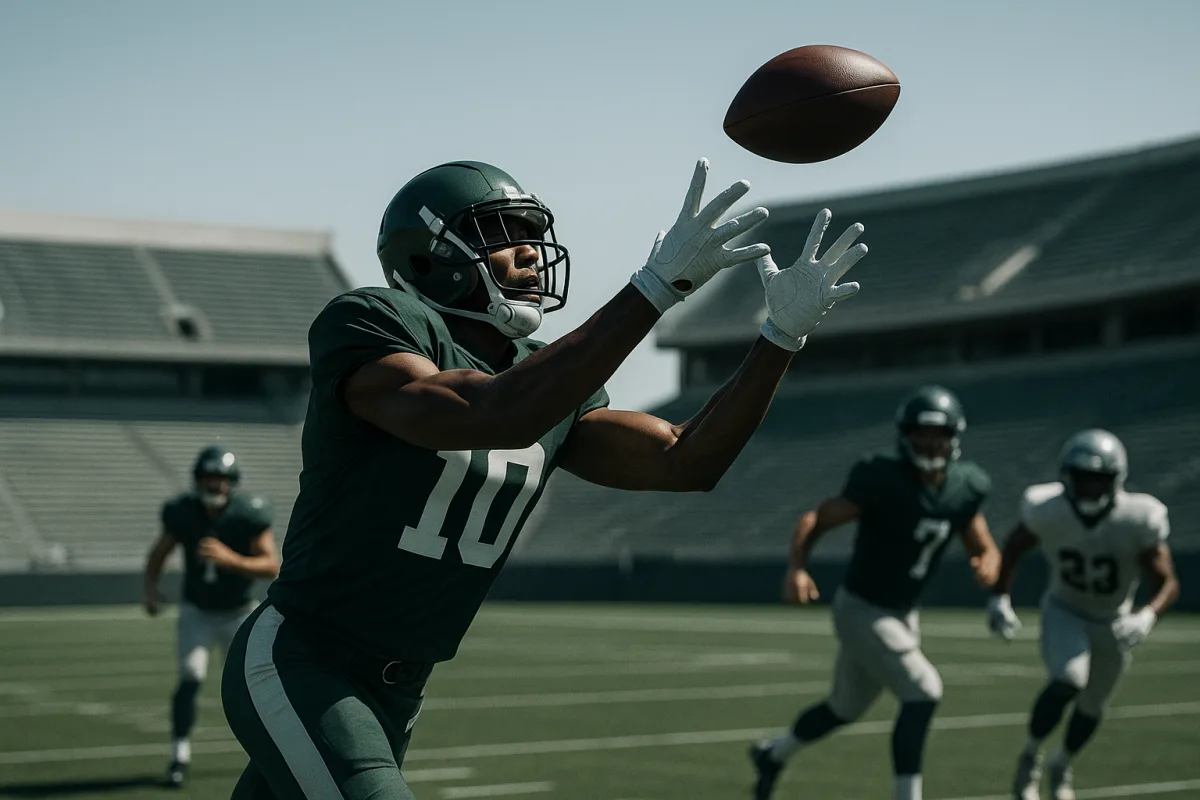
Four targets are the number that needs explaining
Marvin Harrison Jr.’s early 2026 stat line is stark: one reception, 33 yards, no touchdowns, four targets. That is a 25 percent catch rate over two regular-season games, a number that naturally invites questions after the Cardinals used the fourth overall pick on him in 2024. [1]
But the target total deserves more scrutiny than the catch rate. A target is not simply a receiver getting open and a quarterback choosing to throw him the ball. It is the final event in a chain of decisions and matchups.
For Harrison, that distinction matters because the criticism has centered less on drops or a specific failed conversion than on viral clips interpreted as low effort. One clip reportedly drew more than 18 million views, helping turn two quiet games into a debate about his competitiveness. [5]
The available evidence does not establish that conclusion. The Cardinals have publicly defended Harrison, and the independent reporting available provides no internal team report, coaching evaluation or personnel leak that identifies effort or work ethic as a concern.
That does not make the production acceptable. It means the right football question is narrower: why has a receiver who needs downfield routes to develop been targeted only four times, and what does that number actually measure?
A target begins before the quarterback releases the ball
A receiver is credited with a target whenever the quarterback throws a pass intended for him, whether it is caught, dropped, broken up, overthrown or intercepted. It is a useful opportunity stat, but it is not a clean receiver-performance stat.
On a quick hitch, slant or screen, the quarterback often knows the intended receiver before the snap. Those are designed touches. The target says a great deal about play calling, coverage leverage and whether the offense wants to get that player involved early.
Downfield targets work differently. The quarterback may read the deep route first, then move to an underneath route, a checkdown or a scramble based on the coverage and the pass rush. If protection fails before the route matures, no receiver gets a target.
That is the mechanics Harrison described in the Arizona Cardinals’ media availability. For a deep route to produce, he said the offense needs the appropriate coverage, protection that holds up, a winning route and the quarterback to make the correct read and throw.
That answer is not an excuse so much as a description of the position. A vertical receiver can beat a cornerback and still finish the play without a target because the safety stayed deep, the quarterback was pressured, or another route created the earlier and safer completion.
The cost of throwing deep also changes quarterback behavior. A vertical throw usually requires a longer pocket, carries greater interception risk if the safety rotates correctly, and can become a low-percentage play if the receiver does not have clear separation.
Those costs are why a receiver’s target total is often as much a reflection of the offense’s structure as of his individual play. The tape question is not merely whether Harrison ran hard. It is whether his routes forced coverage to widen, carry vertically or rotate help away from others.
Why a downfield role can look quieter than it is
Harrison told Arizona Cardinals reporters that his route tree gets him down the field. That matters because deeper developing routes often produce fewer routine throws than the short-area concepts that build reception totals for slot receivers and running backs.
A go route, for example, may ask a receiver to threaten the corner’s outside shoulder, stack him vertically and hold the safety’s attention. Even if he never receives the pass, that route can create room beneath it for a dig route or an in-breaking route.
That is a useful play, but it does not appear in a box score. The receiver gets no catch, yardage or target. The quarterback may complete a 10-yard throw underneath and receive credit for a successful play while the downfield route did much of the spacing work.
The opposite can also be true. A wide receiver can receive targets without consistently winning. Bubble screens, coverage busts, throwaways under pressure and contested catches all register as opportunities. Targets tell readers where the ball went, not necessarily whether the route was clean.
That is why teammate Michael Wilson’s comments in the Cardinals’ media availability were more useful than broad assurances about “getting him the ball.” Wilson said receiver statistics can represent perceived success and that tape should show whether a player is getting open and playing with the right traits.
Wilson’s larger point holds. A player may have a productive day because the ball found him, or an unproductive day despite winning routes that were not viable throws. Neither outcome should be assumed from a reception total alone.
There is a limit to that defense, though. If the same receiver remains under-targeted over a meaningful sample, the distinction between process and production eventually becomes less helpful. The offense has to find answers, whether by altering alignments, using motion, calling quicker concepts or taking more designed shots.
Two games are not that meaningful sample. Four targets are a warning light, not a verdict.
What criticism gets wrong about effort
The social-media criticism has attached a simple explanation to a complicated offensive result: Harrison looks as if he is jogging, therefore he is not competing. Arizona coach Mike LaFleur disputed that framing, saying Harrison’s running style differs from some players’ and teammates do not see an effort issue. [5]
That does not mean every rep was perfect. Harrison himself did not claim perfection when asked about his run blocking in the Arizona Cardinals availability. He said his responsibility is to get a body on his assignment and keep that defender from making the tackle.
That is the appropriate standard for a receiver blocking on the perimeter. The job is not always to drive a defender five yards backward. Often it is to establish leverage, stay connected long enough, and prevent the defensive back or linebacker from being the first man to the ball.
A wide receiver can lose a block in several ways: failing to identify the correct defender, arriving late, allowing an inside release, losing balance or stopping his feet after initial contact. A clip without the play call and assignment cannot reliably identify which failure occurred.
That context is especially important because external criticism has included claims from former player Breiden Fehoko that Harrison’s struggles are an effort and pride issue. Those are opinions, not corroborated internal evaluations, and no reporting supplied here supports them as a team concern. [8]
Brissett’s public defense was more specific than a generic vote of confidence. According to NBC Sports’ report on comments relayed by Arizona Sports reporter Tyler Drake, Brissett said Harrison remains engaged in meetings, works on the field and has not lost the confidence of the locker room. [5]
LaFleur’s response followed the same line. He said Harrison is attacking his work daily and framed effort improvement as a responsibility for the entire offense, rather than singling out the second-year receiver. [5]
Players and coaches can protect teammates publicly, so their words should not be treated as film proof. But they are still the only sourced perspective from inside the building, and they directly contradict the stronger claim that Harrison has checked out.
The Cardinals need to distinguish attention from force-feeding
Harrison made another important point in the Cardinals’ media availability: if a defense gives one receiver extra attention, someone else has a favorable matchup. That is how a functioning passing game should operate.
Defenses can bracket a receiver with a cornerback underneath and safety help over the top. They can play cloud coverage to his side, rotate a safety late, or assign a linebacker to collision him before a safety takes over. All can reduce clean vertical chances.
The answer is not automatically to throw to Harrison anyway. Forcing targets into bracket coverage can inflate his opportunity total while lowering offensive efficiency. A quarterback who passes up an open checkdown or isolated receiver just to satisfy a target expectation is making the wrong read.
But there is a difference between taking what the defense gives and allowing the defense to remove a premier receiver without consequence. Offensive coordinators can change the math by moving Harrison into the slot, using pre-snap motion, placing him in stacked releases, or pairing his routes with concepts that punish safety help.
Those adjustments create information before the snap and traffic after it. Motion can reveal man or zone tendencies. A bunch alignment can make press coverage harder. A shallow route can occupy an underneath defender and give a deeper in-breaker more room.
The sources do not provide a detailed 2026 route chart or a full tape-based breakdown showing exactly how often Arizona has used those answers. It would be irresponsible to claim the Cardinals have failed at a specific schematic adjustment without that evidence.
What can be said is simpler. Harrison has been targeted four times, and the Cardinals’ passing offense has not yet converted his talent and attention into enough chances. Those are related facts, but the statistic does not tell us precisely why.
Confidence is a process question, not a box-score claim
Harrison acknowledged the start has been slow. In the Arizona Cardinals media availability, he said his confidence comes from preparation and process, not whether he catches zero passes or 10 in a given week.
That is the sensible mindset for a receiver whose role includes routes he may run without receiving the football. It also fits the calendar. Arizona is coming off a franchise-worst 14-loss 2025 season, so every early disappointment is likely to receive more scrutiny than it would on a stable contender.
Top-five receivers face an additional burden. Draft position creates an expectation that they will immediately tilt coverages, produce highlights and carry a passing game. ESPN’s examination of second-year wide receivers noted the heightened pressure surrounding players entering that stage of development. [7]
Harrison cannot control the viral clips, and he should not be insulated from criticism when he misses an assignment or fails to finish a block. He can control route detail, assignment discipline, releases, hands and how consistently he works back to the quarterback.
The Cardinals, meanwhile, control more of the target equation than Harrison does. Brissett must see and trust the throw. The line must create time. LaFleur’s offense must offer answers when coverage tilts toward Harrison. Other receivers must capitalize when defenses overcommit.
That is why the lazy narrative is premature. The early production is real, and it needs to rise. But four targets in two games identify an offensive distribution problem before they prove a confidence problem, an effort problem or a verdict on Marvin Harrison Jr.’s future.
Frequently Asked Questions
Why has Marvin Harrison Jr. been targeted only four times in 2026?
Marvin Harrison Jr.'s target total reflects a combination of factors including protection, coverage, quarterback reads, route timing, and play design rather than just his ability to get open. Deep routes, which Harrison often runs, require the right coverage and protection to develop, and if those conditions are not met, he may not receive many targets. The Cardinals have not yet created or completed enough viable throws to Harrison, which limits his opportunities.
Is Marvin Harrison Jr. showing effort issues amid criticism?
There is no internal team report or coaching evaluation indicating effort or work ethic concerns for Harrison. Despite viral clips and public criticism, the Arizona Cardinals organization, including coaches and teammates, have publicly defended his work ethic and engagement. The criticism appears to stem more from limited production and media narratives than from actual effort issues.
How does target count affect Marvin Harrison Jr.'s performance evaluation?
A receiver’s target count is a useful but imperfect stat because it depends on many factors beyond the receiver’s control, such as offensive scheme and quarterback decisions. Targets indicate where the ball was thrown, not necessarily whether the receiver ran good routes or created separation. Over a small sample like two games, four targets serve as a warning sign but are not sufficient to make a definitive judgment on performance.
What do coaches say about Marvin Harrison Jr.'s confidence and work ethic?
Coaches and teammates, including quarterback Jacoby Brissett and head coach Mike LaFleur, have publicly expressed confidence in Harrison’s work ethic and engagement. They reject the notion that his confidence or effort has diminished despite external criticism. Their statements emphasize belief in his abilities and continued commitment to his development.
How do downfield routes impact Marvin Harrison Jr.'s stats?
Downfield routes often develop more slowly and require longer protection and favorable coverage to result in targets or catches. Even when Harrison runs effective deep routes that draw coverage and create space for teammates, these efforts may not show up in his personal statistics. Such routes can contribute to the offense’s success without generating direct targets or receptions for him.
How we researched this
This article was assembled from 1 video source, 1 published article, 9 cited references.
Nothing here is based on hands-on testing. Where a figure or finding appears, it belongs to the source cited beside it, and the writing says so rather than implying otherwise. Every source is listed below so you can check it.
Sources
WR Marvin Harrison Jr., WR Michael Wilson and CB Starling Thomas V Media Availability | AZ Cardinals — Arizona Cardinals
Jacoby Brissett: No one has lost confidence in Marvin Harrison Jr. — Pro Football Talk
Marvin Harrison Jr. Receiving Stats - NFL Receiving | FOX Sports
Jacoby Brissett: No one has lost confidence in Marvin Harrison Jr. - NBC Sports
Answering big questions on second-year NFL wide receivers - ESPN
Marvin Harrison Jr. Has Gone Viral for a Perceived Lack of Effort. Here's What His Coach Had to Say
Watch Marvin Harrison Jr. Performance and Confidence Amid Criticism on Youtube
Related Articles
Puka Nacua NFL Wide Receiver Status and 2026 Performance
Explore Puka Nacua's rising NFL wide receiver status with 2026 stats, strengths, and comparison to peers like Jaxon Smith-Njigba.
Marvin Harrison Jr. Trade Update and Status Report
Get the latest Marvin Harrison Jr. trade update, including status, likely destination, and why he was inactive for the Cardinals game.
San Francisco 49ers Key Player Performances and Dominance
Explore the San Francisco 49ers' 2026 dominance with key player performances from Brock Purdy, Mike Evans, and their adaptive defense.
Detroit Lions Week 5 Win Analysis and Player Media Coverage
In-depth Detroit Lions Week 5 win analysis with player and coach media coverage, highlights, and tactical breakdowns from the Arizona game.