
NFL Division Structure and Playoff Picture Explained
Explore the NFL division structure and how it shapes the 2026 playoff picture, seeding, and home-field advantages for division winners.
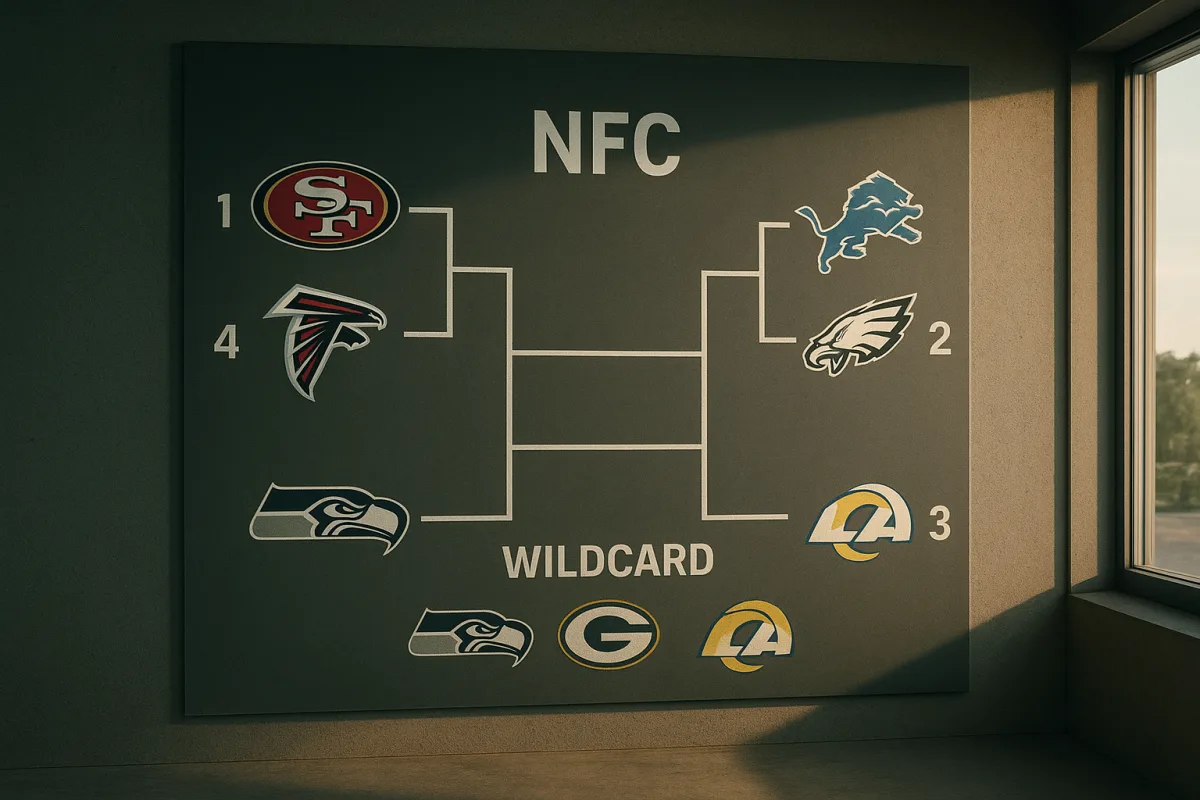
NFL Division Structure Is About Access, Not Just Records
The number that controls the NFC race: seven
Seven is the number to keep in view as the 2026 NFC playoff picture tightens. Seven NFC teams qualify, no matter how the conference’s strength is distributed among its four divisions. [4]
Four of those seven places are reserved before the wild-card race starts. Each NFC division winner qualifies, then receives a seed from No. 1 through No. 4 based on its record against the other division champions. [4]
That leaves only three openings for everybody else. The remaining NFC teams are competing for seeds No. 5, No. 6, and No. 7, ordered by record and then league tiebreakers. [7]
This is the core trade-off in the NFL’s eight-division design. The league rewards winning your local four-team race, even when another division produces multiple teams with superior records.
For a fan, it can look backward. A team that spends January ahead of a rival with fewer wins can still be traveling on wild-card weekend because that rival won its division.
The system is not designed to identify the seven best NFC teams by record. It is designed to identify four division champions, then add the conference’s three best non-champions.
That distinction defines the 2026 debate. The schedule, seeding, and postseason bracket all flow from it.
What a division championship actually buys
Winning a division gets a team into the postseason. It also secures a home game in the Wild Card Round, even if a visiting wild-card team owns the better regular-season record. [4]
The No. 1 seed receives the conference’s only first-round bye. Every other division champion plays on wild-card weekend, usually hosting one of the three wild-card clubs. [4]
So the reward is layered. A division winner can qualify with a modest record, receive a top-four seed, and play its opening postseason game at home.
That is why this is more than an argument about labels. The division winner does not merely reach the bracket ahead of a stronger-recorded non-winner, it can force that opponent onto the road.
Axios highlighted that basic reality when it noted the Panthers hosting a playoff game as a division champion despite the broader questions around division winners and their records. [1] The format deliberately prizes finishing first in a division.
Home field may not carry the edge it once did. A comprehensive survey of NFL home advantage found evidence that the advantage has declined over time, with travel changes and game administration among the factors potentially narrowing it. [2]
But diminishing is not disappearing. Hosting still changes the week for players and coaches, from travel and practice routines to crowd noise on third down and communication at the line of scrimmage.
It also changes the fan experience. A wild-card team with a better record may have to fly across the country, play in another team’s environment, and face a postseason path it could not host under any circumstance.
Why the NFC is a live stress test
The 2026 NFC’s division records have created a sharp gap. As of November 4, the NFC North carried a combined .733 winning percentage and the NFC West stood at .548. [6]
The NFC East sat at .400, while the NFC South was at .367. [6] Those are division-wide records, not a final playoff forecast, but they show how unevenly competitive teams have been distributed.
NFL on NBC’s Pro Football Talk framed the issue through the North and West, where the Vikings, Bears, Lions, Packers, 49ers, Seahawks, and Rams were all part of a crowded group of contenders.
The program’s discussion was intentionally aggressive, projecting that viable teams could miss the field while an NFC South winner secured both a berth and a home game. The important point is structural, not the specific prediction.
If multiple teams from the North and West finish with playoff-caliber records, only two can claim those divisions. The others must fit through three wild-card slots shared with the entire rest of the NFC.
The math creates a bottleneck. Seven teams from those two divisions cannot all qualify, because two division winners plus three wild cards equals five available NFC berths.
That is the cost of having one very deep division. A club can play strong football for four months, lose several games to good divisional opponents, and still find itself outside the playoff field.
Meanwhile, a weaker division cannot send more than one automatic qualifier, but it can still send its champion. The champion does not need to prove it belongs among the conference’s seven strongest records.
That outcome would not mean the weaker division winner failed to earn its title. It would mean the NFL values winning a four-team division as a different accomplishment from posting a better conference record.
Why “just take the best seven” would change the league
The cleanest alternative would be simple in theory: seed the seven NFC teams with the best records, then use tiebreakers when records match. Division winners would have no automatic entry or hosting guarantee.
That would maximize record-based qualification. It would also change what the league asks teams to do over 18 weeks, particularly in a division race where the value of first place currently extends beyond a banner.
The NFL has used its current 14-team playoff structure since 2020. Each conference sends four division champions and three wild cards, with only the No. 1 seed receiving a bye. [4]
Keeping divisions while taking the best seven records would turn division races into scheduling and rivalry containers, not playoff gates. That would be a fundamental philosophical change.
Pro Football Talk’s alternative goes further. The publication proposed replacing the AFC-NFC arrangement with four eight-team conferences, organized around East, North, South, and West groupings.
Under that concept, each eight-team conference winner would automatically qualify. Ten wild-card teams would fill the rest of a 14-team playoff field, and the four conference champions would compete for two first-round byes.
The appeal is easy to see. Winning an eight-team conference likely requires beating more quality opponents than winning a four-team division, so the automatic bid would be harder to capture.
It would also produce one unified playoff tree. In Pro Football Talk’s model, the Super Bowl would not be locked into an AFC champion versus an NFC champion, potentially allowing the league’s two best remaining teams to meet.
The cost of an eight-team conference plan
The argument for reform gets weaker when it reaches the schedule. An eight-team conference could require every team to play seven conference opponents annually, replacing parts of the rotation the NFL uses today.
The regular season already carries a tight framework. Teams play 17 games across 18 weeks, with one bye, and the 2026 regular season runs from September 9 through January 10. [8]
Week 18 is reserved for divisional matchups. [8] That design gives the league late-season rivalry games with direct playoff stakes, which is a feature the current format produces reliably.
An eight-team realignment would also create geographic problems. Combining current AFC and NFC divisions by directional labels sounds tidy, but East and West divisions include teams separated by substantial distances.
More travel can affect recovery, practice time, and competitive balance. It would also make the NFL’s scheduling formula harder to explain, because the league would need to balance annual conference games with cross-conference opponents.
There is an ownership problem, too. Under the current setup, every team begins each season with a one-in-four chance to win its division and host a playoff game.
Move to eight-team conferences, and that chance becomes one in eight. Owners of teams that regularly rely on division races to sell hope, tickets, and late-season relevance would be giving up a meaningful benefit.
That resistance is understandable. The NFL does not organize itself solely to rank teams with mathematical purity. It also protects rivalries, regional identity, television inventory, and competitive stakes in every market.
What to watch as the 2026 race develops
Do not start with the wild-card standings alone. First identify the likely division winner in each NFC division, because those four teams consume four of the seven available postseason places.
Then count the credible non-winners. If the NFC North and NFC West each produce multiple teams above the wild-card line, the pressure falls on every head-to-head game and conference-record tiebreaker.
The league’s tiebreaker system can decide who survives when records match, using factors including head-to-head results, division record where applicable, conference record, and strength-based measures. [4]
That means a November game is not only about the win column. It can become the first tiebreaker, or shape conference record, which matters when two clubs finish with the same overall mark.
The 2026 schedule’s final week will also matter heavily because every Week 18 game is within the division. [8] A late divisional matchup can decide an automatic berth, erase a wild-card path, or change who hosts.
We would keep the current division structure for now, but revisit the automatic home game. Let division winners retain their playoff berths, then seed the seven qualifiers by record.
That narrower change preserves division races and the NFL’s regional architecture while reducing the sharpest penalty for a strong team trapped in a loaded division. It would address the part of the system that most directly changes postseason leverage.
Frequently Asked Questions
How does the NFL division structure affect the 2026 playoff picture?
The NFL’s division structure guarantees each division winner a playoff spot regardless of their overall record. This means that even if a team has a worse record than some non-division winners, it still qualifies and is seeded among the top four in the conference. The 2026 NFC playoff field will include four division winners plus three wild-card teams, limiting the number of wild cards available and creating a bottleneck in stronger divisions.
What playoff advantages do division winners have in 2026?
Division winners not only secure a playoff berth but also earn a home game in the Wild Card Round, even if their record is worse than the visiting wild-card team. The No. 1 seed among division winners receives a first-round bye, while the other three division champions host wild-card teams. Hosting provides logistical and environmental benefits, though recent studies suggest the home-field advantage in the NFL has somewhat diminished.
How many teams make the NFC playoffs in 2026?
Seven teams from the NFC qualify for the playoffs in 2026. This includes the four division winners, who receive seeds 1 through 4 based on their records against other division champions, and three wild-card teams, seeded 5 through 7 based on overall records and tiebreakers.
Why do some division winners have worse records than wild-card teams?
Because each division winner automatically qualifies and is seeded ahead of non-winners, it is possible for a division champion to have a worse record than a wild-card team. This occurs when divisions vary significantly in strength, allowing a team to win a weaker division and gain a playoff spot and home game despite having fewer wins than some wild-card qualifiers.
What are the tiebreaker rules for the 2026 NFL playoffs?
Division winners are seeded 1 through 4 based on their records against other division champions. Wild-card teams are seeded 5 through 7 by overall record and then league tiebreakers if necessary. The specific tiebreakers include head-to-head results, conference records, and other criteria established by the NFL to rank teams with identical records.
How we researched this
This article was assembled from 1 video source, 1 published article, 9 cited references.
Nothing here is based on hands-on testing. Where a figure or finding appears, it belongs to the source cited beside it, and the writing says so rather than implying otherwise. Every source is listed below so you can check it.
Sources
NFC playoff picture: How could things shake out in 2026? | Pro Football Talk, NFL on NBC
2026 season could highlight the unfairness of the eight-division structure, Pro Football Talk
A comprehensive survey of the home advantage in American football
Ranking all eight NFL divisions entering 2026 season | Latest NFL News, Analysis & Updates | NFL.com
How to watch NFL 2026: FREE live streams, broadcast details and Week 8 games
NFL Playoff Seeding Rules 1-7: Complete Guide & Bracket Mechanics (2026)
How Many N F L Teams Are There Breaking Down The Leagues 32 Franchise Structure, CITRAENT
Watch NFL Division Structure and Playoff Picture in 2026 on Youtube
Related Articles

Los Angeles Rams Struggles and 2026 Playoff Outlook
Explore the Los Angeles Rams struggles, key issues, and their 2026 playoff outlook with detailed analysis of offense, defense, and coaching adjustments.

Lamar Jackson Injury and Its Impact on Ravens' QB Future
Explore Lamar Jackson's thumb injury, recovery outlook, and how it shapes the Ravens' quarterback options and offensive strategy in 2026.

Dan Quinn Washington Commanders Coaching Challenges in 2026
Explore the coaching challenges Dan Quinn faces with the Washington Commanders, including game management and operational errors in 2026.

NFL Broadcast Media Developments: ESPN, Contracts & Coverage
Explore key NFL broadcast media developments, including ESPN announcer contracts, international games, and evolving coverage strategies for 2026.