
NFL Week 1 Offensive Strategy and Coaching Insights
Explore NFL Week 1 offensive strategy, including coaching insights, run-pass tendencies, and the sail concept for 2026 season openers.
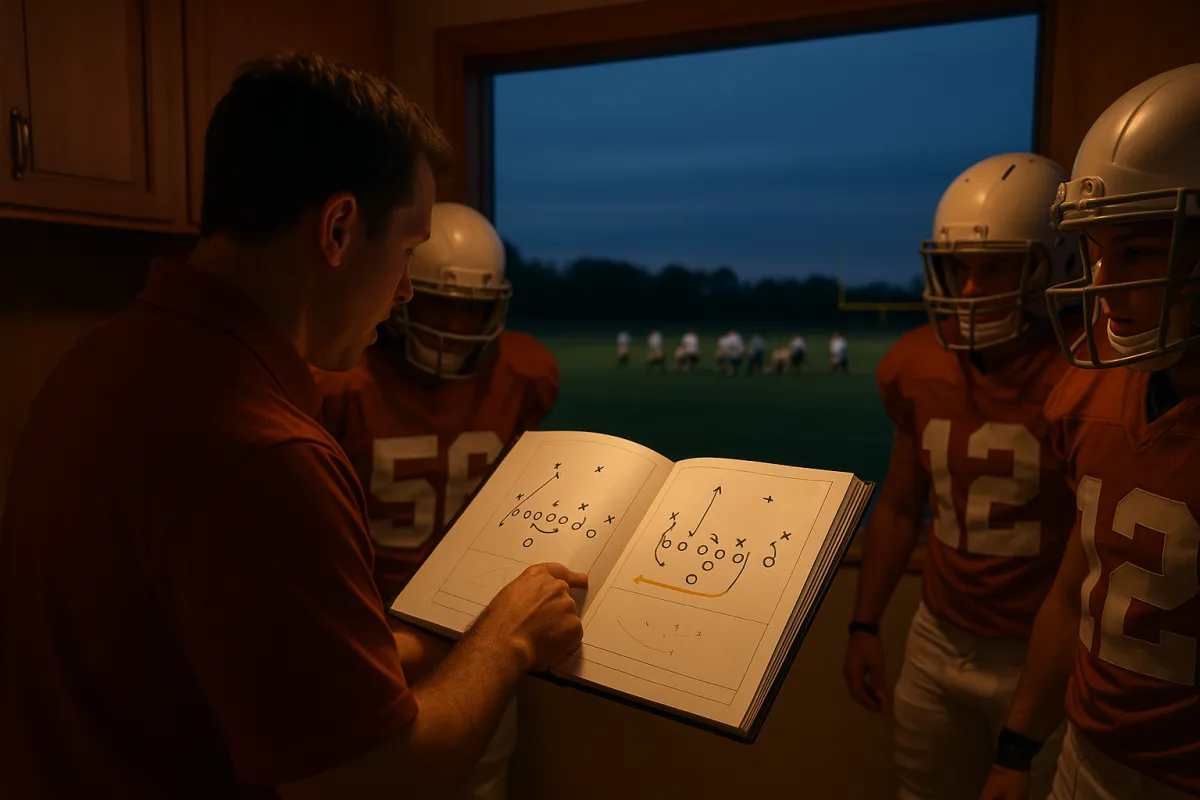
The Week 1 concept worth watching: putting a tendency on tape
NFL teams spend August building a public record of themselves. Preseason tape is limited, starters may play sparingly, and coordinators understandably protect much of their call sheet. Still, formations, motions, personnel packages and basic run-game rules go on film.
That matters because defenses do not merely prepare for plays. They prepare for probabilities. If an offense repeatedly aligns in one formation and runs the ball, the defense begins to set its coverage leverage, front structure and secondary support around that expectation.
Baltimore Ravens offensive coordinator Declan Doyle gave a useful example on the club’s Ravens Game Plan program. Reviewing a preseason completion, he described an offense that had run the ball frequently from a particular formation, then used the same look to present a variation of sail.
That is the essential Week 1 chess match for a new coordinator. It is not necessarily about unveiling something no opponent has seen. It is about making the opponent defend the same picture differently, without making Baltimore’s own players learn an entirely new operation.
Doyle’s stated emphasis through preseason was energy, communication, fundamentals and detail. That can sound generic until it is attached to a concept such as sail, because each of those points is a requirement for the concept to work rather than a coach-speak substitute for strategy.
The Ravens’ new staff has not publicly laid out a detailed 2026 offensive blueprint. NBC Sports’ reporting on Jesse Minter’s first Baltimore staff establishes the organizational change, while Athlon reported Lamar Jackson’s optimism about the system’s complexity. Neither provides reliable evidence for precise Week 1 play-calling tendencies. [1][2]
So the responsible reading is narrower. Baltimore has shown a coordinator using formation history, motion and route spacing to create a defined throwing window. That is evidence of one offensive mechanism, not proof that the Ravens will become a particular kind of offense.
What a sail concept is trying to do
“Sail” is a family name, not one universal route diagram. The common idea is to flood one side of the field with receivers at different depths, forcing a coverage defender to choose between routes that threaten separate levels of his zone.
In Doyle’s preseason example, Baltimore used an outside vertical route, an intermediate out-breaking sail route and a shorter route into the same side’s spacing. He also identified a backside in-breaking route and a checkdown, giving the quarterback answers if the primary flood was covered.
The vertical route is not simply there to run hard and occupy space. It asks the outside corner whether he can stay deep enough to prevent an explosive throw while still helping on the intermediate receiver breaking toward the sideline.
The intermediate sail route, generally breaking out around 15 yards in Doyle’s description, attacks the area beneath or outside that deep coverage. If the corner expands with the vertical route, the sail route can arrive in the void he leaves behind.
The short route, often called the flat control in many versions of the concept, puts pressure on an underneath defender. If that defender gains depth to close the intermediate break, the quarterback has a shorter throw with room to turn upfield.
That is why the play is often described as a three-level stretch. One defender, or a pair of defenders with conflicting responsibilities, is asked to cover a deep threat, an intermediate out-breaker and a short outlet in too little horizontal space.
The quarterback does not throw sail because the route concept has a good name. He throws it because the defense declares its leverage. The coverage shell before the snap, the corner’s depth, an underneath defender’s width and the pass rush all affect the answer.
Against zone coverage, the quarterback is commonly reading how the defenders distribute themselves across that sideline area. Against man coverage, the matchup and route leverage can change the equation, while a blitz may make the checkdown or quick throw the only sensible choice.
Doyle’s point about the clean pocket is central. Flood concepts take time because the intermediate route has to reach its break and the vertical route has to force coverage depth. If protection fails early, the carefully designed spacing never has time to matter.
Why the run tendency is part of the play
The Ravens’ particular wrinkle was not sail alone. It was the decision to call it after showing the formation as a run look. Doyle said Baltimore had put that formation on tape the previous week and believed it had run the ball from it often enough.
That changes defensive behavior before the snap. A safety may fit the run more aggressively. A linebacker may key the backfield rather than widen immediately. A corner may play with leverage suited to containing the perimeter rather than anticipating a layered pass concept.
None of those reactions guarantees an open receiver. NFL defenses are built to handle play-action, motion and tendency breakers. But football is often about making a defender hesitate for a fraction of a second, then placing the ball where that hesitation matters.
The personnel package is part of the disguise. Doyle also showed Baltimore running an open-side play from 12 personnel, meaning one running back and two tight ends. That grouping can invite heavier defensive personnel and signal an offense willing to play physically at the line.
From there, the offense can run to an open side, as Doyle outlined, or use the same bodies and alignment to create a pass presentation. The defense has to respect the tight ends as blockers while accounting for their possible routes, which expands the menu without changing personnel.
That is the value of multiplicity when it is useful. It is not lining up in endless formations for novelty’s sake. It is having enough believable answers from a small cluster of looks that defenders cannot overcommit without accepting a cost.
The cost exists for the offense, too. The more an offense asks its receivers, tight ends and backs to motion, block and run route adjustments, the greater the chance of a communication failure. Week 1 penalties and missed assignments are often the price of excess variety.
Baltimore’s preseason tape, at least in Doyle’s own explanation, suggests the staff understands that tradeoff. The coach repeatedly returned to operation, speed off the ball, combination-block timing and route detail, all of which are the infrastructure beneath the constraint play.
The run game makes the pass credible
Doyle’s run-game breakdown matters because a tendency only has force if the underlying tendency can hurt a defense. He highlighted front-side and backside combinations, vertical movement on defensive tackles and a tackle stretching the edge to create a seam.
A combination block is a two-man job with a deadline. Two linemen initially secure a defensive lineman, then one must climb to the linebacker once the first block is stable. Leave too soon and the lineman defeats the block. Stay too long and the linebacker runs free.
The open-side run Doyle described also requires the running back to stay on the prescribed track. That is not a trivial detail. The back’s path helps him read the blocks, but it also preserves the visual picture that later helps sell the same formation’s play-action and pass complements.
Perimeter effort completes the design. Doyle pointed to receivers blocking downfield and working back to a safety. Those blocks do not always appear in the rushing total, but they decide whether a solid interior run becomes a modest gain or a drive-changing play.
This is where a stat can mislead. A successful sail completion may be credited as quarterback accuracy and receiver production. The box score cannot show that prior run tendency influenced the coverage, or that protection gave the quarterback the extra beat needed for the intermediate route.
Likewise, a failed play-action throw does not necessarily mean the concept was bad. It may mean the corner stayed disciplined, the linebacker carried the route correctly, the protection lost quickly, or the quarterback correctly bypassed a contested throw and took an incompletion.
Harbaugh’s Week 1 record is process, not scheme
Los Angeles Chargers coach Jim Harbaugh enters the Cardinals game with a 6-0 NFL Week 1 record, accumulated with the San Francisco 49ers and Chargers. Pro Football Talk noted that a seventh opening-week win would continue that unbeaten start to his NFL head-coaching career.
That record is notable, but it does not explain what Los Angeles will call on first down or how it will attack Arizona. Six wins across multiple teams and seasons are too small a sample to establish a universal schematic formula, particularly in a sport with changing rosters.
Harbaugh’s own remarks to the Chargers’ media offer a more useful frame. He praised his assistants for establishing a style of play and emphasized that the style, rather than merely the design of a call, is the “end-all be-all.”
That distinction fits the sail example. A coordinator can draw a clean tendency breaker, but it becomes meaningful only if the offense gets aligned, handles motion, protects the quarterback, carries out its route depths and avoids the procedural errors that turn first-and-10 into first-and-15.
Harbaugh’s confidence in Khalil Mack should also be read through that operational lens. NFL Network reported Mack’s one-year, fully guaranteed $18 million agreement with Los Angeles, reflecting the value of a proven edge defender to a team’s weekly plan. [4]
Mack’s impact is not confined to sacks. His 2025 production included 5.5 sacks and four forced fumbles in 12 games, but offenses must also account for his alignment, chip him with a tight end or back, and alter protection toward him. [8]
That affects an opponent’s offensive menu. A pass concept that needs a long-developing intermediate break is less attractive if protection must dedicate an eligible receiver to the edge. The resulting checkdown may look conservative, while actually being the logical answer to personnel and pressure.
The Chargers’ current injury picture also illustrates why Week 1 planning remains provisional. CBS Sports listed Keaton Mitchell as questionable with a hamstring issue and Brenen Thompson as questionable with a hip issue, while Rashawn Slater was not on the report. [7]
Why simple can be sophisticated in an opener
The broader league context favors this kind of disciplined sequencing. The 2026 season includes 21 teams with new offensive coordinators, a volume of turnover that makes installation and shared language especially important in September. [5]
History offers a warning against assuming fresh staffs will instantly produce clean football. Teams with new head coaches went 0-7 in Week 1 during the 2018 season, according to the coaching-trend research compiled by Fantasy Nerds. [5]
That does not mean new coaches should hide their ideas. It means their early advantage usually comes from defining a manageable set of formations, protections and complementary plays, then ensuring every player understands the defense’s likely answers.
For Baltimore, the meaningful Week 1 question is not whether Doyle unveils a radically new Lamar Jackson offense. The evidence available does not support that claim. The question is whether Baltimore can make its base looks credible enough that its complements force Indianapolis to hesitate.
For Harbaugh’s Chargers, the relevant question is similar despite the different personnel and staff. Can Los Angeles make its preferred style show up snap after snap, with protection, physicality and situational clarity intact, rather than relying on the mythology of an unbeaten opener record?
The opening week rewards teams that know what they are, but it also rewards teams that understand what they have shown. The formation on tape is information. The best coordinators use it to create the next decision, then make sure their players can execute it.
Frequently Asked Questions
What offensive strategies do NFL teams use in Week 1?
NFL teams often rely on a limited, clean play menu rather than showing a large volume of schemes. The focus is on fundamentals, energy, and communication to execute plays well. Coordinators may use familiar formations and tendencies to create opportunities, such as running a known formation that looks like a run but turns into a pass concept.
How do NFL coordinators use run tendencies to influence defense in Week 1?
Coordinators put certain run tendencies on tape during preseason to shape defensive expectations. For example, Baltimore’s offense ran the ball frequently from a specific formation, causing defenses to prepare for a run. Then, they used the same formation to run a passing concept, forcing defenders to hesitate or adjust their coverage, which can create openings for the quarterback.
What is the sail concept in NFL offensive strategy?
The sail concept involves flooding one side of the field with receivers at different depths—deep, intermediate, and short routes—to stretch a defender’s coverage vertically and horizontally. The quarterback reads the defense’s leverage and coverage shell to decide where to throw, often relying on protection to allow the routes to develop fully.
How do new offensive coordinators impact Week 1 game plans?
With many teams changing offensive coordinators, Week 1 game plans tend to emphasize running a smaller, well-practiced set of plays cleanly rather than showing extensive new schemes. The challenge is balancing introducing new concepts with ensuring players can execute without confusion, making operational consistency a key factor.
Why is formation tendency important in NFL Week 1 offenses?
Formation tendency matters because defenses prepare based on the probabilities of what an offense usually does from certain looks. If an offense runs the ball often from a formation, defenses will align to stop the run. Offenses can exploit this by using the same formation to run a pass play, forcing defenses to adjust on the fly and potentially creating mismatches or open throwing lanes.
How we researched this
This article was assembled from 2 video sources across 2 channels, 1 published article, 8 cited references.
Nothing here is based on hands-on testing. Where a figure or finding appears, it belongs to the source cited beside it, and the writing says so rather than implying otherwise. Every source is listed below so you can check it.
Sources
Game Plan: Ravens' New Coordinators Break Down Preseason Tape | Baltimore Ravens — Baltimore Ravens
Jim Harbaugh On Injury Updates vs. Cardinals | LA Chargers — Los Angeles Chargers
Jim Harbaugh tries to extend Week 1 record to 7-0 — Pro Football Talk
Ravens announce Jesse Minter's first coaching staff - NBC Sports
Ravens' Lamar Jackson Puts NFL Defenses on Notice Before 2026 Season - Athlon
Potsy Clark Record, Statistics, and Category Ranks | Pro-Football-Reference.com
NFL Week 1: Navigating New OCs, International Games, and Coaching Trends - Fantasy Nerds
Detroit Lions Week 1 preview: Breaking down Saints’ schemes, tendencies | Pride Of Detroit
Los Angeles Chargers Injury Report and Status 2026-27 - CBS Sports
What if the Chargers are the L.A. Team that Leads the NFL in Sacks in 2026?
Watch Coaching and Offensive Strategy Insights for Week 1 on Youtube
Also from the sources
Related Articles
Baltimore Ravens Offense 2026: Lamar Jackson’s New Look
Explore the Baltimore Ravens offense in 2026 and how Lamar Jackson’s new look and pre-snap motion shape their strategy.
Arizona Cardinals Week 1 Media Availability and Team Outlook
Get insights from Arizona Cardinals Week 1 media availability, injury updates, and team outlook ahead of the 2026 season opener.
NFL Week 1 Player Leadership Insights and Media Availability
Explore NFL Week 1 player leadership insights and media availability, highlighting key veterans, captains, and roster readiness for the season opener.
NFL Week 1 Quarterback Outlooks and Team Analysis
Explore NFL Week 1 quarterback outlooks with insights from coaches and analysts on team strategies and player readiness for the 2026 season opener.