
Brandon Aiyuk NFL Reinstatement and $13M 49ers Dispute
Explore Brandon Aiyuk's NFL reinstatement challenges and the $13 million contract dispute with the 49ers impacting his return.
Brandon Aiyuk’s $13 Million Reinstatement Problem, Explained
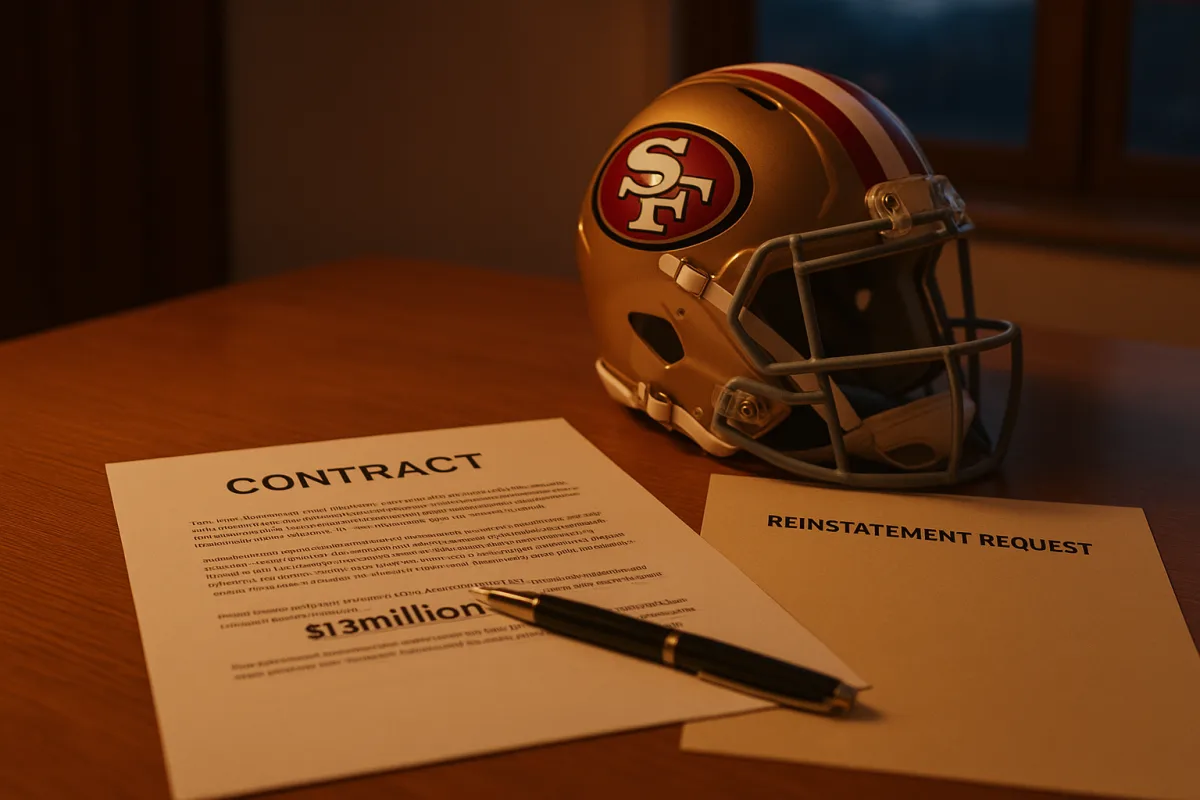
The number that controls the next step: $13 million
On Friday, Brandon Aiyuk arrived at the 49ers’ Santa Clara offices with agent Drew Rosenhaus, saying he was healthy and seeking reinstatement to the NFL. The receiver’s return to football now runs through a financial dispute, not a medical clearance. [5][6]
Aiyuk said he had completed a long rehabilitation process and was “back to 100 percent.” Rosenhaus said the wide receiver was physically ready to return, but neither offered an answer on where Aiyuk would play next. [6]
That caution fits the situation. NFL.com reported that the 49ers and Aiyuk were meeting as he pursued reinstatement, while Pro Football Talk reported afterward that no resolution had been reached and Rosenhaus described the matter as “to be continued.” [6]
The central figure is approximately $13 million. The NFL informed Aiyuk that he owes San Francisco that amount in previously paid bonuses, according to FOX Sports. [5]
This is the figure that can keep a seemingly straightforward return from becoming straightforward at all. Aiyuk wants to regain the ability to play for an NFL team, while the 49ers want clarity on money already paid under a contract they believe was breached.
San Francisco is not merely deciding whether Aiyuk can help its passing game. Coach Kyle Shanahan said the situation had been over for the football team for a long time, which tells you the roster decision and the financial decision are moving on separate tracks. [6]
For Aiyuk, the immediate decision is whether resolving the repayment claim is worth accelerating a return to the market. For the 49ers, the leverage comes from still holding his NFL rights while the debt issue remains unsettled.
Why $13 million and $27 million are different disputes
The most confusing part of this saga is that two large numbers are regularly attached to it. The 49ers’ approximately $13 million claim concerns bonuses already paid, while the roughly $27 million figure concerns future guarantees that San Francisco voided. [5][9]
Those are different buckets of money. A recoupment claim seeks money back from the player. A voided guarantee removes money the club otherwise could have owed later under the contract.
Aiyuk signed a four-year, $120 million extension in August 2024 after a lengthy offseason contract dispute. The deal included $76 million in total guarantees, with $47 million guaranteed before April 1, 2025. [1][2][3]
The extension also contained a $23 million signing bonus. Aiyuk was due $11 million within two weeks of signing, with the rest scheduled alongside his 2024 base salary. [3]
That payment structure explains why a recoupment fight can exist even after future guarantees have been erased. Signing and option bonuses are paid early, then accounted for against the salary cap across multiple seasons.
CBS Sports’ contract reporting said the 49ers voided $27 million in guarantees in July 2026 after Aiyuk reported late to training camp. He was also fined $50,000 per day for missed camp time. [9]
The voided amount closely matches Aiyuk’s 2026 guaranteed compensation. His 2026 option bonus was $24.935 million, with a $1.215 million base salary, $750,000 per-game roster bonus, and $100,000 workout bonus also guaranteed under the original structure. [3]
Added together, those 2026 items total $27 million. That figure represents future contractual compensation the club says it no longer owes, not the same money it is attempting to recover from Aiyuk.
The reported $13 million issue is tied to previously paid signing and option bonuses. Public reporting has not disclosed a dollar-by-dollar accounting identifying exactly which bonus installments make up the claimed repayment amount. [5]
It is also important not to invent contractual language that has not been published. Reports establish the extension’s guaranteed salary and bonus structure, but they do not disclose a specific public conduct or rehabilitation clause governing every part of this dispute. [3]
That leaves room for disagreement over what San Francisco can legally recover, how much Aiyuk actually owes, and whether the parties can settle for less than the reported figure. The NFL Management Council and NFL Players Association are working toward a resolution, CBS Sports reported.
What the reserve/left squad list actually does
Aiyuk’s roster status is the mechanism that gave this dispute its unusual shape. The 49ers placed him on the reserve/left squad list on Dec. 13, 2025, after his relationship with the team deteriorated during his recovery. [6]
The designation exists for a player who leaves a team without permission. Under the Collective Bargaining Agreement, the club must notify the player, who then has five days to return. [4]
If the player returns in that window, the team can reinstate, waive, or trade him. If he does not return, the club can place him on the reserve/left squad list for the rest of that season and postseason. [4]
Once that happens, the player cannot return to the active roster during that season. His contract tolls, meaning the contract effectively pauses, and the team’s salary-cap obligations tied to that period pause with it. [4][8]
That rule explains why Aiyuk could not turn his 2025 absence into a quick release or a move to another club. The reserve/left squad list is not a free-agency mechanism, and it does not erase the team’s contractual control.
The list also makes reinstatement a league matter, even though the conflict began between player and club. Aiyuk can seek reinstatement in the following season, but his return does not automatically terminate the 49ers’ rights to him. [4][5]
Aiyuk filed his reinstatement request in early November and planned to report to the 49ers facility. FOX Sports reported that the NFL had informed him of the approximate $13 million obligation to San Francisco. [5]
That is why the money has become so consequential. A player cannot turn reinstatement into an immediate fresh start elsewhere if the original club still holds his contract and believes it has a valid repayment claim.
Why the 49ers still have leverage after reinstatement
Even if the NFL reinstates Aiyuk, San Francisco will control the next roster move. The 49ers could bring him back, pursue a trade, release him, or negotiate a settlement that clears the path to a release. [4][7]
A return to the 49ers looks unlikely based on the public comments. Shanahan’s response before Friday’s meeting was that he did not care how it went because the issue had been finished for the team long ago. [6]
But releasing Aiyuk would not make the accounting disappear. According to 49ers Webzone’s cap analysis, a release would create $12.35079 million in 2026 dead-cap charges, followed by a $4.987 million cap credit in March 2027. [7]
The later accounting would still leave $19.29858 million in dead money in 2027. Across 2026 and 2027, the projected dead-cap impact is about $31.65 million. [7]
Dead cap is not a new cash payment to Aiyuk. It is the portion of money already paid or committed that must remain on the salary cap after the player is no longer on the roster.
For a contender, that distinction affects the roster around the quarterback. Dead money can reduce room for extensions, veteran signings, injury replacements, or rollover cap space even after the player has left the building.
A trade could shift some future obligations to another team, but Aiyuk’s market is complicated by his prolonged absence, the unresolved repayment issue, and the lack of independent public medical reporting on his recovery. [5][6]
Aiyuk and Rosenhaus say he is healthy. There are no publicly reported independent medical evaluations that would allow another team, or you, to verify his condition beyond those statements and the 49ers’ eventual physical process. [5][6]
That does not mean he cannot play. It means any acquiring club would need its own medical evaluation before attaching draft capital or a revised contract to a receiver who last appeared in a game in October 2024. [6]
The football player underneath the dispute
The financial conflict has buried the reason Aiyuk had leverage in the first place. He was one of San Francisco’s most efficient receivers in 2023, producing 75 receptions, 1,342 yards, and seven touchdowns as the 49ers reached Super Bowl LVIII.
His value in Kyle Shanahan’s offense came from more than catch totals. Aiyuk consistently won outside the numbers and down the field, where he could threaten coverage structure before the ball arrived.
That skill set matters because it creates space for the rest of the offense. When a receiver wins deep on intermediate and vertical routes, defenses have to devote safety help toward him, opening room for crossers, play-action throws, and yards after the catch.
The injury interrupted that trajectory. Aiyuk tore the ACL and MCL in his right knee on Oct. 20, 2024, ending a season in which he had struggled early before recording 147 receiving yards against Arizona in Week 5. [6]
His football value will therefore be assessed through two separate lenses once he is eligible: whether his knee permits him to regain that movement profile, and whether a team can acquire him without inheriting the 49ers’ dispute.
We would focus on the second question first. Until Aiyuk, the NFL, the NFLPA, and San Francisco establish how the reported $13 million will be handled, every potential landing spot remains theoretical.
Frequently Asked Questions
What is the $13 million dispute in Brandon Aiyuk's NFL reinstatement?
The $13 million dispute involves the NFL's claim that Brandon Aiyuk owes the San Francisco 49ers that amount in previously paid bonuses. This recoupment issue is separate from future guarantees that the 49ers voided and is central to whether Aiyuk can be reinstated and return to play.
How does Brandon Aiyuk's contract affect his NFL return?
Aiyuk signed a four-year, $120 million extension in August 2024 with $76 million in total guarantees. The contract included a $23 million signing bonus, part of which the 49ers now seek to recoup. His contract rights remain with the 49ers, meaning they control his NFL status while the financial dispute is unresolved.
What are the financial issues between Brandon Aiyuk and the 49ers?
The financial issues include a $13 million recoupment claim for bonuses already paid and a separate $27 million in future guarantees the 49ers voided. The recoupment claim demands repayment of money already received, while the voided guarantees remove potential future payments.
Can Brandon Aiyuk return to the NFL despite contract disputes?
Aiyuk can pursue reinstatement, but his return depends on resolving the financial dispute over the $13 million the 49ers claim he owes. The 49ers still hold his rights and must decide whether to trade, release, or negotiate with him before he can play again.
What does Brandon Aiyuk's reinstatement mean for the 49ers?
If reinstated, the 49ers retain control over Aiyuk’s rights and face decisions about his roster status and contract. The team must weigh the cost of carrying his contract against potential trade or release options while managing the financial recoupment issue.
How we researched this
This article was assembled from 3 published articles, 9 cited references.
Nothing here is based on hands-on testing. Where a figure or finding appears, it belongs to the source cited beside it, and the writing says so rather than implying otherwise. Every source is listed below so you can check it.
Sources
Brandon Aiyuk returns to 49ers offices to seek NFL reinstatement as $13 million problem looms, CBS Sports NFL
Drew Rosenhaus after Brandon Aiyuk's meeting with 49ers: "To be continued", Pro Football Talk
Brandon Aiyuk: I’m back to 100 percent and looking to get reinstated, Pro Football Talk
Sources: 49ers, Brandon Aiyuk reach 4-year, $120M extension - ABC News
Article 4 | NFL Collective Bargaining Agreement (CBA) | Over The Cap
Brandon Aiyuk Files For NFL Reinstatement, Plans To Report To 49ers Facility Friday
49ers salary cap impact of releasing Brandon Aiyuk | 49ers Webzone
Agent's Take: Brandon Aiyuk faces complex future after contract guarantees voided - CBS Sports
Agent's Take: Brandon Aiyuk faces complex future after contract guarantees voided - CBS Sports
Related Articles
Christian Gonzalez Patriots Contract Extension Sets New
Explore Christian Gonzalez's record Patriots contract extension and its impact on the NFL cornerback market and team strategies.
Joey Porter Jr. Trade Analysis: Value and Contract Impact
Detailed Joey Porter Jr. trade analysis covering draft cost, contract implications, and impact on Dallas Cowboys' defense.
Tucker Kraft Contract Extension: Key Details and Cap Impact
Explore Tucker Kraft's contract extension with the Packers and how the signing bonus affects the team's salary cap and future flexibility.

Josh Jacobs Packers Future
Explore Josh Jacobs Packers future amid controversy, NFL investigation, and team plans for running back depth and availability.