
Joey Porter Jr. Trade Analysis: Value and Contract Impact
Detailed Joey Porter Jr. trade analysis covering draft cost, contract implications, and impact on Dallas Cowboys' defense.
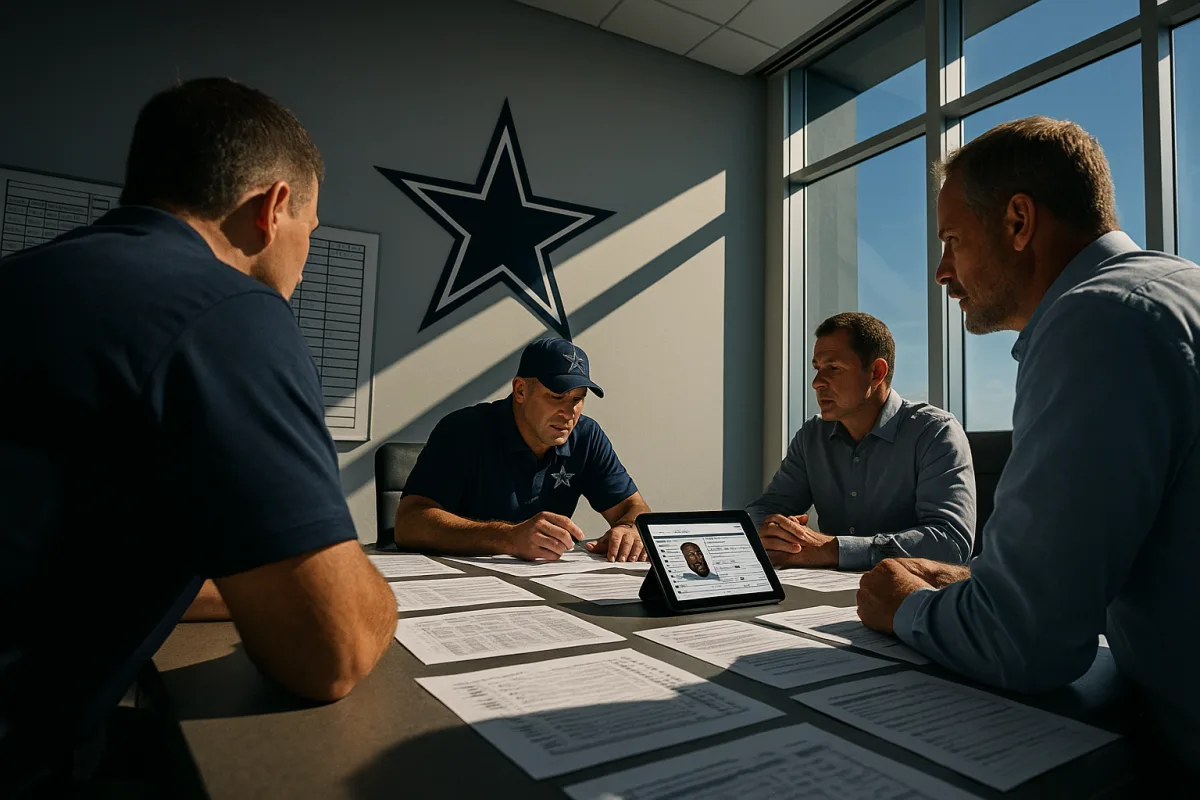
Joey Porter Jr. trade analysis: Dallas bought the player, not the contract answer
The real trade is for a negotiating window
The Dallas Cowboys acquired cornerback Joey Porter Jr. from the Pittsburgh Steelers for a 2027 sixth-round pick and a 2028 second-round pick, according to NFL.com’s trade report. [5] On the surface, that is a future-second-rounder deal for a starting cornerback.
That description misses the most important part. Dallas did not acquire Porter with a cheap multiyear contract attached, nor did it acquire a player whose future salary is already known. It acquired the right to solve that question first.
Porter entered the final year of his rookie agreement amid a reported contract stalemate. That changes how the trade should be evaluated. The Cowboys are not simply comparing a second-round pick against Porter’s tape, they are comparing it against the cost of Porter plus his next deal.
That distinction matters because the trade has two separate prices. The first is the draft compensation paid to Pittsburgh. The second is the financial commitment Dallas may need to make if it wants Porter beyond this season.
A team can win the first transaction and lose the second. If Porter plays well enough to command a premium extension but Dallas cannot fit that extension into its broader cap structure, the Cowboys may have paid a second-round pick for a short-term rental.
That does not automatically make the move reckless. It explains why calling it a simple bargain is premature. Cornerback is a premium position, and acquiring a proven young starter before free agency can be valuable, but only if the acquiring team is prepared for the leverage shift.
Why contract timing changes a player’s value
An NFL rookie contract gives the club substantial cost certainty. The player is paid under the rookie wage scale, and the team knows its near-term cap charge. Once that deal nears expiration, the player’s market becomes much less predictable.
The player has more leverage because an extension must compete with outside-market prices. The team has leverage because it can negotiate exclusively before free agency. A trade for a player in that position is essentially a bet that exclusivity has meaningful value.
Dallas now gets months, not days, to decide what Porter is worth in its own defense. It can examine his practice fit, his medical information, his response to Christian Parker’s coverage calls and whether his style works with DaRon Bland.
That is more useful than evaluating a player strictly from another team’s tape. But it is not the same as gaining a discount. If Porter plays at a high level in Dallas, the price of retaining him may rise rather than fall.
The current cornerback market supplies the important reference point. Sports Illustrated’s cornerback salary breakdown put the top of the position between DaRon Bland’s $22.5 million annual average and Christian Gonzalez’s $33.75 million annual average. [7]
Those deals do not mean Porter will receive either figure. Contract negotiations are determined by age, guarantees, length, injury history, production, agent leverage and the club’s alternatives. They do establish that a top-end cornerback extension is not a minor cap decision.
Public reporting has not established that Dallas and Porter are actively negotiating a long-term deal. That absence matters. It is reasonable to project that the Cowboys will explore an extension, but it is not reasonable to present an extension as settled or inevitable.
What the 2028 second-round pick really costs
The second-round pick is in 2028, not the next draft. That makes the compensation less immediately painful for Dallas, but it does not make it meaningless. Deferred picks still remove a future opportunity to add inexpensive talent at a premium position.
That is especially relevant because Dallas has built an expensive roster at the top. Quarterback Dak Prescott, wide receiver CeeDee Lamb, defensive tackle Quinnen Williams and other established veterans require the Cowboys to find useful contributors on rookie contracts.
A second-round pick is often where a club expects to find a player capable of starting during his rookie deal. The Cowboys are effectively saying that Porter, if retained, is more valuable than the flexibility of that future selection.
The sixth-round pick is the minor piece of the deal. Late-round selections can produce contributors, but their hit rates are lower and their roles are less predictable. The meaningful decision is Dallas attaching a future second to a player with an approaching financial reckoning.
Pittsburgh gets the opposite form of value. The Steelers exchanged a player nearing a contract crossroads for picks that are controllable, cheaper and not attached to a difficult extension negotiation. NFL.com confirmed Pittsburgh received both the second- and sixth-round selections. [5]
This is why the trade should not be reduced to whether Porter is “worth a second.” Pittsburgh was also pricing the cost and uncertainty of keeping him. Dallas was pricing the chance to add an outside cover player for a defense that needs one.
The tape question: can Porter fit Dallas’ structure?
Porter’s appeal is easiest to see when he is aligned outside and allowed to contest receivers through the route. His NFL.com statistical record shows steady ball production, with one interception in each of his first three seasons and passes defended rising to 14 in 2025. [2]
The rising passes-defended number is more informative than the interception total alone. Interceptions can be volatile because they depend on quarterback decisions, tipped passes and whether targets are even available. Pass breakups more directly reflect contested opportunities.
Still, no single coverage statistic can certify a cornerback’s full value. Completion percentage allowed can be influenced by the depth of targets. Interceptions can be influenced by a defense’s pass rush. A corner can also benefit from being avoided by opposing quarterbacks.
The Cowboys’ more practical question is how Porter changes the calls available to Parker. A defense gains flexibility when it has an outside corner capable of handling difficult matchups without routine safety help over the top.
If Dallas can trust Porter on one boundary, it can devote more coverage resources elsewhere. That can mean bracket coverage on an elite slot receiver, a safety tilted toward the opposite perimeter corner, or more bodies committed to stopping the run.
That is how one cornerback can help a defense without producing five interceptions. The benefit is not necessarily a highlight play. It is the coordinator avoiding calls designed to hide a matchup problem.
Porter also could reduce the number of snaps in which Bland is forced to play a role that does not maximize his instincts. Bland has been at his most dangerous when he can read concepts, break on throws and turn disrupted plays into turnovers.
Dallas does not need to lock either player into one rigid alignment. It can use matchups, formations and offensive personnel to determine who plays outside, who travels, and who takes slot responsibilities. The depth is the point.
Why the Cowboys’ defense will not be fixed by one cornerback
The trade improves a position group. It does not solve every reason a defense struggles. Coverage and pass rush are connected, but they are not interchangeable. Better corners can make quarterbacks hold the ball longer, yet they cannot guarantee pressure.
Likewise, a cornerback cannot repair missed run fits, poor tackling or coverage busts in the middle of the field. Dallas needs Porter to play good football, but it also needs the rest of a heavily reshaped defense to communicate accurately.
That caution is particularly important because a new arrival often gets credited for changes he did not cause. If Dallas improves after the trade, Porter may deserve credit. So may better health, a more settled rotation or Parker adjusting his pressure and coverage balance.
The reverse is also true. If Dallas still allows explosive plays, that would not automatically prove Porter was a bad acquisition. Cornerback play is dependent on leverage, safety positioning, pressure and the offense’s ability to force opponents into passing situations.
There are real roster-management risks around the move. NBC Sports has tracked the Cowboys’ broader transaction environment, while Yardbarker detailed that Bland’s restructuring created present cap room while increasing future cap charges. [3] [4]
That is the part of cap management often lost in simple “Dallas has room” discussions. Restructures can create immediate flexibility by moving charges forward. They do not erase the obligation, and they can make future extension decisions tighter.
The Cowboys can make an extension work if they prioritize it. Nearly every contender can create room for a player it considers essential. But creating room has a cost, whether that means future cap charges, fewer outside additions or another veteran departure.
Pittsburgh’s side of the decision
For Pittsburgh, the trade represents a preference for certainty. The Steelers did not merely lose a talented defensive back. They converted an unresolved player-contract situation into defined future assets before the player could leave with less direct return.
That approach fits a franchise that has not treated every recognizable young player as untouchable. Pro-Football-Reference’s record of Pittsburgh’s 2025 transactions includes the George Pickens trade, another example of the club choosing a transaction over an indefinite roster issue. [6]
The comparison has limits. Pickens is a wide receiver, Porter is a cornerback, and every negotiation has different circumstances. The useful connection is organizational: Pittsburgh has shown a willingness to trade talent rather than let uncertainty dictate its roster calendar.
Pittsburgh’s earlier acquisition of Ahkello Witherspoon, documented in AS’s review of Steelers personnel moves, also illustrates the franchise’s long-running interest in using trades to shape its cornerback room rather than treating it as a fixed group. [8]
The Steelers still must replace Porter’s snaps. That is the football cost, and it cannot be dismissed by pointing to draft picks. A future second-round selection becomes valuable only if Pittsburgh turns it into a productive player.
Dallas has the inverse burden. It must turn Porter’s immediate availability into better snaps now, then decide whether the evidence warrants a major second contract. The trade’s winner will not be clear when the picks are announced.
It will become clear when Porter’s coverage responsibilities in Dallas are defined, when Pittsburgh deploys his replacement, and when the Cowboys decide whether they bought a foundational cornerback or merely an expensive negotiating window.
Frequently Asked Questions
What was the cost of the Joey Porter Jr. trade to the Dallas Cowboys?
The Dallas Cowboys traded a 2027 sixth-round pick and a 2028 second-round pick to the Pittsburgh Steelers for Joey Porter Jr. The second-round pick in 2028 is the more significant asset, representing a future opportunity cost for Dallas to add a starting-caliber player on a rookie contract.
How does Joey Porter Jr.'s contract situation affect his trade value?
Porter was entering the final year of his rookie contract amid a contract stalemate, so Dallas acquired the exclusive negotiating rights before he hits free agency. This means the trade’s value includes not only the draft picks given but also the potential cost of a new, possibly expensive extension, which could range from $22.5 million to $33.75 million annually based on the current top cornerback market.
Why did the Dallas Cowboys trade for Joey Porter Jr.?
Dallas acquired Porter primarily for the negotiating window to control his contract situation before free agency. They value having the exclusive chance to evaluate his fit and decide on a long-term deal, rather than waiting to compete on the open market, which could drive up his price or result in losing him.
What draft picks did the Steelers receive for Joey Porter Jr.?
The Pittsburgh Steelers received two future draft picks in exchange for Porter: a 2027 sixth-round pick and a 2028 second-round pick. These picks give Pittsburgh cost-controlled assets without the uncertainty of negotiating a contract extension.
How we researched this
This article was assembled from 8 published articles, 8 cited references.
Nothing here is based on hands-on testing. Where a figure or finding appears, it belongs to the source cited beside it, and the writing says so rather than implying otherwise. Every source is listed below so you can check it.
Sources
Why the Cowboys traded for CB Joey Porter Jr. from the Steelers and where his contract stands — CBS Sports NFL
Why the Cowboys traded for CB Joey Porter Jr. from the Steelers and where his contract stands — CBS Sports
With Joey Porter Jr. trade, Steelers couldn’t set pride and precedent aside — The New York Times
Cowboys send Steelers 2027 sixth-round pick and 2028 second-round pick for Joey Porter Jr. — NBC Sports
3 strictly football reasons why you should love the Dallas Cowboys’ trade for Joey Porter Jr. — A to Z Sports
Why the Lions should’ve made the Joey Porter Jr. trade — SB Nation
Cowboys news: Dallas finalizing a trade for CB Joey Porter Jr. — SB Nation
AFC North: Steelers trade away cornerback the night before Browns TNF matchup — SB Nation
Steelers trading CB Joey Porter Jr. to Cowboys in exchange for second-, sixth-round picks
2025 Pittsburgh Steelers Trades | Pro-Football-Reference.com
Estos han sido todos los movimientos de Pittsburgh Steelers en la agencia libre 2026 de la NFL
Related Articles
Dallas Cowboys Team Updates and Media Insights for Week 6
Get the latest Dallas Cowboys team updates, injury status, and media insights ahead of Week 6 against Green Bay Packers.
Tucker Kraft Contract Extension: Key Details and Cap Impact
Explore Tucker Kraft's contract extension with the Packers and how the signing bonus affects the team's salary cap and future flexibility.
Puka Nacua NFL Wide Receiver Status and 2026 Performance
Explore Puka Nacua's rising NFL wide receiver status with 2026 stats, strengths, and comparison to peers like Jaxon Smith-Njigba.
Cleveland Browns Week 4 Performance and Key Player Impact
Analyze the Cleveland Browns' Week 4 performance, key player impacts, and strategic adjustments in their win over the Steelers.