
NFL Trade Deadline Strategies and Their Impact in 2026
Explore NFL trade deadline strategies for 2026, including buying, selling, and pricing moves that impact playoff pushes and team success.
2026 NFL Trade Deadline Guide: How Teams Should Buy, Sell, and Price a Playoff Push
Mark the deadline before building a target list
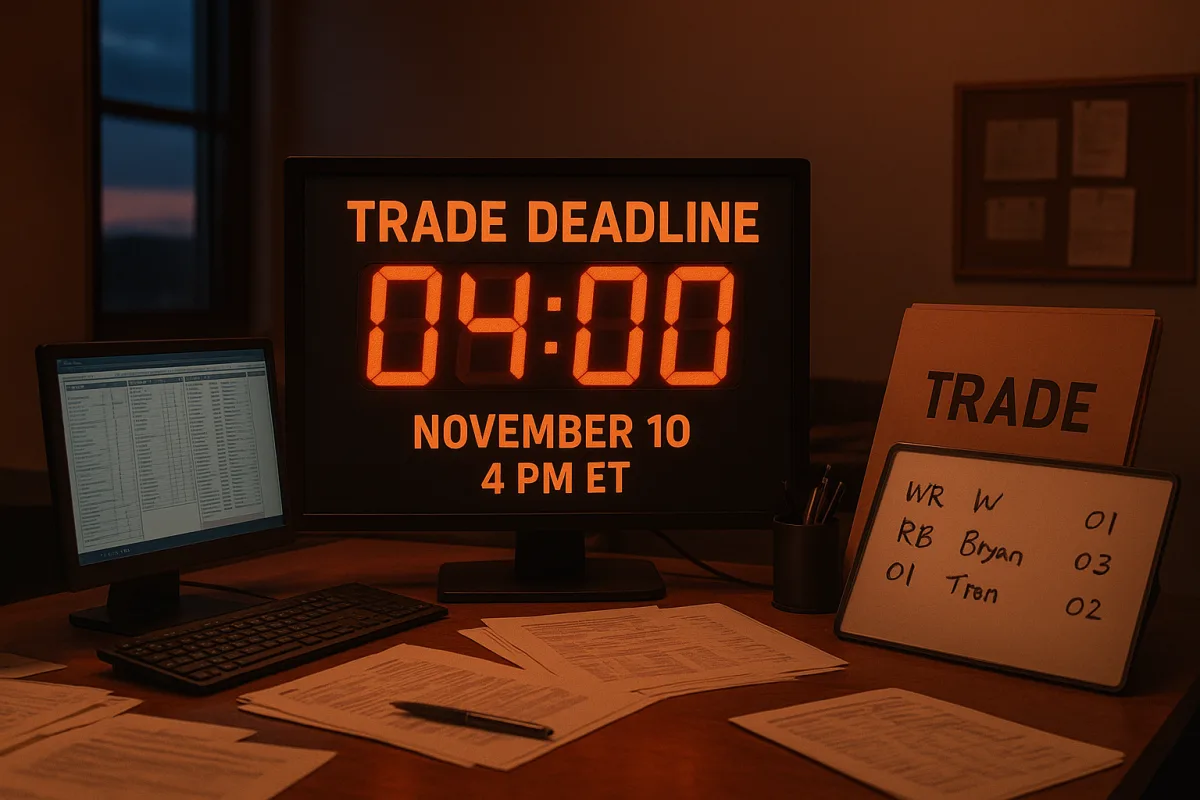
Your clock runs out at 4 p.m. ET, or 1 p.m. PT, on Tuesday, November 10. The 2026 deadline arrives after Week 9, giving teams one more weekend of evidence before deciding whether their current roster can survive January football. [4][5]
After that point, clubs cannot make trades until the 2027 trading period begins March 11 at 4 p.m. ET. That makes Week 9 less about public declarations and more about identifying which problems persisted even when a team won. [5]
The NFL moved the deadline later in the season as part of the adjustment to the 17-game schedule. That extra week changes the calculation for a team at 5-4 or 6-3, because one result can separate an aggressive buyer from a club protecting future picks. [4]
Do not confuse a close standings race with a reason to trade. A contender should ask whether its failure is structural, such as losing too many one-on-one matchups, or temporary, such as injuries likely to resolve without spending draft capital.
Audit the snaps that are costing you games
Start with the unit that repeatedly forces your quarterback, coordinator, or defense into bad calls. The right deadline move gives a coach a new answer on third down, in the red zone, or against the opponent’s preferred personnel grouping.
Buffalo provides a clean example. CBS Sports reported the Bills have allowed the NFL’s fifth-most completions of 20 or more yards, even as edge rusher Greg Rousseau and tackle Deone Walker have improved the front.
That points to a safety need, not an automatic cornerback trade. A post safety who can handle deep space would free Cole Bishop to play closer to the line, which addresses the coverage problem without disrupting the rookie’s better traits.
Denver’s issue is different. The Broncos rank 26th in explosive-play rate, according to CBS Sports, and their tight ends have produced the league’s second-lowest receiving-yard total at the position, per TruMedia.
Those are separate roster questions. A running back with home-run speed changes early-down structure, while a tight end who blocks and threatens seams changes personnel tendencies. Do not pay for both unless the team’s cap and pick inventory support it.
Pittsburgh’s passing-game diagnosis is even more specific. CBS Sports lists the Steelers 25th in EPA per play and 30th in success rate on dropbacks against man coverage, a sign they need a receiver who creates separation before the catch.
Jacksonville should focus inside. With Davon Hamilton out for the season, the Jaguars have lost a major run-defense component, and rotational tackle Ruke Orhorhoro leads their interior group with an 11.2 percent pressure rate, per CBS Sports.
A team that cannot stop interior runs or generate push up the middle does not need another edge rusher because the name is bigger. It needs a tackle who changes first and second down, then keeps quarterbacks from stepping up.
Decide whether you are buying wins or selling time
The confirmed market already shows two very different motivations. Indianapolis moved left guard Quenton Nelson to Seattle for a 2027 third-round pick and a 2028 fifth-round pick, while also trading defensive tackle DeForest Buckner to San Francisco for a 2027 fourth-rounder. [2][3]
Seattle bought a proven offensive-line piece for its current window. San Francisco bought interior defensive help at a lower pick cost. Indianapolis collected draft resources, a clear sign that a front office can make multiple timeline decisions without declaring every player available.
Tennessee made the more dramatic sale, moving Jeffery Simmons to Chicago. The Titans received 2027 first- and fourth-round picks plus a 2028 first-rounder, while Chicago also received a 2028 fifth-round pick with Simmons. [1][3]
Chicago paid that price because a disruptive interior defender affects every call behind him. Simmons can compress the pocket without a blitz, force more one-on-one blocks, and create cleaner paths for the linebackers and edge players around him.
That does not mean every losing team should auction its best veteran. Trading an established leader can leave a locker-room and snap-count void, while accelerated signing-bonus charges can create dead money that complicates the next roster build. [7]
The Yahoo Sports headline urging Baltimore to make a Derrick Henry move after a Thursday loss captures the pressure around a struggling team. But a frustrated reaction is not a roster plan, particularly when the selling club must absorb cap consequences and replace a high-volume role.
Set the price from role, contract, and replacement level
Start with the role, then check the contract. A star’s name should not be the first thing you price, because a player’s value rises when his skill fixes a rare weakness and falls when your roster already has a similar player.
For Buffalo, CBS Sports identified Falcons safety Jessie Bates III as a high-end fit because he can affect the ball in the air and create takeaways. Bates is in the final year of his Falcons contract and has three pass breakups, one interception, and three forced fumbles in 2026.
That is a different transaction from acquiring Titans safety Amani Hooker, whom CBS Sports frames as the more attainable option. Hooker’s ability to play deep would complement Bishop’s closer-to-the-line usage, so Buffalo would be buying a cleaner role fit at a lower expected cost.
For Jacksonville, Christian Barmore is the premium version of the interior-rush solution. CBS Sports says Barmore’s 11.8 percent pressure rate since 2025 would lead the Jaguars over that span, and he leads New England in total pressures since 2025.
Miami’s Zach Sieler represents the fallback tier. CBS Sports credited him with 16 pressures in seven games, making him an option for a club that needs productive interior rotation snaps but cannot justify the cost of a younger, higher-ceiling rusher.
Cap space remains a gatekeeper. The acquiring team needs room for the player’s contract, while the selling team must model accelerated bonus money and any future flexibility it loses by moving salary. [7][10]
We would avoid paying a Simmons-level package for a rental unless that player changes your best postseason matchup. Draft picks are not abstract assets in this market, they are the price of replacing starters once the current core becomes expensive.
Match the player to the coordinator’s calls
Kansas City needs a receiver who makes defenses defend more grass. CBS Sports noted that tight end Travis Kelce leads the Chiefs with 10 explosive receptions and that injured wideout Tyquan Thornton remains tied for the receiver lead in that category.
That is why a vertical boundary receiver makes more sense than another short-area option. CBS Sports listed Jacksonville’s Brian Thomas Jr. as a plausible fit, citing his ability to win outside on go routes, corners, and out routes despite occasional focus drops and route-depth issues.
Garrett Wilson of the Jets is the higher-end hypothetical target in CBS Sports’ framework. His appeal is not only production, it is the ability to separate at all three levels and place Rashee Rice and Xavier Worthy into narrower, more favorable assignments.
The Kansas City Star has separately focused on what the Chiefs need to solve before the deadline. The film-based answer is explosive receiving production that reduces the burden on Kelce and prevents defenses from squeezing intermediate windows.
Pittsburgh should apply the same discipline at receiver. Colts slot receiver Josh Downs, identified by CBS Sports as an aspirational target, has converted 80.4 percent of his receptions against man coverage into first downs or touchdowns since 2023 among players with at least 175 targets.
Downs would give Aaron Rodgers a receiver for option routes and quick slants when the coverage count favors the offense. That is a defined cure for Pittsburgh’s man-coverage issues, not an attempt to collect another large-bodied target.
If Pittsburgh instead buys on defense, Commanders cornerback Amik Robertson is the cleaner role-specific idea from CBS Sports. His inside-outside experience and previous work under defensive coordinator Patrick Graham would give the Steelers flexibility without requiring a total secondary redesign.
The New York Times has identified wide receiver, cornerback, and safety as Pittsburgh’s deadline positions. That broad list makes sense, but the Steelers should rank them by the failure they expect to face in January, beginning with man coverage.
Separate a blockbuster from a usable upgrade
A blockbuster needs to change your playoff math, not your social-media mood. The Bears made that bet on Simmons, adding an established interior force to a defense that now has a clearer path to controlling NFC North opponents. [1][6]
Seattle’s Nelson trade follows the same logic on offense. A left guard affects the run game, pass protection, and the quarterback’s ability to operate on schedule, so the Seahawks purchased help at a position that influences every offensive series. [2][6]
The 49ers’ Buckner acquisition has a lower stated draft price but could still reshape a division race by reinforcing their defensive front. Those projected outcomes are not guarantees, but they show why contenders target players whose roles are already central to their schemes. [2][3][6]
By contrast, Denver pursuing Colts running back Jonathan Taylor would be a bigger swing with a less certain cost-benefit balance. CBS Sports notes Taylor has 78 explosive runs since 2023, fifth-most in the league, which directly addresses Denver’s shortage of big plays.
Dallas Goedert is the more controlled Broncos answer. CBS Sports describes the Eagles tight end as a reliable seam receiver and competitive blocker, traits that would let Denver use him without telegraphing run or pass based on personnel.
Philadelphia also has its own deadline decisions. Delawareonline.com has argued that the Eagles should consider dealing four veterans to create rookie opportunities, a reminder that an apparent contender can still use the deadline to rebalance future playing time.
Make the call only after checking the replacement plan
Before approving a sale, identify who takes every departed player’s snaps. A team trading a starting defensive tackle must account for base downs, nickel pass-rush snaps, short-yardage packages, and the communication that player handled up front.
Before approving a purchase, identify the new player’s first 15 snaps. If the coordinator cannot say whether he starts, rotates, plays in dime, or enters on third-and-medium, the club is buying a reputation rather than solving a football problem.
Front offices have become more aggressive around the deadline, as Sports Now’s deadline analysis observes. The response should not be panic, it should be preparation: know your need, cap room, pick limit, medical threshold, and replacement plan before another team sets the market. [8][10]
Frequently Asked Questions
What are effective NFL trade deadline strategies for playoff pushes?
Teams should target additions that fix specific, repeated problems on the field, such as improving coverage against explosive passes or enhancing interior defensive pressure. Prioritizing players with clear schematic fits over headline names helps address weaknesses without duplicating existing strengths. It is also important to assess whether the issue is structural or temporary before committing draft capital.
How do NFL teams decide to buy or sell at the trade deadline?
Teams buying at the deadline typically seek players who can immediately improve a key area, while sellers often trade veterans to accumulate draft picks and build for the future. For example, Seattle acquired a proven offensive lineman to bolster their current roster, whereas Indianapolis traded veterans for draft resources, signaling a longer-term approach. Teams must weigh the cost of losing leadership and the impact of dead money when selling.
What impact do NFL trade deadline trades have on team performance?
Deadline trades can significantly affect team dynamics and playoff prospects by addressing critical weaknesses. For instance, Chicago’s acquisition of Jeffery Simmons aims to strengthen their interior defense and improve overall defensive calls. However, trading core veterans can create leadership voids and snap-count gaps that teams must manage carefully.
How should NFL teams price players at the trade deadline?
Player pricing should reflect their impact on the field and the acquiring team’s needs, with recent trades showing high draft pick costs for disruptive players. The Jeffery Simmons trade, which involved multiple first-round picks, serves as a benchmark for the value of a game-changing interior defender. Teams must also consider salary cap implications and dead money when negotiating trades.
When is the 2026 NFL trade deadline and why does it matter?
The 2026 NFL trade deadline is November 10 at 4 p.m. ET, following Week 9 of the season. This deadline is crucial because no trades can occur until the 2027 trading period opens on March 11, 2027, making it the last opportunity for teams to adjust rosters for playoff pushes or rebuilds during the season. The later deadline reflects adjustments made for the 17-game schedule.
How we researched this
This article was assembled from 8 published articles, 11 cited references.
Nothing here is based on hands-on testing. Where a figure or finding appears, it belongs to the source cited beside it, and the writing says so rather than implying otherwise. Every source is listed below so you can check it.
Sources
2026 NFL trade deadline: One realistic, one pipe dream trade scenario for every playoff contender, CBS Sports NFL
NFL Week 9 expert picks, best bets: Bears beat down Bucs, Saints get on track with a win, CBS Sports NFL
The NFL trade deadline is nearing. Here’s what the Chiefs need to solve, Kansas City Star
Who should the Steelers target at the trade deadline? Options at WR, CB, safety, The New York Times
4 veterans Eagles should trade by NFL deadline so these rookies can play, Delawareonline.com
“The Season Is Done”: NFL Analyst Urges Ravens To Pull “No Brainer” Derrick Henry Move After Humiliating TNF Loss, Yahoo Sports
2027 NFL Draft: Don’t Mess With Ashton Hampton, Clemson’s Unforgiving Shutdown Corner, Sports Illustrated
Falcons reveal uniforms for Week 9 game vs. Bengals in Madrid, Falcons Wire
Colts Trade Quenton Nelson, DeForest Buckner: What It Means | Veydr Athletics
What You Need to Know About the Chargers Ahead of 2026 NFL Trade Deadline
How Do NFL Trades Work? Cap Hits, Deadlines and Draft-Pick Compensation · sports24
Inside the NFL Trade Deadline Boom: Why Front Offices Are Embracing Aggression | Sports Now
NFL trade-deadline buyers with most and least salary cap space available
Related Articles
NFL Trade Deadline Key Players and Team Strategies 2026
Explore key players and team strategies for the NFL trade deadline 2026, including trade values and impacts on contenders and sellers.
Colts Trade Deadline Rebuild
Explore the Colts' trade deadline rebuild, including Nelson and Buckner trades and their impact on the team's future roster and draft capital.
NFL Trade Deadline 2026: Colts, Bears, and Vikings in Focus
Explore the 2026 NFL trade deadline buzz around the Colts, Bears, and Vikings, including key players and cap considerations.
Colts GM Chris Ballard Fired: Front Office Changes Explained
Learn why Colts GM Chris Ballard was fired and how front office changes affect the team's 2026 season and trade deadline strategy.