
NFL Trade Deadline Key Players and Team Strategies 2026
Explore key players and team strategies for the NFL trade deadline 2026, including trade values and impacts on contenders and sellers.
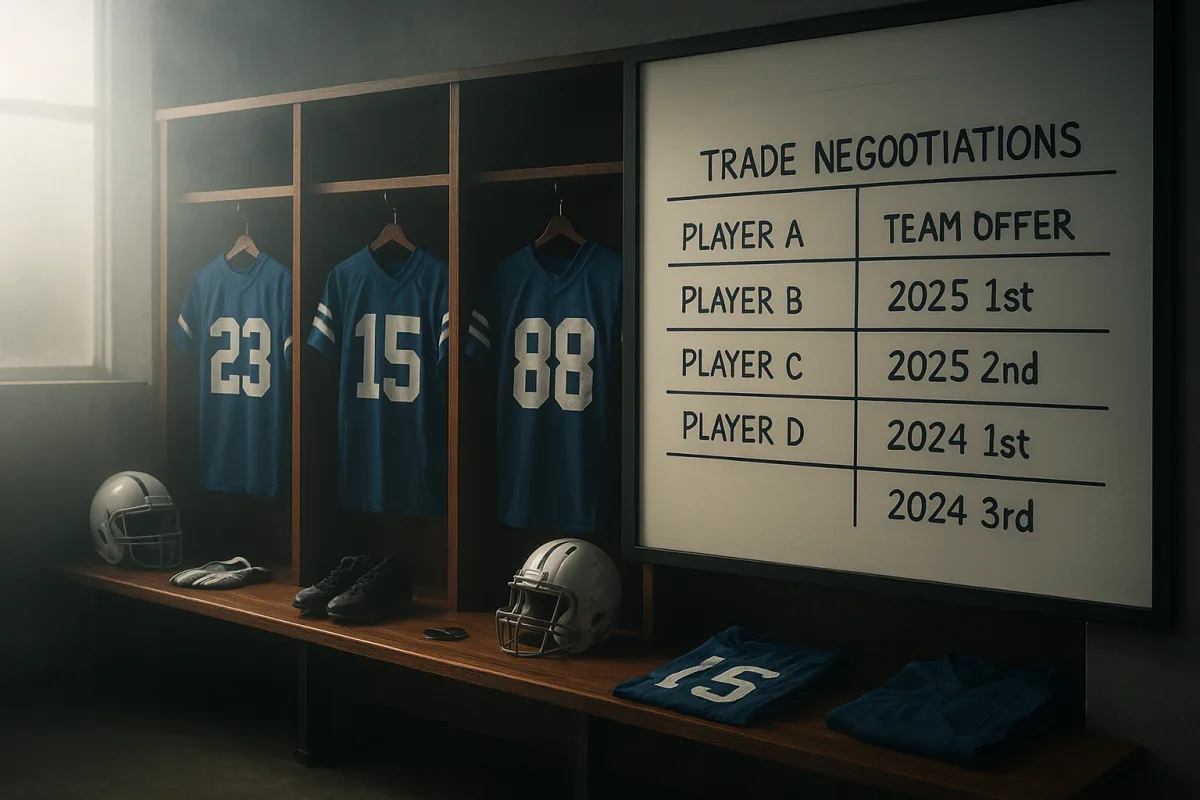
The quick list
- Best overall: Jonathan Taylor, for a contender that needs a feature back and can absorb two years and $44 million in remaining extension value.
- Best immediate line upgrade: Quenton Nelson, for the Seahawks, who have already paid a third- and fifth-round package for an established guard.
- Best high-variance move: Saquon Barkley, for a club that wants explosive backfield talent and can live with contract, health and dead-money complications.
The central question ahead of the deadline is not which recognizable name is most likely to move. It is which team can justify paying for a player whose position, contract and fit match its actual weakness.
That distinction matters with the three most discussed names. Taylor would change a backfield. Barkley would change both a backfield and a balance sheet. Nelson has already changed teams, providing a cleaner reference point than rumor-driven discussions of either running back.
The market is moving, but not evenly
The NFL’s 2026 trade deadline falls on Nov. 10 at 4 p.m. ET. [10] The Colts’ 2-5 record, Chris Ballard’s Oct. 18 firing and the club’s need to restock draft capital have made Indianapolis a logical team to watch. [1][2]
But a rebuilding team does not automatically auction every recognizable veteran. The Colts can entertain calls on Taylor while still deciding whether the offers clear their internal threshold. Reporting has established interest from the Packers, Seahawks, Broncos and Vikings, but not a confirmed price. [1]
That is why Taylor and Nelson should not be treated as the same story. Nelson’s market is finished. Seattle paid a 2027 third-round selection and a 2028 fifth-round selection for him on Oct. 27. [2]
The return reflects the trade-off for an accomplished guard on an expiring contract. Nelson remains healthy and carries eight Pro Bowl selections, but his contract expires in March 2027, limiting the security Seattle acquired unless it extends him. [2][9]
The package also gives evaluators a useful boundary. A team seeking Taylor cannot simply point to Nelson’s third- and fifth-round value, because a premium running back with two years left on his extension is a different financial and roster proposition.
Comparison table: what each move really costs
| Player | Status entering deadline | Reported acquisition price | Contract and cap issue | What the tape question should be | Best fit |
|---|---|---|---|---|---|
| Jonathan Taylor, Colts running back | Still with Indianapolis, trade interest reported | Unknown, no official asking price reported [1] | Two years, $44 million remaining on extension [1] | Can the buyer create downhill runs, light boxes and usable receiving answers for him? | A playoff-caliber team with an inefficient run game |
| Saquon Barkley, Eagles running back | Trade candidate in speculative reporting | No confirmed offer or active talks | A trade would create $26 million in Eagles dead money in 2027 [8] | Can the buyer preserve his space-game and perimeter-run value without overloading him? | A contender with cap flexibility and a strong line |
| Quenton Nelson, Colts guard | Traded to Seattle on Oct. 27 | 2027 third-round pick and 2028 fifth-round pick [2] | Contract expires March 2027 [2] | Can Seattle plug him into its core run concepts quickly? | Seattle, which has already made the move |
The table is also a warning against treating draft-pick compensation as a universal ranking. A third- and fifth-round package for Nelson is not evidence that Taylor should cost more or that Barkley should cost less.
Position, years of control, age, cap accounting and the buyer’s urgency set the price. The most important number may be the one not available: Indianapolis has not disclosed what it wants for Taylor. [1]
Jonathan Taylor: the cleanest football fit, at an unclear price
Taylor is the player whose appeal is easiest to understand on football grounds. A contender that cannot run efficiently on early downs often reaches the postseason needing its quarterback to solve too many obvious passing situations.
A back of Taylor’s caliber can reduce that burden, but only if the scheme gives him defined reads and credible run-pass conflict. The acquisition is not a substitute for blocking, quarterback play or an offensive coordinator’s answers against loaded fronts.
That is the piece often lost in deadline chatter. A rushing total tells readers how much production happened, not whether the back was consistently creating beyond the blocking or merely operating in a favorable environment.
Without current snap, carry-location and personnel data, it would be irresponsible to declare Taylor a seamless fit for Green Bay, Denver, Minnesota or Seattle. Those teams have been linked by reported interest, but interest is not a deal and does not reveal price. [1]
The contract is the practical hurdle. Taylor has two years and $44 million on his extension, which means a buyer is not renting him for nine or 10 games. [1] It is taking on a significant commitment at a position where many clubs prefer cheaper rotation and draft options.
That does not make a Taylor trade foolish. It means the buyer should be certain its problem is runner-dependent. A team with poor guard play or a predictable offense can spend heavily on Taylor and still see too many carries meet defenders at or behind the line.
The Colts have reason to listen. Their record, front-office change and depleted draft position point toward asset collection. [1] Still, a franchise does not need to trade its best offensive player merely because rival teams would like him.
Saquon Barkley: explosive upside, broader risk
Barkley is different because Philadelphia’s decision would be harder to separate from its own roster construction. The Eagles are 2-4, have endured offensive-line change after trading Cam Jurgens and Lane Johnson’s retirement, and carry reported cap space of $42.9 million, effectively $34.5 million. [3][5]
Those facts explain the discussion. They do not establish that the Eagles are shopping Barkley. Reports have described executive speculation and an ESPN-proposed scenario involving the Texans, draft picks and rookie Woody Marks, not a confirmed negotiation. [6][7]
Philadelphia also acquired Tank Bigsby from Jacksonville for 2026 fifth- and sixth-round picks. [4] That matters because it gives the Eagles a backfield contingency and another runner to evaluate, but it is not proof that Bigsby can replace Barkley’s workload or impact.
The scheme question is more demanding with Barkley. A buyer would want to know whether it can create the perimeter space, receiving matchups and explosive-play opportunities that justify paying for a premium runner. Simply handing him a high volume of interior carries misses the point.
Barkley’s Week 4 hamstring injury, with an expected Week 7 return, is part of the risk calculation. [8] Injury history should not be used as shorthand for a player being unreliable, but it must be priced into a deal involving a veteran runner and substantial cap exposure.
The dead-money figure is equally important. A Barkley trade would reportedly leave Philadelphia with $26 million in 2027 dead money. [8] That is a real reason the Eagles may prefer to retain him, even if the club is not playing to its preseason expectation.
For an acquiring team, Barkley could be worth an aggressive offer only if it already has the blocking and quarterback structure to turn his touches into explosives. If it needs a cure for several offensive problems, it should keep its picks.
Quenton Nelson: the finished deal is the deadline’s best reference point
Nelson’s trade offers the most concrete lesson of the group: elite reputation does not erase contract timing. Seattle acquired a healthy, decorated guard for a third in 2027 and a fifth in 2028, not a first-round pick. [2][9]
That is not a dismissal of his ability. It is the market accounting for an expiring deal. Seattle must now decide whether the immediate improvement in the interior is enough or whether it wants to secure the relationship beyond March 2027. [2]
For a line-focused offense, a guard can be more directly transferable than a running back. Guards affect the firmness of interior run lanes, the depth of pocket disruption and the offense’s ability to stay on schedule against stunts and interior pressure.
Still, even this move should not be analyzed as a simple before-and-after grade based on rushing yards. The meaningful review will be snap-based: Nelson’s pass-protection assignments, his work in double teams, Seattle’s efficiency on interior concepts and whether he reduces quick pressure.
The 49ers have been connected in speculative discussion to the idea of acquiring a star left guard, which shows why Nelson’s availability drew attention. [5] But Seattle acted first, and the rest of the league now has a verified price rather than a hypothetical one.
What Philadelphia and Indianapolis actually need
Indianapolis needs picks, organizational clarity and a plan for the players it chooses to keep. The Nelson deal addressed the first need. A Taylor move would be more consequential because it would remove the offense’s clearest premium skill player.
The Colts should not force that move for a middling return simply to validate a rebuild. A reasonable offer must reflect Taylor’s production ceiling and remaining contract, while also recognizing the risk a buyer takes at running back.
Philadelphia’s decision is not just whether Barkley has value. It is whether moving him makes the Eagles more coherent in 2026 and beyond. A 2-4 record creates pressure, but it does not necessarily make selling a core player the correct football decision. [3]
The Eagles’ 204 rushing yards allowed in their loss to Dallas, as reported by Pro Football Talk, underline that the roster has issues beyond running back. Defensive run fits, tackling and personnel balance cannot be repaired by moving Barkley. [2]
A roster with multiple problems should resist a transaction that looks decisive but addresses the wrong unit. The Eagles may need more offensive-line answers, but they also need to decide whether their current season warrants subtracting proven offensive talent.
Who each option suits
Jonathan Taylor suits a genuine contender with a defined run-game identity. The ideal buyer has adequate line play, an offense that can keep defenses out of loaded boxes and enough cap room to carry his two-year, $44 million commitment. [1] It should not be a team hoping one back fixes an unstable offense.
Saquon Barkley suits a team willing to accept variance. The buyer needs a strong line, a credible passing game and a clear plan for using him in space. It must also be comfortable with the health questions and the reality that Philadelphia’s reported $26 million dead-money consequence could raise the Eagles’ threshold to move him. [8]
Quenton Nelson suits Seattle because Seattle has already made the investment. The Seahawks paid a defined third- and fifth-round price for an experienced interior lineman, then inherited the decision on his next contract. [2] For other contenders, Nelson is no longer an option, but his trade is the most useful guide to how the league values an accomplished veteran with limited remaining control.
Frequently Asked Questions
Who are the key players involved in the NFL trade deadline 2026?
The key players discussed are Quenton Nelson, Jonathan Taylor, and Saquon Barkley. Nelson was traded from the Colts to the Seahawks for draft picks, Taylor remains with the Colts but is a trade candidate, and Barkley is a complicated trade candidate with the Eagles amid injury and contract considerations.
What are the team strategies for the NFL trade deadline?
Teams weigh the cost of acquiring veterans against preserving draft capital. Rebuilding teams like the Colts may trade key veterans to restock picks, while contenders assess if a player’s position, contract, and fit address their weaknesses. The deadline allows teams to decide if paying a premium is justified.
How do player contracts affect NFL trade deadline decisions?
Contracts significantly impact trade decisions. For example, Nelson’s expiring contract limits long-term security for the Seahawks, Taylor’s extension includes two years and $44 million in remaining value, and Barkley’s trade would create $26 million in dead money in 2027. These factors influence trade feasibility and team salary cap management.
Which NFL players have been traded or are likely to be traded at the deadline?
Quenton Nelson has been traded to the Seattle Seahawks for a 2027 third-round and a 2028 fifth-round pick. Jonathan Taylor is a likely trade candidate with reported interest from several teams, but no official asking price or trade has been confirmed. Saquon Barkley is also a potential trade candidate amid ongoing speculation.
What impact do NFL trade deadline moves have on team performance?
Trade moves can provide immediate upgrades, such as Nelson improving the Seahawks’ offensive line. However, acquiring players like Taylor or Barkley involves risks including contract costs, injury history, and fit within the team’s scheme. The actual impact depends on how well the player addresses team weaknesses and integrates into the roster.
How we researched this
This article was assembled from 1 video source, 8 published articles, 12 cited references.
Nothing here is based on hands-on testing. Where a figure or finding appears, it belongs to the source cited beside it, and the writing says so rather than implying otherwise. Every source is listed below so you can check it.
Sources
Will the Colts Trade Taylor? + Why the NFL is the Best Reality Show | The Adam Schefter Podcast — NFL on ESPN
Jalen Carter, Riq Woolen decline to speak to reporters after loss to Cowboys — Pro Football Talk
NFL trade deadline 2026: 3 teams that need Brian Thomas Jr. the most — NFL Spin Zone
Patriots trade rumor lays out uninspiring deadline expectation — Yahoo Sports
49ers overreactions: Would trading for star left guard be most helpful? — NBC Sports Bay Area & California
This Lions-Cowboys trade idea might be much closer to what Brad Holmes is actually looking for — A to Z Sports
What’s being said about the Chiefs ahead of the NFL trade deadline — Kansas City Star
NFL trade deadline, 2026: 3 teams that need Quenton Nelson the most — NFL Spin Zone
Steelers eyeing 'semi-big' wide receiver trade, per report — Yahoo Sports
The Colts could trade Jonathan Taylor, and/or others, before the deadline - NBC Sports
Colts Trade Quenton Nelson to Seahawks as a 2-5 Season Becomes a Full Rebuild - Athlon
Philadelphia Eagles Roster & Depth Chart 2026 | Teamistry Football
NFL Executives Wondering if Eagles Could Trade Away Saquon Barkley - NFL News | Fantasy Football
Eagles' Saquon Barkley a Trade Candidate in Proposed ESPN Scenarios - Fantasy Nerds
Should the Eagles Trade Saquon Barkley? The $26M Cap Hit & Trade Rumors Explained (2026)
2026 Indianapolis Colts Injuries | Pro-Football-Reference.com
Four Running Backs the Giants Could Trade For Amid Backfield Struggles
Watch NFL Trade Deadline: Key Players and Team Strategies on Youtube
Related Articles
NFL Trade Deadline 2026: Colts, Bears, and Vikings in Focus
Explore the 2026 NFL trade deadline buzz around the Colts, Bears, and Vikings, including key players and cap considerations.
NFL Roster Cuts 2026: Key Player Moves and Team Strategies
Explore NFL roster cuts 2026 with analysis of key player moves, team strategies, and impacts on depth charts and season outlooks.
Colts GM Chris Ballard Fired: Front Office Changes Explained
Learn why Colts GM Chris Ballard was fired and how front office changes affect the team's 2026 season and trade deadline strategy.
Fantasy Football 2026 Advice and Player Predictions
Get expert Fantasy Football 2026 advice with player predictions, sleeper picks, and draft strategies for the upcoming NFL season.