
NFL Game Day Operations: Behind the Scenes Insights
Explore NFL game day operations, including equipment, communication, and logistics behind the scenes at Highmark Stadium.
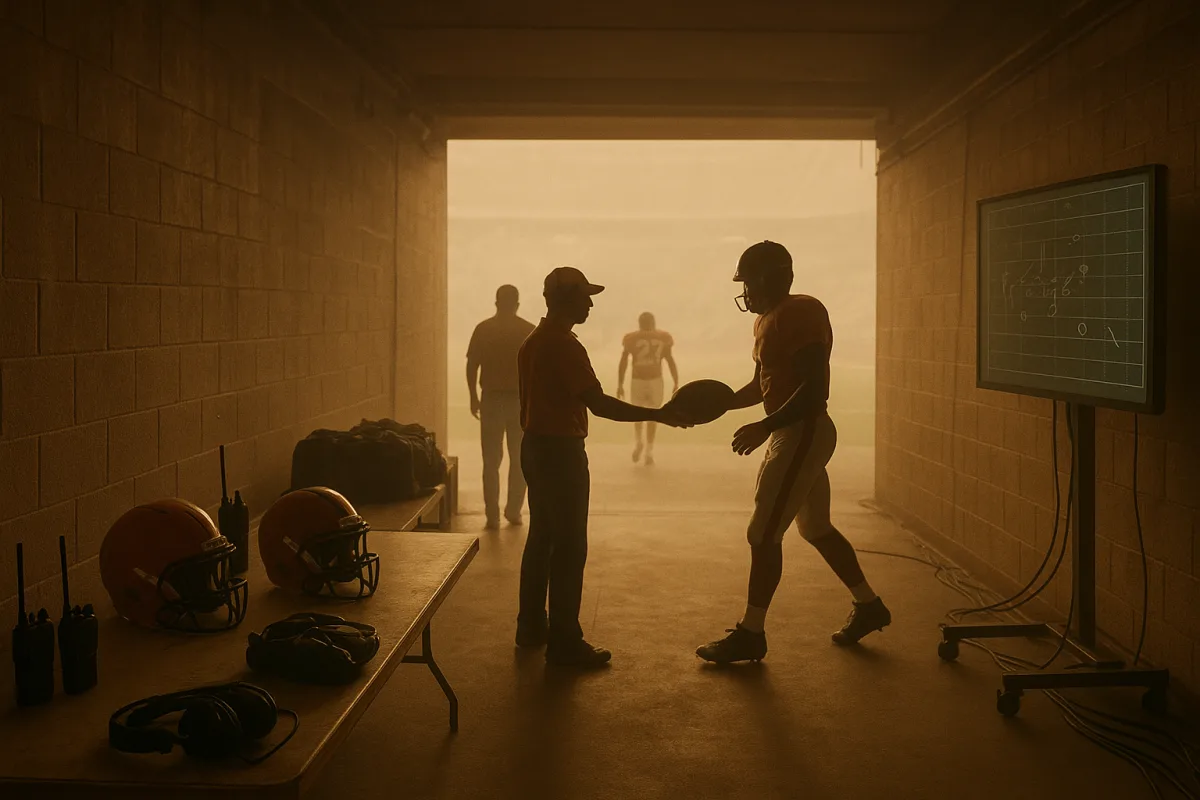
The NFL Home Opener Is a Redundancy Test, Not a Three-Hour Event
The real game is the handoff chain
The most useful way to understand an NFL home opener is not as a football game with entertainment around it. It is a chain of handoffs. Equipment staff hand prepared gear to players. IT staff hand video and audio to coaches. Medical staff hand injury information to decision-makers.
That chain is why an opening game in a new building creates pressure even when the team has hosted games for decades. The procedures may be familiar, but the distances, rooms, network routes, loading paths and sightlines are new.
The Buffalo Bills’ own Built For Buffalo production shows the practical version of that problem during the club’s first regular-season home opener in the new Highmark Stadium. The staff is not improvising a grand event. It is walking each route, checking each room and trying to remove uncertainty.
That is also why the phrase “game-day operations” can mislead. It suggests a separate department that springs to life on Sunday. In reality, operations are the connections among football, medical, facility, security, technology, broadcast and guest-service work.
The opening-game question is not whether each group can do its own job. It is whether the work still moves when something changes. A player wants different cleats. Rain affects field paint. A headset loses charge. A camera catches a sideline development that the booth cannot see.
The Bills’ production captures an equipment staffer making a point that is easy to overlook: moving to the new stadium did not radically change the packing checklist, but it changed the route. The old trip “down the hill” became a trip across the street.
That sounds trivial until the move includes player-specific gear, backup uniforms, rain equipment, laundry systems, sewing supplies and footwear options. The new building does not make those items less necessary. It gives them more places to be misplaced.
Redundancy is the operating principle
The single concept underneath nearly every visible task is redundancy. In football terms, redundancy means carrying an alternative before the first option fails. It is not waste. It is a way to prevent a small disruption from becoming a competitive disadvantage.
The Bills’ equipment operation, as shown by the Buffalo Bills channel, illustrates it cleanly. There are only 53 players on the active roster, but one staffer says the club carries more than 500 pairs of gloves because weather, wear and player preference cannot be solved after kickoff.
That inventory is not simply 500 identical emergency replacements. The staff distinguishes rain gloves from regular gloves, carries different colors, maintains backup jersey bags and prepares a second jersey for every player. A replacement must meet the player’s actual need, not merely fill a space.
The same logic applies to cleats. The Bills’ feature shows staff bringing multiple styles and screw-in options for a natural-grass surface. That choice reflects a live operational variable, field conditions, rather than a fashion detail or a pregame ritual.
A player’s custom-painted cleats make for better television than a storage trunk, but the underlying point is familiar to anyone who studies snaps. Players rely on equipment they trust. New footwear can change comfort and feel, so altering a broken-in pair can preserve that preference.
Uniform preparation works the same way. The club’s equipment personnel fit jerseys over pads and use towels as temporary forms, then remove the towels when the player dresses. For a player who wants a tighter jersey, staff use tape and sometimes need two people to complete the fit.
There is no public ledger showing the total cost of this kind of game-day preparation at Highmark Stadium. The Bills, New York State and Erie County have not disclosed a full per-game operating-cost figure, so any claim to know that number would be speculation.
That distinction matters because stadium finance often gets reported as if construction expense explains weekly operating expense. It does not. Stadiums of Pro Football and public-financing reporting have documented a project whose cost rose above $2.1 billion, but construction costs are not a game-day budget. [1] [2]
Nor should a reader confuse a fan’s bill with the club’s operational bill. The Action Network’s reported estimate of Bills family spending measures tickets, concessions and related fan costs. It says something about the market-facing cost of attendance, not staffing, field care, network operations or equipment logistics.
A headset system is a football system
The most consequential handoff in an NFL game is often invisible: the offensive play call traveling from a coach to the quarterback. It is easy to call that “communication,” but it is really a tightly controlled technology workflow.
The Bills’ behind-the-scenes feature shows the basic chain. A coach wears a wireless belt pack. When the play caller activates the quarterback channel, the play reaches the quarterback’s helmet. That sequence has to be reliable during crowd noise, weather and a fast-moving game.
The point is not merely that the quarterback hears a voice. The staff must confirm that the correct devices are connected, assigned and powered. A communication failure can force a timeout, slow substitution, alter tempo or leave a quarterback without the intended call.
That is why the Bills’ IT staff checks a dashboard before the game, watching individual headset packs come online and monitoring battery level. Equipment is duplicated between the field-level technology cart and the coaching booth, a textbook redundancy design.
The Bills’ production notes a change to longer-lasting green batteries, replacing units that lasted roughly three or four hours with units estimated to last six or seven. The benefit is operational, not cosmetic: staff no longer need a planned halftime battery swap.
That is a small adjustment with real consequences. A halftime replacement creates another handoff under time pressure. Longer battery life removes one scheduled failure point, though it does not eliminate the need to monitor the system or maintain backup gear.
The new Highmark Stadium’s broader network was built around the same principle of consolidation with safeguards. The research brief describes a converged network that carries broadcast, security and fan Wi-Fi functions, using Wi-Fi 7 and an IP-based media workflow compatible with SMPTE 2110 standards.
That does not mean every system shares a single point of failure. It means the venue can manage multiple services through a coordinated network architecture, while departments still need their own devices, permissions, support staff and fallback procedures.
The scale of connectivity is substantial. During a 2026 preseason game, fans reportedly used about 16 terabytes of Wi-Fi data. That figure does not prove network quality by itself, since usage depends on attendance and behavior, but it does show why capacity planning is now core stadium infrastructure.
The coaches’ tablets are not magic tape
The Buffalo Bills channel’s production also gives a useful look at the coaching-video workflow. Coaches receive images of plays on tablets, while quarterbacks and receivers can use wide and end-zone views to study coverage, route spacing and protection.
That process is valuable because it compresses the film-room loop. A coach does not need to wait until Monday to confirm whether a receiver was open, whether a defender disguised coverage or whether pressure came from a missed protection assignment.
But the tablets do not decide anything. They show a view, and a coach or player interprets it. A wide view can reveal the shell and distribution of defenders. An end-zone angle can clarify spacing, but neither angle alone captures every blocking assignment or route detail.
The important operational fact is timing. The image must be recorded, transmitted, available on the right device and usable quickly enough for a coach to make an adjustment before the situation changes. The system supports the decision. It does not replace football judgment.
That difference is often lost in discussions of “advanced technology.” More video does not necessarily create better decisions. The best game-day workflow makes the relevant picture available, then gets out of the way before the next call.
Broadcast is another redundancy system
The Los Angeles Chargers channel’s production on NFL broadcasting describes a parallel operation with the same basic problem. A network telecast can involve 80 to 100 people, but it has no retakes and no time to revisit a missed live shot.
The production truck divides responsibility. The producer determines priorities and communicates with announcers. The director selects the shots viewers see. The technical director executes those choices on the switcher, while replay, graphics, audio and commercial personnel handle their separate lanes.
That division is not bureaucratic excess. It keeps one person from trying to see every camera, choose every replay, mix crowd sound, prepare graphics and coordinate breaks simultaneously. The broadcast works because information reaches specialists who own a particular decision.
Replay operators preserve the angles that become useful after a major play. The producer can call for a specific camera isolation, then decide whether it explains the play, supports an analyst’s point or simply repeats the result without adding anything.
That last distinction matters. A replay is not analysis. The Chargers’ broadcast personnel describe analysts using tape to explain why a play worked or failed. The useful replay identifies the coverage, the free rusher, the leverage error or the route adjustment.
The sideline reporter is another handoff point. As the Chargers’ feature explains, that reporter can notice injury-related movement, personnel changes or emotional reactions that a high camera does not capture, then relay that information to the booth.
The booth still has to verify what it uses. A player walking toward the locker room is an observation. Declaring the severity of an injury without confirmation would be something else. Good live television separates visible evidence from an assumption, much as good football analysis should.
A new building makes the margins visible
The new Highmark Stadium was built under unusual logistical pressure. Reporting on the project described roughly 1,500 to 1,600 workers on site daily as construction pushed toward completion, while a February 2026 security breach briefly stopped work in secured areas. [5]
Those facts matter because a stadium does not become operational the instant construction ends. Construction turnover gives way to testing. Rooms need assignments. Access controls need verification. Network systems need integration. Staff need to learn routes that may look obvious only on a rendering.
The building has a listed capacity of 60,108, down from the old stadium’s roughly 72,000, and its canopy covers about 60 percent of the seating bowl. [1] Those are venue features, but they also shape operations through crowd flow, weather exposure and sightlines.
Some fans raised concerns about obstructed views before the 2026 debut, and the Bills said adjustments would be made. That is not a minor customer-service footnote. A sightline issue is another example of why opening a stadium is a systems test, not a ribbon-cutting moment.
The total number of people working a Bills game remains undisclosed. The Org identifies John Hagelberger as leading the Bills’ game-day operations group, but does not publish a department headcount. [4] Volunteer listings identify only fragments of the workforce, not a total. [3]
That uncertainty is worth preserving rather than filling with a guess. An NFL game requires a very large labor force, but public sources do not provide a verified aggregate for Buffalo’s 2026 home dates. The reliable story is the design of the operation, not an invented staffing number.
Frequently Asked Questions
What are the key components of NFL game day operations?
NFL game day operations involve a complex chain of handoffs among multiple departments including football, medical, facility, security, technology, broadcast, and guest services. Success depends on these groups coordinating equipment, information, and personnel without failures disrupting the game. The operation is continuous and integrated rather than a separate, isolated event.
How do NFL teams manage equipment and logistics on game day?
Teams prepare extensive inventories of player-specific gear, including hundreds of gloves, multiple styles of cleats, backup uniforms, and rain equipment to address varying conditions and player preferences. Logistics also involve adapting to new routes and storage locations in a stadium, ensuring all items are accessible and correctly matched to players’ needs to avoid delays or mismatches during the game.
What role does redundancy play in NFL game day operations?
Redundancy is a core principle designed to prevent small disruptions from becoming competitive disadvantages. Teams carry multiple backups of critical equipment, such as extra gloves, jerseys, and cleats, to ensure replacements meet specific player needs. Communication systems also have duplicated devices and monitored battery levels to maintain reliability throughout the game.
How do NFL coaches communicate plays during a game?
Coaches use a wireless headset system where the play caller activates a channel that transmits the play directly to the quarterback’s helmet. This system requires careful monitoring of device connections and battery life to ensure uninterrupted communication despite crowd noise, weather, and game speed. Redundancy in equipment and real-time status checks help prevent communication failures.
What technology supports NFL game day broadcasts?
Broadcast operations involve 80 to 100 workers focused on identifying plays, preserving camera angles, and making quick decisions before each snap. The broadcast relies on a unified converged network infrastructure to manage video and audio feeds, enabling seamless coverage and rapid response to on-field developments.
How we researched this
This article was assembled from 2 video sources across 2 channels, 5 cited references.
Nothing here is based on hands-on testing. Where a figure or finding appears, it belongs to the source cited beside it, and the writing says so rather than implying otherwise. Every source is listed below so you can check it.
Sources
NEVER BEFORE SEEN Look At What Goes Into An NFL Game Home Opener! | Built For Buffalo, Episode 6 — Buffalo Bills
Everything It Takes To Broadcast An NFL Game — Los Angeles Chargers
New Highmark Stadium - Information, Renderings and More of a future Buffalo Bills NFL stadium
Rising Costs and Controversy Surrounding New NFL Stadiums and Public Financing
Volunteers needed for the 2026 Buffalo Bills Home Games - Volunteer Opportunity - Idealist
John Hagelberger - Game Day Operations at Buffalo Bills | The Org
Construction of Buffalo Bills' New Stadium Stopped After Secure Locations Compromised
Watch Behind the Scenes of NFL Game Day Operations on Youtube
Also from the sources
Related Articles
Buffalo Bills Week 1 Defensive Highlights and Team Outlook
Explore Buffalo Bills Week 1 defensive highlights, player insights, and the impact of the new stadium on their 2026 season opener.

NFL Week 3 Quarterback Insights and Offensive Analysis
Explore NFL Week 3 quarterback insights and offensive strategies from media, including Bo Nix, Joe Burrow, and C.J. Stroud’s performances.

NFL Global Expansion: Rams-49ers Game in Australia Analysis
Explore the NFL's global expansion with the Rams-49ers game in Australia, attendance, logistics, and its impact on the league's international growth.

NFL Veteran Kus Campbell: A Season of Dedication and Determination
Follow the inspiring journey of NFL veteran Kus Campbell in his 17th season with the Miami Dolphins. Discover his relentless dedication, training regimen, and quest for a Super Bowl ring amidst the challenges of aging in the NFL.