
Tucker Kraft Contract Extension: Key Details and Cap Impact
Explore Tucker Kraft's contract extension with the Packers and how the signing bonus affects the team's salary cap and future flexibility.
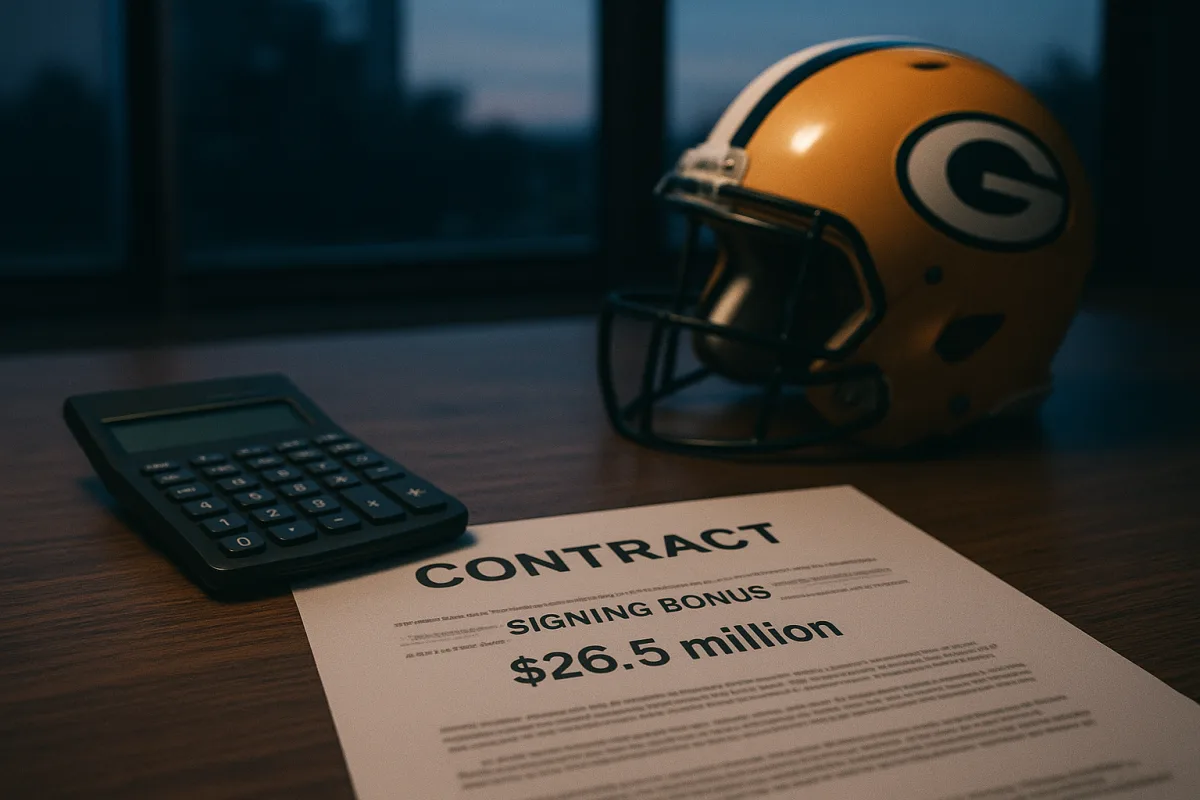
Tucker Kraft’s $75 Million Extension Is Really a Cap-Accounting Bet
Start with the number that matters
The headline is simple: the Packers have agreed to a four-year, $75 million extension with tight end Tucker Kraft, keeping the 25-year-old under contract through 2030. The deal includes a $26.5 million signing bonus and can reach $92 million through incentives. [2]
The more useful number is not $75 million. It is $26.5 million, because the signing bonus is the portion that shapes the Packers’ accounting options, their short-term cap flexibility and the cost of moving on later.
NFL contracts involve two ledgers. One is cash, the actual money paid to the player. The other is the salary cap, which assigns that cash to specific league years under collectively bargained accounting rules.
Those ledgers often overlap, but they are not identical. A player can receive a large check today while his cap charge is distributed across several seasons. That is the central mechanism behind Kraft’s extension.
Why a signing bonus changes the cap math
A signing bonus is generally paid promptly after a deal is executed, or on a contractually scheduled timetable shortly afterward. For cap purposes, though, it is prorated evenly across the contract’s eligible years, up to five seasons.
Kraft had been entering the final year of his rookie contract, with a scheduled 2026 base salary of $3.624 million. His extension runs through 2030, giving Green Bay a five-season window, from 2026 through 2030, in which to allocate bonus proration. [3]
If the entire $26.5 million bonus is prorated over those five contract years, the annual cap charge from that bonus alone would be $5.3 million. That is the basic arithmetic: $26.5 million divided by five.
That calculation does not mean Kraft’s 2026 cap number is definitely $5.3 million. It means $5.3 million is the likely annual signing-bonus component if the reported contract structure uses all five available seasons without unusual provisions.
His actual yearly cap charge would combine that bonus proration with his 2026 salary, any roster or workout bonuses, potential salary guarantees, and any contract restructures. Incentives may also count differently depending on whether the league classifies them as likely or not likely to be earned.
That is why readers should be careful with claims that the extension “costs Green Bay $18.75 million against the 2026 cap.” It almost certainly does not work that way. The $18.75 million figure is an average annual value, not a reported single-season cap charge. [2]
What is known, and what has not been reported
The reported deal gives the public several firm points: four new years, $75 million in base value, a $26.5 million signing bonus, and up to $17 million in incentives. [2] It does not provide a complete cap sheet.
No credible public breakdown has established Kraft’s 2026 base salary after the extension, his year-by-year cash flow, the dates of any roster bonuses, or the exact amount fully guaranteed at signing. Those details decide the real cap charge.
The distinction matters because two contracts can share the same $75 million total while producing radically different cap outcomes. One can be built for a low first-year charge and escalating later hits, while another can place more salary in the first two seasons.
Green Bay could have converted some of Kraft’s scheduled 2026 pay into bonus, left his rookie-year salary largely intact, or built in new guaranteed salary. Without the full terms, assigning an exact 2026 number would be a guess presented as reporting.
The incentives are another area where the public needs restraint. Reports say the package can rise to $92 million, but no reliable disclosure identifies the triggers, whether they involve receptions, yards, Pro Bowl honors, team wins or postseason success. [3]
That means $92 million is a ceiling, not a salary-cap projection. Until the incentive language is known, nobody outside the contract process can responsibly say how attainable those bonuses are or whether they count immediately against a given cap year.
The benefit Green Bay gets from spreading the bonus
The Packers’ benefit is immediate flexibility. Rather than putting the full $26.5 million onto the 2026 cap, the club can distribute the charge across the seasons in which it expects Kraft to remain a central offensive player.
That matters for a roster already paying its young core. CBS Sports reported that Green Bay also extended receiver Christian Watson, receiver Jayden Reed and defensive tackle Devonte Wyatt during the same offseason, alongside its existing commitment to quarterback Jordan Love.
Cap management is not just about avoiding a league limit in one year. It is about deciding which players consume room now, which players consume it later, and which positions retain enough flexibility for injury replacements or outside additions.
A five-year proration window effectively turns one $26.5 million cash obligation into a $5.3 million annual accounting charge, assuming the standard structure described above. That can make a top-of-market extension easier to fit in the current season.
It does not make the money disappear. The Packers still have to carry the remaining bonus charges in future years. Accounting creates timing flexibility, not a discount on the cash paid to the player.
The cost if the projection is wrong
Signing-bonus proration also explains the risk in extending Kraft before he plays a full season following his ACL tear. If the player is released or traded, the remaining unamortized signing-bonus charges generally accelerate onto the club’s cap as dead money.
Suppose, strictly as an illustration, Kraft’s $26.5 million bonus is spread evenly at $5.3 million per season. After one year, four years of proration would remain, leaving $21.2 million of unamortized bonus accounting on Green Bay’s books.
The Packers could sometimes use post-June 1 treatment to divide that acceleration across two cap years, but that does not erase the obligation. It changes when the club absorbs it, which can help short-term planning but extends the financial cleanup.
This is why the record-sized signing bonus matters more than an annual-value ranking. The signing bonus is the portion Green Bay has committed in a way that is hardest to unwind if injury, decline or an unexpected scheme change alters Kraft’s value. [2]
Kraft tore his ACL on Nov. 2, 2025, ending a season in which he had 32 catches, 489 receiving yards and six touchdowns through eight games. NFL.com and NBC Sports reported the injury as season-ending. [8][9]
Green Bay activated Kraft from the physically unable to perform list on July 31, and the available reporting described a progression from individual work to team drills during camp. That is encouraging rehabilitation news, not proof that the knee carries no performance risk. [11]
Why the Packers accepted that risk
The football argument is visible in Kraft’s pre-injury production. His 489 yards in eight games ranked third among tight ends at the time, and his 344 yards after catch led the position group in the CBS Sports figures.
Yards after catch can be a misleading stat when read alone. It can reflect broken tackles, but it also reflects route depth, quarterback placement, coverage leverage, open-field space and how often an offense gives a player short throws with room to run.
In Kraft’s case, the important part is not merely that he produced after the catch. It is that the Packers had enough evidence to treat him as more than a red-zone specialist or a limited in-line blocker catching occasional play-action targets.
His 15.3 yards per reception before the injury is similarly notable but incomplete. That number does not tell readers whether every target was efficient, whether he was facing favorable coverage, or whether Green Bay’s offense can repeat the same opportunities after an ACL recovery.
The extension is therefore a projection based on role as much as box-score output. Green Bay is paying for the possibility that Kraft remains a full-time matchup player who can align attached to the formation, release into routes and finish plays after contact.
What the deal says about Kraft’s place in the market
At $18.75 million annually, Kraft sits in the small group of tight ends paid like primary offensive options rather than complementary players. CBS Sports placed him third among tight ends by annual value, behind George Kittle and Trey McBride.
There is some market-context variation across reported lists. The supplied research identifies Kittle’s four-year, $76.4 million 2024 extension, roughly $19.1 million annually, as the top benchmark relevant to Kraft’s deal. [1]
That same research places Travis Kelce and Kyle Pitts around $18 million per year on their newer agreements. Kraft is therefore not merely “well paid for a tight end.” He is being compensated in the league’s top tier at the position. [5]
The label “third-highest-paid tight end ever” should be used carefully because rankings change with contract timing, whether a list counts new-money averages or total contract averages, and whether it includes incentives. Kraft’s $18.75 million base average is the stable fact. [2]
The bigger point is that Green Bay did not wait for Kraft to establish a longer healthy résumé. The Packers bought before the next full breakout, accepting uncertainty in exchange for avoiding the price escalation that comes if he returns healthy and dominates in 2026.
The 2026 role is still not a snap-count promise
Kraft has said he intends to be available for Week 1 against Minnesota without a snap restriction, and Packers reporting described him as eager for a full workload. [10][14] That is the player’s stated goal, not a published offensive plan.
The Packers have not released a snap-count target, detailed usage plan or a declaration that Kraft will immediately reprise every pre-injury assignment. There is no evidence that Green Bay will reduce his role, but there is also no basis to claim nothing changed.
That distinction matters after an ACL injury. A tight end’s workload is not just routes run. It includes blocking reps, contact in condensed formations, transitions from attached alignments and the repeated change-of-direction demands of working underneath coverage.
Kraft’s new contract tells us Green Bay believes he can again occupy a major role in its offense. The opening-week deployment will tell us something more concrete: whether the club trusts him for full personnel packages, third-down routes and late-game snaps immediately.
Until those snaps arrive, the most accurate reading is financial rather than predictive. The Packers have converted belief in Kraft’s pre-injury tape and production into a major long-term obligation, while using signing-bonus proration to keep the first cap consequences manageable.
Frequently Asked Questions
What are the key details of Tucker Kraft's contract extension with the Packers?
Tucker Kraft signed a four-year, $75 million extension with the Green Bay Packers, keeping him under contract through 2030. The deal includes a $26.5 million signing bonus and can reach up to $92 million with incentives. The average annual value is $18.75 million, making it one of the largest tight end contracts in the league.
How does Tucker Kraft's signing bonus affect the Packers' salary cap?
The $26.5 million signing bonus is prorated evenly across the five years of Kraft’s contract for salary cap purposes, likely resulting in about a $5.3 million cap charge per year from the bonus alone. This allows the Packers to spread the cap hit over multiple seasons rather than absorbing it all in 2026, providing short-term cap flexibility.
How is Tucker Kraft's contract structured for cap accounting purposes?
The contract uses the standard NFL practice of prorating the signing bonus over the contract length, up to five years. Kraft’s 2026 cap charge will combine the prorated bonus with his base salary, any roster or workout bonuses, guarantees, and incentives, though the exact 2026 cap figure has not been publicly disclosed.
What risks does the Packers' contract extension with Tucker Kraft carry?
The extension carries meaningful future dead-money risk because Kraft is coming off a major ACL injury sustained in November 2025. Although his recovery has progressed well, there is uncertainty about his ability to return to pre-injury performance levels, making the sizable financial commitment a notable risk for the Packers.
What impact does Tucker Kraft's ACL injury have on his contract extension?
Kraft’s ACL tear caused him to miss the remainder of the 2025 season, but by mid-2026 he had progressed to full team drills and was expected to play without snap count restrictions in the season opener. The injury factored into the timing and risk assessment of the extension, but the Packers proceeded with the deal based on his prior production and recovery progress.
How we researched this
This article was assembled from 3 published articles, 15 cited references.
Nothing here is based on hands-on testing. Where a figure or finding appears, it belongs to the source cited beside it, and the writing says so rather than implying otherwise. Every source is listed below so you can check it.
Sources
Tucker Kraft, Michael Mayer join highest-paid tight ends with contract extensions — CBS Sports NFL
Packers, Tucker Kraft agree to four-year extension — Pro Football Talk
Bengals Quarterback Room BARELY Ranked Among Top-10 NFL Groups Entering 2026 Season — Sports Illustrated
George Kittle agrees to an extension with the 49ers that makes him the highest-paid tight end ever
Tucker Kraft Agrees to Four-Year Extension with Packers - NFL News | Fantasy Football
BREAKING: Packers Signing TE Tucker Kraft To Four-Year, $75M Extension - NFLTradeRumors.co
Tucker Kraft signs four year, $75 million deal with Packers - Tucker Kraft News | FantasyPros
Tucker Kraft Contract Extension: Packers Agree to $75 Million Deal
Packers tight end Tucker Kraft out for season with torn ACL - NBC Sports
Packers TE Tucker Kraft will remain ‘hungry for every snap’ in 2026
Tucker Kraft Activated Off PUP: Fantasy Impact & Depth Chart
Green Bay Packers News: Latest Tucker Kraft Injury Update Sheds Light on 2026 Usage
Related Articles
Christian Gonzalez Patriots Contract Extension Sets New
Explore Christian Gonzalez's record Patriots contract extension and its impact on the NFL cornerback market and team strategies.
Packers Roster Moves and Josh Jacobs Exempt List Impact
Explore how Packers roster moves address Josh Jacobs' exempt list status and its effect on running back depth and team strategy.

NFL Joint Practices and Preseason Finales: Key Team Insights
Explore how NFL joint practices and preseason finales shape roster decisions and team readiness in the 2026 preseason.
Deshaun Watson Named Browns Starting Quarterback for 2026
Learn why Deshaun Watson was named the Browns starting quarterback in 2026, including performance, contract impact, and offensive strategy insights.