
Packers Roster Moves and Josh Jacobs Exempt List Impact
Explore how Packers roster moves address Josh Jacobs' exempt list status and its effect on running back depth and team strategy.
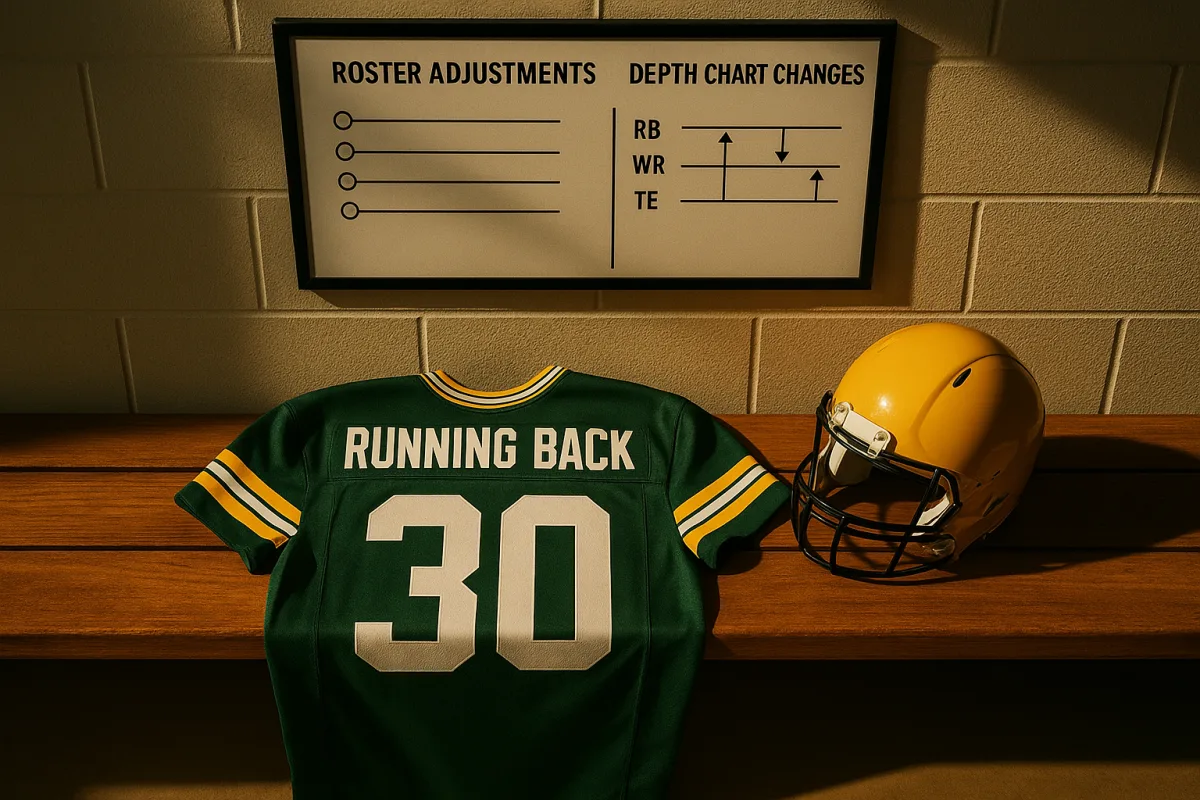
Packers Roster Moves Show the Real Cost of the Josh Jacobs Exempt-List Decision
The important roster number is zero
The cleanest way to understand Green Bay’s response to Josh Jacobs’ legal situation is to start with the number of usable Jacobs snaps: zero. The Commissioner’s Exempt List is not injured reserve, a suspension or a normal absence.[1][3]
A player on the list cannot practice or play. He may attend team meetings and continues to receive his salary, but the coaching staff cannot build its weekly offense around him or use him as emergency depth on Sunday.[1]
That distinction explains why the Packers did not simply keep their existing depth chart intact and wait. Jacobs’ absence creates an immediate operational issue: Green Bay must replace a player’s game-day role, not merely fill an empty roster line.
FOX Sports reported that Jacobs was placed on the list while facing misdemeanor charges. That is the central fact, and it requires care: the placement is not a finding of guilt, while the underlying allegations remain serious and the legal process is unresolved.[5]
The NFL uses the list case by case. ESPN’s overview of 2026 placements includes Jacobs, Denver Broncos edge rusher Jonathon Cooper and Seattle Seahawks cornerback Terrion Arnold, each facing serious criminal matters but not necessarily identical procedural circumstances.[3]
There is no published fixed number of weeks that dictates reinstatement. The league can reinstate a player before a criminal case ends, as occurred with former New England Patriots safety Jabrill Peppers in 2024, or leave the status in place longer.[3]
That flexibility is why Green Bay general manager Brian Gutekunst could not offer a reliable availability forecast. On NBC’s Pro Football Talk, Gutekunst said the Packers would let the process play out and be prepared either way.[4]
That is not evasive roster language. It is an accurate description of a structure in which the team does not control the league’s reinstatement decision and cannot know whether Jacobs will be available when its offense needs him.
Why the Packers treated this like a depth-chart emergency
Matt LaFleur’s offense does not ask a running back only to take handoffs. The position has to identify protection rules, execute timing in play-action looks, help sustain the outside-zone run game and contribute in receiving alignments.
Those jobs are learned through meetings and practice reps. A player prohibited from practicing cannot serve as a normal contingency option, even if he remains connected to the building and continues drawing his contractual pay.[1]
That is the practical cost of the exempt list. The Packers still carry Jacobs’ contract, but their active backfield must divide his touches and his assignment load among MarShawn Lloyd, Chris Brooks and whichever newcomer earns work.[4]
Green Bay acquired Kaleb Johnson on the August 30 cutdown-day shuffle. Public reporting agrees that Johnson arrived via trade, but it does not agree on every detail, which is worth stating plainly rather than turning a transaction into mythology.[6][8]
The Packers’ own discussion of the moves described Johnson as a former Pittsburgh Steelers third-round pick. The research record also identifies a Steelers trade and a 2028 sixth-round selection, while another account names the Atlanta Falcons and leaves terms unclear.[8]
The only responsible conclusion is that Green Bay acquired Johnson and that the full public accounting is unsettled. The club should not be credited or criticized for a particular draft-pick price that has not been consistently reported.[6][8]
Johnson had 28 carries for 69 yards over 10 games as a rookie in 2025. That production does not establish him as a Jacobs replacement, and it certainly does not tell us whether he can carry a starter’s workload.[8]
It does show why the trade was a low-cost roster bet in concept. Green Bay needed another player who could be coached immediately, activated if necessary and evaluated on actual protection, ball-security and special-teams snaps.
The Packers’ move also matters because this is unprecedented within the franchise’s running-back history. The research brief notes that Jacobs is the first Packers running back placed on the Commissioner’s Exempt List, meaning there is no club-specific template to follow.[5]
A trade is often a way to buy certainty
Cutdown day creates a peculiar market. Teams are trying to move from 90 players to a regular-season roster, while every club knows its own waiver position may prevent it from landing a preferred released player.
That is why a trade can be more valuable than a waiver claim, even for a player low on another team’s depth chart. The acquiring club gets the player immediately instead of waiting to see whether other teams claim him.
Green Bay’s transaction with Miami illustrates the point. The Packers sent quarterback Kyle McCord to the Dolphins and received a 2028 draft pick, a deal that is confirmed even though the exact round was not consistently established publicly.[6][8]
McCord had been a developmental quarterback rather than Green Bay’s obvious regular-season answer at the position. Miami, needing control over the acquisition rather than exposure to the waiver process, had reason to make a direct deal.
The Packers then added practice-squad quarterback Kedon Slovis after he had recently been with the Arizona Cardinals. That sequence was not necessarily a grand judgment on McCord, but a conversion of surplus at one spot into flexibility elsewhere.[8]
The same logic applies at tight end. Green Bay acquired Mark Redman in a confirmed trade, though public reporting has not supplied dependable compensation details. The club also added veteran Jonnu Smith as it worked through depth concerns.[6][8]
Redman’s role projection is more revealing than his old depth-chart rank. Packers.com characterized him as an inline, blocking-oriented tight end, the type who can make heavier personnel groupings function without forcing the offense to change its run-game menu.[8]
Smith represents the opposite kind of tight-end value. The Packers’ official discussion highlighted his positional versatility, and his 88-catch 2024 season in Miami shows that he has previously been used as a meaningful receiving piece.[8]
Neither addition directly replaces Jacobs. They do help the offense retain formation flexibility, which matters when a team cannot be sure how much it can lean on its original primary ball carrier.
The cap question is more complicated than “cut him”
The public conversation around an exempt-list player often jumps from availability to release. That skips the contract mechanics, which are relevant because Green Bay cannot make a football decision without considering the accounting consequences.
NBC Sports described Jacobs’ four-year, $48 million agreement as a one-year deal with three one-year options in effect. He received a $12.5 million signing bonus, and no guarantees reportedly extend beyond the first year.[4]
For 2026, Jacobs is due a $10.2 million base salary, a $600,000 workout bonus and up to $700,000 in per-game roster bonuses. Those figures matter differently depending on whether he remains under contract or is released.[4]
A signing bonus is generally charged to the cap over the life of the contract rather than all at once. If a player is released, the remaining unpaid accounting portions can accelerate onto the current year’s cap.
That is the difference between cash and cap. Green Bay may avoid some future salary obligations by releasing Jacobs, but it cannot erase bonus money already paid merely because the player is no longer on the roster.
The reported pre-June 1 result would be a $17 million 2026 cap hit. A post-June 1 release would divide the charge at roughly $8.5 million in 2026 and $8.5 million in 2027, creating earlier cap room but extending the bookkeeping.[4]
That does not mean a post-June 1 release is automatically preferable. A team with a tight future cap may not want dead money pushed into the next league year, and the football decision depends on facts that have not been publicly resolved.
Gutekunst’s public answer fits those constraints. He did not promise that Jacobs would be on the 2026 team, nor did he announce a planned release. He said Green Bay would let the legal and league processes unfold.[4]
That is appropriately narrower than some commentary around the situation. NBC’s Pro Football Talk panel speculated that the club may be preparing for the possible release of video evidence, but that is analysis of public remarks, not confirmed Packers intent.[4]
The only established organizational response is on the roster: Green Bay added another back, preserved flexibility through trades and continued building complementary depth at quarterback and tight end. The rest remains contingent.
What the moves say about the 2026 roster build
The Johnson trade was not made in isolation. Earlier in the offseason, Green Bay traded defensive lineman Colby Wooden to the Indianapolis Colts for linebacker Zaire Franklin, addressing a different part of the roster with an established defender.[6]
The Packers also signed defensive tackle Javon Hargrave and added developmental competition across tight end, safety, offensive line and special teams. Their draft class emphasized defensive front depth, cornerback talent, interior offensive line and kicking.[7]
That wider context matters because Green Bay entered cutdown day with only six draft selections in 2026. Packers.com noted that five made the initial roster, leaving the front office to use pro personnel channels to supplement thin spots.[7][8]
The right reading of the Jacobs response is therefore structural, not dramatic. The Packers did not solve an uncertain legal timeline, because no team can trade for that certainty.
They solved the part they control: the next practice, the next protection install, the next game-day inactive decision and the next set of running-back snaps. That is what a contingency plan looks like in an NFL roster room.
Frequently Asked Questions
What does the Packers placing Josh Jacobs on the commissioner’s exempt list mean?
Being placed on the Commissioner’s Exempt List means Josh Jacobs cannot practice or play in games but can attend team meetings and continues to receive his salary. This status is used while Jacobs faces misdemeanor charges and is not a suspension or injured reserve designation. The NFL applies this list case-by-case without a fixed timeline for reinstatement.
How have the Packers addressed running back depth after Josh Jacobs’ exempt list placement?
The Packers treated Jacobs’ absence as an immediate depth issue and acquired running back Kaleb Johnson via trade to add carries, protection reps, and special-teams availability. They also rely on existing backs MarShawn Lloyd and Chris Brooks to share Jacobs’ workload, as Jacobs cannot participate in practice or game plans.
Who is Kaleb Johnson and what role will he play for the Packers?
Kaleb Johnson is a running back acquired by the Packers on August 30, 2026, from the Pittsburgh Steelers (though some reports mention the Falcons). In 2025, he played 10 games with 69 rushing yards on 28 carries. Johnson is expected to provide immediate depth and contribute in running, protection, and special teams due to Jacobs’ unavailability.
What are the roster and cap implications of the Josh Jacobs exempt list decision?
Jacobs remains under contract and on the payroll, so the Packers carry his salary cap hit without his on-field availability. If released before June 1, 2026, Jacobs would incur a $17 million dead-cap charge in 2026; a post-June 1 release would split roughly $8.5 million in dead cap between 2026 and 2027. The Packers face a challenging salary cap situation in 2026, making roster decisions complex.
How does the commissioner’s exempt list affect a player’s ability to practice and play?
A player on the commissioner’s exempt list is prohibited from practicing and playing in games but may attend team meetings and continues to be paid. This status prevents coaches from including the player in weekly game plans or using him as emergency depth, effectively removing him from all on-field activities until reinstated.
How we researched this
This article was assembled from 3 video sources across 2 channels, 10 cited references.
Nothing here is based on hands-on testing. Where a figure or finding appears, it belongs to the source cited beside it, and the writing says so rather than implying otherwise. Every source is listed below so you can check it.
Sources
Packers Unscripted: Many moving parts — Green Bay Packers
Packers Safeties answer your most-asked questions — Green Bay Packers
How will Packers handle Josh Jacobs' ongoing legal situation? | Pro Football Talk | NFL on NBC — NFL on NBC
What is the Reserve/Commissioner Exempt List? | Latest NFL News, Analysis & Updates | NFL.com
NFL places Broncos OLB Jonathon Cooper on Commissioner's Exempt List
What is the NFL commissioner's exempt list? Who is on it? - ESPN
The Josh Jacobs contract is a one-year deal with three one-year options - NBC Sports
Packers make 3 trades on roster cutdown day: Compensation details here - Yahoo Sports
Watch Packers Roster Moves and Handling of Josh Jacobs Situation on Youtube
Also from the sources
Related Articles
Seattle Seahawks 2026 Season Preview and Coach Mike
Get a detailed Seattle Seahawks 2026 season preview with insights on Coach Mike Macdonald, roster changes, and key player roles.
NFL Roster Cuts 2026: Key Player Moves and Team Strategies
Explore NFL roster cuts 2026 with analysis of key player moves, team strategies, and impacts on depth charts and season outlooks.
Aaron Rodgers and Steelers Injury Challenges Impacting
Explore how Aaron Rodgers and the Steelers are managing wide receiver injuries and their effect on the 2026 offense.

Giants Roster Moves and Odell Beckham Jr. Status Explained
Explore the Giants' roster moves and Odell Beckham Jr.'s status, focusing on practice squad roles and special teams impact.