Jaxson Dart Development with the New York Giants in 2026
Explore Jaxson Dart's development with the New York Giants, focusing on his 2026 progress, challenges, and adaptation to Matt Nagy's offense.
Jaxson Dart’s Development With the Giants: What Actually Matters Entering 2026
First, establish what Dart is being asked to improve
The easy story is that Dart is a second-year starter ready for a leap. The more useful starting point is narrower: he is learning a new offense after a rookie season that produced enough efficient football to keep the job.
Dart played 14 games and made 12 starts in 2025, finishing with 2,272 passing yards, 15 touchdowns and five interceptions, according to NFL.com. [2] That interception total matters, but it cannot independently prove sound quarterbacking.
A five-interception season can reflect good decisions, conservative play-calling, dropped interceptions, limited downfield aggression, or some combination. The tape questions entering this year were more specific: can Dart process coverage quickly, stay mechanically connected in the pocket and make the routine answer consistently?
Reports from Giants minicamp pointed to uneven deep-ball placement and discomfort operating from under center. [12] Those are not cosmetic issues. Under-center drops change the quarterback’s launch point, demand more disciplined footwork and can delay his eyes getting back to the coverage.
The Giants’ 4-13 finish in 2025 and Brian Daboll’s November dismissal also matter here. [12] Dart is not simply adding layers to a stable system. He is absorbing a new coordinator’s language, protection rules, route adjustments and answers versus pressure.
The first development test is operation, not highlight throws
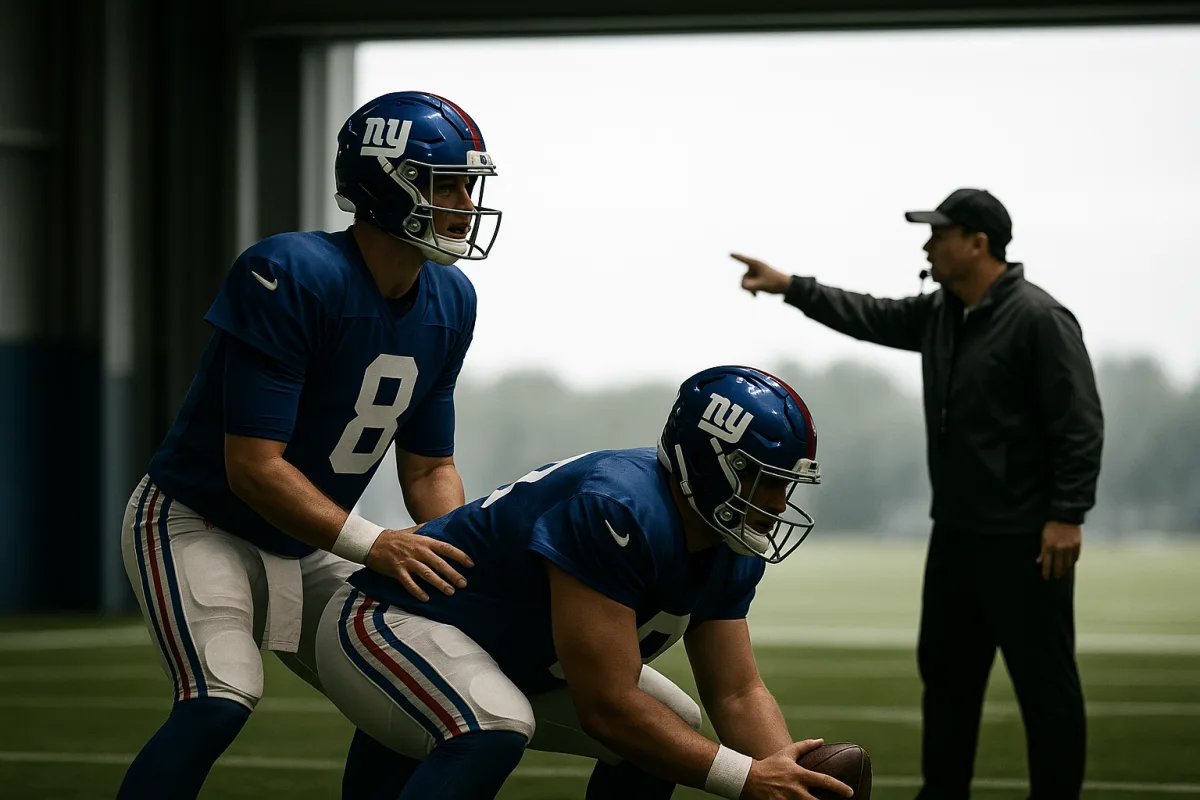
Coach John Harbaugh, speaking on the New York Giants’ YouTube channel, framed Dart’s biggest growth as operating and executing the entire offense. That is the right lens because the quarterback controls the pre-snap communication and the post-snap distribution.
When Harbaugh says Dart is “running the whole show,” do not translate that into a claim that he has mastered it. Harbaugh also made the important qualification: the next test is game time, and one game will only begin the evaluation.
For a viewer, the first actionable checkpoint is the huddle-to-snap process. Watch for clean personnel substitutions, timely motion, protection calls that match the pressure look, and whether the offense gets to the line with enough time to identify disguises.
A quarterback can complete a short pass after a late, improvised snap count and still leave the offense vulnerable. Conversely, an incompletion may be acceptable if Dart correctly identifies pressure, changes the protection and gives the receiver a viable one-on-one opportunity.
Dart said on the Giants’ channel that he feels more “in command” and more comfortable seeing defenses. That is encouraging, but the meaningful evidence will be whether that comfort produces fewer late decisions when defenses change the picture after the snap.
Understand what Nagy’s scheme is designed to solve
The new offense under coordinator Matt Nagy reportedly emphasizes quick reads and efficient ball release, with the stated aim of protecting Dart. [8] That is a practical response to a young quarterback’s development needs, not an admission that he cannot push the ball downfield.
Quick-game structure gives Dart answers before the snap and immediately after it. If a defense shows soft leverage, a hitch, speed out or quick screen can punish it. If the defense crowds the box, the offense can create easier throws outside.
The danger is mistaking a quick release for a good decision. A fast throw is productive only if Dart has correctly identified leverage, anticipated the receiver’s break and understood where the extra defender is rotating from.
On third-and-medium, watch whether the Giants use condensed formations, motion and bunch alignments to declare man or zone coverage. Those tools can simplify the picture for the quarterback and create free releases for receivers, but Dart still has to locate the correct answer.
A useful snap-count exercise is to separate designed quick throws from pressured quick throws. If Dart is getting the ball out quickly because the structure creates clean first-read completions, that is functioning offense. If he is rushing every throw under immediate pressure, the protection issue remains.
Watch Dart’s feet when the first read is covered
Dart himself identified pocket footwork and eye discipline as areas he wanted to improve in the spring. On the Giants’ channel, he later said he felt substantially better in both areas, particularly in his command of the system.
The practical way to assess that claim is not to stare at his release alone. Start at the top of his drop. Is he balanced, does he hitch toward the intended throw, and can he reset without drifting into edge pressure?
Footwork becomes especially important in Nagy’s design because quick concepts often require the ball out on rhythm. A quarterback whose base is too narrow or whose feet stop moving may be forced to arm the ball, even when the read is correct.
Then follow Dart’s helmet and shoulders. Young quarterbacks can appear to scan a defense while their body remains locked on the first option. Real progression work often shows up when the feet and torso reset with the eyes.
The more demanding snaps will come against disguised two-high looks, simulated pressures and late safety rotations. Dart said the Giants’ defense surprised him early in camp, and he credited those daily reps for making him and the offense better.
That point is sensible, but it should not be exaggerated. Training-camp reps can sharpen recognition, yet they are not live NFL snaps. Defenses do not fully reveal their pressure inventory in August, and quarterbacks are not being hit after every late throw.
Measure the deep ball by decisions, not just completions
The Giants reportedly added taller receivers in part to expand Dart’s downfield opportunities. [12] That can help on contested catches and boundary throws, but it does not automatically improve a quarterback’s deep-ball accuracy or anticipation.
When examining a vertical attempt, ask whether the ball went to the right matchup. A completed 45-yard pass into bracket coverage may be a low-percentage decision that happened to work. An incompletion versus tight man coverage can be the proper calculated shot.
The better indicator is whether Dart gives receivers a chance without exposing the ball to the deep safety. On outside go routes, placement matters as much as distance. On seam throws, timing and safety leverage determine whether the target is open.
Minicamp reports that cited inconsistency on deeper throws should remain part of the baseline until game evidence changes it. [12] Do not declare that concern solved because of a few practice highlights or because a new receiver has a larger catch radius.
Be careful with the Beckham narrative
Dart spoke warmly about working with veteran receiver Odell Beckham Jr. during the offseason. He said Beckham traveled to throw with him and that conversations about how veteran quarterbacks communicate with receivers have been helpful.
That is useful context for a young starter. Beckham has played with multiple high-level quarterbacks, and Dart can learn how they organized route adjustments, corrected details and built receiver trust over a season.
Still, the public record does not show a concrete, measurable change in Dart’s preparation or performance that can be assigned to Beckham. The Giants Wire report on Beckham’s experience helping Dart is a pointer to the relationship, not proof of a transformed quarterback.
The actionable thing to watch is communication at the line of scrimmage. If Dart and Beckham consistently identify hot adjustments, sight routes and coverage conversions the same way, that will show up in fewer broken plays, not necessarily more spectacular catches.
Dart also praised Beckham’s alignment, assignment discipline and ability to get open in space during his Giants-channel availability. Those traits matter to a quarterback because a receiver who is where the concept expects him to be makes the progression trustworthy.
Separate readiness from available evidence
The Giants list Dart as their starting quarterback, with Jameis Winston behind him and Jake Haener third on the depth chart. [5][6][7] That is the organization’s clearest public statement about its intended 2026 quarterback hierarchy.
It is not proof that Dart has already made a year-two leap. As of early September, the available statistical databases showed no preseason or regular-season production for Dart in 2026. [3][4] There is no public explanation establishing an injury, a benching or a change in role.
That absence creates an evaluation problem, not a conclusion. It would be wrong to call Dart unready based solely on zero statistics before he has logged a game snap. It would be equally wrong to use practice praise as a substitute for game evidence.
Harbaugh’s own framing is more disciplined than the hype cycle. He said Dart looks comfortable in the offense, then immediately identified game time as the next test. That distinction should guide every early-season judgment.
In Week 1, chart three things before looking at passing yards: how often Dart gets the offense into the correct protection, whether he takes the available answer against pressure, and whether his feet remain connected to his reads after the first option closes.
Keep health and self-protection in the evaluation
Dart’s 2025 season included a concussion against the Chicago Bears, and the NFL later reviewed the Giants’ handling of concussion protocol. [1] That context should change how viewers evaluate scrambling, designed quarterback runs and late throws near the sideline.
The right question is not whether Dart is tough enough to absorb contact. He has already shown a willingness to compete through difficult circumstances. The question is whether the offense gives him safer answers before a play turns into an unnecessary collision.
A quarterback protecting himself can mean throwing the ball away after the progression is exhausted, sliding rather than fighting through multiple tacklers, or taking a short completion against a loaded coverage shell. Those are often winning decisions over 17 games.
Training-camp reports noted that Dart responded to early struggles with red-zone touchdown passes and rushing scores. [10] That resilience is worth tracking, but it needs a companion test: can he respond without forcing a difficult throw after the defense takes away his preferred option?
The strongest early evidence of growth would be boring. Clean operation, decisive feet, quick answers against pressure, selective downfield aggression and fewer self-created negative plays would show the new offense is helping Dart develop rather than merely protecting him.
Frequently Asked Questions
How is Jaxson Dart developing with the New York Giants?
Jaxson Dart entered the 2026 season as the Giants’ listed starter but had not played any preseason or regular-season snaps as of early September 2026. His 2025 rookie season showed promise with 15 touchdowns and five interceptions in 12 starts, but his 2026 progress remains unproven without game action. He is currently learning a new offense under coordinator Matt Nagy, which adds complexity to his development.
What are the key areas of improvement for Jaxson Dart in 2026?
Dart’s main areas for improvement include processing coverage more quickly, maintaining mechanical consistency in the pocket, and improving footwork and eye discipline. Reports from Giants minicamp highlighted uneven deep-ball placement and discomfort operating from under center, which affect his timing and decision-making. He is also working on operating the offense more smoothly, including pre-snap communication and protection adjustments.
How does Matt Nagy's offense impact Jaxson Dart's growth?
Matt Nagy’s offense emphasizes quick reads and efficient ball release to protect Dart and simplify his decision-making. The scheme aims to reduce the time Dart holds the ball and limit the need to manufacture throws outside the structure. While this approach can help Dart avoid pressure, it requires him to correctly identify defensive leverage and anticipate receiver routes to be effective.
What challenges does Jaxson Dart face entering the 2026 season?
Dart faces the challenge of mastering a new offensive system after the Giants fired head coach Brian Daboll following a 4-13 2025 season. He must improve his ability to operate under center, process defensive coverage quickly, and execute protection calls. Additionally, his lack of game snaps in 2026 so far raises questions about his readiness and the team’s cautious approach to his development.
Has Jaxson Dart shown progress in his footwork and decision-making?
Dart himself has acknowledged improvement in pocket footwork and eye discipline during the offseason and minicamp, feeling more “in command” of the system. However, meaningful evaluation depends on seeing how this translates to game situations, especially in making timely decisions when defenses disguise their coverage.
How we researched this
This article was assembled from 2 video sources, 2 published articles, 12 cited references.
Nothing here is based on hands-on testing. Where a figure or finding appears, it belongs to the source cited beside it, and the writing says so rather than implying otherwise. Every source is listed below so you can check it.
Sources
Coach John Harbaugh on Jaxson Dart's growth: 'He's come a long way' | New York Giants — New York Giants
Jaxson Dart 'continuing to learn, continuing to grow as a player' | New York Giants — New York Giants
How Odell Beckham's NFL experience is helping Giants QB Jaxson Dart — Giants Wire
Jaxson Dart says Giants’ defense is ‘best reps I could possibly get’ — SB Nation
NFL is reviewing how concussion protocol was followed for Giants rookie QB Jaxson Dart
2026 NFL Preseason Receiving Statistics | The Football Database
Jaxson Dart "Adjusting Really Well" to New Offense - NFL News | Fantasy Football
Jaxson Dart's Year 2 Leap Will Determine Whether the Giants' Rebuild Is Real
Watch Jaxson Dart's Development with the New York Giants on Youtube
Also from the sources
Related Articles
Giants vs Rams Injury Impact
Analyze the Giants vs Rams injury impact in Week 2 and how key injuries changed offensive performance and game outcomes.
New York Giants Roster Cuts and Preseason Finale Analysis
Detailed analysis of the New York Giants' 2026 preseason finale and roster cuts, including key player evaluations and roster decisions.
Las Vegas Raiders Quarterback Preseason Analysis and QB
In-depth Las Vegas Raiders quarterback preseason analysis covering Kirk Cousins and Fernando Mendoza's QB battle and reps management.
Puka Nacua NFL Wide Receiver Status and 2026 Performance
Explore Puka Nacua's rising NFL wide receiver status with 2026 stats, strengths, and comparison to peers like Jaxon Smith-Njigba.