Las Vegas Raiders Quarterback Preseason Analysis and QB
In-depth Las Vegas Raiders quarterback preseason analysis covering Kirk Cousins and Fernando Mendoza's QB battle and reps management.
The quarterback competition is really a reps competition
The public framing of the Raiders’ quarterback decision has been familiar: experienced veteran Kirk Cousins against Fernando Mendoza, the No. 1 overall pick and 2025 Heisman Trophy winner from Indiana. [1] That framing is accurate, but incomplete.
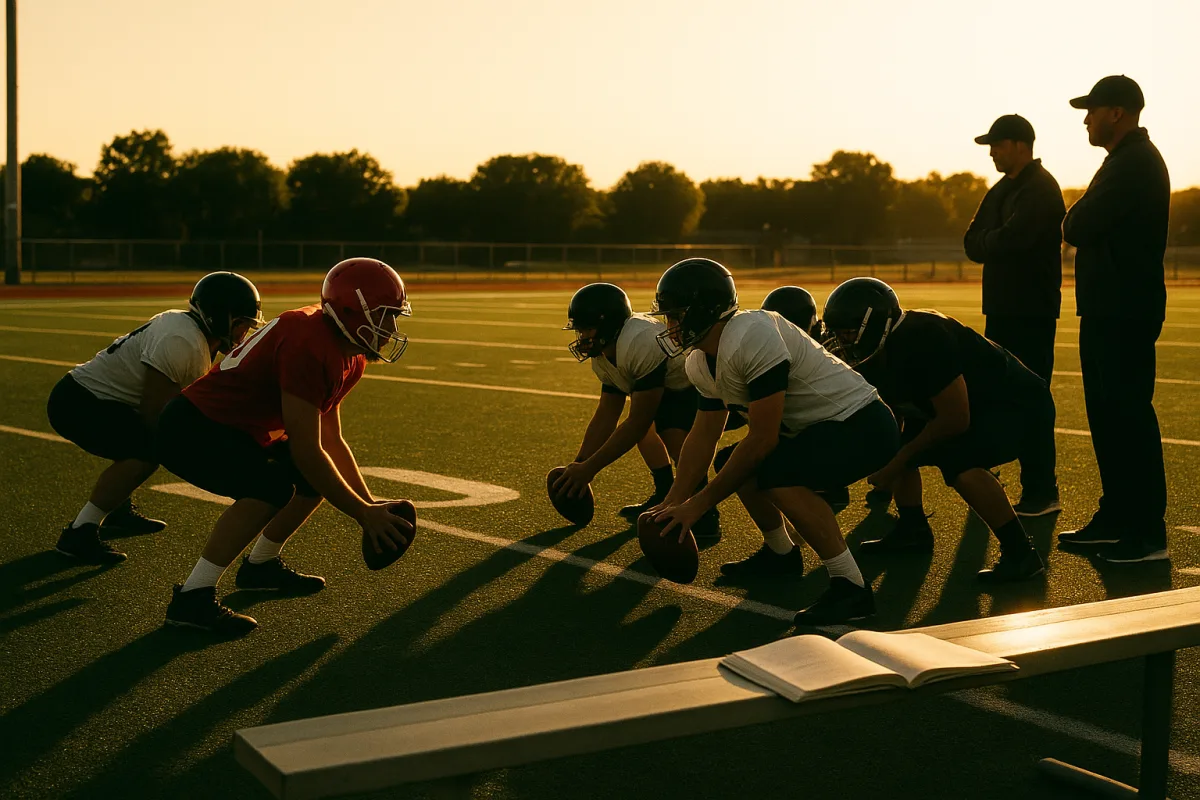
The real competition is not decided by a preseason box score. It is decided by who receives the reps that resemble the regular-season job: first-team protection calls, first-team route adjustments, third-down checks and two-minute ownership.
That is why Cousins has maintained the practical edge even while head coach Klint Kubiak has declined to make a formal Week 1 announcement. The veteran began camp atop the depth chart and received the work with the starting offense. [5]
That distinction matters more than it may sound. A quarterback can take 20 preseason snaps, complete 14 passes and still not demonstrate that he can run the offense on Sunday. The context of those 20 snaps determines what they mean.
Cousins, 37, is not competing solely on arm talent or upside. The Raiders signed him to a two-year, $12.645 million deal with $11.345 million guaranteed, according to PlayerProfiler. [4] They are paying for immediate operational competence.
Mendoza is the long-term investment, a decorated college quarterback whose Indiana team won the national championship during his Heisman season. [1] But college production does not eliminate the first NFL problem: seeing the defense, setting the protection and delivering the ball on time.
What first-team reps actually buy a quarterback
A quarterback’s practice rep begins before the snap. He identifies the front, counts potential rushers, establishes the “Mike” linebacker for protection purposes and makes sure the line, backs and receivers share the same answer.
That process can change with one defender walking toward the line. A six-man protection may become five-man protection with a running back releasing into the route, or the quarterback may keep the back in to account for pressure.
Those adjustments look routine when Cousins makes them. That is partly the point. Veteran quarterback play often appears less dramatic because the work happened before the television camera finds the throw.
First-team reps give a quarterback repeated access to that work against the defense’s most complex looks. The starting center learns the quarterback’s cadence and protection language. The tackles learn when the ball should leave. Receivers learn where the quarterback expects them to sit against zone coverage.
The same play can be fundamentally different with the second unit. A receiver may be less precise at the top of his route. A backup lineman may lose quickly on a one-on-one block. A young quarterback then has to decide whether the pocket failure was his protection call, the blocker’s loss or an unanticipated rush.
That is the cost of evaluating preseason quarterbacks through raw passing totals. Passing yardage cannot show whether a completion came after the quarterback correctly defeated a disguised coverage, or whether a simple throw gained yards because the defense missed a tackle.
Likewise, an incompletion may reflect poor accuracy, but it may also follow an unblocked pressure, a receiver failing to recognize coverage leverage or a timing issue created by a new offense. Tape and personnel context have to come before the stat line.
Kubiak’s comments have pointed directly toward this reality. He said Mendoza ideally would benefit from additional preseason games and acknowledged that rookie practice opportunities shrink when the regular season begins. [5] That is not coach-speak. It is the central roster-management issue.
Why Mendoza’s difficult throw was still instructive
NFL on ESPN showed the clearest example of Mendoza’s current stage during the final preseason game. He tried to fit a pass over the middle, the ball arrived high, it was tipped and intercepted.
The mistake was not simply that Mendoza threw an interception. Quarterbacks can throw interceptions on good decisions, especially when a receiver falls or a defender makes an exceptional break. This play was more instructive because the decision and the ball trajectory raised the risk together.
Chris Simms, on NFL on NBC’s Chris Simms Unbuttoned, described it as the classic danger zone: a high throw over the middle, with a linebacker underneath the throwing lane. That is one of the NFL’s most punishing errors.
The geometry explains why. On an outside-breaking route, a late or high throw often travels toward the sideline, away from the middle-field defenders. The quarterback still risks an incompletion or a cornerback break, but the ball is moving away from traffic.
The middle is different. Linebackers are directly beneath the route, safeties are closing from depth and the quarterback often has to throw over one defender while beating another. Elevating the ball to clear the linebacker adds time in the air.
More time in the air gives the defense more time to react. More height makes a tip more likely. And a tip in the middle of the field rarely dies harmlessly. It can become an interception because multiple defenders are already near the ball.
Mendoza’s arm strength is part of both the appeal and the issue. Simms repeatedly noted the rookie’s ability to generate velocity even without a clean platform or room to step into the throw. That is a legitimate NFL trait.
But velocity cannot fix every window. A quarterback must vary speed, arc and placement according to the receiver’s leverage. A hard throw at chest level might be catchable. The same throw, a foot high over a linebacker, can become a turnover.
This is what refinement means for a young quarterback. It is not reducing aggression until he becomes a checkdown player. It is identifying which aggressive throws produce favorable outcomes and which ones ask too much of the route, receiver and protection.
NFL on ESPN analyst Louis Riddick made a similar point, saying Mendoza appeared to be testing the limits of what he could fit over the second level of the defense. That is a sensible part of preseason development, provided the Raiders correctly identify the lesson.
The lesson is not “never throw over the middle.” Kubiak’s offense needs intermediate throws, especially off play action, to threaten linebackers and create space for the run game. The lesson is that the ball must arrive on the proper line.
The pressure problem cannot be separated from the decision
Simms noted on NFL on NBC that Mendoza faced pressure on seven of 18 dropbacks in the preseason game he reviewed. That figure should be treated as a tape observation, not a complete official preseason accounting.
The independent research available for this story does not provide comprehensive official 2026 preseason passing data for either Cousins or Mendoza. It also does not offer a complete public sack or pressure breakdown for both quarterbacks.
That limitation is important because some reports have circulated detailed preseason lines that do not align with the partial official information available. Cousins’ documented August 13 line was five completions on six attempts for 50 yards and a touchdown, but a full verified preseason ledger is not available. [2]
So the temptation to declare Cousins the winner by percentage or Mendoza the loser by passer rating should be resisted. Those numbers would be fragile even if they were complete. In preseason, sample size and supporting cast can distort them badly.
Still, pressure changes the evaluation. A quarterback who is hurried immediately after play action has little opportunity to work through the progression as designed. He may be forced into an off-platform throw, a sack, a scramble or a throwaway.
That does not absolve Mendoza for a poor risk decision. It does explain why Kubiak should separate plays into categories: protected dropbacks, pressured dropbacks, blitz recognition, free rushers and throws made after the play structure broke down.
Cousins’ advantage is that he has spent years doing that sorting in real games. A veteran knows when the protection has failed and when the offense should accept a punt rather than create a turnover.
That is also why the Raiders should not interpret conservative veteran quarterback play as proof that Cousins lacks ambition. A quarterback operating a new offense may choose the quick completion because it confirms the protection, route and coverage picture.
Three preseason games are not a league-imposed limit on Mendoza’s role
The NFL’s standard preseason schedule gives most teams three games, while Hall of Fame Game participants get four. [3] That format unquestionably limits the total available game inventory for young players.
But it does not limit rookie quarterback reps within those games. The league does not dictate that a first overall pick must receive a specific number of series, passes or quarters. That allocation belongs to Kubiak and his staff.
Kubiak’s position has been consistent: Mendoza needs more experience, while Cousins remains the quarterback receiving the primary preparation. [5] The coaching staff appears to be choosing gradual integration rather than forcing a rookie into the lineup because of draft status.
There is a cost to that choice. Once the regular season starts, the starter receives the overwhelming majority of meaningful practice repetitions. The backup gets scout-team work, limited developmental periods and whatever game action becomes available.
That arrangement can help Mendoza. He can study how Cousins handles protections, situational football and weekly game plans without carrying every early-season consequence. Kubiak specifically described observing Cousins and continuing Mendoza’s development as valuable. [5]
It can also slow Mendoza’s live growth. The rookie will not get an extra three preseason games, as Kubiak said he would prefer. [5] He will get fewer chances to test pocket movement, coverage recognition and ball placement against defenses playing at NFL speed.
That is why the Raiders should be clear about what they are doing. Starting Cousins is not a declaration that Mendoza has failed. It is an acknowledgment that the most difficult quarterback skill is not throwing hard, it is making every player’s assignment fit together.
For now, Cousins is better positioned to do that because he has accumulated the right reps. Mendoza’s preseason tape shows why the Raiders believe in his physical talent, and why Kubiak is right not to confuse talent with readiness.
Frequently Asked Questions
Who is leading the Las Vegas Raiders quarterback battle in preseason 2026?
Kirk Cousins holds the practical edge in the Raiders’ quarterback battle because he has taken the first-team practice work and operates the offense with the starting offensive line and receivers. While Fernando Mendoza is the long-term investment, Cousins’ experience and reps with the first unit position him as the likely Week 1 starter.
How are Kirk Cousins and Fernando Mendoza performing in Raiders preseason?
Cousins has shown operational competence by running the offense with first-team reps, but detailed preseason passing stats are limited. Mendoza’s preseason tape shows talent but also areas needing refinement, especially on intermediate throws requiring precise velocity and placement. Mendoza’s limited playing time is a coaching decision rather than a league restriction.
What do first-team reps mean for Raiders quarterbacks in preseason?
First-team reps involve working with the starting offensive line, primary receivers, and full protection calls, allowing the quarterback to practice making real-time adjustments like protection changes and route adjustments. These reps are crucial for demonstrating readiness to run the offense on game day, beyond just raw passing statistics.
Why is Kirk Cousins expected to start over Fernando Mendoza?
Cousins is expected to start because he has the experience to operate Klint Kubiak’s offense immediately and has taken the first-team reps during preseason. The Raiders signed him to a contract reflecting their need for immediate operational competence, while Mendoza is seen as a developing rookie who benefits from more preseason reps before starting.
How does the Raiders coaching staff manage rookie QB development during preseason?
Head coach Klint Kubiak manages rookie development by limiting Mendoza’s preseason reps to gradually integrate him behind Cousins. This approach allows Mendoza to develop without the pressure of starting immediately, but it also reduces his practice volume once the regular season begins, complicating the timing of any future starting role.
How we researched this
This article was assembled from 2 video sources across 2 channels, 2 published articles, 7 cited references.
Nothing here is based on hands-on testing. Where a figure or finding appears, it belongs to the source cited beside it, and the writing says so rather than implying otherwise. Every source is listed below so you can check it.
Sources
Louis Riddick says the Raiders will be patient with Fernando Mendoza 👀 | SportsCenter — NFL on ESPN
'Set in stone' Kirk Cousins starts over Fernando Mendoza | Chris Simms Unbuttoned | NFL on NBC — NFL on NBC
Raiders' Klint Kubiak still won't name Week 1 QB starter, here's why all signs point to Kirk Cousins — CBS Sports NFL
Raiders' Klint Kubiak still won't name Week 1 QB starter, here's why all signs point to Kirk Cousins — CBS Sports
Fernando Mendoza wins the Heisman Trophy as college football's top player
Klint Kubiak: Ideally, you don't want a rookie QB to start from Day 1 - NBC Sports
Watch Las Vegas Raiders QB Battle and Preseason Analysis on Youtube
Also from the sources
Related Articles
Cleveland Browns Preseason Roster Cuts and Player Analysis
Detailed Cleveland Browns preseason roster cuts and player performances shaping the 2026 team ahead of the final 53-man deadline.
Quarterback Battles Heating Up: Preseason Analysis
Explore the intensifying quarterback battles in the NFL preseason and the metrics that matter for evaluating performance.
Washington Commanders Upset Win Over Seattle Seahawks
Detailed analysis of the Washington Commanders' upset win over the Seattle Seahawks, focusing on quarterback performance and key game factors.
NFL Rookie Impact Analysis: Early Roles and Contributions
Explore NFL rookie impact analysis covering early roles, key plays, and how rookies contribute in their first games of the 2026 season.