
Deshaun Watson Named Browns Starting Quarterback for 2026
Learn why Deshaun Watson was named the Browns starting quarterback in 2026, including performance, contract impact, and offensive strategy insights.
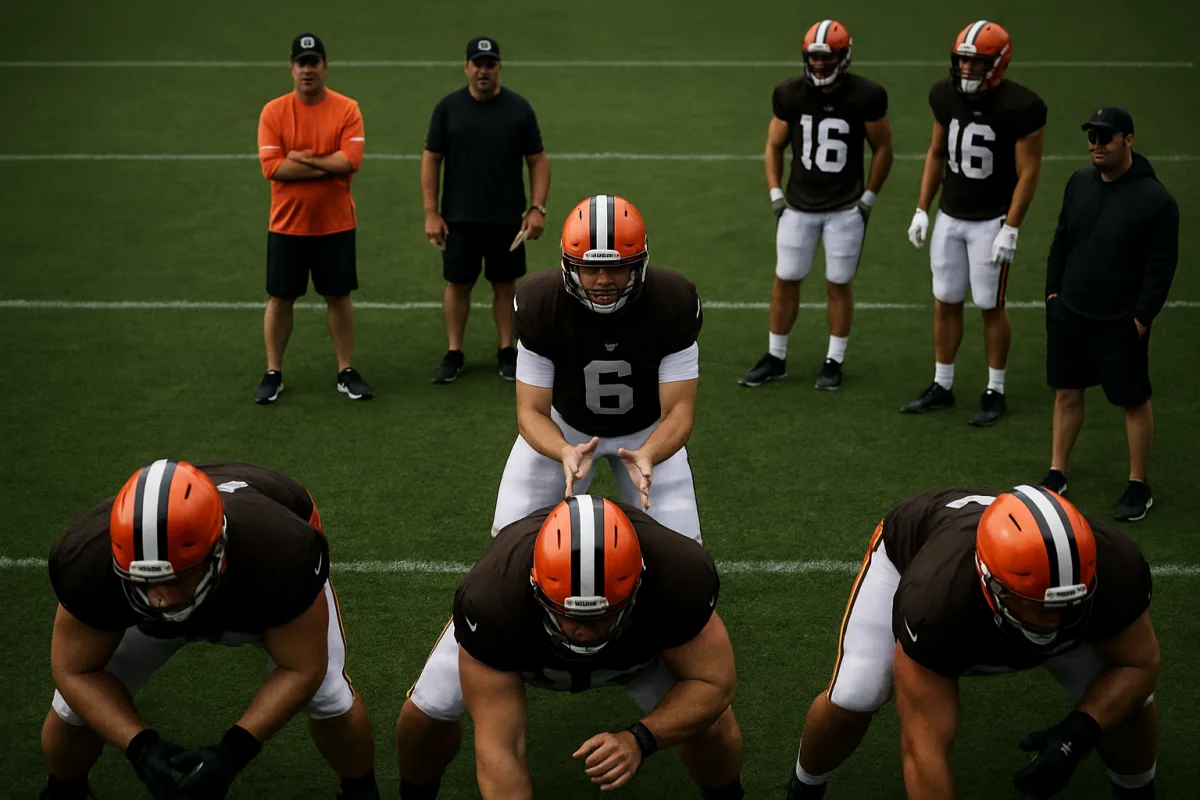
Cleveland has chosen quarterback continuity over quarterback sentiment
The Cleveland Browns have named Deshaun Watson their starting quarterback for 2026. The important part is not simply that Watson won a camp competition. It is that Cleveland is making a short-term operational decision while asking its fan base to accept a player and a contract that have become the franchise’s biggest source of friction.
The evidence that the shift is real comes from several directions. The Browns made the starter designation publicly through the team and national outlets. [5][8] Cleveland.com and Plain Dealer reporter Mary Kay Cabot said on NBC’s Dan Patrick Show that head coach Todd Monken made the call as a football decision, centered on giving the offense its most experienced traffic controller for the opener in Jacksonville. NFL reporting and commentary have also framed the decision through the unavoidable contract consequences, rather than as a clean verdict that Watson is the club’s best long-term option. [3][6]
That distinction matters. A starting job in August can mean, “This player gives us the best chance to function in Week 1.” It does not necessarily mean, “This player is definitively better than every quarterback on the roster,” or, “This player is the quarterback of the future.”
Cleveland has chosen the first proposition. It has not yet proved the second.
Why Todd Monken’s offense points toward Watson, for now
Cabot’s explanation of the decision is more useful than the usual “veteran versus rookie” framing. She described Monken’s offense as one requiring substantial quarterback control at the line of scrimmage: setting protections, identifying pressure, managing motions, making checks and getting the offense in and out of the huddle efficiently.
Those are not cosmetic tasks, especially in a road opener. Jacksonville will have crowd noise, silent-count issues and the normal communication stress that comes with a new season. Cleveland is also trying to install a new offense with new personnel, including a rebuilt offensive line and young receivers, according to Cabot’s reporting on NBC. In that setting, the coordinator may reasonably prefer the quarterback with the most experience handling an NFL huddle and responsibility at the line.
That is the football case for Watson. It is not a claim that he was clearly superior on every throw during the preseason.
In fact, the available preseason production points the other way. Shedeur Sanders completed 9 of 11 passes for 74 yards and a touchdown in the Aug. 22 preseason game against Buffalo. Watson finished 5 of 12 for 36 yards, with an interception. [11] One preseason game does not settle a quarterback competition, and it certainly does not capture protection calls, route adjustments, practice reps or command of the offense. But it does undercut any argument that Watson’s on-field performance made the decision obvious.
The same caution applies to camp observations. Retired Browns left tackle Joe Thomas said on ESPN’s First Take that he had attended practices and watched exhibition games and believed Watson had been the best quarterback in camp. That is a meaningful informed observation from a former elite offensive lineman. It is still an observation, not a publicly available grading system. Other analysts on the same ESPN segment said the competition appeared close and argued that a close race should favor Sanders because of age and developmental upside.
Both ideas can be true. Watson may be further along in operating Monken’s offense today. Sanders may still have supplied the more encouraging preseason tape and offer the more important long-term evaluation.
The contract makes every quarterback decision harder
Watson’s contract is the reason the starting decision cannot be treated like a normal depth-chart move. He signed a fully guaranteed five-year, $230 million deal with Cleveland in March 2022. [2] A quarterback with that level of guaranteed money is not easy to release, trade or simply set aside without consequences to the rest of the roster.
There is some confusion in public cap reporting because the estimates describe different accounting moments. ESPN reported that the Browns reworked Watson’s contract in March 2026 to reduce what had been an NFL-high cap charge. [3] Spotrac’s post-restructure calculation places his 2026 cap hit at roughly $44.96 million. Sporting News, using a different view of the salary-to-bonus conversions and cap allocation, reported a figure around $80.7 million, or 26.8 percent of Cleveland’s cap. [6]
Those figures should not be treated as interchangeable. The lower number reflects the cap charge after a restructuring calculation. The higher number emphasizes how much of the club’s financial commitment is still being carried through conversions and guarantees. The common conclusion is sturdier than either single number: Cleveland has already committed resources to Watson that restrict its flexibility.
The dead-money discussion needs the same precision. Sporting News described a 2026 release as carrying more than $80 million in dead money. [6] Spotrac projects roughly $131.16 million in dead cap if Watson is released after the 2026 season, a calculation that includes future guaranteed obligations. The exact timing of a transaction matters. Either way, moving on is not cost-free, and the Browns cannot recover the sunk cost by giving Watson first-team reps.
That is where the narrative needs correction. Starting Watson does not solve the contract problem. The contract is guaranteed whether he starts, sits or gets hurt. The only football justification for playing him is that Monken believes Watson currently gives the offense its best chance to execute and win.
If that belief changes, the money should not decide every Sunday snap.
The tape and recent production leave Cleveland little margin for error
Watson is not merely returning from a poor preseason stat line. He is returning from two Achilles surgeries in 2024 and missed the entire 2025 season. [7] For a quarterback whose earlier best work included escape ability, second-reaction throws and movement outside structure, the Achilles recovery is central to evaluating whether his game can return.
The Browns need more than a quarterback who can recite the terminology. They need a quarterback who can protect himself and the offense when a play does not go according to plan.
That is particularly relevant behind an offensive line that allowed 23 sacks in eight games during Sanders’ rookie season, according to the available 2026 reporting. Watson himself has taken 70 sacks in 19 starts for Cleveland. [4] Sacks are not solely a quarterback statistic. They can come from a beaten tackle, an unrecognized blitz, a route concept that develops too slowly, a receiver failing to separate, or a quarterback holding the ball after the structure has broken down.
But the snap-level problem is clear: Cleveland cannot operate a high-volume, long-developing passing game if its protection is unstable and its quarterback is still regaining mobility. Monken’s early answer should be expected to include protection help, defined reads, quick game, condensed formations and play-action concepts that reduce the number of pure dropbacks. That is not a concession to Watson. It is how a new offense protects all its quarterbacks while its line and receiving corps develop communication.
Watson’s recent efficiency also demands caution. Reporting on Cleveland’s decision noted that his 2024 and 2025-level performance context ranked near the bottom of the league in EPA per pass play, around 77th or 78th among qualifying quarterback seasons in the cited comparisons. [4] EPA is useful because it measures how a play changes expected points, not just whether a pass gained yards. It is not a full diagnosis. It does not isolate line play, receiver quality, down-and-distance or injuries perfectly.
Still, it tells the Browns what the box score alone can miss: Watson has not recently produced efficient offense often enough to assume a rebound.
Fan backlash is real, but attendance claims would be speculation
The morale question is not manufactured. Cabot told NBC that local reaction had been sharply negative, with fans expressing anger outside the Browns’ facility and local sports-talk programming carrying substantial criticism. CBS Sports reported vandalism at the Jim Brown statue amid protests over Watson’s elevation to QB1. [9] Watson was also booed during the preseason, including the Aug. 22 game against Buffalo. [10]
Axios and The Ringer have both treated the decision as larger than a standard quarterback competition, arguing that Cleveland is risking further alienation of a fan base that has already lived through the failure of the Watson trade and contract. [1][4]
There is, however, no reliable attendance dataset establishing a precise post-announcement decline. It would be inaccurate to say ticket sales or stadium turnout have measurably collapsed. What the available evidence supports is narrower: public opposition is visible, sustained and broader than a few unhappy callers.
The other complication is Sanders. He is not just a backup waiting behind Watson. He is a second-year quarterback coming off a Pro Bowl rookie season, even with 10 interceptions, and he has played better than Watson in the most cited preseason comparison. [11] Dillon Gabriel, the 2025 third-round pick, and Taylen Green also remain on the quarterback depth chart, though there is not enough public evidence to make a serious comparative claim about either player’s readiness.
Sanders’ presence changes the cost of patience. Every week Watson starts is a week Cleveland delays meaningful regular-season evaluation of a younger quarterback. That does not make the Week 1 decision wrong. It does mean the Browns need a clear performance threshold rather than an open-ended appeal to experience.
What Cleveland must learn quickly
The Browns’ decision is defensible only if it is tied to specific operational goals. Can Watson identify pressure and organize Monken’s offense cleanly? Can he get the ball out on time? Can the offense create manageable third downs rather than asking him to repeatedly rescue broken pockets? Can he retain enough movement ability after the Achilles injuries to punish aggressive edges and extend plays selectively?
If the answers are yes, Cleveland can stabilize an offense that needs quarterback competence more than it needs a weekly storyline. If the answers are no, the argument that Watson’s contract requires him to start becomes backward. The money is already committed. The remaining decision is about allocating snaps.
For teams planning their own quarterback transitions, Cleveland offers a useful warning. Do not confuse a financial obligation with a developmental plan. A veteran may be the right opening-week choice because he can manage protections and run the system. But that choice needs checkpoints, especially when a younger player has shown enough to merit live-game evaluation.
The Browns are betting that Watson’s experience in Monken’s new offense matters more in September than Sanders’ preseason edge and future value. That is a manageable bet for one road opener. It becomes much harder to justify if the offense remains inefficient, the protection remains leaky and Watson’s mobility does not return.
Cleveland has named a starter. It has not settled its quarterback future.
Frequently Asked Questions
Why was Deshaun Watson named the Browns starting quarterback in 2026?
The Browns named Watson the starter as a short-term football decision focused on giving the offense its most experienced leader for the Week 1 opener. Head coach Todd Monken’s offense requires substantial quarterback control at the line of scrimmage, and Watson’s experience handling NFL huddles and responsibilities made him the preferred choice despite a close competition with Shedeur Sanders.
How does Deshaun Watson's contract affect the Browns' quarterback decision?
Watson’s fully guaranteed five-year, $230 million contract signed in 2022 significantly limits the Browns’ roster flexibility. The 2026 cap hit, after a restructuring, is estimated between roughly $45 million and $81 million depending on the accounting method, and releasing him could create dead money exceeding $80 million. These financial commitments make it difficult for the Browns to simply bench or release Watson without major cap consequences.
What preseason performance comparisons exist between Watson and Sanders?
In the August 22, 2026 preseason game against Buffalo, Shedeur Sanders completed 9 of 11 passes for 74 yards and a touchdown, while Watson finished 5 of 12 for 36 yards with an interception. Although Sanders showed better statistical production in that game, the decision to start Watson was based more on experience and command of the offense rather than preseason stats alone.
What offensive factors influenced the Browns to start Watson?
Todd Monken’s offense requires the quarterback to manage protections, identify pressure, make route adjustments, and efficiently run the huddle. Given the challenges of a road opener with crowd noise and a rebuilt offensive line and young receivers, the Browns preferred Watson’s experience in handling these complex responsibilities over Sanders’ developmental upside.
How might Watson's Achilles injury recovery impact his 2026 season?
Watson missed the entire 2025 season recovering from two Achilles surgeries in 2024. This injury history and recovery add uncertainty to his 2026 performance and durability, especially as he adjusts to a new offensive scheme and builds chemistry with new teammates.
Sources
Mad Dog is MAD about Deshaun Waston being named Browns' QB1 😡 | First Take — NFL on ESPN
Cleveland Browns rolling with Deshaun Watson a 'football decision' | Dan Patrick Show | NFL on NBC — NFL on NBC
Sources: Browns rework Watson contract to lower NFL-high cap hit - ESPN
The Browns Are Losing Their Season—and Much More—by Starting Deshaun Watson - The Ringer
Deshaun Watson works to showcase ‘productive football’ during Browns training camp
Like it or not, Browns need Deshaun Watson in 2026: Here's why | Sporting News
Why Deshaun Watson may not play this season and what it means for 2026 - CBS Sports
Cleveland Browns Name Deshaun Watson The Starting QB | FOX Sports
Sanders gana terreno sobre Watson por la titularidad en Browns
4 Glaring Flaws the Browns Must Fix to Optimize Their Brand-New Offense in 2026
Watch Deshaun Watson named Browns starting QB on Youtube
Also from the sources
Related Articles
Cleveland Browns Week 4 Performance and Key Player Impact
Analyze the Cleveland Browns' Week 4 performance, key player impacts, and strategic adjustments in their win over the Steelers.
Cleveland Browns Preseason Roster Cuts and Player Analysis
Detailed Cleveland Browns preseason roster cuts and player performances shaping the 2026 team ahead of the final 53-man deadline.

Las Vegas Raiders Quarterback Preseason Analysis and QB
In-depth Las Vegas Raiders quarterback preseason analysis covering Kirk Cousins and Fernando Mendoza's QB battle and reps management.
Aaron Rodgers and Steelers Injury Challenges Impacting
Explore how Aaron Rodgers and the Steelers are managing wide receiver injuries and their effect on the 2026 offense.