
Texans vs Chargers Week 9 Preview and Defensive Analysis
Detailed Texans vs Chargers Week 9 preview focusing on defensive strategies and injury impacts for an informed game outlook.
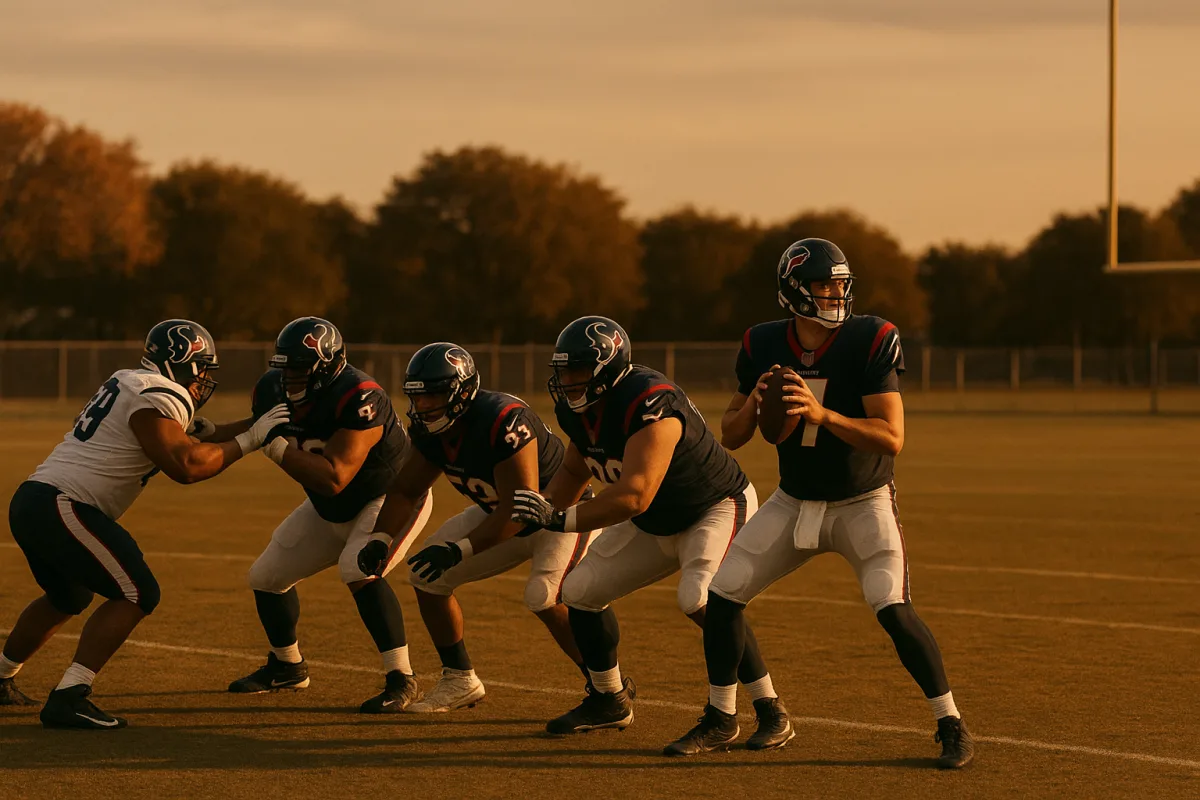
Start by making Herbert stay in the pocket
The Texans’ priority is clear before they call a single coverage: make Justin Herbert play from the pocket, and make every throw arrive on Houston’s terms. The Chargers have not won a game, and their offense has failed to reach 10 points in consecutive games.
Herbert has absorbed an unusually heavy volume of damage for a seventh-year quarterback. He has thrown 10 interceptions and taken 23 sacks through seven games, creating the rare combination of stalled drives and turnover chances Houston needs to exploit. [1]
The NFL’s game preview noted that Los Angeles had not reached 75 rushing yards in either of its previous two games. That puts more of the offense on Herbert’s arm, which is exactly where Houston should want the game decided.
Houston does not need to chase a reckless sack total. It needs to prevent clean pockets on third down, force Herbert to reset his feet, and make him throw through crowded throwing lanes after the rush has compressed the pocket.
Trust Will Anderson Jr. and Danielle Hunter to create the stress
Houston has the edge players for this matchup. Will Anderson Jr. had 7.5 sacks after seven games, while Danielle Hunter had four, as the Texans reached 21 team sacks entering Week 9, according to the NFL preview.
The best version of the Texans pass rush works as a unit. Anderson and Hunter can win outside, but interior rushers must eliminate the step-up lane that turns a nearly completed pressure into a Herbert scramble.
That is where the Texans have to be disciplined. The Houston Texans channel emphasized that Herbert still has enough mobility to hurt a defense that loses contain, especially if an early scramble produces a first down and restores his rhythm.
We would make Herbert see bodies at the edges and a closing lane inside, then force him to deliver under pressure. A sack is ideal, but an off-platform checkdown short of the sticks or an incompletion also wins the down.
Do not confuse pressure with an all-out blitz plan
Houston’s identity has generally been built around pressure from its front four. The Houston Chronicle reported a 23.8 percent blitz rate in 2025, ranking 20th in the league, which reflects a defense designed to rush four and protect its coverage structure. [2]
That framework fits this opponent. Herbert has been hit and hurried enough that Houston should not need to repeatedly sacrifice coverage numbers in pursuit of a highlight-reel blitz.
The danger is giving Herbert easy pre-snap answers. If Houston brings too many obvious rushers, the Chargers can simplify the read with quick throws, screens, or one-on-one routes outside.
The Texans can still add a fifth rusher selectively, especially in obvious passing situations. But the important part is making the pressure look connected, with the rush lanes and underneath defenders accounting for Herbert’s ability to escape.
Put a linebacker in charge of Herbert’s escape routes
Houston linebacker Henry To’oTo’o is a central player in this game because the Chargers ask their quarterback to create when protection or the run game fails. To’oTo’o must handle the ordinary linebacker work first, then close Herbert’s escape lane when the call requires it.
The Texans channel identified To’oTo’o as a key defensive player, pointing to his prior strong performance against the Chargers and his role making calls in the middle of the defense. Houston needs that command against a quarterback who can punish undisciplined rush paths.
Herbert scrambling for a first down is not the same as a designed rushing attack, but it can change the emotional temperature of a struggling offense. Houston cannot give him cheap conversions after winning the first two seconds of the play.
If the Texans choose to spy him on longer downs, the spy has to remain patient. Chasing Herbert before he commits to leaving the pocket opens a throwing window, while waiting too long concedes the sideline.
Hunt the ball without gambling away explosives
Houston has only two interceptions through seven games, according to the Texans’ game preview, a low number for a defense that wants takeaways to change games. Herbert offers a chance to improve that total, but the route to it is pressure plus coverage discipline.
The Rams intercepted Herbert twice in their 24-9 win over the Chargers. Rams safety Quentin Lake said afterward that the defense expected turnovers, then criticized Herbert’s decision-making in unusually direct terms. Pro Football Talk reported Lake said Herbert was “seeing ghosts.”
Chargers coach Jim Harbaugh rejected that reading. Pro Football Talk reported Harbaugh said Herbert had done his job “exceptionally well,” apart from two throws he would want back, while Herbert said he was focused on what was happening inside the building.
Houston should ignore the rhetoric and play the tape-based answer: pressure has produced bad decisions, and the Texans should be ready for them. Cornerbacks and safeties must drive on late throws, not abandon assignments hoping to create one.
The Texans also cannot let their takeaway pursuit become a reason for busted coverage. Los Angeles still has receivers capable of winning downfield, and Herbert remains talented enough to punish a defense that guesses wrong.
Force Los Angeles to run before it wants to
The Chargers’ offense has struggled to produce on the ground, while Houston has held opponents to 3.8 yards per carry, according to the NFL preview. That matchup favors the Texans if they stay structurally sound on early downs.
Houston should make Los Angeles repeatedly prove it can sustain conventional rushing success. If the Chargers cannot, second-and-long and third-and-long become opportunities for Anderson, Hunter, and the rest of the front to dictate the snap.
The Texans can use their five-defensive-linemen front when they need to tighten the run game, but that should be a response to an actual problem, not a default. Los Angeles has shown too little recent rushing production to justify overcommitting early.
A Chargers offense facing third-and-seven is more likely to ask Herbert to make the kind of pressured, difficult throw that has led to his 10 interceptions. [1] Houston’s job is to keep presenting that equation.
Check the Chargers’ protection and secondary injuries before kickoff
Los Angeles guard Kayode Awosika has been ruled out with a fibula injury. That is the Chargers injury that most directly affects Houston’s pressure plan, because any altered interior protection can help the Texans collapse the pocket sooner. [3]
Safety Derwin James, cornerback Deane Leonard, and wide receiver Brenen Thompson are also ruled out. Cornerbacks Donte Jackson and Rodney Shelley are questionable with hamstring injuries, while wide receiver Tre Harris practiced on a limited basis with hamstring issues and has no official game status listed. [3]
Those absences affect both sides of the matchup. Houston’s defense must account for a Chargers receiving group that may be thinner, while Stroud could face a secondary missing James and Leonard and potentially managing more cornerback uncertainty.
The final call belongs to the official inactive list, not the midweek report. Injury designations can change before Sunday, so check the Chargers’ official update before assuming either questionable corner will be available. [3]
Make C.J. Stroud use every eligible target
Houston should not turn this into a game where Stroud forces hero throws because the Chargers are 0-7. Stroud has been productive, with the NFL preview crediting him with more than 265 passing yards per game, a rating above 100, and only one interception.
That is the formula Houston should preserve: identify the coverage, take the open intermediate throw, and let the pass-catchers create after the catch. The Chargers have been weak on third down and only middle of the league in red-zone defense, according to the NFL preview.
Nico Collins remains the centerpiece. The Texans preview described Collins as Houston’s only receiver above 50 yards per game, at 65 yards with three touchdowns, and the offense should make Los Angeles account for him on every high-leverage down.
That does not mean forcing the ball into double coverage. It means using Collins’ alignment and route presence to create opportunities elsewhere, then taking the one-on-one matchup when the Chargers fail to commit extra help.
Bring Dalton Schultz and Tank Dell into the plan early
Houston has reasons to spread targets around. Dalton Schultz was averaging 46 receiving yards per game in the NFL preview, while Tank Dell returned from injury with 43 yards in his first game back.
Schultz can help Stroud punish linebackers and safeties underneath, particularly if Los Angeles plays coverage designed to limit Collins outside. Dell gives Houston another route runner who can stress a defense horizontally and vertically without requiring a forced deep shot.
The Texans also have recently acquired receiver Marvin Harrison Jr., plus Xavier Hutchinson and Kayshon Boutte as complementary options. Houston’s own preview singled out Harrison after a promising early stretch and argued for a larger role following the bye.
Jaylin Noel will not be available because he remains on injured reserve without a return date. Houston lists safeties Reed Blankenship and Jalen Pitre, running back David Montgomery, and tackle Blake Fisher as questionable. [4]
Protect the game state, then make the Chargers chase it
Houston’s recent record against Los Angeles says this matchup should not be treated as automatic. The Texans lead the Chargers 3-1 in meetings since 2021, however, including a 32-12 playoff win in January 2025 and a 20-16 road win in December 2025. [5][6]
Those results offer a useful reminder: Houston has found ways to beat this opponent, but the margins have varied. The Texans cannot rely on Herbert’s turnover numbers to do the work for them.
The cleanest Houston script is an early lead built through Stroud’s efficient passing, a contained Chargers running game, and a pass rush that gradually shortens Herbert’s internal clock. That lets Houston attack a desperate offense without gifting it short fields.
We would judge the Texans’ defensive day less by blitz totals or raw sack totals than by this sequence: did they stop the run, keep Herbert in the pocket, create third-and-long, and convert pressure into punts or takeaways? If those answers are yes, Houston should control Week 9.
Frequently Asked Questions
How will the Texans pressure Justin Herbert in Week 9?
The Texans plan to rely primarily on their front four to generate pressure, focusing on forcing Herbert to throw from the pocket under duress. They aim to prevent clean pockets on third down and make Herbert throw through crowded lanes, using edge rushers like Will Anderson Jr. and Danielle Hunter to create stress while interior defenders eliminate escape routes.
What are the key defensive strategies for the Texans vs Chargers game?
Houston’s defense will emphasize disciplined pressure from the front four rather than frequent blitzing, maintaining coverage integrity to avoid giving Herbert easy pre-snap reads. They will force Herbert to prove he can protect the ball early, limit his mobility by containing his escape lanes, and avoid gambling on turnovers that could lead to big plays for the Chargers.
Which Chargers players are injured ahead of Week 9 matchup?
The Chargers will be without guard Kayode Awosika, safety Derwin James, and cornerback Deane Leonard, all ruled out due to injuries. Wide receiver Brenen Thompson is also ruled out, while cornerbacks Donte Jackson and Rodney Shelley are questionable with hamstring injuries, and wide receiver Tre Harris has a hamstring injury but no official game status.
How can the Texans exploit the Chargers' depleted secondary?
The Texans can attack the Chargers’ weakened secondary by utilizing C.J. Stroud’s full progression and keeping receivers like Nico Collins involved even when coverage is focused on him. Maintaining pressure on Herbert will increase the chances of forcing poor decisions, but Houston must balance aggression with coverage discipline to avoid giving up big plays.
What role does Henry To’oTo’o play in containing Justin Herbert?
Henry To’oTo’o is tasked with ordinary linebacker duties and also containing Herbert’s escape routes when necessary. He must remain patient as a potential spy on longer downs, avoiding premature pursuit that opens throwing windows, and help prevent Herbert from gaining confidence through scrambles that extend drives.
How we researched this
This article was assembled from 2 video sources across 2 channels, 1 published article, 7 cited references.
Nothing here is based on hands-on testing. Where a figure or finding appears, it belongs to the source cited beside it, and the writing says so rather than implying otherwise. Every source is listed below so you can check it.
Sources
Houston Texans vs Los Angeles Chargers | 2026 Week 9 Game Preview, NFL
Texans vs. Chargers: C.J. Stroud, Tank Dell & How Houston Can Win, Houston Texans
Jim Harbaugh, Justin Herbert respond to Quentin Lake's "seeing ghosts" critique, Pro Football Talk
Chargers Injury Report | Los Angeles Chargers - chargers.com
Houston Texans Injury Report and Status 2026-27 - CBS Sports
Houston Texans vs. Los Angeles Chargers, confrontos diretos: Texans lidera 3-1 desde 2021
Houston Texans vs Los Angeles Chargers Head-to-Head Record & Results | SharpModels
Watch Houston Texans vs Los Angeles Chargers Week 9 Preview and Analysis on Youtube
Also from the sources
Related Articles
San Francisco 49ers Week 4 Preview and Player Updates
Get the San Francisco 49ers Week 4 preview with injury updates and analysis on handling Denver's pressure defense.
Week 5 NFL Game Previews and Injury Impact Analysis
Get detailed Week 5 NFL game previews with injury updates and tactical analysis to understand how player availability shapes matchups.
Bears vs Seahawks Week 8 Preview: NFC Contenders Showdown
Get a detailed Bears vs Seahawks Week 8 preview with key matchups, injury updates, and NFC playoff implications.
Ravens Week 8 Preview and Player Media Availability
Get the latest Ravens Week 8 preview, injury updates, and player media availability ahead of their game against the Bills.