
June Jones Coaching Legacy and Impact on Passing Offense
Explore June Jones' coaching legacy and how his run and shoot offense revolutionized passing in football.
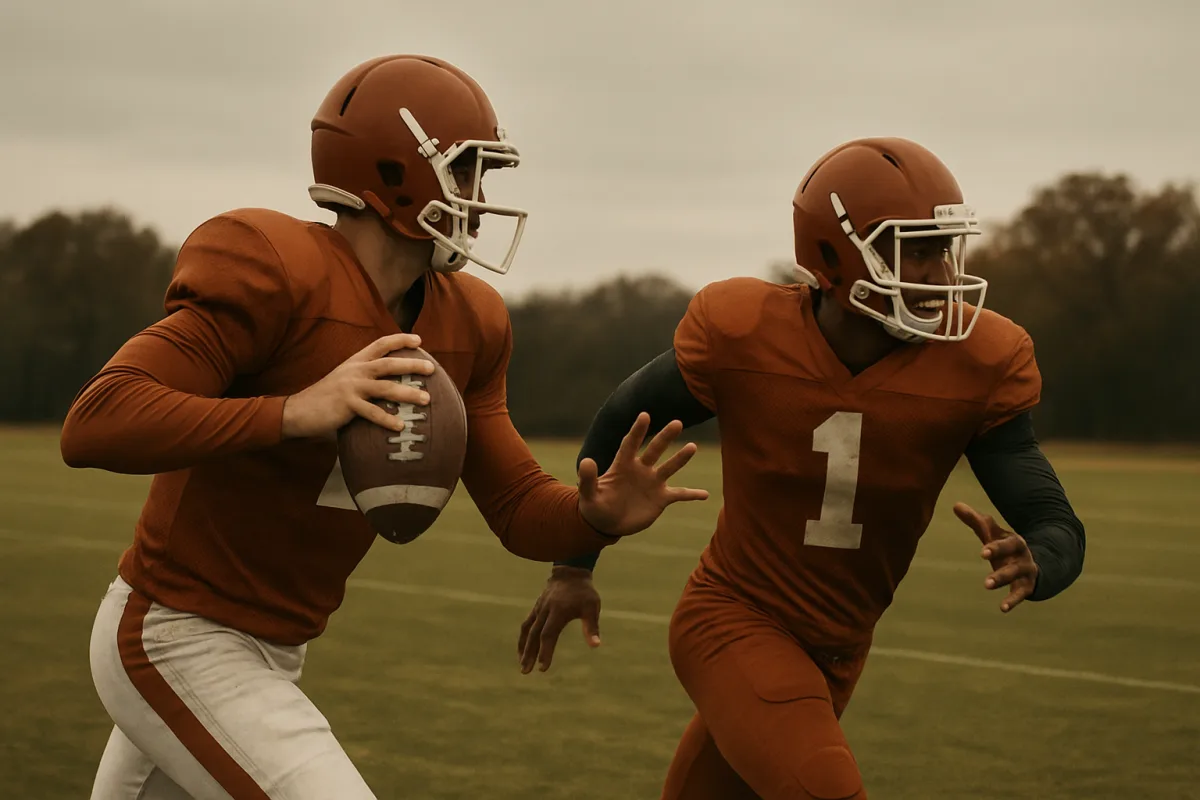
June Jones’ Legacy Lives in the Route Adjustments, Not the Formation
The idea behind June Jones’ football
June Jones died at 73 after a coaching life that ran from the NFL to Hawaiʻi, SMU, the CFL, the XFL and smaller developmental leagues. CBS Sports credited the former quarterback with helping make the run and shoot a major force in modern offensive football.[2]
The shorthand version of Jones’ legacy is that he believed in passing. That is accurate, but incomplete. Plenty of coaches have called passes. Jones’ real distinction was how his passing game distributed responsibility after the snap.
The run and shoot did not ask a receiver merely to run the route printed in the playbook. It asked him to identify leverage, coverage shell and defender movement, then choose from a defined menu of answers.
That distinction matters because it explains both the offense’s production and its volatility. When a quarterback and four receivers recognized the defense identically, the ball came out into space before coverage could recover. When they did not, the play could look disorganized.
Jones learned the system as a quarterback at Portland State under Mouse Davis, whose offense put passing volume and receiver spacing at the center of its structure. Jones later carried those ideas into professional and college coaching, with his most visible work coming in Houston, Atlanta and Hawaiʻi.[2]
One formation, four receivers, many answers
The traditional run and shoot personnel package is one running back and four wide receivers. That is a useful starting point, not the entire system. Four receivers spread a defense horizontally, forcing every coverage player to declare how he will handle space.[2]
A defense can still play man coverage, spot-drop zone or pressure from that structure. The point is that fewer bodies are available to disguise intentions near the line, while each receiver has more room to stress an individual defender.
Picture a receiver aligned wide to the right, with a cornerback outside and a safety deeper over the top. A fixed-route offense may tell that receiver to run a 12-yard out regardless of coverage. The run and shoot instead gives him rules.
If the corner squats outside with help over the top, the receiver may bend inside or settle where the underneath defender vacates. If the corner plays soft and the safety stays high, the receiver may break outside and take the available grass.
The quarterback is reading the same picture, on the same clock. He is not waiting to see which route looks open in a broad, improvisational sense. He is anticipating the receiver’s correct adjustment and throwing to the point that adjustment should produce.
That is why the offense is often called a choice-route system. The receiver has a choice, but it is not freelance football. His available routes are constrained by coaching rules, route depth, defensive leverage and the complementary routes around him.
The slot receiver’s role is especially important. Inside alignments create two-way releases, meaning a defender cannot simply use the sideline as an extra boundary. The slot can threaten inside, outside, vertically or sit down against zone coverage.
That leverage stresses nickel defenders and safeties because they must protect more space while often making their coverage declaration later. A clean inside release can force a safety to drive downhill, opening a seam behind him for another route.
The outside receiver, meanwhile, can use width to pull a corner toward the boundary. That does not always create a completion for him. It may instead enlarge the window for the slot or for a crossing receiver arriving behind linebackers.
This is the piece often missed in retrospective discussions of high-volume passing offenses. A completion total does not prove every throw was a difficult one. Many throws were manufactured by alignment, route complements and a defense stretched across the field.
What the quarterback actually has to do
The quarterback’s job begins before the snap, but it cannot end there. He identifies the likely shell, counts potential rushers and finds the defender who will determine the first read. Then he confirms or corrects that picture after movement.
If a defense rotates from a two-high shell to single-high coverage, the route answer can change. If a linebacker widens with a slot receiver, a receiver settling inside may become the immediate target. The throw follows the coverage rule.
That is more demanding than the phrase “throw it around” suggests. The quarterback needs arm talent, certainly, but also rapid processing and a practiced visual language with his receivers. He cannot be late, because the route itself may be changing.
At Hawaiʻi, that language produced massive quarterback numbers. Timmy Chang finished with 17,072 passing yards, and Colt Brennan set the Division I-A single-season touchdown record with 58 in 2006, according to biographical records cited in the research on Jones’ career.[7]
Those numbers describe opportunity as well as execution. The scheme generated a large passing workload and many favorable spacing situations. They do not mean every quarterback could walk into the offense, throw often and automatically produce at that level.
Brennan’s 2006 season also illustrates what full command can look like. He finished third in Heisman Trophy voting after a year in which Hawaiʻi repeatedly punished defenses that could not maintain leverage across the entire width of the formation.[7]
Jones’ Hawaiʻi teams were not successful because they found a loophole in football. They were successful because the players repeatedly practiced the same recognition-and-response decisions until the route adjustment and quarterback throw became one action.
The cost of giving receivers answers
Every offensive structure pays for its advantages. The run and shoot pays in precision. A receiver reading man coverage while the quarterback reads zone does not create a modest inefficiency. It creates an interception opportunity in open space.
The system also puts pressure on pass protection. Four-receiver personnel frequently removes a tight end or fullback from the core of the protection picture. The running back can help, but he must identify blitz threats correctly and do it immediately.
That weakness became more pronounced as defenses developed better zone-pressure packages. Grantland’s examination of the offense noted that zone blitzes could disrupt its timing, particularly by making quarterbacks believe a throwing lane was available before a dropping rusher occupied it.[5]
That is not a philosophical objection to passing. It is a structural response. The offense wants defenders spread and predictable. A zone blitz muddies that picture by bringing an apparent coverage player and dropping an apparent rusher into a passing lane.
The quarterback may still have a receiver breaking open, but his throwing window has changed. If the ball comes out on the original rhythm, the dropped defender can be waiting. If the quarterback hesitates, the pressure has won anyway.
This is why the run and shoot can be mischaracterized as reckless when it fails. The issue is not that an offense passed too much in the abstract. The issue is whether the protection, quarterback and route adjustments stayed synchronized against disguised pressure.
There is a parallel lesson in the running game. Critics often framed the Detroit version of the offense as a poor fit for Barry Sanders, but the formation could create lighter boxes because defenses had to account for four receivers. Jones and Davis showed a star back could function within it.[2]
The tradeoff was that the run game did not receive the same structural commitment as a tight-end-based offense. It was usually an answer to defensive numbers and fronts, not the organizing principle. That distinction matters more than the number of handoffs.
Jones’ NFL work was real, but not a simple success story
Jones worked with Warren Moon as Houston Oilers quarterbacks coach after Jerry Glanville hired him in 1987, a significant proving ground for a pro version of the system. The offense demonstrated that a high-level NFL quarterback could operate in a receiver-driven structure.[2]
Later, Jones became Atlanta’s head coach from 1994 through 1996. Pro Football History lists his regular-season record at 19-29, with no playoff appearances, which is a necessary correction to any account that treats innovation as automatic NFL success.[1]
That record does not erase the scheme’s influence, nor does influence turn the record into something better than it was. NFL defenses are better equipped to disguise coverage, pressure protections and punish operational errors than most college opponents.
The better way to assess Jones’ NFL legacy is through concepts that survived adaptation. Modern teams regularly use shotgun spacing, four-receiver formations, quick access throws and routes designed to exploit leverage, all ideas linked to the broader run-and-shoot family.[3]
They generally do not run the system in its purest historical form. Many modern spread teams reduce receiver discretion, use packaged run-pass options, involve tight ends more heavily or build protection around motion and condensed formations.
That is adaptation, not rejection. Coaches kept the valuable part, forcing defenses to defend width and making fast throws available, while adding answers for the pressures and coverage disguises that once troubled more rigid run-and-shoot structures.
College football made that influence especially visible. Spread offenses have continued to emphasize receiver-based mismatches and wide formations, a lineage that scheme analysis traces in part to the run and shoot’s spacing principles.[4]
Hawaiʻi was the clearest proof of Jones as a teacher
Jones’ Hawaiʻi tenure remains the cleanest measure of his ability to build an offense around a detailed system. He inherited a program coming off an 18-game losing streak and went 9-4 in his first season, earning national coach-of-the-year recognition.[2]
Across nine seasons, he posted a 76-41 record at Hawaiʻi and led the program to a 12-1 finish in 2007. The season ended with a Sugar Bowl loss to Georgia, but the record belonged to a sustained program build, not one statistical spike.[2]
The tape-level value of that turnaround is not captured simply by saying Hawaiʻi threw more than its opponents. Jones installed a language: coverage alerts, receiver adjustments, quarterback timing, protection rules and the expectation that players could execute them at speed.
That is also why the system traveled unevenly. Its installation requires practice time and continuity. A roster can understand concepts in a meeting room and still lack the accumulated repetitions necessary to make a sight adjustment reliable on third-and-eight.
CBS Sports connected Jones’ work at SMU to the program’s eventual return to relevance, while also noting he did not reproduce Hawaiʻi’s peak results there.[2] The available research does not provide verified detailed SMU statistical achievements, so the case should not be overstated.
Jones remained active across football after his major college jobs, including work in the CFL, XFL and coaching education. The Run and Shoot Certification program he co-founded continues to offer extensive instructional material and archived All-22 teaching film, according to its published program description.[6]
That continuing teaching footprint fits the actual legacy. June Jones did not merely leave behind a formation that coaches can copy on a grease board. He left a demanding offensive premise: give players rules, give them space, and trust preparation enough to let them solve the coverage.
Frequently Asked Questions
What is June Jones' coaching legacy in football?
June Jones is credited with popularizing the run and shoot offense, a system that emphasizes passing and receiver route adjustments based on defensive coverage. His legacy includes record-setting quarterback performances at Hawaiʻi and influencing modern offensive football through his innovative approach to receiver and quarterback coordination after the snap.
How did June Jones influence modern passing offenses?
Jones’ run and shoot offense introduced principles such as four-receiver sets, quick passing, and spacing that have been integrated into modern NFL and college spread offenses. These elements help create mismatches and leverage defensive alignments, shaping the evolution of pass-oriented offensive schemes.
What is unique about June Jones' run and shoot offense?
The run and shoot offense is unique in that it replaces fixed routes with coverage-based adjustments, requiring receivers to read defensive leverage and choose routes accordingly. This system demands precise timing and a shared understanding between quarterbacks and receivers to exploit defensive weaknesses in real time.
How did June Jones' system affect quarterback play?
Quarterbacks in Jones’ system must quickly identify defensive coverage before and after the snap, anticipate receiver adjustments, and deliver the ball with precise timing. This requires not only arm talent but also rapid processing and practiced communication with receivers to execute the option-route structure effectively.
What challenges did June Jones' offense face against defenses?
Jones’ offense was vulnerable to zone blitz defenses that disrupted timing and receiver improvisation, making it difficult to sustain effectiveness in the NFL. The system’s reliance on precise timing and route adjustments also posed challenges in recruiting and maintaining consistent team success.
How we researched this
This article was assembled from 2 published articles, 7 cited references.
Nothing here is based on hands-on testing. Where a figure or finding appears, it belongs to the source cited beside it, and the writing says so rather than implying otherwise. Every source is listed below so you can check it.
Sources
June Jones, innovator of the run and shoot offense, dies at 73 — Pro Football Talk
June Jones dies at 73: Pioneer coach produced innovative offenses at SMU, Hawaii and the NFL's Atlanta Falcons — CBS Sports NFL
Atlanta Falcons head coach history | Pro Football History.com
June Jones dies at 73: Pioneer coach produced innovative offenses at SMU, Hawaii - CBS Sports
Impact of New Offensive Schemes-How 2026 QB Prospects Fit Modern NFL Systems
» June Jones’s Retirement, and the Lasting Influence and Likely End of the Run-and-Shoot Offense
Related Articles
J.J. McCarthy Giants Breakout Performance vs Texans Analysis
Analyze J.J. McCarthy's efficient and mobile breakout performance in his first Giants start against the Texans, highlighting offensive strategy and key
Commanders vs 49ers Monday Night Football Preview
Get a detailed Commanders vs 49ers Monday Night Football preview with key matchups, injury updates, and tactical analysis for the October 19, 2026 game.
Under Center Quarterback Strategy: NFL Offensive Insights
Explore under center quarterback strategy and how it shapes NFL offensive play-action and bootleg tactics in modern football.
Falcons vs Ravens Overtime Game and Injury Impact Analysis
Detailed analysis of the Falcons vs Ravens overtime game and how player injuries impacted the outcome and team strategies.