
Minnesota Vikings Defense Success Under Brian Flores in 2026
Explore how Brian Flores' defensive strategies fuel the Minnesota Vikings' success with high blitz rates and zone coverage in 2026.
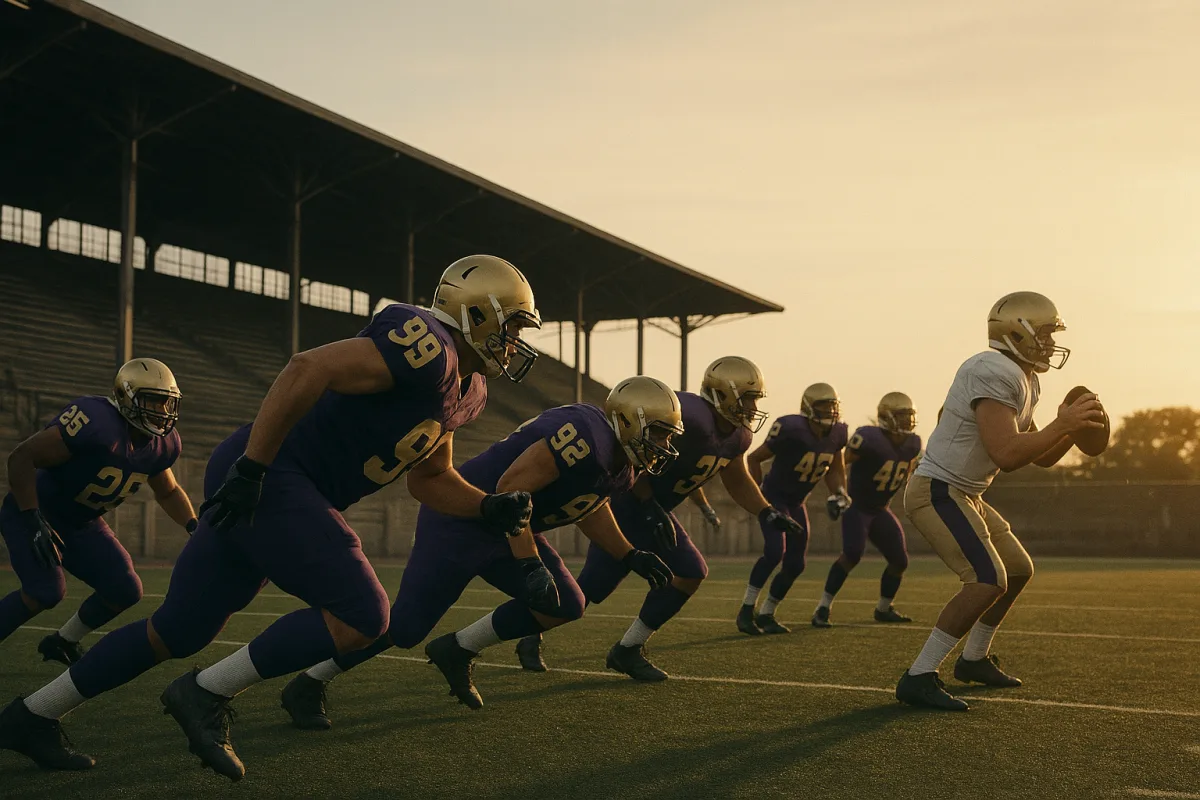
The number that explains Minnesota’s start: 71 percent
The headline number around Brian Flores’ defense is 71 percent. That is Minnesota’s blitz rate in 2026, a massive increase from last season’s 50 percent and far beyond the rate most NFL defenses can live with. [3]
That figure can be misunderstood. A blitz rate tells us how often a defense sends more rushers than the offense can block with its five offensive linemen alone. It does not mean Minnesota is blindly sending six defenders after every snap.
Flores’ idea is more demanding than that. The Vikings use pressure to alter an offense’s play before it begins, especially its protection rules, quarterback read and timing. The sack is useful, but it is not the only intended result.
A conventional offense wants to use its full menu. It wants to run the ball, use play-action, release backs and tight ends into routes, and let deeper route combinations develop. That requires time and predictable protection.
Minnesota’s pressure takes choices off that menu. If a quarterback sees five or six possible rushers crowding the line of scrimmage, he cannot casually carry out a long play-action fake and wait for a 20-yard route to uncover.
He has to identify who is rushing, decide where the protection is sliding, locate his hot throw, and make sure the ball comes out before an unblocked defender arrives. Flores wants that process to happen under stress.
ESPN’s Kevin Seifert described Flores’ larger aim as pushing opponents away from their preferred offensive identity. Against pressure, the offense is less likely to call its normal game and more likely to operate from its emergency answers. [3]
That distinction matters. A quarterback can complete a three-yard throw against a blitz. In fact, Minnesota is often willing to allow it. The defense has still won if it has forced a second-and-10 offense to settle for third-and-seven.
Why zone coverage changes the math
The unusual part is what Minnesota does behind the pressure. Blitz-heavy defenses have traditionally leaned heavily on man coverage, asking cornerbacks and safeties to cover receivers one-on-one while extra rushers try to beat the protection.
Flores has not treated that as a requirement. Minnesota can bring extra rushers while playing zone behind them, a combination that runs against the conventional pairing of pressure with man-to-man coverage. [2][3]
In man coverage, the basic trade is clear. The defense gains a rusher but accepts isolated matchups outside. If the pressure does not get home, the quarterback may have a clean one-on-one throw against a defensive back with his back turned.
Zone behind pressure changes the quarterback’s picture. Defenders do not simply chase individual receivers. They drop to assigned areas, read the quarterback’s eyes and drive on throws that the blitz has encouraged him to make quickly.
That is why a Vikings pressure can produce an incompletion without a sack or even a quarterback hit. The quarterback sees a free rusher, throws to what appears to be an immediate outlet, then finds a linebacker or defensive back waiting in that window.
The pressure and coverage are connected. The rush makes the quarterback release the ball before a route develops. The zone defender is positioned for the early answer. Neither part is enough by itself as consistently as the combination.
Blake Cashman, Minnesota’s linebacker, described the work required in a Vikings media availability. Linebackers must understand when to show rush, when to drop, what their coverage landmarks are and how any stunt changes their responsibility.
Cashman also pointed to the value of lining up near outside linebacker Andrew Van Ginkel, whose presence can draw protection attention. The point is not merely that Van Ginkel might win a rush, but that offenses must account for him before the snap.
If a center slides toward Van Ginkel or a running back is held in to help, the offense has fewer bodies available for the rest of the formation. That can create a favorable matchup for another rusher or reduce the number of receivers in the route.
The pre-snap illusion is the real pressure
The important word in Minnesota’s scheme is not blitz. It is uncertainty. Flores wants the offense to see more potential rushers than it can comfortably account for, without knowing exactly who will cross the line at the snap.
A linebacker may walk into an A-gap between the center and guard. A safety may threaten from the edge. A defensive back may align close enough to suggest pressure, while an edge rusher or linebacker is actually assigned to drop into coverage.
The offense has to make its protection decision before it knows the answer. Most protections are built on counting threats, identifying the likely extra rusher and assigning blockers accordingly. Flores tries to corrupt those counts.
If the offense commits six protectors against a possible six-man pressure, it may be safe up front but reduced in the passing game. A tight end or running back kept in protection cannot also be the quick outlet or the extra route defender fears.
If the offense sends only five blockers and guesses wrong, the quarterback may be responsible for a free defender. That does not always create a sack. It can create the hurried throw, abandoned fake or throwaway that Minnesota is seeking.
This is also where simulated pressure matters. A simulated pressure presents a blitz look, but not every apparent rusher comes. One player drops out, while a defender from somewhere else attacks. The offense may protect the wrong people.
That is harder than simply calling an all-out blitz. It requires defenders with coverage competence and a shared understanding of the call. A player cannot freelance because he thinks he has a clearer path to the quarterback.
Cashman called the scheme the most complicated defense he had entered, and said it took live repetitions against another team before its stress on offenses became clear. He also said experience lets players anticipate restricted run and route concepts. [7]
That is a key point. Flores’ system asks for aggression, but it is not chaos. Its best plays are organized chaos, with the offense confused about the rush while Minnesota’s defenders know precisely who is responsible for each lane and coverage area.
The cost of playing this way
Every pressure package creates space somewhere. When a defense sends extra rushers, it has fewer defenders available in coverage. When a safety enters the front, there may be less protection deep. When linebackers mug gaps, run fits can change quickly.
That is the unavoidable cost. A defense cannot have six rushers, seven coverage defenders and a perfect answer for every route at once. The coordinator is choosing where to accept risk and trusting execution to keep it manageable.
The usual counter is simple in theory. Get the ball out quickly, use screens, attack vacated zones, force the defense to tackle in space, and punish failed pressure with explosive gains. The practical challenge is recognizing the real rush in time.
Minnesota’s record against explosive plays suggests the pressure has not come at the usual price. The Vikings have allowed 147 plays of 20 or more yards across the past three seasons, the fewest in the NFL. [3]
That number does not prove every call is airtight. It does show that Flores’ aggression has not produced a league-wide pattern of broken coverages or a defense regularly surrendering chunk gains in exchange for highlights.
The Vikings’ 12.3 points allowed per game through six contests is the more immediate measure of success, and it leads the NFL. [6] But it remains a six-game sample, not evidence that this group has already earned a place beside full-season historic defenses.
Points allowed can also be influenced by field position, offensive turnovers and late-game situations. The more instructive schematic evidence is that Minnesota is creating pressure while continuing to prevent the explosive plays that usually make aggressive defenses vulnerable.
Why Cashman and Rodriguez matter to the structure
Flores’ scheme needs players who can handle assignments that do not match a traditional depth chart label. Cashman is central because he can play the run, threaten pressure and retreat into coverage without tipping the defense’s eventual call.
Cashman has recorded at least seven tackles in 15 consecutive games, a franchise record, while adding 2.5 sacks and contributions in coverage. [7] Those numbers show volume, but his pre-snap versatility is more important to the scheme than any single total.
A linebacker who can credibly rush changes protection. A linebacker who can then drop underneath a slant or sit in a shallow passing lane changes the quarterback’s quick answer. That dual role is the mechanism, not an accessory.
Interior play matters just as much. Levi Drake Rodriguez, a 2024 seventh-round selection, had become a starting nose tackle with 57 tackles and three sacks by Week 7 of the 2026 season. [7] His growth gives the pressure package an interior anchor.
A nose tackle does not need to produce a sack to help a blitz. If he occupies the center and guard, he can prevent the pocket from expanding or force the running back to step up as a protector rather than release into a route.
Cashman said Rodriguez’s development has shown in the consistency of his assignments, not only the visible effort and physicality. That is exactly what Flores needs from the interior, a player who maintains the structure while other defenders move around him.
The Vikings’ unbeaten start has understandably drawn attention to the raw blitz percentage. But the 71 percent figure is best understood as the entrance point to Flores’ system, not the entire explanation for it.
Minnesota is not winning because it sends bodies recklessly. It is winning because the pressure forces hurried offensive decisions, while zone coverage, disciplined landmarks and flexible players turn those hurried decisions into manageable plays rather than easy answers.
Frequently Asked Questions
How does Brian Flores' blitz rate impact the Minnesota Vikings defense?
Brian Flores’ 71 percent blitz rate in 2026 forces opposing offenses into faster decisions, shorter route concepts, and limited protection options. This pressure disrupts offensive timing and reduces the quarterback’s ability to execute longer, more complex plays, contributing to the Vikings allowing an NFL-low 12.3 points per game through six games.
What defensive strategies has Brian Flores implemented for the Vikings?
Flores employs a blitz-heavy scheme that pairs aggressive pressure with zone coverage behind the rush. This combination allows defenders to attack the quarterback while maintaining coverage responsibilities, forcing quick, often inaccurate throws. The scheme also emphasizes communication and continuity to ensure all defenders reach their assigned landmarks.
Why does the Vikings defense use zone coverage behind blitzes?
Using zone coverage behind blitzes changes the quarterback’s read by having defenders drop into assigned areas rather than following receivers man-to-man. This approach allows defenders to watch the quarterback’s eyes and react to quick throws induced by the blitz, increasing the chance of incompletions even without sacks or hits.
How does Brian Flores create uncertainty for opposing offenses?
Flores creates uncertainty by sending more potential rushers than the offense can block, forcing quarterbacks to quickly identify who is rushing and where protection is sliding. This pre-snap pressure disrupts offensive rhythm and pushes teams away from their preferred game plans toward emergency or less effective options.
What makes the Vikings defense effective under Brian Flores in 2026?
The Vikings’ effectiveness stems from their unprecedented blitz rate combined with disciplined zone coverage, limiting big plays and points allowed. Key players like linebacker Blake Cashman and nose tackle Levi Drake Rodriguez have thrived in versatile roles, contributing to a defense that has allowed the fewest plays of 20+ yards over three seasons and the lowest points per game in the NFL through six games.
How we researched this
This article was assembled from 4 video sources across 2 channels, 14 cited references.
Nothing here is based on hands-on testing. Where a figure or finding appears, it belongs to the source cited beside it, and the writing says so rather than implying otherwise. Every source is listed below so you can check it.
Sources
Minnesota Vikings Team Press Conferences | Week 8 vs. Detroit Lions | October 28 — Minnesota Vikings
Blake Cashman on His Big Game vs. Colts, His Role in Brian Flores' Defense, Evolution of Defense — Minnesota Vikings
Blake Cashman on His Big Game vs. Colts, His Role in Brian Flores' Defense, Evolution of Defense — Minnesota Vikings
The SECRET Behind the NFL’s Only Undefeated Team | Mahomes, Raiders, Goff & More | Leaguewide — NFL on ESPN
Understanding Brian Flores’ Blitz-Heavy Scheme | Daily Norseman
Vikings’ Brian Flores Has the NFL Searching for Answers - Athlon
Minnesota Vikings defense: Blake Cashman, unsung stars for Brian Flores
How Brian Flores' Blitz-Heavy Scheme Has Fueled the Vikings�... - Vikings Intel
Minnesota Vikings 2026 Offensive Splits | Pro-Football-Reference.com
Vikings news: Tip your cap to Brian Flores for these bonkers defensive stats
Minnesota Vikings, el único equipo invicto de la NFL tras la Semana 7
One Thought on All 11 Vikings Defensive Starters One Month Into the 2026 Season
Watch Minnesota Vikings' Defensive Success Under Brian Flores on Youtube
Also from the sources
Related Articles
Vikings Week 1 Win Over Packers Hinged on Fourth-and-One
Explore how the Vikings' Week 1 win over the Packers was shaped by a crucial fourth-and-one defensive stop and Carson Wentz's steady play.
Seattle Seahawks vs Kansas City Chiefs Analysis
Detailed Seattle Seahawks vs Kansas City Chiefs analysis highlighting defensive strategy and offensive balance in the 2026 game.
Atlanta Falcons Roster Moves and Defensive Changes Explained
Explore the Atlanta Falcons roster moves and defensive changes, including linebacker updates and edge depth shifts in 2026.
San Francisco 49ers Key Player Performances and Dominance
Explore the San Francisco 49ers' 2026 dominance with key player performances from Brock Purdy, Mike Evans, and their adaptive defense.