
Vikings Week 1 Win Over Packers Hinged on Fourth-and-One
Explore how the Vikings' Week 1 win over the Packers was shaped by a crucial fourth-and-one defensive stop and Carson Wentz's steady play.
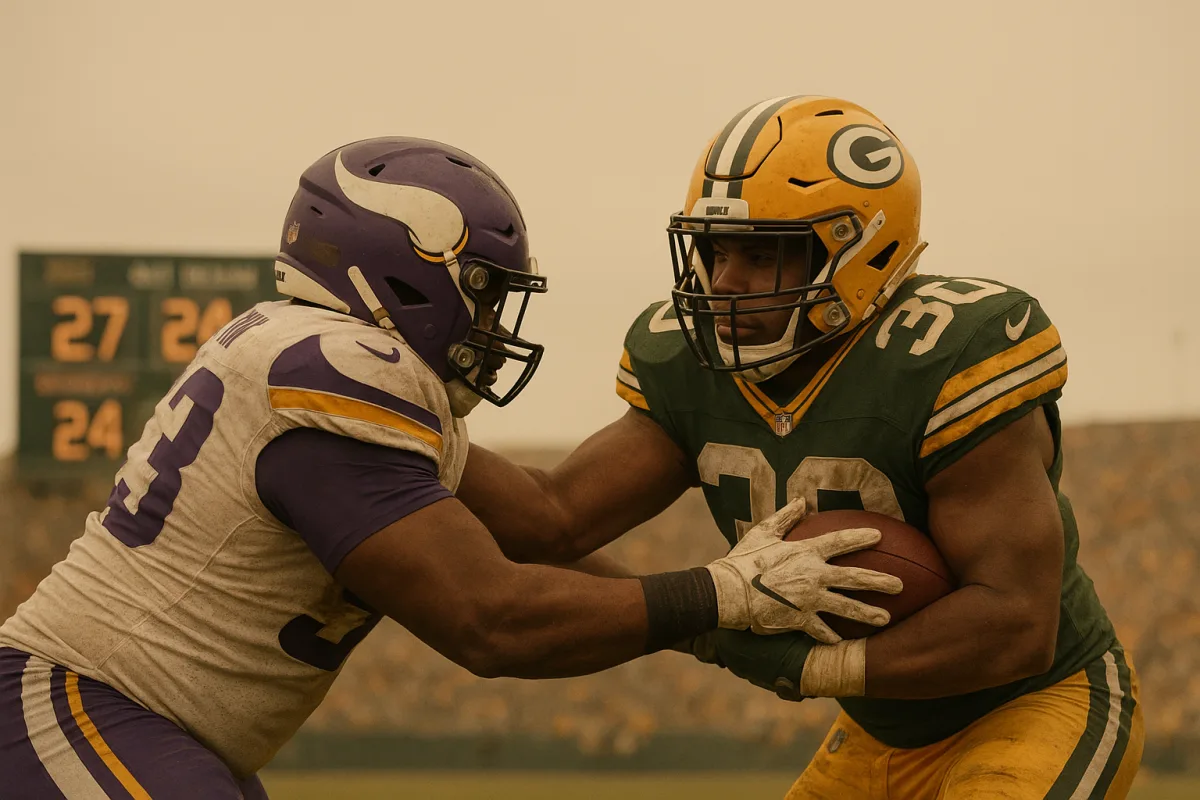
Minnesota’s Week 1 comeback was not dominance, it was a fourth-and-one lesson
The game changed when Green Bay chose one yard over three points
The cleanest explanation for Minnesota’s comeback is not that the Vikings suddenly became a different offense. It is that Green Bay created a fourth-and-one situation, declined available points, and failed to gain one yard.
According to NBC Sports’ account of the game, the Packers led 22-10 late in the third quarter before Minnesota scored the final 29 points in a 39-22 victory at U.S. Bank Stadium. [4] That is a comeback, not wire-to-wire control.
That distinction matters because “dominant” can conceal what actually happened. Minnesota was not simply winning every matchup for four quarters. The Vikings absorbed an early quarterback injury, trailed by double digits, then capitalized when Green Bay’s margin for error disappeared.
The pivotal choice came after a Vikings offside penalty gave Green Bay a chance to reset the situation. Packers coach Matt LaFleur declined a 40-yard field-goal attempt and went for fourth-and-one, a decision that would have pushed the lead to two possessions if converted. [4]
LaFleur’s rationale, shared in the Green Bay Packers’ postgame availability, was straightforward. The Packers saw a front with no defender directly over the center, checked to a quarterback sneak, and believed they could get the needed yard.
That is the core mechanics of the decision. A quarterback sneak is not a complicated play, but it is also not automatic. It depends less on a ballcarrier creating space than on the offense immediately owning the interior gaps.
Why a quarterback sneak succeeds, or fails
On most short-yardage sneaks, the center and guards are responsible for preventing immediate penetration. The offense wants the quarterback to take the snap, drive behind his center or guard, and fall forward before defenders can reset their leverage.
The first read is often the nose tackle, the defender aligned over the center. If there is no defender head-up on the center, an offense may see a cleaner initial path inside. That was the look LaFleur said prompted Green Bay’s check.
But the absence of a head-up nose does not mean the middle is empty. Defenses can crowd either shoulder of the center, angle a defensive tackle across the center’s face, or shoot linebackers into interior gaps at the snap.
The decisive factor is usually not the offensive call itself. It is who wins the first half-second after the ball moves. If the center and guards create even a narrow vertical crease, the quarterback can usually get a yard.
If a defender crosses a blocker’s face, gets low, or forces the quarterback sideways before his momentum starts, the sneak becomes a pile. Once it becomes a pile, the offense is relying on push rather than design.
Minnesota defensive coordinator Brian Flores has built a system around making protections and blocking counts uncertain. The Vikings’ postgame interviews repeatedly described the defense as one that changes alignments, pressures from multiple spots, and forces offenses to identify threats late.
That does not mean every Minnesota stop is a disguised blitz. On this specific fourth-and-one, the essential point is simpler: the Vikings got penetration and denied Green Bay the clean vertical movement the sneak required.
The result was not merely a turnover on downs. It was a field-position and score-state swing. A converted attempt could have extended Green Bay’s lead and forced Minnesota’s backup quarterback into a more aggressive, less comfortable game script.
Instead, Minnesota got the ball back with the game still within one score. The Vikings then converted that defensive stop into points, which is what made the decision feel larger than one failed yard.
Analytics can support aggression, but they cannot block the front
Short-yardage fourth-down decisions are frequently discussed as if analytics produces a command. It does not. Models estimate the value of going for it based on score, time, field position, and historical conversion rates.
A model can reasonably say a fourth-and-one attempt is preferable to a field goal. It cannot know whether the offense will miss a protection, whether the defense will anticipate the call, or whether a lineman loses leverage immediately.
LaFleur acknowledged that the analytical case likely favored aggression, but also said the decision was based on Green Bay’s belief it could get the yard against the defensive look it received. The execution, not the philosophy, failed.
That is an important distinction for evaluating the Packers. Going for it was defensible. Running a sneak was defensible. The problem is that Green Bay chose the play expecting a favorable interior picture and did not finish the block structure.
The Packers’ own postgame comments also help explain why that play became so costly. LaFleur said Minnesota’s defense made life difficult once Green Bay fell behind the sticks, because Flores could crowd the line and create uncertainty about who was rushing.
That is the cost of losing a short-yardage snap. The offense loses control of its menu. Instead of operating with its full run-pass balance and play-action options, it becomes more predictable, especially when it must throw.
Minnesota’s pass-rush pressure then became more valuable because Green Bay had fewer ways to slow it down. A defense does not need to blitz every snap once the offense is in obvious passing situations. The threat of pressure can do enough work.
Carson Wentz supplied steadiness, not a magic explanation
The quarterback story requires more care than the easy version. Kyler Murray left early with a concussion and did not return, and no public medical update or expected return date was available after the game. [1]
That injury changed the game before Minnesota’s comeback did. It forced the Vikings to move from their planned quarterback structure to Carson Wentz, a veteran whose job became less about replacing every element of Murray’s game than keeping the operation stable.
In the Minnesota Vikings’ postgame availability, Wentz said he relied on mental repetitions, previous experience in the offense, and familiarity with the huddle. He also admitted that a backup does not receive every game-plan rep during a normal practice week.
That is the meaningful leadership point. Veteran quarterbacks can reduce operational mistakes when a game changes suddenly. They can communicate protections, repeat calls clearly, manage substitutions, and keep teammates from treating the backup entry as an emergency.
Minnesota tight end T.J. Hockenson, speaking in the Vikings’ postgame locker-room coverage, described Wentz as poised and communicative both inside and outside the huddle. Justin Jefferson similarly called him “cool, calm, and collected” in his postgame interview.
Those are useful observations from teammates, but they are not evidence that leadership independently produced the 29-point swing. There is no public leadership metric, no snap-by-snap communication data, and no way to separate Wentz’s presence from field position and defensive takeaways.
Wentz himself supplied the more grounded explanation. He said Minnesota stayed on course, began converting third downs, and benefited from penalties that extended drives. He even acknowledged a throw that should have been intercepted but instead drew a flag.
That is not minimizing the quarterback’s role. It is identifying it correctly. Wentz did what Minnesota needed after Murray’s injury: he kept the offense functional long enough for the defense and special teams to change the game.
There is also a factual inconsistency in the supplied reporting around Wentz’s 2026 status. The research brief says he signed with Minnesota in March but did not appear in a regular-season game after shoulder surgery, while the Vikings’ supplied postgame transcripts identify him as entering this game.
That conflict means broad claims about Wentz’s tenure or his physical condition should be treated carefully. The immediate postgame accounts establish the football explanation offered by the Vikings, but they do not provide a complete, independently verified record of his season.
Minnesota’s offense benefited from the environment it was given
The Vikings deserve credit for capitalizing. Minnesota finished four-for-four in the red zone, according to coach Kevin O’Connell’s postgame comments, and that is a meaningful situational number because red-zone possessions are where drives either become touchdowns or settle for field goals.
Still, red-zone efficiency is not the same thing as offensive dominance. It can be heavily influenced by starting field position, penalties, turnover timing, and a defense playing with a lead or trying to protect a short field.
Minnesota’s postgame interviews credited a major kick return with changing the energy of the game. That is another reason the comeback should be viewed as a three-phase shift rather than a pure offensive takeover.
The Packers also helped extend Minnesota possessions. LaFleur specifically pointed to defensive penalties that prevented Green Bay from getting off the field, including flags on third downs and a defensive holding call after an apparent interception near the end zone.
Those plays count. Minnesota still had to make the ensuing snaps matter. But a defense that gives an opponent extra downs is effectively adding plays to a drive, and more plays create more chances for an offense to find its preferred matchup.
Green Bay’s personnel context belongs in the evaluation as well. The Packers were without Parsons and Hargrave, two important front-seven pieces, which reduced their ability to rotate pass rushers and maintain disruption late in the game. [6]
That does not invalidate Minnesota’s win. It does limit what can be projected from it. A Vikings offensive line that struggled to establish a consistently productive run game should not be declared solved because it closed one game well against a depleted front.
The Vikings’ next test is whether the structure travels
The useful takeaway for Minnesota is not that it can always survive an early quarterback injury. It is that Flores’ defense can keep a game close enough for the offense to recover when the script breaks.
The next requirement is cleaner early-down offense. O’Connell acknowledged that Minnesota’s running game was not efficient, and the Vikings cannot rely every week on a fourth-down stop, a long return, and opponent penalties to generate scoring opportunities.
For Green Bay, the fourth-and-one call will receive the attention, but the deeper issue is what followed it. The Packers had chances to stop Minnesota, committed penalties instead, then struggled once their offense became predictable under pressure.
The 39-22 final says Minnesota won decisively. The tape-oriented reading is more precise: the Vikings won the leverage snaps late, forced Green Bay into the game state Flores wants, and finished possessions when the Packers gave them another chance.
Frequently Asked Questions
How did the Vikings win their Week 1 game against the Packers?
The Vikings overcame a 22-10 deficit late in the third quarter by scoring the final 29 points to win 39-22. Their comeback was not due to dominating the Packers all game but capitalizing on a critical defensive stop on a fourth-and-one play and benefiting from Green Bay’s mistakes and penalties.
What was the key play in the Vikings' comeback over the Packers?
The pivotal moment was a fourth-and-one stop late in the third quarter. After a Vikings offside penalty, the Packers declined a 40-yard field goal attempt and instead went for a quarterback sneak, which Minnesota’s defense stopped at the line of scrimmage, shifting momentum and field position decisively.
Why did the Packers fail on fourth-and-one against the Vikings?
The Packers’ quarterback sneak failed because Minnesota’s defense disrupted the offensive line’s ability to create a vertical crease. The Vikings’ defensive penetration and leverage denied the Packers the clean interior movement needed for the sneak to succeed, forcing a turnover on downs.
How did Carson Wentz impact the Vikings' Week 1 victory?
Carson Wentz provided calmness and helped with communication after starter Kyler Murray’s early concussion. However, no specific metrics or evidence isolate Wentz’s leadership as the reason for the Vikings’ rally, and his impact beyond steadying the offense is unclear.
What defensive strategy helped the Vikings stop the Packers late?
Minnesota’s defense, coordinated by Brian Flores, uses shifting alignments and pressures from multiple spots to confuse protections and blocking assignments. This approach helped the Vikings penetrate the line and disrupt the Packers’ short-yardage play, particularly on the decisive fourth-and-one stop.
How we researched this
This article was assembled from 5 video sources across 2 channels, 2 published articles, 6 cited references.
Nothing here is based on hands-on testing. Where a figure or finding appears, it belongs to the source cited beside it, and the writing says so rather than implying otherwise. Every source is listed below so you can check it.
Sources
Kevin O’Connell on Comeback Win Over Green Bay & Kyler Murray’s Injury | Vikings vs. Packers — Minnesota Vikings
Carson Wentz on Entering Vikings vs. Packers Game: “It Means A Lot That They Believe in Me” — Minnesota Vikings
Justin Jefferson on the Vikings Comeback Win Over Packers: “It Was a Great Team Win” — Minnesota Vikings
Matt LaFleur speaks about loss to the Vikings on the road — Green Bay Packers
Minnesota Vikings Postgame Locker Room Interviews | Week 1 — Minnesota Vikings
Sunday's loss was the latest Green Bay meltdown — Pro Football Talk
NFL Power Rankings: Where Jalen Hurts ranks among NFC East QBs — theeagleswire.usatoday.com
Packers suffer heartbreaking loss to Browns after late-game collapse | FOX Sports
Packers melt down in fourth quarter, Vikings pull off 39-22 victory - NBC Sports
One Potential Weakness the Vikings Can't Allow the Packers to Exploit in Week 1
Watch Minnesota Vikings Historic Week 1 Win Over Packers on Youtube
Also from the sources
Related Articles
NFL Week 1 Quarterback Outlooks and Team Analysis
Explore NFL Week 1 quarterback outlooks with insights from coaches and analysts on team strategies and player readiness for the 2026 season opener.

Week 1 Fantasy Football Winners and Losers Analysis
Analyze Week 1 fantasy football winners and losers with insights on player usage, projections, and role changes for smarter roster decisions.
NFL Week 1 Offensive Strategy and Coaching Insights
Explore NFL Week 1 offensive strategy, including coaching insights, run-pass tendencies, and the sail concept for 2026 season openers.
Broncos vs Chiefs Week 1 Preview: Key Matchups and Analysis
Get a detailed Broncos vs Chiefs Week 1 preview with key matchups, player updates, and game analysis for the 2026 NFL season opener.