NFL Celebration Fines and Bud Light’s Marketing Response
Explore NFL celebration fines for beer gestures and how Bud Light turned the controversy into a marketing campaign.
The decision: enforce the celebration rule or market the contradiction?
The head-to-head choice is not really between football and fun. The NFL can regulate celebrations, and players can be expected to avoid props or prolonged choreographed routines that delay the game.
The actual comparison is between two responses to the September 2026 beer-miming fines: the NFL’s strict application of its celebration rule and Bud Light’s decision to build a marketing campaign around the league’s own enforcement.
Bud Light wins this comparison as communications strategy. The league has the authority to fine players, but its application has created a contradiction that the official beer sponsor can exploit more effectively than the NFL can explain.
That is not an argument that every touchdown celebration should be legal. It is an argument that a policy has to survive its context. Here, the context is a league selling beer sponsorships, serving alcohol in stadiums and fining players for pretending to drink it.
Option 1: The NFL’s fine-first enforcement
The NFL’s case begins with a rule, not with a beverage. League celebration guidelines prohibit players from using objects as props, and officials have treated miming a beer chug as a violation under that framework. [2]
That distinction matters. The league is not fining a player merely for making a drinking gesture because alcohol exists. It is treating a simulated drink as a prop-based or unsportsmanlike celebration, subject to the same broader framework governing post-touchdown conduct.
The Week 2 examples made the enforcement visible. San Francisco 49ers fullback Kyle Juszczyk was fined $14,926, Indianapolis Colts guard Matt Goncalves was fined $8,847, and Dallas Cowboys tight end Jake Ferguson was fined $13,611. [3]
Those three cases matter more than one isolated flag or fine because they establish a pattern. The NFL was not simply reacting to one player who went too far. It was signaling a new enforcement point across teams and positions.
There is a football argument for clarity. Coordinators want extra-point operations moving quickly, special-teams units want predictable substitution windows, and officials do not need a subjective debate after every touchdown over whether a gesture became an impermissible prop.
That said, this was not a scheme issue disguised as a celebration. Nobody gained a competitive edge from a beer-chug motion. The practical effect was not to protect the game from a delay, but to draw a boundary around an image.
The NFL has also fined celebration acts unrelated to beer. Cincinnati Bengals receivers Ja’Marr Chase and Tee Higgins were disciplined for a “people’s elbow” celebration, which supports the league’s claim that this is broader enforcement rather than a beer-specific crackdown. [5]
Still, consistency across categories is not the same as credibility within a category. A league can say it is enforcing all prohibited celebrations and still face a reasonable question about why beer imagery is uniquely awkward in a beer-sponsored environment.
Juszczyk’s response sharpened that problem. The 49ers fullback said he does not drink beer and was appealing the fine, making the issue less about promoting alcohol than about how the league interpreted a recognizable touchdown gesture. [2]
Ferguson also appealed his $13,611 fine after the Cowboys’ celebration. [6] Appeals do not prove the fines will be overturned, and no reported policy adjustment has followed, but they show players are contesting the interpretation rather than quietly accepting it.
Financially, the penalties are manageable for established NFL players. A fine approaching $15,000 is real money, but it is a small share of a typical NFL salary and does not function like a game suspension or a lost roster spot.
Symbolically, however, the fines are expensive. They make the NFL look more interested in policing an image than explaining a competitive or safety issue, and they hand an official sponsor an unusually clean opening to turn discipline into advertising.
Option 2: Bud Light’s Celly Jar campaign
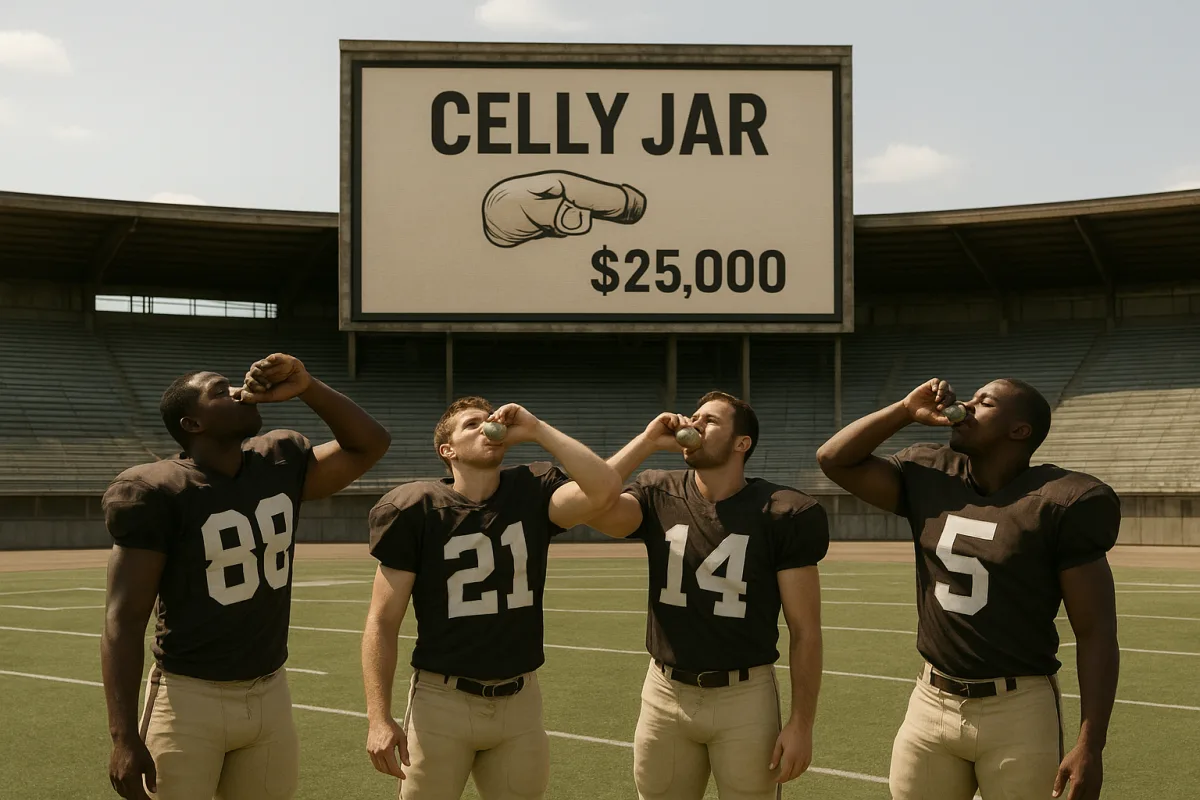
Bud Light did not need to dispute the rulebook to win the public-relations exchange. It simply took the three fines, added them correctly and posted the total, asking how many beers $37,384 would buy that weekend. [3]
That is effective because the company stayed on the right side of the joke. It did not tell players to violate league policy, promise to pay their penalties, or claim that the league had changed its rules.
Instead, Bud Light made the NFL’s own numbers the campaign copy. That is better marketing than a conventional commercial because fans already understand the premise: football celebrates touchdowns, beer sponsors football, and the league fined beer-adjacent celebrations.
The campaign also recognizes what the raw fine totals do and do not show. The $37,384 total is not an estimate of league discipline or a measure of player hardship. It is a precise, memorable number tied to three specific incidents. [3]
Bud Light benefits from the ambiguity. The brand can frame itself as aligned with fans and players while leaving the NFL to explain why a routine celebratory motion became punishable in a league that markets beer aggressively.
The contradiction became even harder to ignore around the Cowboys’ international trip. Reporting noted Miller Lite branding on the Cowboys’ Brazil press-conference backdrop while Ferguson faced a fine connected to a beer-drinking celebration. [2]
That does not mean Miller Lite caused the fine or that the Cowboys did anything improper. It means the visual environment around NFL football includes beer brands constantly, which makes the league’s distinction between commercial alcohol and mimed alcohol look narrow.
Bud Light’s limitation is just as important. The campaign works because the NFL supplied an absurdly specific setup. It does not resolve the underlying rule, help players win appeals, or establish that every celebration should be permitted.
The brand is also leveraging a moment created by player discipline. That can be funny without being altruistic. Bud Light is a sponsor using a cultural opening, not an advocate rewriting the collective bargaining agreement or the NFL rulebook.
The tape-level issue: what the rule actually polices
The useful way to evaluate this is not through the usual “No Fun League” slogan. Celebration policy is supposed to regulate game administration, sportsmanship and use of prohibited props, not erase every expression after a score.
NFL films and team-produced mic’d-up footage routinely show how much emotional energy follows big plays. In the San Francisco 49ers’ George Kittle mic’d-up feature, the tight end celebrates teammates’ touchdowns, sacks and blocks as part of the game’s internal rhythm.
That footage does not establish a legal standard, and it should not be treated as evidence that any particular celebration is allowed. It does show why the league’s line-drawing must be intelligible to players and viewers.
On tape, a brief mimed drink does not resemble a celebration that creates a prolonged stoppage, involves equipment, or pulls multiple players into a rehearsed production. The offense is symbolic, which is why the punishment generated more scrutiny than the conduct itself.
There is a useful contrast in Rob Gronkowski’s NFL on NBC interview about the Patriots’ media discipline. Gronkowski described Bill Belichick using an exaggerated public comment to teach a point about how outside messaging can be reframed.
The NFL’s celebration problem is also a messaging problem. It can enforce a technical rule correctly and still lose the argument if the public-facing result appears incompatible with the partnerships displayed around every broadcast and stadium.
That is what Bud Light understood. The company did not need a football explanation because the visual evidence was already obvious to fans. Its campaign succeeded by highlighting the gap between the league’s commercial presentation and disciplinary presentation.
Comparison table
| Criteria | NFL fine-first enforcement | Bud Light’s Celly Jar marketing |
|---|---|---|
| Core objective | Protect the league’s celebration standard and reinforce the prohibition on prop-style gestures. | Turn the fine controversy into a memorable beer-brand conversation. |
| Message discipline | Clear in rulebook terms, although the public explanation has been limited. | Clear immediately, using the $37,384 combined fine total as the punchline. [3] |
| Football relevance | Has a legitimate interest in standardizing post-touchdown conduct and avoiding case-by-case enforcement. | Has no direct competitive value, but accurately identifies why the enforcement became a football news story. |
| Consistency problem | Falls down because the NFL sells beer partnerships while penalizing simulated beer drinking. [2] | Falls down because it profits from a disciplinary dispute rather than solving it. |
| Player impact | Costs players $8,847 to $14,926 in the three reported cases and has prompted appeals. [3][[6]](https://sports.ndtv.com/us/nfl/jake-ferguson-appeals-13-611-nfl-fine-after-dallas-cowboys-beer-celebration-12099418?utm_source=openai "Jake Ferguson Appeals $13,611 NFL Fine After Dallas Cowboys Beer Celebration | NFL |
| Fan response potential | Risks looking overly technical, especially when the celebration is brief and no actual object is used. | Strong, because fans understand the contradiction without needing a rulebook explanation. |
| Long-term value | Useful only if the league applies the standard transparently across similar celebrations. | Useful while the contradiction remains fresh, but difficult to sustain after the news cycle moves on. |
| Overall verdict | Defensible authority, weak presentation. | Better communications play, though not a substitute for policy reform. |
Why the NFL’s position is not entirely wrong
The NFL should not be forced to abandon a written standard every time a sponsor sees an advertising opportunity. If the league permits mimed beer drinking after a fine, it invites questions about whether sponsors can effectively shape enforcement.
There is also a real administrative benefit to bright lines. Players, coaches and officials prefer knowing whether a gesture is permitted before the next controversy arrives, rather than learning through social-media reaction after a Monday fine memo.
But bright lines work only when the league can articulate them. If the objection is use of an imaginary prop, say that plainly. If the concern is excessive duration or a coordinated act, identify those thresholds and apply them consistently.
What the NFL cannot persuasively do is pretend the commercial context does not exist. The Washington Post framed the obvious tension directly: the NFL is effectively the official sport of beer while fining players who imitate drinking beer. [2]
That tension does not require outrage to be real. It is a branding problem created by the league’s own business model, and Bud Light’s Celly Jar campaign is effective precisely because it identifies that mismatch without needing to exaggerate it.
Who each option suits
The NFL’s fine-first approach suits a league office that prioritizes rulebook control, uniform enforcement and a narrow definition of acceptable celebrations. It falls short for players and fans who want a clear explanation of why a quick gesture warrants discipline.
Bud Light’s Celly Jar approach suits a sponsor seeking cultural relevance with minimal risk. It works for fans who see the humor in the contradiction, but it does not suit anyone expecting it to produce a fairer appeals process or a rewritten celebration policy.
For players, the practical choice is simpler than the marketing debate. Until the NFL clarifies or changes the standard, avoid mimed drinking and other prop-like celebrations. The tape may show a harmless gesture, but the fine notices show how the league currently reads it.
Frequently Asked Questions
What are the NFL celebration fines for beer-related touchdown gestures?
In September 2026, NFL players were fined for miming beer drinking as part of their touchdown celebrations. The fines included $14,926 for Kyle Juszczyk, $8,847 for Matt Goncalves, and $13,611 for Jake Ferguson, totaling $37,384. These fines are based on the league’s rule prohibiting the use of props or simulated props during celebrations.
How did Bud Light respond to the NFL's celebration fines?
Bud Light publicly responded by humorously referencing the total amount of fines ($37,384) on social media, asking how many beers that sum could buy. The company used the situation as a marketing opportunity without encouraging players to break league rules or disputing the fines directly.
Why does the NFL fine players for miming beer celebrations?
The NFL fines players because its celebration guidelines prohibit the use of objects or props during celebrations, and miming beer drinking is treated as a prop-based or unsportsmanlike act. This enforcement aims to maintain clear and consistent celebration rules rather than specifically targeting alcohol-related gestures.
What is the contradiction between NFL fines and its beer sponsorship?
The contradiction lies in the NFL fining players for beer-miming celebrations while simultaneously having Bud Light as its official beer sponsor and selling alcohol in stadiums. This creates an inconsistent message, as the league profits from beer sponsorships but penalizes players for gestures involving beer imagery.
How much have NFL players been fined for beer-related celebrations?
Three players were fined a total of $37,384 for beer-related celebrations during Week 2 of the 2026 season: Kyle Juszczyk ($14,926), Matt Goncalves ($8,847), and Jake Ferguson ($13,611). These fines represent a small portion of typical NFL salaries but carry symbolic weight in the debate over celebration enforcement.
How we researched this
This article was assembled from 2 video sources across 2 channels, 8 published articles, 6 cited references.
Nothing here is based on hands-on testing. Where a figure or finding appears, it belongs to the source cited beside it, and the writing says so rather than implying otherwise. Every source is listed below so you can check it.
Sources
103 Minutes of George Kittle Mic'd Up (4K) — San Francisco 49ers
Gronk calls Trey McBride, Colston Loveland the next great TEs | Dan Patrick Show | NFL on NBC — NFL on NBC
Bud Light leans in to fines for beer celebrations — Pro Football Talk
Kurt Warner fires back after Jayden Daniels injury comments spark backlash — Yahoo Sports
NFC Notes: Mac Jones, Marvin Harrison Jr., 49ers, Cardinals, Rams — NFLTradeRumors.co
Bud Light leans in to fines for beer celebrations — ProFootball Talk on NBC Sports
Bud Light creates eye-popping ‘Celly Jar’ winnings for Kyle Juszczyk ‘drinking’ fine — NY Post Sports
Bud Light creates eye-popping ‘Celly Jar’ winnings for Kyle Juszczyk ‘drinking’ fine — Yahoo Sports
Bears ST coach says Eagles are violating intent of the rule by using holder on kickoffs — ProFootball Talk on NBC Sports
Tee Higgins speaks out on celebration fine from NFL — Yahoo Sports
Trump feuded with NFL players in his first term. Now, some are busting out his dance moves
Colts G Matt Goncalves was also fined for beer-related celebration - NBC Sports
NFL Fines Juszczyk, Goncalves for Beer-Chugging TD Celebrations - Fantasy Nerds
NFL fines Ja’Marr Chase and Tee Higgins for ‘people’s elbow’ celebration – NBC Connecticut
Jake Ferguson Appeals $13,611 NFL Fine After Dallas Cowboys Beer Celebration | NFL | NDTV US Sports
Watch Celebration Fines and NFL's Bud Light Marketing on Youtube
Also from the sources
Related Articles
NFL Week 2 Injury Updates
Get the latest NFL Week 2 injury updates including Sam Darnold’s status and how injuries impact teams and roster decisions.
SEC Big Ten Ban NFL Players Returning to College Football
Explore the SEC and Big Ten bans on NFL players returning to college football and how eligibility and roster rules impact schools and athletes.
San Francisco 49ers Key Player Performances and Dominance
Explore the San Francisco 49ers' 2026 dominance with key player performances from Brock Purdy, Mike Evans, and their adaptive defense.
San Francisco 49ers Week 4 Preview and Player Updates
Get the San Francisco 49ers Week 4 preview with injury updates and analysis on handling Denver's pressure defense.